Qalaat al-Madiq: A Medieval Fortress near Apamea, Syria
Site at a Glance
- Popularity
- High
- Country
- Syria
- Primary era
- Medieval
- Eras represented
- Medieval, Early Modern
- Civilizations
- Ayyubid, Ottoman
- Site type
- Military
- Remains
- Fort
On this page12 sections
History
Qalaat al-Madiq is a fortress in Syria, near the ruins of the ancient city of Apamea. The area may have been associated with the Late Bronze Age kingdom of Niya, and Qalaat al-Madiq has been proposed as Niya’s capital, though that identification remains uncertain.
Apamea in Antiquity
The city had an earlier name during Achaemenid rule, the period of a Persian dynasty that preceded Alexander the Great. After Alexander, a Macedonian king, conquered the region, it was called Pella. Seleucus I, one of Alexander’s successors, reorganized the city and named it Apamea after his wife, Apama. The Seleucid dynasty, founded by Seleucus, established the city in the third century BCE. Rome took control in 64 BCE and substantially developed it.
Earthquakes repeatedly damaged Apamea, including in AD 115, 526, and 528. In 611, forces of the Sasanian ruler Khosrow II captured and destroyed the city. The Sasanians ruled the Persian Empire; the Byzantines, or eastern Romans, later recovered Apamea.
Early Islamic and Medieval Rule
Apamea surrendered to Muslim forces in 638, during the rule of Umar, the second caliph, under the command of Abu Ubaidah ibn al-Jarrah, an early Muslim commander. The inhabitants welcomed the army and accepted land taxes and jizya, a tax levied on non-Muslim subjects. Under Muslim rule, the city was known as Afamiyya or Famiyyah.
In 891, the geographer al-Yaqubi described Afamiyya as the ruins of an ancient Greek city beside a large lake. In 998, Byzantine forces besieged its citadel, then held by the Fatimids, an Ismaili Muslim caliphate. Egyptian reinforcements relieved the citadel and defeated the besiegers on 19 July.
In 1106, Nizari Ismailis, a branch of Ismaili Islam, bought the citadel from an Egyptian lord appointed by the Fatimids. Ridwan, the Seljuk ruler of Aleppo, supported the purchase in the hope that the new holders would strengthen the defenses against the Crusaders of Antioch, Latin Christian forces based in the region. Tancred of Antioch first made an agreement with the Ismailis in exchange for tribute, then captured the fortress in a second assault. The Ismailis fled to Aleppo. Amid public resentment against them, Abu Tahir al-Sa’igh and others were later executed by Ridwan’s son and successor, Alp Arslan al-Akhras, on the Seljuk sultan’s orders.
In 1119, Usama ibn Munqidh led a force from Shaizar, accompanied by Bedouin raiders, against the Crusader garrison at Afamiyya and raided its cultivated lands. The town was again under Muslim control by 1149. The present fortress was built during the rule of Nur ad-Din, a Zengid ruler of Syria from 1146 to 1174. He repaired it after an earthquake in 1157. Further earthquakes damaged the area in 1154, affecting Apamea, Shaizar, and Kafr Tab, and in 1170.
In the 1220s, the geographer Yaqut al-Hamawi placed Afamiyya at the center of a district in Hims Province, the historical province of Homs. In the early fourteenth century, the Syrian historian and geographer Abu’l Fida assigned it to the district of Shaizar.
Ottoman Rule and Modern Conflict
In the early nineteenth century, Qalaat al-Madiq belonged to the Ottoman Province of Aleppo. In 1811, the Kurdish warlord Mulla Isma’il took the fortified town after rebelling against Ottoman authorities. The Ottoman Janissary force, elite infantry troops, evacuated the fortress after the takeover. Together with Ariha and Jisr al-Shughur, the town became a refuge for rebellious tribes, particularly the Mawali, and local lords.
In the late nineteenth century, a village lay within the fortress walls, and its inhabitants were impoverished Bedouins. By the early twentieth century, the citadel was the town’s only inhabited part; building later spread to its west and south. During the Ottoman period under Sultan Suleiman I, a mosque, school, and khan, a lodging place for travelers and traders, were built inside the fortress.
Belgian archaeological excavations took place in 1928, 1930, 1938, 1947, and 1953. Work resumed in 1965 through cooperation between the Belgian archaeological research center and Syria’s Directorate-General of Antiquities and Museums.
During the Syrian Civil War, which began in 2011, rebels controlled much of the town while government forces held the fortress. Police were driven out in September 2011. In March 2012, government forces shelled the town for 17 consecutive days in an attempt to dislodge rebel forces. Troops entered on 28 March but did not establish full control; clashes killed five rebels, four soldiers, and four civilians. By 2012 the Free Syrian Army, a coalition of opposition forces, controlled the fortress, and the al-Nusra Front, an Islamist militant group, held it by early 2016.
In October 2016, the fortress served as a transit point for 1,287 people, about half of them rebel fighters, who had agreed to leave al-Hamah and Qudsaya for safe passage to rebel-held territory. Government forces retook Qalaat al-Madiq in May 2019. On 30 November 2024, Hay’at Tahrir al-Sham (HTS), a Syrian Islamist coalition, captured the city from the Syrian Army. The army recaptured it in a counterattack, but that victory was short-lived; Bashar al-Assad fled Syria on 8 December 2024.
Remains
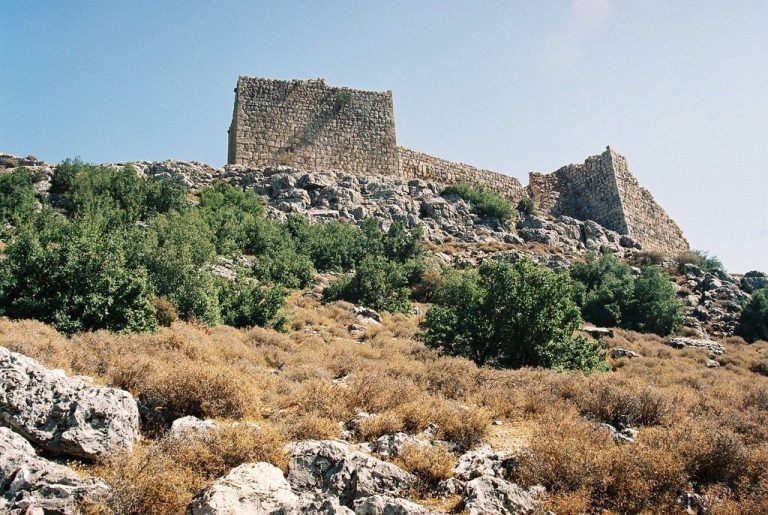
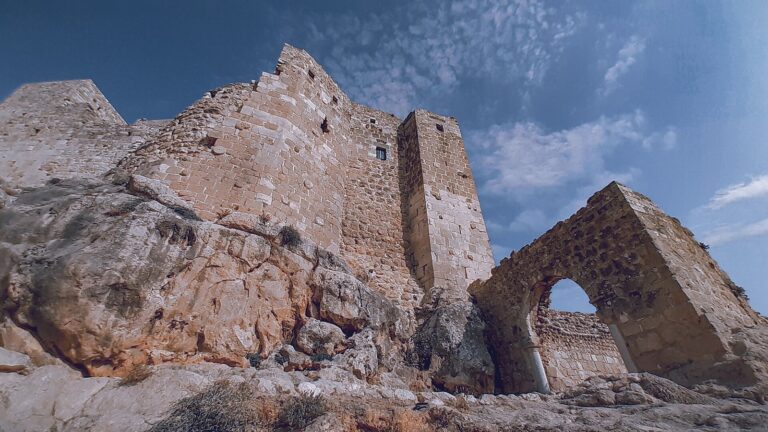
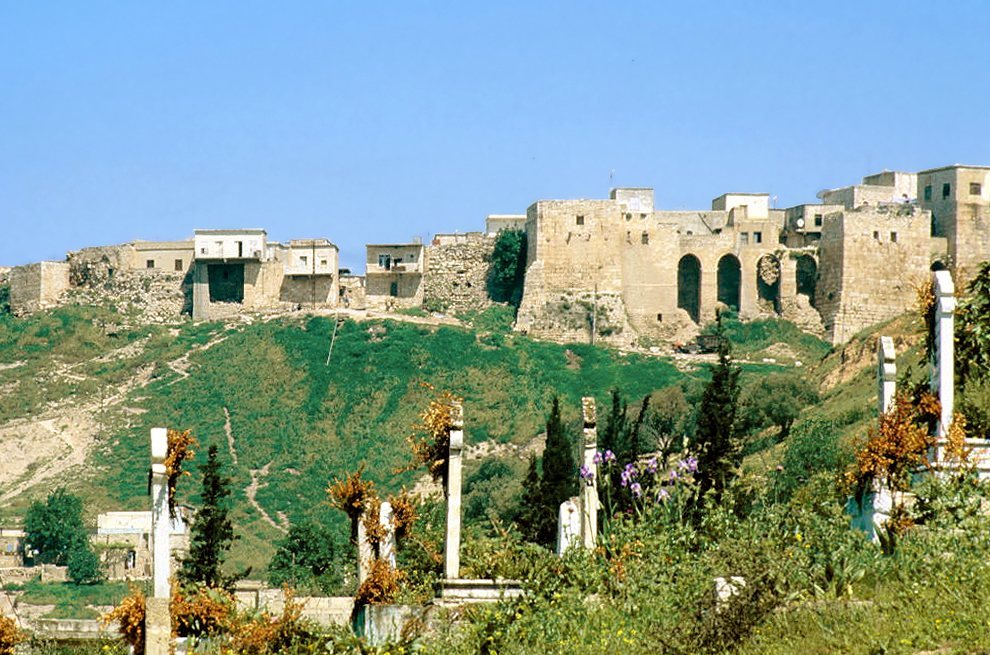
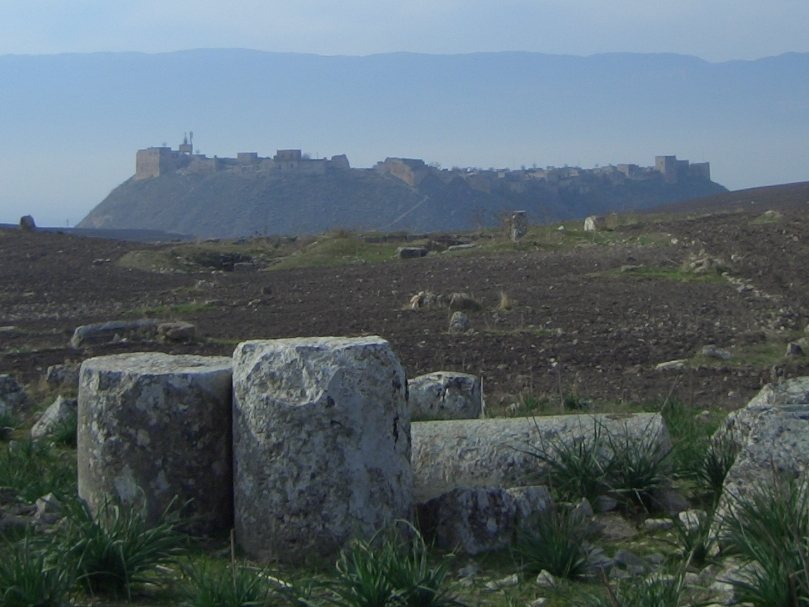
The fortress crowns a high hill at the eastern edge of the al-Ghab plain, east of the Orontes River and near the ruins of Apamea. Its name means “Citadel of the Narrow Pass” and refers to the passage between the hill and the mountain opposite. Low plains surround the hill, whose position overlooks the al-Ghab plain, a nearby valley, neighboring settlements, and the slopes of the al-Suqaylabiyah plateau. The surrounding valley and plains support agriculture and livestock. The fortress walls enclose the summit in a roughly circular plan, with an average diameter of about 300 metres.
Fortress Enclosure
Walls and outer defenses
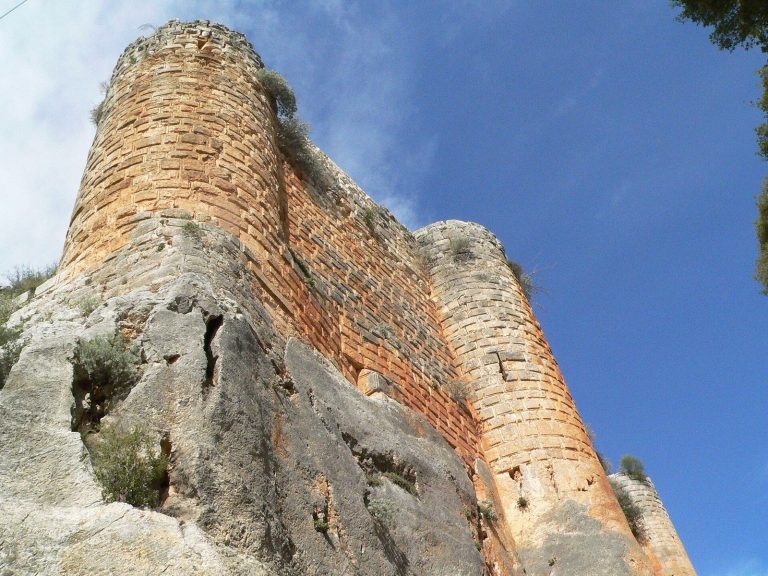
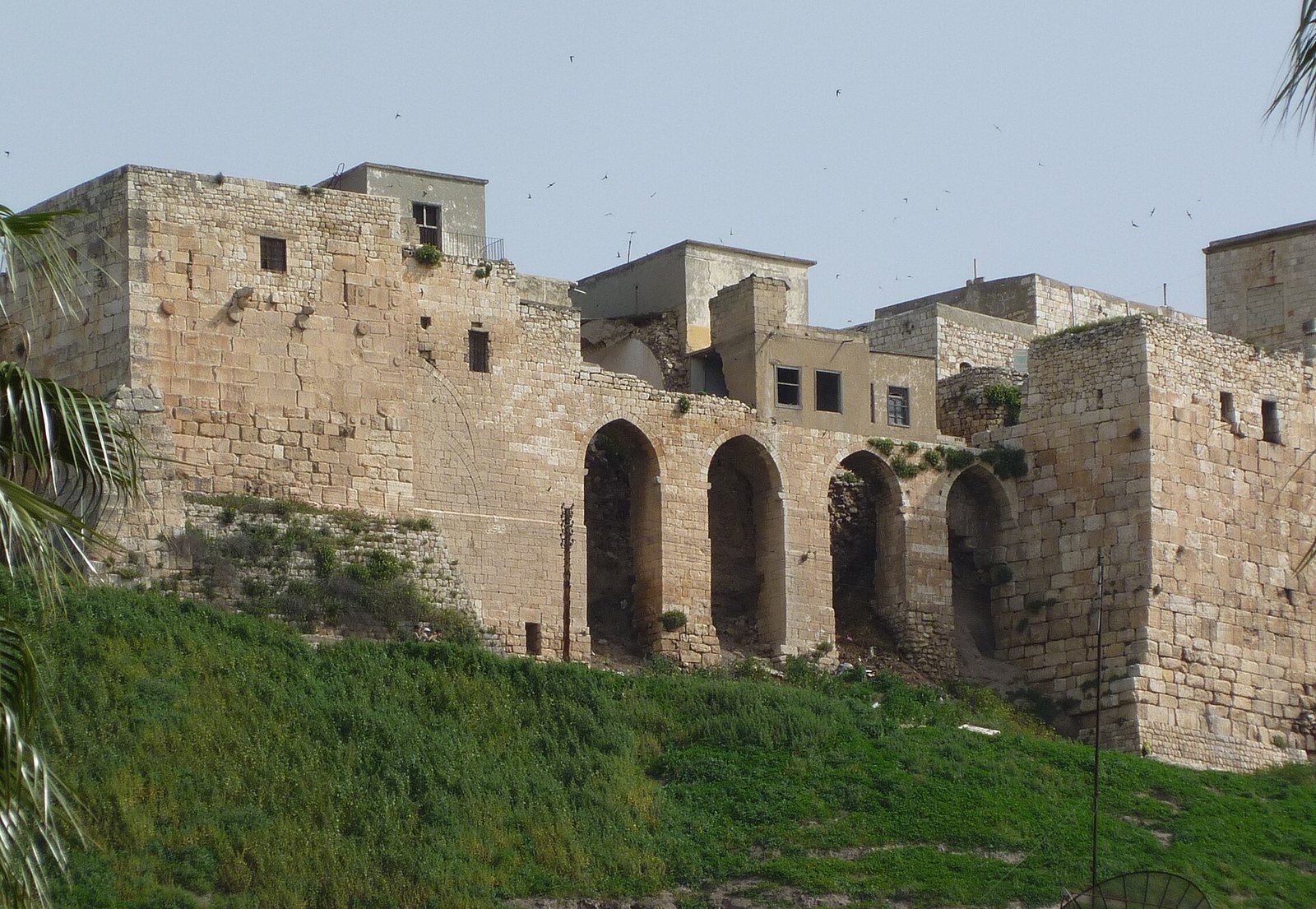
The enclosure is built from large, dressed limestone blocks and incorporates 19 towers. The western side has fewer and smaller towers. Arrow slits in the walls and the steep hillside, faced with stone, contribute to the defenses. A high polygonal wall with square towers and a moat also surrounds the fortress. During an attack, water from the Orontes could be directed into the moat.
Southern entrance
The entrance lies on the south side between two defensive towers. An arched gate in the style of the Ayyubid dynasty, founded by Saladin, opens into a passage with a vaulted ceiling built of dressed stone. An inscription on the gate names al-Nasir Yusuf, grandson of al-Zahir Ghazi. Inscriptions on the towers name al-Zahir Ghazi, Saladin’s son.
Interior Buildings
Vaulted spaces
Old vaulted spaces within the fortress date to the Ayyubid and Ottoman periods. The outer walls and towers survive, and the fortress remains inhabited.
Ottoman complex
A mosque, school, and khan form part of the Ottoman-period buildings within the walls. The khan later became the Apamea Mosaic Museum, administered by Syria’s Directorate-General of Antiquities and Museums. A village occupies part of the area within the old fortress walls.
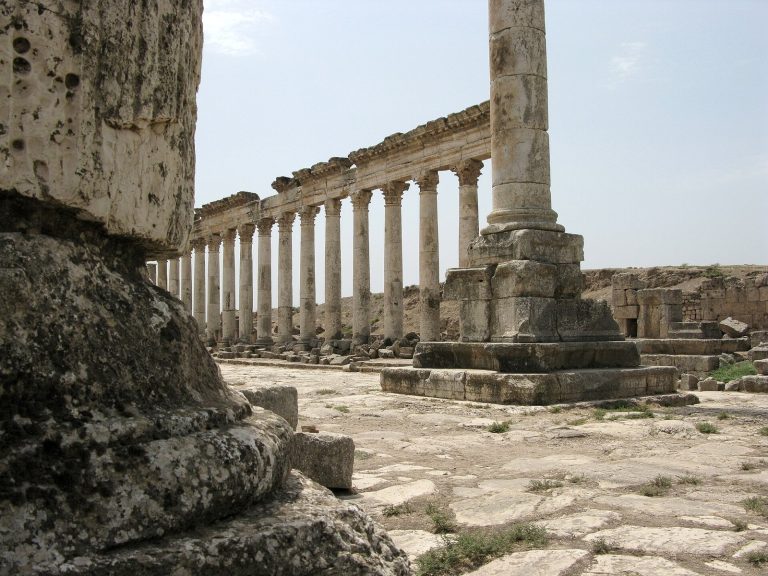
Ruins of Apamea
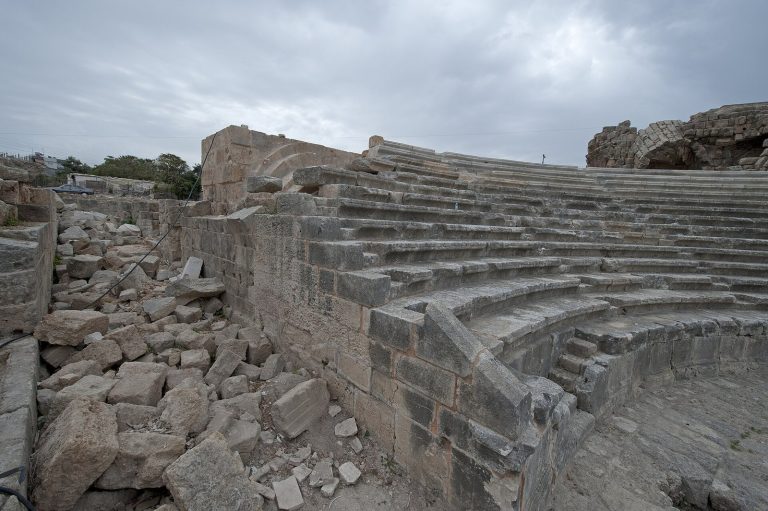
The ancient city’s ruins lie just east of the town. They include a Roman theater with room for at least 10,000 spectators, one of the largest theaters in Syria. The theater has not been restored.