Mahalibeh Castle: A Medieval Fortress in Syria


Site at a Glance
- Rating
- 4.6
- Popularity
- Very Low
- Country
- Syria
- Primary era
- Medieval
- Eras represented
- Medieval
- Civilizations
- Byzantine
- Site type
- Military
- Remains
- Castle
On this page9 sections
History
Mahalibeh Castle is a medieval fortress in Syria, first built in the eleventh century by the princely Banu al-Ahmar family. Also known as Balatanos or Balatunus, its alternate name derives from the Latin Platanus. The Byzantine Empire, the medieval eastern Roman state centered on Constantinople, occupied the castle in 1031 and completed its construction.
Byzantine and Crusader Control
In 1118, western European Christian forces of the Crusades, led here by Roger of Salerno, occupied Mahalibeh Castle. Roger was associated with the Principality of Antioch, one of the Crusader states established in the eastern Mediterranean. Repeated clashes damaged the fortress, which eventually surrendered to Saladin in 1188. Saladin, the Muslim ruler who founded the Ayyubid dynasty and conquered much of the Levant from the Crusader states, transferred authority over the castle in 1194 to his son, al-Zahir Ghazi, the Ayyubid emir of Aleppo.
Mamluk Rule and Destruction
Around 1260, the castle passed to the Mankus family and later came under Mamluk control. The Mamluks were a military ruling class that governed Egypt and Syria from the thirteenth to the sixteenth century. Mamluk Sultan Baybars restored the castle in 1269, but it subsequently came under the control of the rebellious emir Sunqur al-Ashqar. Sultan Qalawun retook it in 1285.
A powerful earthquake severely damaged Mahalibeh Castle in 1408. After this destruction, the fortress was abandoned and was no longer inhabited.
Ottoman and Modern History
During Ottoman rule, at least in the early seventeenth century, the authorities used the castle to store state grain and rice. By the early eighteenth century, it had become associated with the Muhalaba, an Alawite tribal grouping predominant in the surrounding area. Ottoman government records also referred to this group as the Muhalaba.
The castle suffered extensive damage over time. Restoration by the Syrian General Directorate of Antiquities and Museums was under way by 2018, revealing archaeological remains and inscriptions. One stone inscription records the construction of a mosque during the reign of al-Malik Sunqur al-Ashqar.
Remains
Mountain Fortress and Enclosure
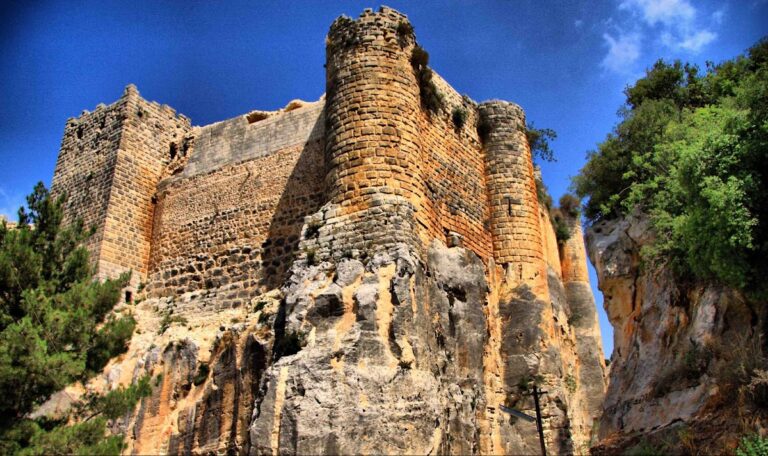
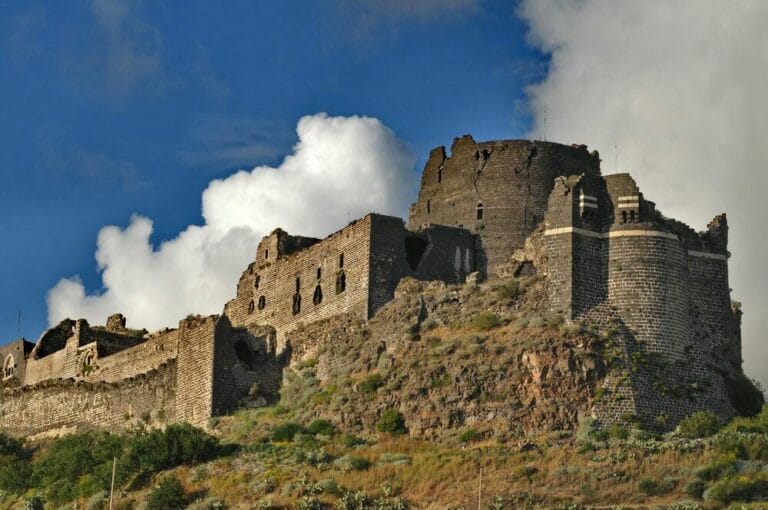
Mahalibeh Castle occupies the summit of a high mountain near Latakia, about 750 metres above sea level and approximately 40 kilometres inland from the Syrian coast. It lies near the village of Mahalibeh in the Qardaha area. Massive outer walls enclose the main body of the fortress, although the surviving structure is extensively ruined and damaged.
Outer Walls and Towers
Portions of the outer walls remain, together with surviving towers and other structural elements. These defensive remains form the principal enclosing fabric of the castle and preserve part of its mountain-top plan.
Interior Rooms and Water Storage
Within the enclosure are cisterns, constructed reservoirs for collecting and storing water, as well as underground rooms, remnants of internal premises, and arches. The restoration work brought archaeological remains and inscriptions to light, including the stone inscription concerning a mosque built during al-Malik Sunqur al-Ashqar’s reign.
Access and Approach
The castle connects with the surrounding ground through a narrow southern passage or connecting lane. A paved road reaches it from Qardaha to the west and Jawbat Burghal to the east.
Nearby sites