Ballymore Castle: A Sixteenth-Century Fortified Residence in Ireland
Site at a Glance
- Popularity
- Medium
- Country
- Ireland
- Primary era
- Early Modern
- Eras represented
- Early Modern, Modern
- Civilizations
- British, English
- Site type
- Military
- Remains
- Castle
On this page8 sections
History
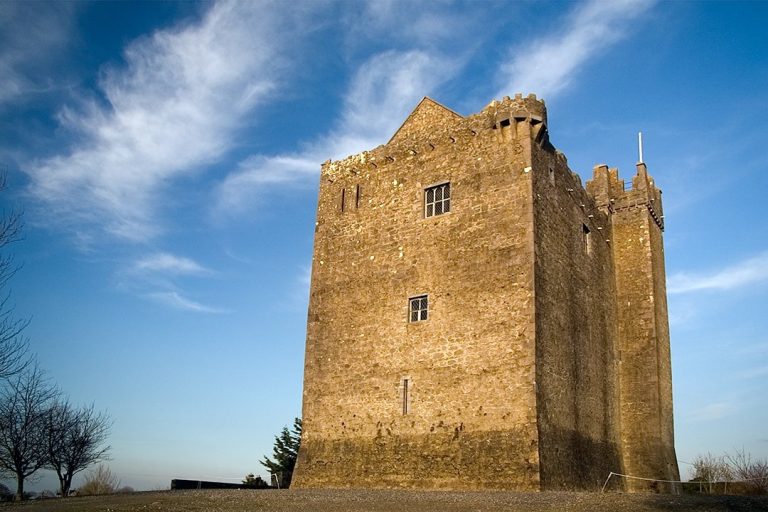
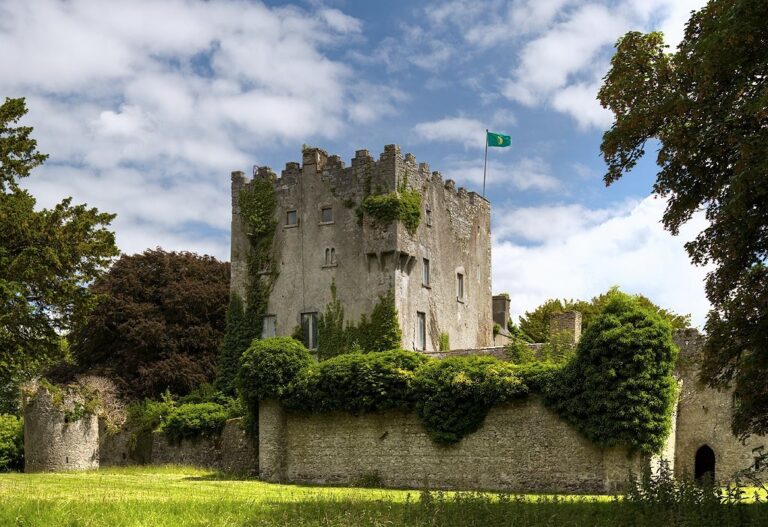
Ballymore Castle is a sixteenth-century fortified residence in Lawrencetown, County Galway, Ireland, built by John Lawrence in 1585. Its history includes a siege during the Williamite War in 1691, when Williamite forces captured the castle’s defenders.
Lawrence family and construction
Lawrence built the castle on land he had acquired by marrying a daughter of O’Madden, Lord of Longford. In 1603, his eldest son, Walter Lawrence, married Cecily Moore, a granddaughter of Richard Burke, 2nd Earl of Clanricarde. After warfare damaged the castle, Walter restored it in 1620.
Forfeiture and the Williamite War
In 1641, John Lawrence the Younger lost the estate after supporting the royalists in the Wars of the Three Kingdoms, interconnected conflicts in England, Scotland, and Ireland. Oliver Cromwell confiscated the property and transferred it, along with much of its land, to Sir Thomas Newcomen. Newcomen leased the castle back to the Lawrence family for many years.
During Ireland’s Williamite War, a late-seventeenth-century conflict between supporters of James II and William III, Patrick Sarsfield, 1st Earl of Lucan, sent Ulick Burke, 1st Viscount Galway, to hold the castle. In early June 1691, about 1,200 defenders occupied a separate fort on the shore of Lough Seudy, while a small garrison remained in the castle. De Ginkell’s Williamite force stormed the castle and captured its defenders. He ordered a sergeant to be hanged.
De Ginkell’s force then attacked the lakeside fort with artillery from land and boats on the water. Colonel Ulick surrendered the next day. De Ginkell stayed at the castle for ten days while preparing for the next operation at Athlone.
Later owners and the Seymour family
After Newcomen’s death, the property passed to his stepson, Nicholas Cusack of Cushinstown, County Meath. Cusack sold it around 1720 to John Eyre of Eyrecourt. The Seymour family, tenants at the castle from about 1700, continued there after the sale. Thomas Seymour bought the castle and surrounding land from Giles Eyre in 1824. His son David Thompson Seymour, later Queensland’s police commissioner, was born at the castle in November 1831. The Seymour family held the property for generations.
After parts of the estate were acquired by the Irish Land Commission, a state body involved in transferring agricultural land from landlords to tenant farmers, Mrs Hale, a Seymour relative, inherited what remained. The castle and surrounding land later passed to Joe Naughton, whose family continued to own it.
Remains
Surviving buildings
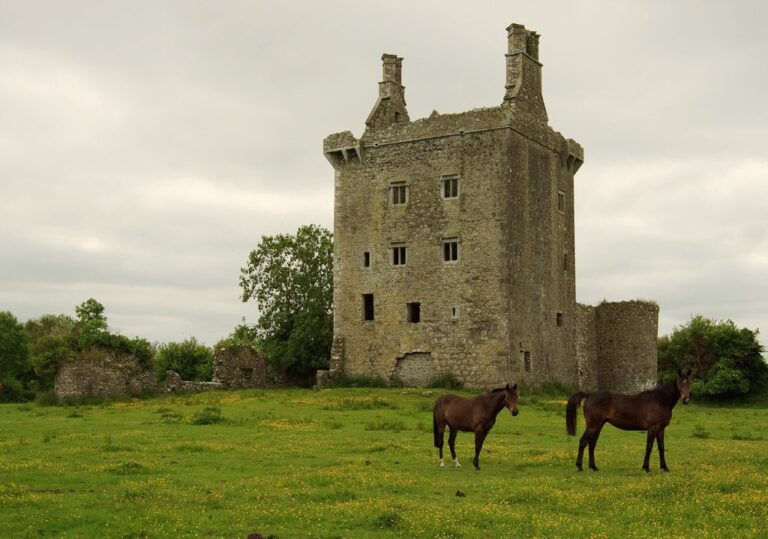
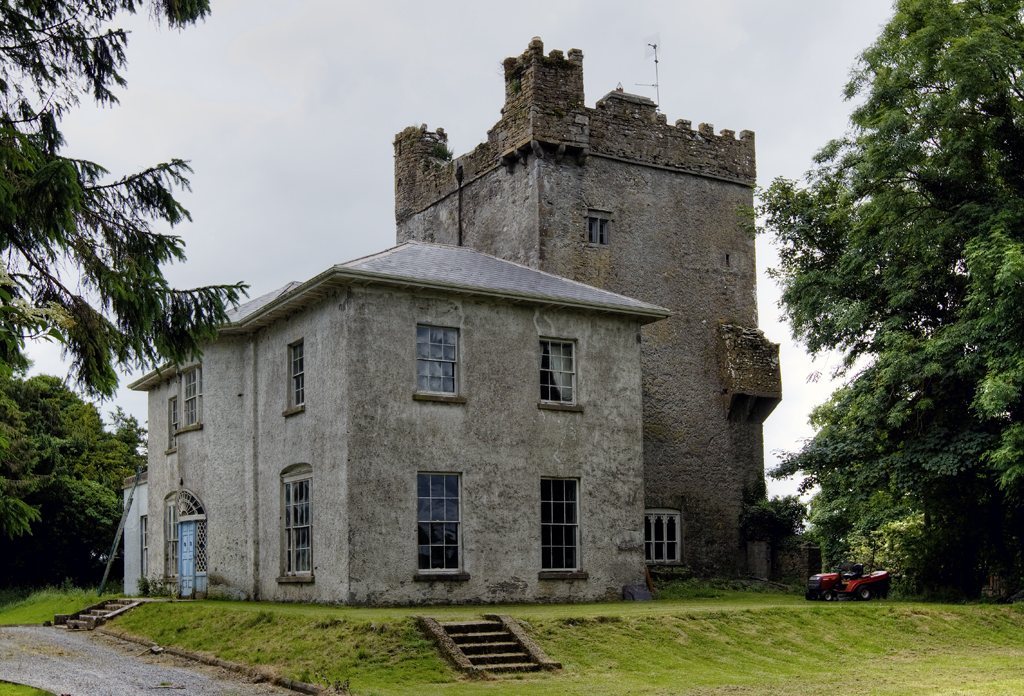
The castle’s surviving fabric brings together an original stone tower and later residential construction. The structure is described as well preserved, though substantially altered.
Original tower house
The sixteenth-century core is a tower house, a tall fortified residence with floors arranged vertically. It was built of rubble stone, using irregular pieces of stone in its masonry.
Residential additions
A house was added to the tower in 1620. An upper room contains a marble mantelpiece inscribed “W.L. 1620,” referring to Walter Lawrence. The 1815 modernization added a large, two-storey house with a central projecting bay, a section extending outward from the facade. Its entrance is topped by a fanlight, a window set above a doorway.