Castle in Szaflary: A Medieval Stronghold on the Dunajec Trade Route
Site at a Glance
- Popularity
- Medium
- Country
- Poland
- Primary era
- Medieval
- Eras represented
- Medieval
- Civilizations
- Kingdom of Poland
- Site type
- Military
- Remains
- Castle
On this page9 sections
History
The Castle in Szaflary was a medieval stronghold in Podhale, a region at the northern foothills of the Tatras in Poland. It belonged to a chain of castles along the Dunajec that guarded a trade route between the Kingdom of Poland and Upper Hungary, a historical name for lands broadly corresponding to parts of present-day Slovakia. The route followed the Dunajec and Poprad rivers.
Possible early stronghold and Cistercian ownership
The castle’s beginnings are uncertain. A wooden stronghold may have stood here as early as the 11th century, while the castle itself is generally dated to the 13th century. It may have been built to defend the lands of the Cistercians, a Catholic monastic order that developed from the Benedictine tradition, against raids. Another possibility is that descendants of Teodor Gryfita, a Kraków provincial governor, founded it.
During the 13th and 14th centuries, the castle and village belonged to the Cistercian abbey associated with Ludźmierz and Szczyrzyc. A document from 1334 calls the site a new castle. In 1338, Piotr of Słupia is named as its castellan, an official involved in a castle’s administration.
Royal seizure and fifteenth-century rebuilding
In 1380, the abbot of the Cistercian monastery at Szczyrzyc leased the castle to a Jewish convert to Christianity, who set up a mint producing counterfeit coins. King Louis of Hungary, later also king of Poland, ordered Sędziwój of Szubin, the Kraków starosta (a senior royal administrative official), to seize and destroy the castle. That year, the castle and village became part of the royal domain.
The castle was rebuilt or enlarged during the 15th century, with a further expansion dated to 1470–1480. In 1474, King Casimir IV Jagiellon leased it to the Polish nobleman Piotr Komorowski. Three years later, royal troops led by Kraków starosta Jakub of Dębno seized the castle after Komorowski supported Matthias Corvinus, king of Hungary from 1458 to 1490. Casimir then assigned the property to Marek Ratold in settlement of money the king owed him.
Abandonment and later interpretation
The castle was abandoned in the following period and fell into ruin during the first half of the 16th century. It may already have been entirely ruined before 1505. From the mid-19th century, as travel to the Tatras developed, the rocky site attracted people journeying from Kraków to Zakopane. Before the First World War, travel writer Mieczysław Orłowicz noted competing explanations of the ruins: some understood them as a chapel, while others identified them as the Cistercian castle destroyed after the counterfeit-coin affair.
During the German occupation, archaeological work took place at the site in 1942 under the direction of Rudolf Jamka. The names Szaflary and the castle are thought to derive from the German word Schäfer, meaning “shepherd.”
Remains
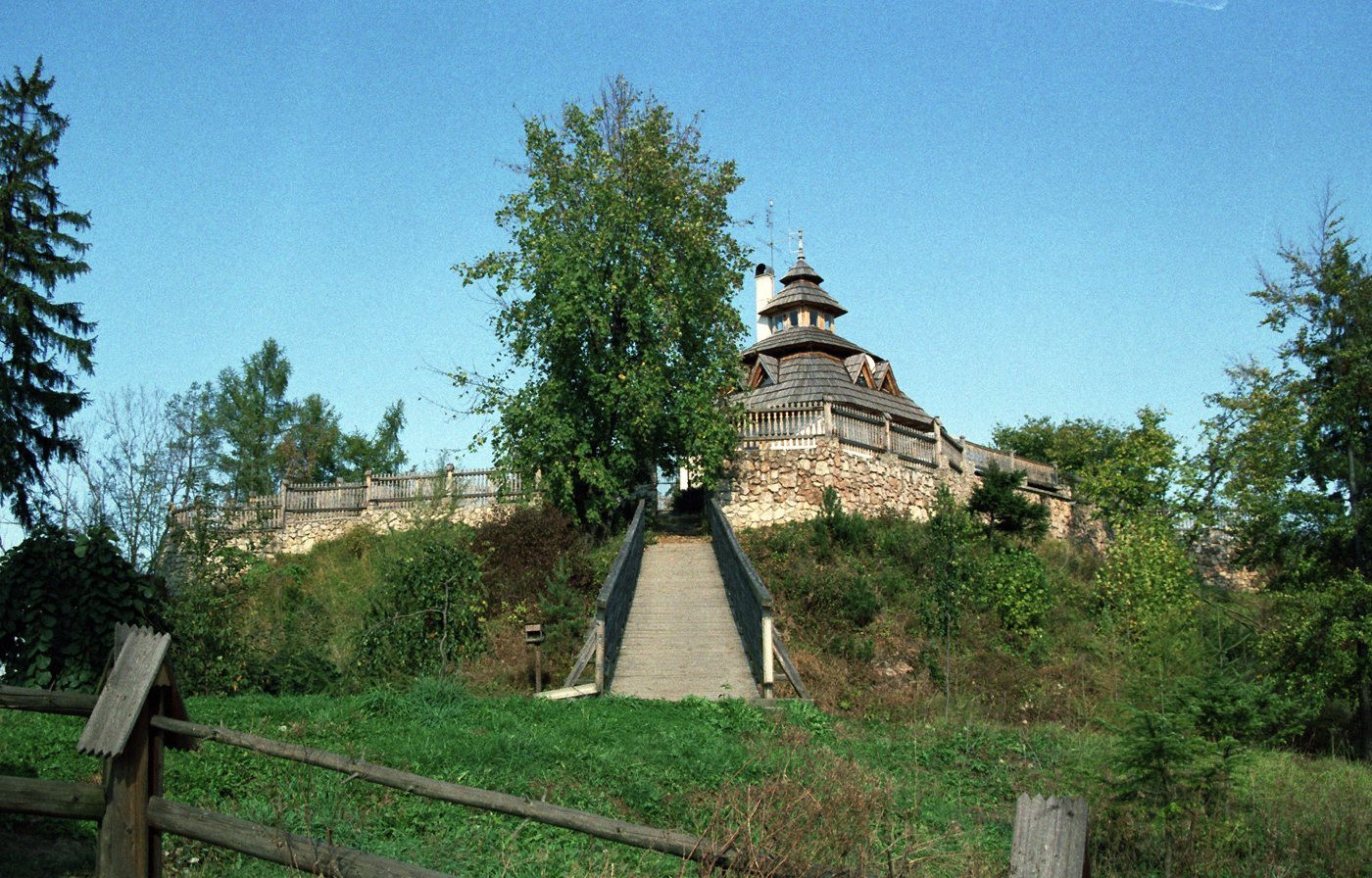
The castle stood on a limestone outcrop on the left bank of the Biały Dunajec. Its compact summit was enclosed, and the buildings combined masonry and timber. The site’s defenses made use of the rock’s steep edges and gentler slopes.
Rock-top enclosure and defenses
Summit and perimeter wall
The flat summit measured about 20 by 30 metres. Cliffs bordered it to the north and east, while the southern and western sides descended more gently. The perimeter wall had three straight sides and one rounded side. Foundations from part of the wall, dated to the early 14th century, survive; later building partly covered the site.
Southern defenses and entrance
Remnants of a rampart remain on the southern side. A stone defensive rampart may have been added around 1474. The approach reportedly crossed a wooden bridge and passed through a barbican, an outer defensive work protecting an entrance to a fortified site.
The summit in 1857
When travel writer Maria Steczkowska visited in 1857, a neglected, open masonry pavilion stood at the summit. Its walls carried numerous inscriptions. She also described a path up the rock bordered by dense shrubs and an enclosure at the top formed by stones laid like a wall. From the pavilion doorway, she noted views over the Nowy Targ valley, the Beskids, and the snow-covered Tatra peaks.