Heskin Hall: A Tudor Manor House in the United Kingdom
Site at a Glance
- Popularity
- Medium
- Country
- United Kingdom
- Primary era
- Early Modern
- Eras represented
- Early Modern
- Civilizations
- English
- Site type
- Domestic
- Remains
- Manor House
On this page8 sections
History
Heskin Hall is a Tudor manor house in the United Kingdom, where construction of the present building began in 1545.
Dudley and Molyneux ownership
In 1506, the estate lands were sold to Edmund Dudley, a minister to Henry VII. After the king had Dudley executed for treason, the property passed to his widow, Elizabeth, who later married Arthur Plantagenet. In 1511, the lands passed to John Dudley, who was later executed by Queen Mary. John’s son Robert became a favourite of Elizabeth I.
Richard Molyneux bought the estate in 1556 and also acquired land from Mary Seymour, widow of Thomas Seymour, Jane Seymour’s father. After Richard’s death in 1568, his son William inherited the property. The Molyneux family continued to make the house their home until 1739, when it became a seat of the Mawdesley family.
Civil War traditions
During the English Civil War, the seventeenth-century conflict between supporters of the king and Parliament, several battles took place near the hall. Local tradition says Oliver Cromwell stayed there overnight as a guest of John Molyneux, who had declared for Parliament after the siege of Lathom House. The same tradition tells of two ghosts: a young Roman Catholic girl whom a priest supposedly hanged to demonstrate his conversion to Protestantism, and the priest, whom Cromwell’s soldiers allegedly hanged in turn after doubting his conversion. Lady Lilford once reported that guests had left after experiencing the ghosts.
Later owners and uses
Alexander Kershaw bought the estate in 1744 and died in 1788. His will named three children: Edmund Newman Kershaw, John Copper, and James Kershaw. Edmund, the eldest, inherited the estate, which later passed to John Copper. John died in 1833, as had his brother, and neither had children. A legal dispute followed; title went to the heirs of Alexander’s sister, Mary Scott, as the legitimate heirs.
Henry Rawcliffe of Gillibrand Hall purchased the estate in 1885. Lord Lilford was the last person to occupy the house, with Lady Lilford, his fourth wife. After their divorce in 1969, she received the Heskin Estate in the settlement. The house later served as a training centre for Blackburn College and as offices and a sales-training site for Moben Kitchens. It became an antique centre, which opened in 1995. Heskin Hall was listed at Grade I on 22 October 1952, the highest of England’s three grades for buildings of exceptional interest. The entrance gate piers received a separate Grade II listing on 17 April 1967.
Remains
The house and entrance
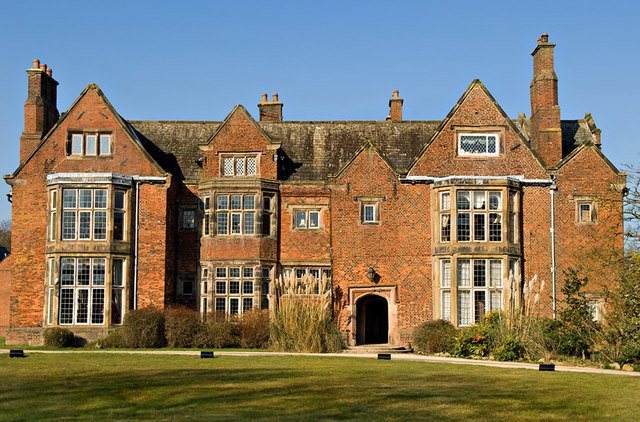
The surviving complex centres on an L-shaped, three-storey manor house, with gate piers at the entrance to its drive.
Manor house
The south-facing front is asymmetrical and gabled. Its red brickwork includes blue diapering, a repeated decorative pattern made with contrasting-colour bricks, and the walls have sandstone dressings. The roofs are covered with blue slate. A date of 1670 appears on the front wall. A rainwater spout head, which channels water from the roof gutter into a downpipe, bears the date 1679 and the initials of Alexander Mawdesley.
Drive entrance
Gate piers stand at the entrance to the drive leading to the hall.