Auchenharvie Castle: A Sixteenth-Century Tower Castle in North Ayrshire
Site at a Glance
- Popularity
- Medium
- Country
- United Kingdom
- Primary era
- Early Modern
- Eras represented
- Early Modern
- Civilizations
- Kingdom of Scotland
- Site type
- Military
- Remains
- Castle
On this page8 sections
History
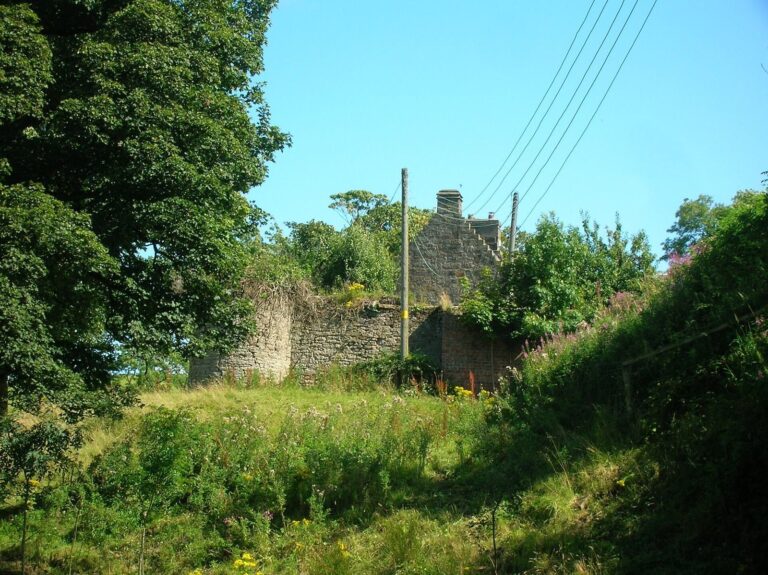
Auchenharvie Castle is a sixteenth-century tower castle, a defensible home centered on a tower, on Auchenharvie Farm near Torranyard in North Ayrshire, United Kingdom. It was in use into the seventeenth century and was held for a long period by the Cunninghame family.
Landscape and early ownership
Pollen evidence from Bloak Moss indicates extensive land clearance in the fifth or sixth centuries CE. The castle’s elevated position above the mosses may have offered early settlers strategic value, but this evidence concerns earlier landscape use, not the date of the castle.
Edward Cunninghame of Auchenharvie was killed in 1526 during a feud with Clan Montgomery, a Scottish kinship group. David Cunninghame, the first baronet of Auchinhervie, a hereditary title below the peerage, held the castle until 1642. A depiction dated 1604–08 already shows it as a ruin.
Seventeenth-century ownership and succession
In 1628, while a royal visit was being planned, David Cunninghame considered the house too small for his friends. He asked his cousin David Cunninghame of Robertland to accommodate his mother so that his friends could stay at Auchenharvie. In 1634 he planned additions, beginning with a garden wall around the old tower.
Dr. Robert Cunninghame, the castle’s best-known owner, became physician to Charles II in Scotland shortly after the King’s coronation at Scone in 1651. That September, Cunninghame accompanied the royal army at the Battle of Worcester, a major royalist defeat in the Wars of the Three Kingdoms. He was imprisoned in the Tower of London and released after a ransom was paid. In 1656 he bought back the Barony of Stevenston, a territorial lordship, from the Earl of Eglinton. He received a Nova Scotia baronetcy, a Scottish hereditary title, in 1673.
Robert died in 1676, and his son died two years later. Because his daughter could not inherit, the estate passed through the male line to Robert Cunninghame, a cousin. In January 1678, an Edinburgh apothecary and druggist named Robert Cunynghame was recorded as heir to Anne, his cousin. His inheritance included the Barony of Stevenston, Auchenharvie lands, and lands at Lambroughton and Chapeltoun. He had married Anne Purves in 1669, had 17 children, and later fell into serious debt.
Ruins, later records, and local tradition
The castle was described as ruinous by the 1770s. Its name appears in several forms over time, including Achin-Hervy, Awthinharye around 1564, Auchinbervy in 1745, Achenhay in 1775 and 1807, and Auchenhowy in 1821. Timothy Pont, a Scottish mapmaker and topographer active around 1600, interpreted the name as referring to a hill in a field of yellow corn.
A map made by Aitken in 1829 showed the castle as belonging to Colonel Barns. Local tradition links the ruins to body-snatching before the Anatomy Act of 1832, which regulated the supply of bodies for dissection. In one version, people concealed bodies obtained locally at the castle before taking them to Glasgow at night for sale to surgeons and medical students. Another version places the gathering at Darnshaw, a remote house near Bloak Moss on the old Auchenharvie–Megswell route, and says bodies from neighbouring parishes were sold in Glasgow for £10 each. The nearby old toll road, toll gate, and tollhouse have been cited as reasons to doubt the castle’s role in the story.
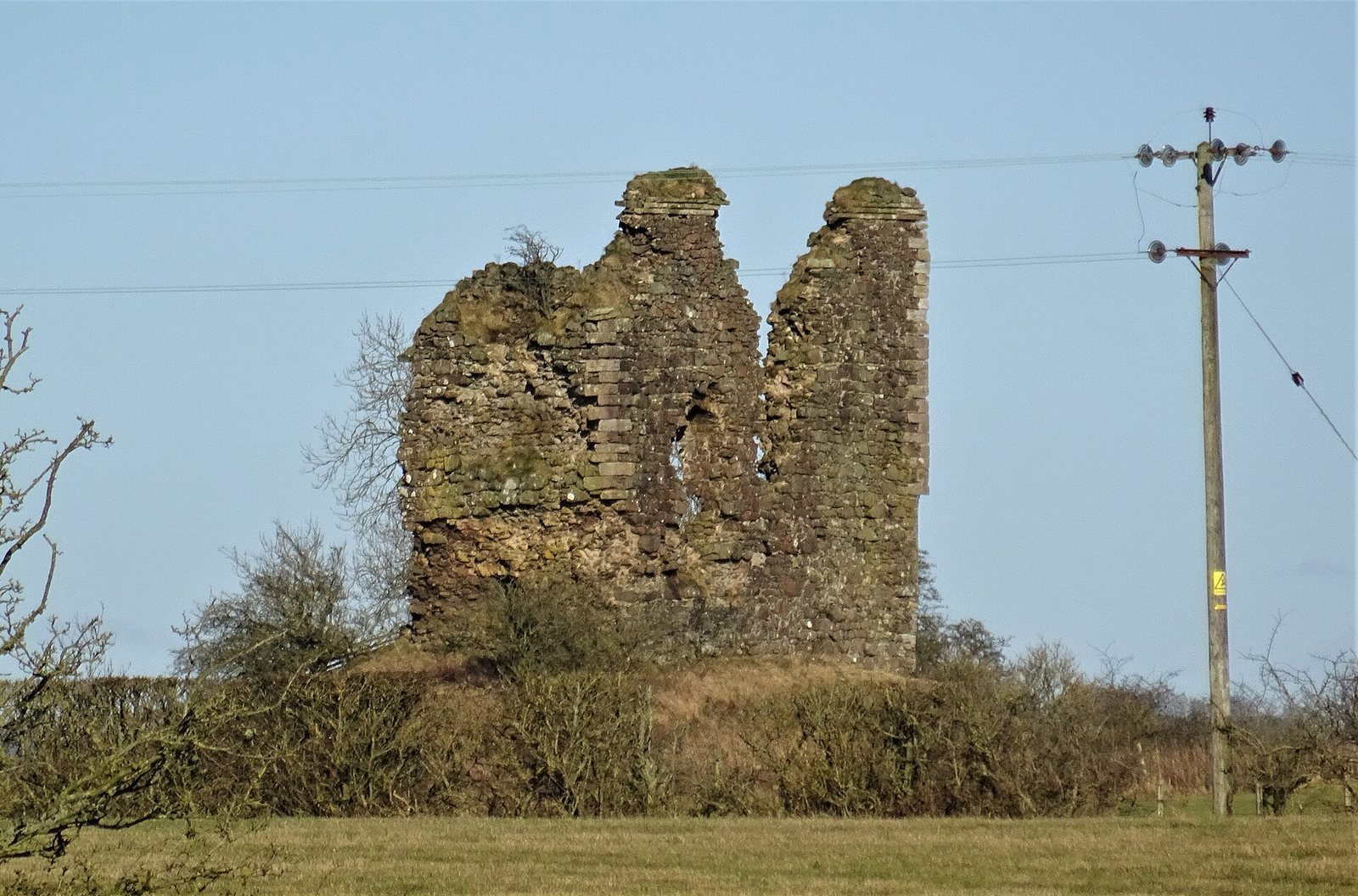
Some consolidation work has been carried out on the ruins.
Remains
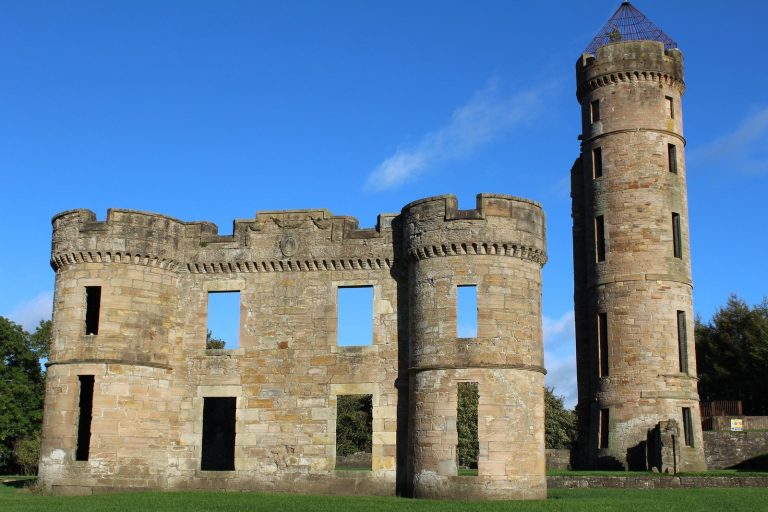
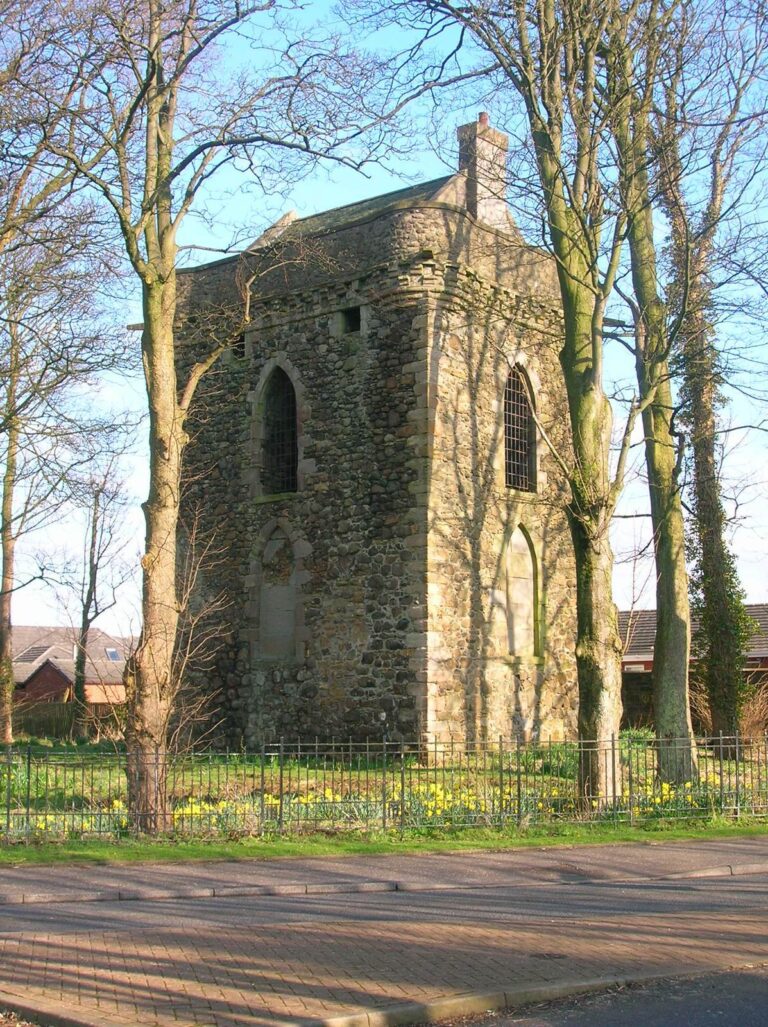
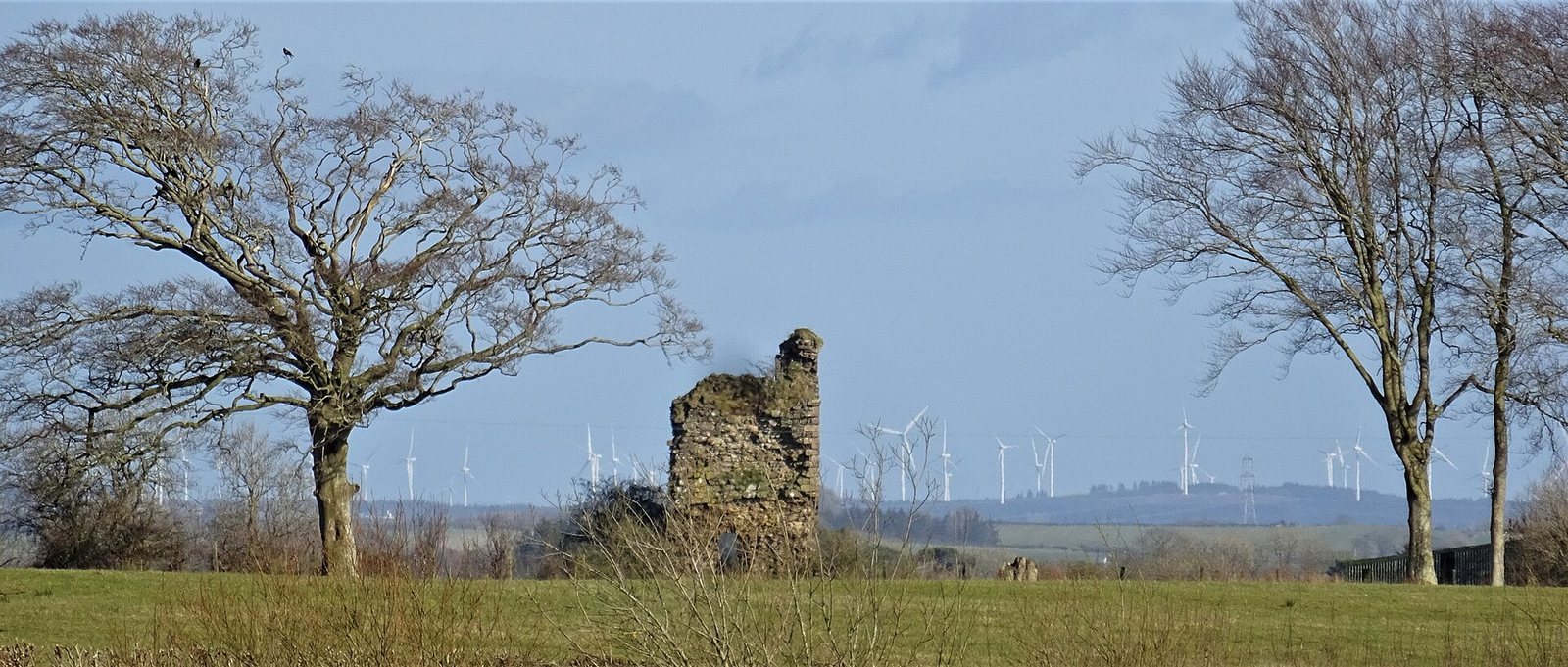
The castle occupies an elevated, defensible position, though quarrying has substantially altered the site. It is a tower-centered residence, and much of the ruin survives. The tower and its mound were considered too small and restricted for practical conversion into a larger, more comfortable home.
Tower and mound
Tower
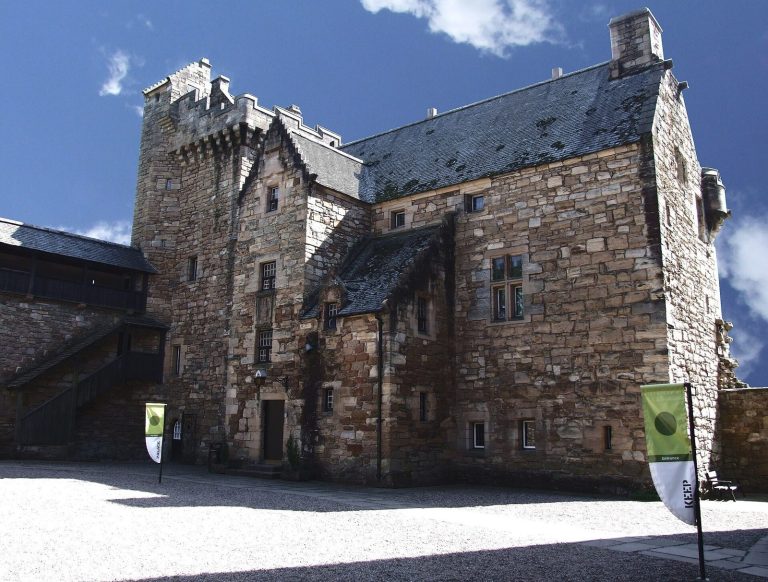
The tower is built of hard, dark whinstone, with readily worked freestone at its corners. Traces of a continuous curved vault, a side tower, and ornate sandstone decoration survive. The projecting masonry supports beneath the low protective parapet are shorter than usual, a feature also found in work at Law Castle and Barr Castle.
Mound
The motte, a raised mound used as a defensive platform, forms part of the castle site. Uncommon orchids have been recorded growing there, and the mound is rich in wildflowers.