Kilwinning Abbey: A Tironensian Benedictine Monastery in Scotland


Site at a Glance
- Rating
- 4.5
- Popularity
- Low
- Country
- United Kingdom
- Primary era
- Medieval
- External website
- Open
- Eras represented
- Medieval, Modern
- Civilizations
- Kingdom of Scotland
- Site type
- Religious
- Remains
- Monastery
On this page17 sections
History
Kilwinning Abbey is a ruined Tironensian Benedictine abbey in Kilwinning, Scotland, founded around 1162 during the later twelfth century. The Tironensians were a distinct Benedictine monastic congregation whose houses followed Benedictine religious practice and formed a network originating at Tiron in the former diocese of Chartres. Dedicated to Saint Winning and the Virgin Mary, the abbey developed as a dependent foundation of Kelso Abbey, whose monks established the community.
Foundation and medieval development
A church may have occupied the site in the seventh or eighth century, although this early phase remains uncertain. Archaeological investigation later identified an earlier church beneath the abbey. It may have been built during the period of Hugh de Morville, a twelfth-century Anglo-Norman nobleman, around 1157. The abbey itself was founded around 1162, with proposed foundation dates extending to 1188. Initial construction was completed around 1187 to 1189, while enlargement continued for roughly another century.
Richard de Morville, Lord of Cunninghame and Great Constable of Scotland, is the probable patron or founder, although this attribution is not certain. King William of Scotland may also have supported the foundation. A tradition identifying the founder as a different Richard de Morville associated with the murder of Thomas Becket cannot be correct because the chronology does not fit.
Kilwinning was known as the younger sister of Kelso Abbey. Its community may have reached about forty monks, especially during the fourteenth and fifteenth centuries, but only sixteen monks remained by the 1540s. The abbey’s surviving historical record is incomplete because its chartulary, a medieval collection of institutional charters, was lost or destroyed. It was reportedly carried away during an attack in 1571. William Melville’s unsuccessful legal attempt in 1591 to recover it from Jean Blair or Cunninghame further illustrates the uncertainty surrounding the abbey’s documentary history. Timothy Pont later claimed to have examined the chartulary, and the monastery’s seal survived at Eglinton Castle.
Lands, jurisdiction, and economy
Robert II granted the abbey’s lands the status of a free regality, a Scottish territorial jurisdiction whose holder possessed extensive legal and administrative powers. Robert III and James IV later confirmed the charter. The abbots exercised the rights of ecclesiastical barons, holding baronial courts and possessing the powers known as “pit and gallows,” which included authority to impose severe criminal punishments. Their principal court hill for the Barony of Beith stood at Gateside, and another court site may have been located near Bridgend.
Around 1470, James III allowed the abbots to hold chamberlain courts on a privileged acre between Corsehill Burn and Bridgend. The abbey also maintained town houses in Glasgow and Irvine. Its income came from sixteen parish churches, including those at Kilwinning, Irvine, Kilmarnock, Dalry, Ardrossan, Kilbirnie, West Kilbride, Dunlop, Stevenston, Beith, Dreghorn, Dumbarton, South and North Knapdale, Kilmory, and Kilbride.
The monastery controlled lands at Monkcastle and Monkredding, granges at Beith and Craignaught, and agricultural estates that produced large quantities of cheese. The monks were deeply involved in farming and may also have worked coal deposits, particularly in connection with salt production at coastal saltpans. Other holdings included the Grangehill estate, the patronage of churches on Arran granted in 1337, and several mills on or near the River Garnock. Monkcastle served as the abbots’ country residence, while Monkredding was a rest house associated with the monks.
The abbey’s wealth brought aristocratic interference. In 1512, the Earls of Glencairn and Angus attempted to force Abbot William Bunche, or Bunsh, to resign. Abbot Adam had earlier petitioned the Vatican in 1439 for permission to build a bridge over the River Garnock. Adam’s Bridge remained in use until its demolition in 1765 for a replacement crossing.
Reformation, decline, and property transfer
Kilwinning Abbey was plundered in 1513 and damaged by supporters of George Wishart during the 1540s. In 1559, amid the Scottish Protestant Reformation, the Earl of Glencairn led a raid during which images, statues, books, vestments, and other religious objects were reportedly burned. A further assault in 1562 involved the breaking of tombs and stained glass and the disturbance of graves.
The abbey’s decline resulted chiefly from the loss of its revenues after the Reformation, rather than from one isolated act of destruction. The complex was demolished in stages, with 1591 marking a major phase of destruction, and its stone was subsequently quarried for other buildings. The final abbot, Archbishop Gavin Hamilton of Roplock, was also commendator, an office-holder who administered a monastery’s lands and income when no abbot exercised full control. He died at Restalrig on 15 June 1571 during the conflict between supporters of Mary, Queen of Scots, and the opposing Protestant faction.
Alexander Cunninghame later became commendator. In 1581 he refused to pay parish ministers from the former abbey revenues and was declared an outlaw. In 1592 the commendary was converted into a free barony for William Melville. Melville sold the lands and rights to Hugh Montgomerie, fifth Earl of Eglinton, in 1603. A royal charter confirmed Montgomerie’s title to the former abbey lands, offices, rights, and the sixteen associated parish churches.
Later use and preservation
The Earls of Eglinton progressively reused the former abbey properties. The Garden or Easter Chambers, originally the abbot’s lodging, became a dower house and family residence, while gardens and orchards continued within the old abbey walls. Abbey stone was reused at Eglinton Castle, its deer-park wall, the castle dovecot, and other buildings. Part of the abbey chancel served as a parish church until 1775, when it was demolished and replaced on the same site by a new Abbey Church built partly with medieval masonry.
Other local buildings also received stone from the ruins, including Seagate Castle and the Railway Cottage at South Millburn. Earls of Eglinton continued to be buried at the abbey until 1886, and family burial vaults remained until their demolition in 1961 because they had become unsafe. In 1789 the surviving abbey tower was repaired, but lightning on 2 August 1809 caused major cracks and fissures. The remaining northern tower was demolished with gunpowder in 1814, and a replacement clock tower was begun in December that year and completed in 1816.
Conservation between 1993 and 1995 converted the surviving clock tower into a heritage centre presenting the history of the abbey and tower, as well as material concerning local figures and organizations such as the Kilwinning Archers. Investigations during the 1960s recovered two additional fragments of Saint Winning’s Cross and clarified successive construction phases, including the earlier church beneath the abbey.
The abbey’s association with pilgrimage derives from traditions of miracles connected with Saint Winning. The place-name Corsehill commemorated a cross that welcomed pilgrims and offered a place for prayer. Local traditions also referred to the saint’s well, relics, hidden treasure, and a tunnel to Eglinton Castle, but the supposed two-mile tunnel has no supporting evidence. Several chapels may have belonged to the abbey before the Reformation, including chapels near Chapelholm or Benslie Wood, Weirston, Stanecastle Gate, and the Drukken Steps. The Weirston chapel was reportedly a private chapel of the Montgomerie family and remained in use until about 1570.
Kilwinning’s traditional connection with Freemasonry rests on the belief that foreign and Scottish masons built the complex. The Ancient Society of Kilwinning Archers, traditionally dated to 1483, still holds its annual papingo shoot in the abbey grounds. A papingo is a wooden bird-shaped target suspended above the ground, which competitors attempt to strike and dislodge.
Remains
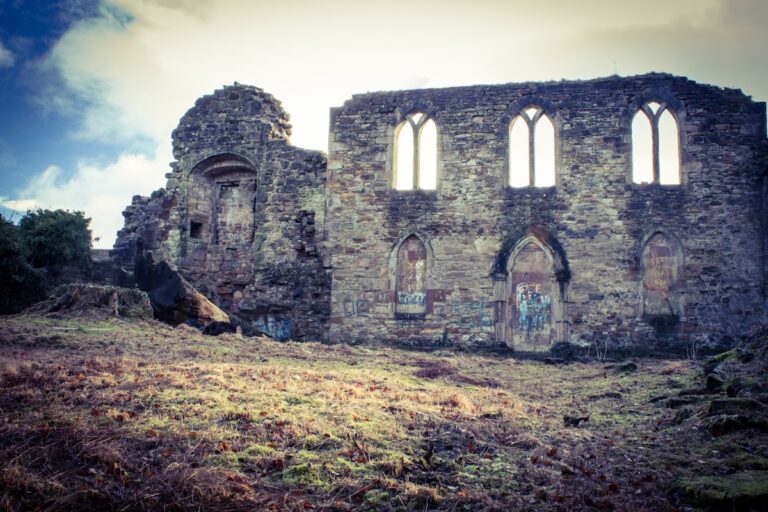
The surviving site consists chiefly of parts of the medieval church and cloister buildings, together with the nineteenth-century clock tower. The abbey church had a cruciform plan, with a choir at the east end, a nave as its main congregational space, and transepts crossing the nave to form the church’s arms. The church was approximately 225 feet long, with a nave about 65 feet wide. The nave and transepts together measured about 100 feet across.
Church ruins and cloister
Church
The west entrance was flanked by two towers, and a central tower may have stood over the crossing. The western towers were separate from the main body of the church and rested on massive supporting piers. One collapsed at an early date, probably because of an inherent structural weakness that may have been hastened by Reformation-era damage. A major enlargement or reconstruction took place during the 1230s, while the two western towers and the west transept appear to have been added during the 1250s. The monastery may still have been partly incomplete at that time.
The abbey appears to have been built around the earlier church. A long stretch of walling may represent the south side of that predecessor. A large processional arch between a gable and a wall may date from about 1190 to 1200. Its Norman-style capital, a carved feature at the top of a column, bears two figures traditionally identified as Adam and Eve, the biblical first man and woman.
The south-transept facade is the most substantial surviving section of the church ruins. The lower part of one western tower also remains. The south wall of the church, which formed the north side of the cloister, survives in part and contains the entrance from the cloister into the church. The modern parish church occupies the medieval choir and north-transept site, and its uneven exterior walls reflect the reuse of medieval abbey masonry.
Cloister and chapter house
The rectangular cloister lay south of the nave, with its eastern side aligned with the south transept. A cloister was a covered walkway around an enclosed court, linking the principal monastic buildings. Its surviving buildings are better preserved than the church, especially on the east and west sides. The remains of the chapter house border the cloister. A chapter house was the room where the monks met for official business and heard a daily reading from their rule, and parts of its passageway and complex may date from the 1180s.
Later buildings and associated features
Clock tower
The surviving nineteenth-century clock tower stands beside the remains of the medieval tower and rises 103 feet. Built between 1814 and 1816 after the unsafe earlier tower was demolished, it now contains the heritage centre. Together with the church and cloister ruins, it forms the principal visible group of remains.
Easter Chambers
The former Easter Chambers, originally the abbot’s lodging, survived as a residence of the Earls of Eglinton. Related stonework was reused in the stables and offices of Eglinton Castle, where masons’ marks identify some blocks as having come from the abbey.
Dovecot
A dovecot at Eglinton, probably transferred from the abbey estate, incorporates carved stonework attributed to Kilwinning. The building has a sixteenth- or seventeenth-century design, ornamental door carvings, and medieval carving said to have originated at the abbey. A dovecot was a structure built to house domestic pigeons or doves. A possible abbey font is preserved in the old village of Dalgarven, while carved coats of arms reportedly taken from the abbey were incorporated into Kerelaw Castle.
Cross, well, vaults, and mills
Saint Winning’s Cross
Saint Winning’s Cross survives in fragments. The shaft segment, now held at the North Ayrshire Heritage Centre in Saltcoats, has double-beaded interlace on one side. The other side carries carvings of David with a harp, David on horseback carrying a spear, and a lamb attacked by a lion. Its style has been associated with the Govan School and compared with crosses at Govan, Barochan, and Inchinnan. The cross was traditionally linked with the first church attributed to Saint Winning and with Saint Bridget and the Virgin Mary. A modern replica of the Mercat Cross stands on Kilwinning’s Main Street, while two excavated fragments are held by Historic Scotland.
Well and underground vaults
Saint Winning’s Well stood slightly south of the manse near Saint Winning’s Road and still supplied water in the 1860s. It was destroyed during construction of the Glasgow and South Western Railway. Workers clearing ground near the abbey in 1826 uncovered a lead pipe running from the abbey toward the well. Vaults beneath the former precinct remained partly accessible until about two centuries ago, when later rebuilding and extension of the old parish church removed access.
Former mills
The abbey’s former mills included the Walkmylne of Groatholm, now associated with Dalgarven Mill, and probably Sevenacres Mill. The location of a third mill is uncertain. A Bridgend mill on the River Garnock was granted by commendator Alexander Cunninghame to his son James of Montgreenan in 1645 and again in 1674.
Nearby sites