Vieux Chambord Castle: A Fourteenth-Century Fortified House in Treteau, France
Site at a Glance
- Popularity
- Medium
- Country
- France
- Primary era
- Medieval
- Eras represented
- Medieval
- Civilizations
- French
- Site type
- Military
- Remains
- Castle
On this page8 sections
History
Vieux Chambord Castle is a fortified house in Treteau, France, built in the third quarter of the fourteenth century. Its defensive purpose was to guard the Besbre valley and control a former Roman road between Autun and Vichy. Roman legionaries used the road when travelling to the thermal baths at Aquae Calidae, the Roman-era name associated with Vichy. The route’s importance helps explain why a fortified house here is mentioned by the thirteenth century.
The Châtillon and Champropin lords
The estate was held by the Châtillon family, lords of the powerful castellany of Jaligny, a territory governed from a castle. Hugues de Châtillon transferred Chambord to his brother Guillaume, who later became bishop and duke of Laon and a peer of France, one of the kingdom’s highest-ranking nobles. In 1276, Guillaume transferred the property to Jean I Champroprin on condition that Jean remain his vassal, a landholder bound by duties to a superior lord. Guillaume’s death ended that obligation, and the estate subsequently passed through alliances and inheritance.
In 1322, Jean’s son Philippe de Champropin formally acknowledged his tenure to Duke Louis I of Bourbon, declaring the land he held and the obligations owed to the duke. Philippe was also the duke’s squire, an attendant in a noble household. In 1346, Philippe’s son received high, middle, and low justice over the estate, meaning authority at different levels of the law. The land was described as an allod, meaning it was held outside the usual obligations of feudal tenure.
Louis I de Chambord, a direct descendant of the first Champropin, was among the lords who accompanied the French military commander Bertrand du Guesclin at the siege of Randan in 1377. The estate later passed to a descendant named Pierre and, in 1386, to Pierre’s widow.
Later inheritance and the Devaulx name
In 1514, the estate passed to Louis II Champropin, Pierre’s nephew. Louis was an archdeacon of Clermont, a senior church administrator, and a licentiate in canon law, an advanced qualification in church law. A confirmation of his rights is dated 1346 and attributed to Anne de Beaujeu, an influential political figure of the late fifteenth century. That date is chronologically uncertain because it precedes Louis’s inheritance in 1514.
The property passed from the Champropin family to the Joulle family and then to the Devaulx. Inheritance through women maintained the Champropin family’s connection to the estate from 1276; the Devaulx descended through female lines from Bord de Champropin de Chambord, a Bourbonnais noble family. In 1815, Louis XVIII authorized Devaulx descendants to take the name Devaulx de Chambord. The façades, roofs, and enclosure of the main courtyard were classified as French historic monuments in 1972.
Remains
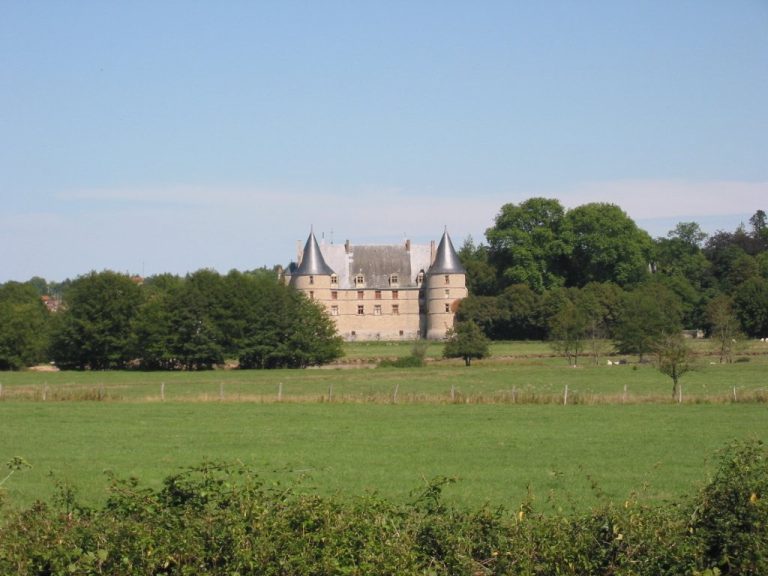
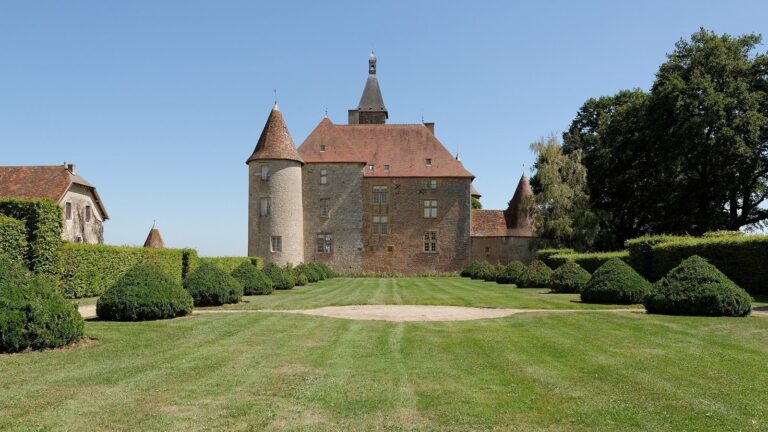
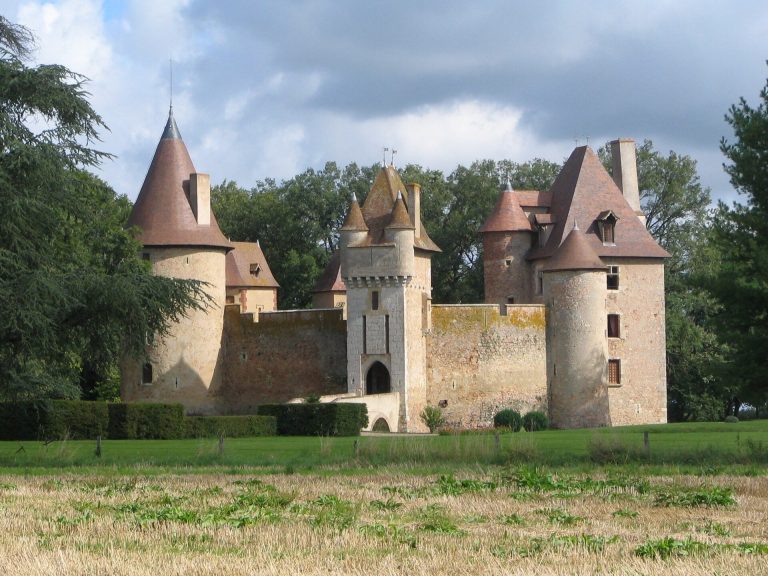
The château occupies a commanding position facing Chavroches and overlooking the winding Besbre. Its layout brings together a square keep and a long, multi-storey residential building, combining a fortified structure with a substantial dwelling.
Keep and residential buildings
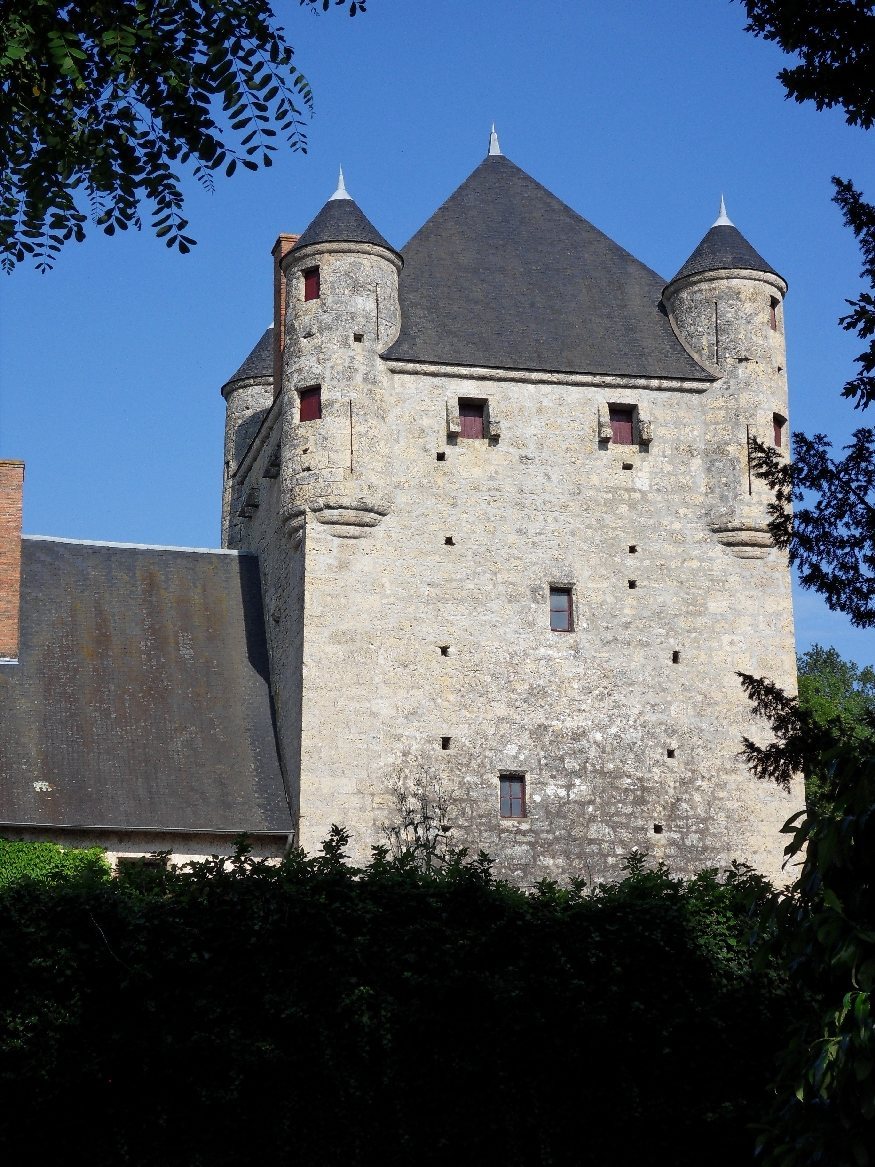
Keep and corner turrets
The square keep dates to the fourteenth century and rises 28 metres. Projecting turrets stand at its corners, supported by corbels, projecting structures that carry the masonry above them. Each turret has two levels, an uncommon arrangement.
Residential building
A large, elongated building with several storeys is attached to the keep. The basic arrangement has a parallel at Château de Montessus in Changy, Saône-et-Loire, where a square keep with corner turrets is also joined to a multi-storey residence.
Bell
A bell dated 1222 survives in association with the château and provides an early chronological marker for its history.