Boleskine House: A Loch Ness Hunting Lodge and Historic Estate
Site at a Glance
- Popularity
- Very High
- Country
- United Kingdom
- Primary era
- Early Modern
- Eras represented
- Early Modern, Modern
- Civilizations
- British
- Site type
- Domestic
- Remains
- Elite Residence
On this page9 sections
History
Boleskine House is an eighteenth-century manor on the southeast shore of Loch Ness in Scotland, United Kingdom. Built in the 1760s as a hunting lodge for Scottish colonel Archibald Fraser, it stands on the site of an earlier church and became closely associated with occultist Aleister Crowley after he bought it in 1899.
The church and the Fraser lodge
The parish of Boleskine was established in the thirteenth century, when a church and graveyard were built on the site. Local legend says the church caught fire during a service, killing everyone inside. Another tale links the graveyard to Minister Thomas Houston, who lived from 1648 to 1705. It says he had to return corpses to their graves after a wizard raised the dead.
Fraser built the house on the former church site as a hunting lodge. Its location may have been intended to provoke Simon Fraser of Lovat, a nobleman who supported the Hanoverian side during the Jacobite rising of 1745, an attempt to restore the Stuart dynasty to the British throne. Archibald Fraser resented that allegiance, while the surrounding land belonged to Simon. The Fraser family continued enlarging the lodge until about 1830.
Crowley and the house’s occult reputation
Aleister Crowley, an English occultist and writer associated with ceremonial magic, bought the property from the Fraser family in 1899 for £2,000. It was then called the Manor of Boleskine and Abertarff, a name linked to the local parish. Crowley chose the secluded house for a ritual based on The Book of Abramelin, a manual of magical practices. The ceremony aimed to contact a personal Guardian Angel, understood in that tradition as a spiritual protector, and to summon and bind twelve Kings and Dukes of Hell.
The ritual required at least six months of preparation, along with celibacy and abstinence from alcohol. Crowley was called to Paris by the leader of the Hermetic Order of the Golden Dawn, a late-nineteenth-century group devoted to Western ceremonial magic, during disputes within the order. He left the work unfinished and later said his experiments with black magic had become difficult to control.
Crowley was also associated with animal sacrifices and sexual-magic ceremonies at the house. Stories from the period include a servant who, after twenty years of abstinence, became drunk and tried to kill his family, and the deaths of two children of lodge keeper Hugh Gillies. A local legend held that spirits Crowley had summoned remained in the house and accounted for later reports of strange events. Crowley left in 1913, moving to a cottage near Falkirk. From 1920, the house drew pilgrims among Thelemites, followers of Crowley’s religious and philosophical movement, and Satanists outside the LaVeyan tradition.
The house also entered popular culture. W. Somerset Maugham’s 1908 novel The Magician depicts a house recognizable as Boleskine, renamed “Skene” in the story. Crowley considered the novel plagiarism and answered Maugham in Vanity Fair under the name Oliver Haddo, a character from the book. A fantasy sequence in Led Zeppelin’s 1976 concert film The Song Remains the Same was filmed on the property.
Later owners, fires, and restoration
After the Second World War, Major Edward Grant owned the house. On 9 November 1960, he died by suicide with a shotgun in Crowley’s bedroom. A newly married couple later moved in, but after about a month the husband left his blind wife at the house. In 1969, experimental filmmaker Kenneth Anger rented the property for several months. Led Zeppelin guitarist and producer Jimmy Page bought it in 1970, hoping to restore its appearance from Crowley’s time. Page spent little time there and left its care to his friend Malcolm Dent, who lived there with his family.
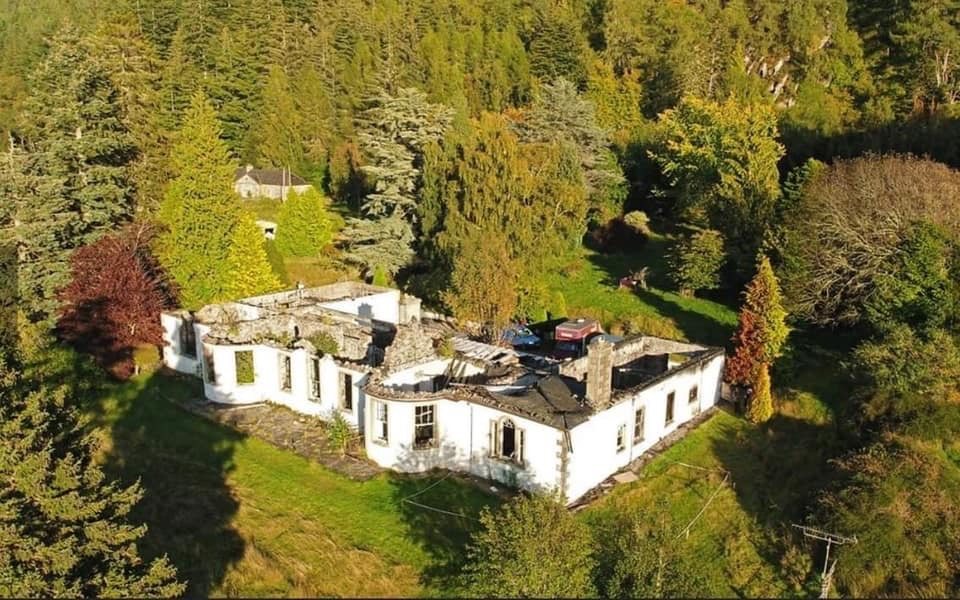
Ronald and Annette MacGillivray bought the house in 1992, renovated it, and turned it into a hotel. After Ronald died in 2002, the property went on the market again. Dutch owners converted it back to a private residence and used it as a holiday home. A fire on 23 December 2015, probably starting in the kitchen, caused extensive damage; no one was believed to be inside and there were no casualties. In July 2019, another fire affected two estate buildings, with arson suspected, and destroyed the house’s remaining interior.
In 2019, the Boleskine House Foundation acquired the ruins and 22 acres of land with the aim of restoring the house and gardens and opening the estate to the public. Work began in December that year.
Remains
The site occupies the southeast side of Loch Ness, about 34 kilometres south of Inverness, opposite Meall Fuar-mhonaidh and roughly halfway between Foyers and Inverfarigaig. The main building is a large, low, single-storey manor house. Adjacent to it are the stables and a gate lodge, a small building beside an estate entrance.
The house and its interiors
Original plan
The original lodge arranged its rooms on one floor. It had four bedrooms, a kitchen, a lounge, a drawing room, and a library, with a servants’ attic bedroom above the kitchen. A tunnel connects the house with the graveyard.
Crowley’s ritual space
Crowley set aside the southwestern half of the house for ritual work. The largest room had a bow window, which projects outward in a curved shape. He added a door facing north and built a terrace covered with fine river sand, ending at a small lodge. Inside the room, he installed a wooden oratory, a space for religious rites, partly lined with large mirrors brought from London.
Later interiors and surviving fabric
During Page’s ownership, artist Charles Pace painted Crowley-inspired murals on the walls. They drew on murals at Crowley’s Abbey of Thelema in Sicily, which Anger had discovered in 1955. The MacGillivrays later stripped the interior back to bare walls and reroofed the house. Its rooms then included four bedrooms and four bathrooms, as well as a large drawing room, dining room, library, and smaller rooms.
The 2015 fire almost completely destroyed the interior, while part of the roof and the outer walls survived. The 2019 fire destroyed the remaining interior fabric. Restoration work used traditional building techniques and materials. Its final phase redesigned the interior to evoke the Jacobean, Georgian, and Victorian periods, with a drawing room, dining room, and library.