Inverness Castle: A Historic Fortress and County Courthouse in Scotland

Site at a Glance
- Rating
- 4.1
- Popularity
- Medium
- Country
- United Kingdom
- Primary era
- Modern
- External website
- Open
- Eras represented
- Modern
- Civilizations
- British
- Site type
- Civic
On this page11 sections
History
Inverness Castle is a historic castle complex in Inverness, United Kingdom, occupying a site where successive fortifications have stood since 1057. The earliest castle is traditionally attributed to Malcolm III, also known as Malcolm Canmore, the eleventh-century king of Scotland. An initial fortification of wood and earth was later followed by stone structures, including buildings made from red sandstone. The present complex, completed in the nineteenth century in an early castellated style, replaced the earlier castle while retaining its place in the history of Inverness.
Medieval fortress and royal authority
Robert I of Scotland, known as Robert the Bruce, partially destroyed the first castle in 1307 during the Scottish struggle for independence from England. Its battlements were razed, but the site continued to serve as a fortified royal and regional centre.
In 1428, James I summoned fifty Highland clan chiefs to Inverness Castle under the pretext of a parley. Many were arrested and imprisoned, while several were executed. Alexander, 3rd Lord of the Isles, was held for twelve months. After his release, he returned with 10,000 men, burned Inverness, and made an unsuccessful assault on the castle.
The castle was occupied during the Raid on Ross in 1491. Walter Ogilvy received payment in February 1498 to repair its two paired towers, described at the time as “gemmel” towers. In February 1509, James IV appointed Alexander Gordon, 3rd Earl of Huntly, hereditary keeper of the castle and sheriff of Inverness.
The Gordon keepership and Mary, Queen of Scots
A further castle, including a tower, was completed in 1548 by George Gordon, 4th Earl of Huntly. James V and Margaret Tudor had required Huntly to build a hall and chapel in connection with his marriage to Elizabeth Keith in 1530. Huntly remained constable until 1562. Mary of Guise, the regent of Scotland before the personal rule of her daughter, Mary, Queen of Scots, held justice courts at Inverness in August 1556.
When Mary, Queen of Scots, visited Inverness in August 1562, the Gordon family refused her entry to the castle. The Clan Fraser, Clan Munro, and Clan Chattan then expelled the Gordons and seized the castle for the Queen. Mary later ordered the execution of the Gordon governor who had denied her admission. George Munro of Davochgartie and Milntown became keeper, although in December 1562 Mary ordered him to surrender the office to John Ross, provost of Inverness.
During the Chaseabout Raid, a political crisis involving Mary and her opponents, Mary and Lord Darnley appointed Hucheon Rose of Kilravock keeper on 22 September 1565. This replaced George Munro and his son Andrew, although the Earl of Huntly was again designated keeper in October. In August 1583, James VI ordered the imprisonment of John Leslie of Balquhain, Andrew Munro of Newmoir, and William Douglas of Lochleven in the castle, permitting each man six servants.
Decline, civil war, and Jacobite conflict
By May 1619, much of the castle had fallen into disrepair. James VI instructed the Earl of Mar and Gideon Murray to arrange repairs after priority work at Linlithgow Palace and Dumbarton Castle, but the work was not undertaken at that time.
In 1649, forces supporting Charles II expelled the garrison and demolished the castle’s walls and fortifications. During the Scottish Civil War siege of Inverness in 1650, Lewis Gordon, 3rd Marquess of Huntly, unsuccessfully besieged the castle under the direction of James Graham, 1st Marquess of Montrose.
After unrest in 1665, Clan MacDonald besieged the castle in 1689 with about 900 men. The attackers plundered Inverness and took hostages. Mediation by John Graham, 1st Viscount Dundee, secured payment of a ransom and the release of the prisoners.
During the Jacobite rising of 1715, a campaign by supporters of the Stuart claim to the British throne, Clan Mackenzie captured the castle under Sir John Mackenzie Cole. Simon Fraser, 11th Lord Lovat, then besieged it in support of Clan Rose and Clan Forbes. Cole surrendered the following day under terms that allowed him to avoid imprisonment and join the Jacobite army led by John Erskine, Earl of Mar.
General George Wade expanded, strengthened, and modernised the fortress in 1725. During the Jacobite rising of 1746, Jacobite forces besieged the castle, and Major George Grant surrendered on 21 February. The Jacobite army subsequently destroyed the castle.
The nineteenth-century courthouse
The present building was constructed on the historic castle site as the sheriff court and administrative centre of Inverness-shire. A sheriff’s court is a Scottish court with civil and criminal jurisdiction. The complex incorporated the former county buildings and later became a meeting place for Inverness-shire County Council after the Local Government (Scotland) Act 1889.
When the county council moved to Glenurquhart Road in 1963, the building continued to accommodate sheriff’s-court hearings and monthly justice-of-the-peace hearings. Inverness Sheriff Court hearings moved to the Inverness Justice Centre on 30 March 2020. The castle and grounds closed in 2021 for extensive renovation and remodelling. The building is a Category A listed structure, a designation for exceptional national architectural or historic interest in Scotland.
Inverness Castle also has a literary association through William Shakespeare’s tragedy Macbeth. Shakespeare, an English playwright and poet of the late sixteenth and early seventeenth centuries, presents the castle as the residence of Macbeth and Lady Macbeth and as the place where King Duncan is murdered. An illustration of the castle appeared on the reverse of a Royal Bank of Scotland £50 note introduced in 2005.
Remains
The red-sandstone complex
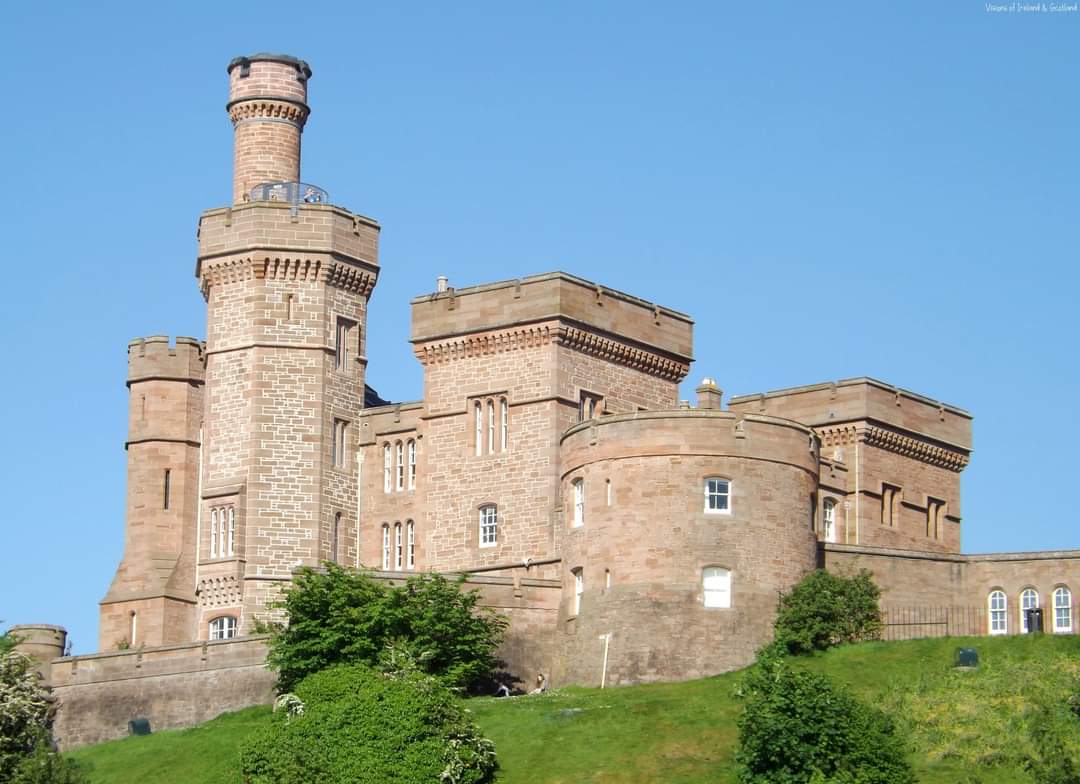
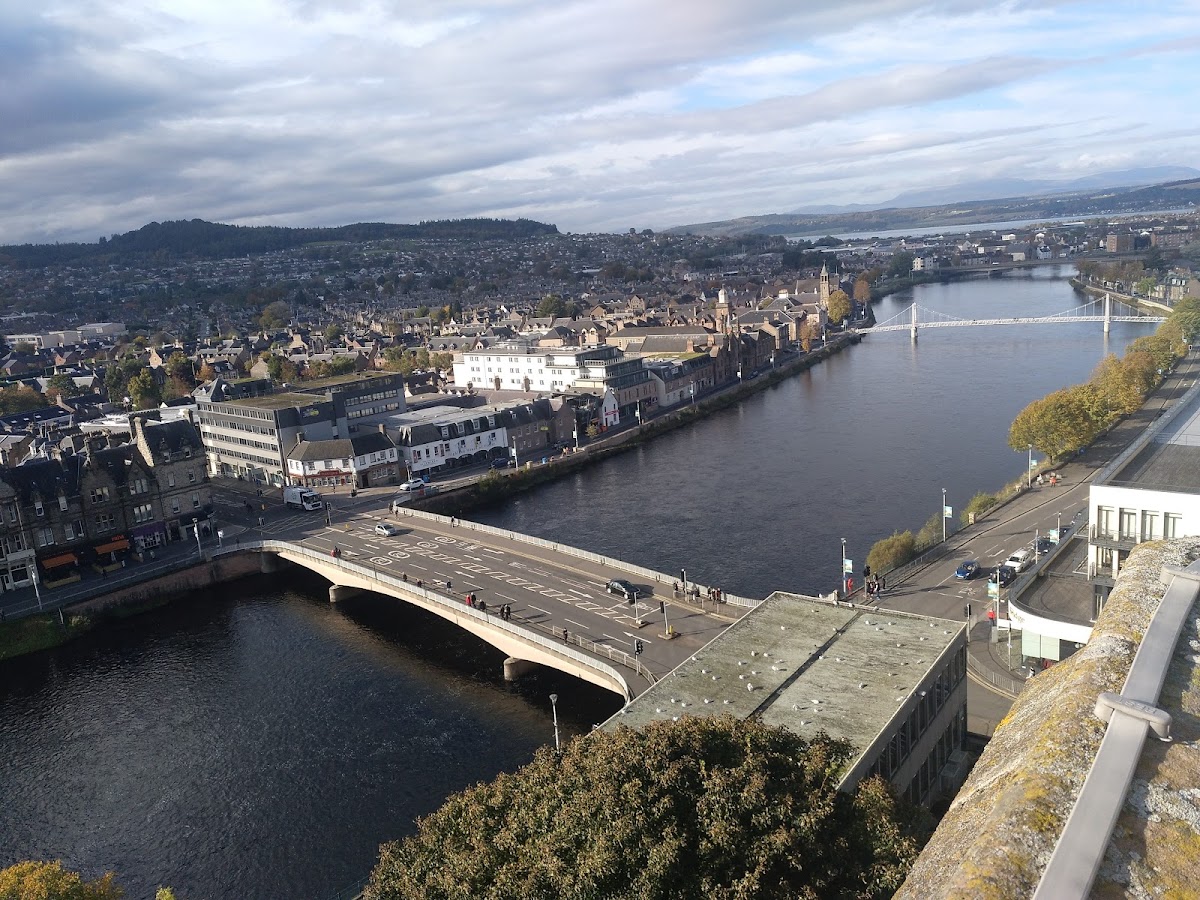
Inverness Castle stands on a rocky height above the River Ness as a red-sandstone complex. The foundations of the earlier castle lay slightly farther east. A surviving section of old wall and an old well provide physical evidence of the pre-1835 castle, while the principal visible buildings belong to the nineteenth-century reconstruction.
Southern block
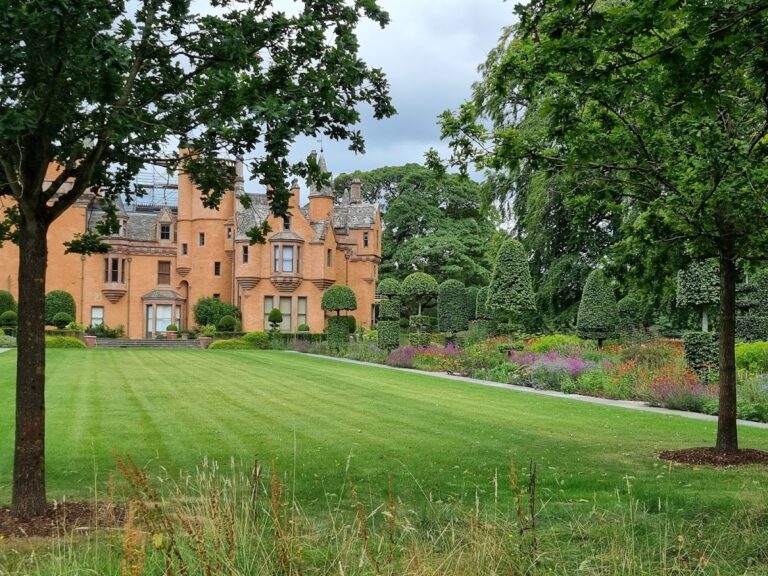
William Burn designed the principal southern block, which was completed in 1836 in an early castellated style. It incorporated the old county buildings, including the sheriff court. The south-facing frontage is symmetrical and has seven bays. Its slightly projecting three-bay centre contains a round-headed doorway, round-headed ground-floor windows, and three round-headed windows on the first floor, with a battlement above.
The outer bays form castellated towers. The tower on the left is round, while the tower on the right is square. Together, the towers and battlement give the courthouse complex its fortified appearance while expressing its nineteenth-century civic purpose.
Northern block
Thomas Brown II designed the northern block in a similar red-sandstone style, and it was completed in 1848. The building originally served as Inverness Prison and was later used as an additional courthouse. Its construction extended the nineteenth-century complex beyond the southern block and preserved the site’s association with public administration and law.
Enclosing walls and old well
Joseph Mitchell designed the enclosing walls, which include projecting defensive sections known as bastions. A bastion is a projecting part of a fortification designed to provide defensive fire along the enclosing walls. The old castle well stood between the two nineteenth-century buildings. It later became ruinous but was restored in 1909.
Memorial features and surviving guns
A statue of the Jacobite heroine Flora MacDonald with her dog stands in front of the castle. It was erected in 1899. Four field guns were placed on the frontage in 1920. They included a gun captured by the 5th Battalion, Queen’s Own Cameron Highlanders, at the Battle of Loos on 25 September 1915, and a bronze gun captured by the 7th Battalion at an unidentified battle in France.
The group also included two Russian field guns taken after the Siege of Sevastopol during the Crimean War and presented to Inverness after the Treaty of Paris in 1857. In 1941, the Russian guns were sold for scrap to support the Second World War effort. An error led to the removal of the 7th Battalion gun instead of one of the Sevastopol guns, and it was scrapped before the mistake was discovered. The surviving Sevastopol gun returned to the castle frontage, was later moved inside, and remained there until construction of the second courtroom in the 1970s. By 2017, the Loos gun was the only one of the four known to survive, and it was displayed at the Clan Cameron Museum in Achnacarry.