Castle of Verneuil-sur-Avre: A Medieval Frontier Fortress
Site at a Glance
- Popularity
- Medium
- Country
- France
- Primary era
- Medieval
- Eras represented
- Medieval, Modern
- Civilizations
- French
- Site type
- Military
- Remains
- Castle
On this page9 sections
History
The Castle of Verneuil-sur-Avre is a medieval fortress in France, built around 1120 by the Anglo-Norman ruler Henry I Beauclerc, Duke of Normandy and King of England. Positioned on the duchy’s frontier, Verneuil became one of Normandy’s important strongholds. The new town was enclosed by ramparts and ditches as the fortress was established.
Frontier stronghold and royal conflict
In 1135, Verneuil supported Stephen of Blois in his conflict with Geoffrey Plantagenet, and fighting devastated the surrounding countryside. King Louis VII of France burned the town’s suburbs in 1152 and again in 1153. In 1169, Henry II Plantagenet reinforced Normandy’s vulnerable southern border, building forts at Verneuil, Courteilles, Tillières, and Nonancourt. Louis VII captured Verneuil after a month-long siege in 1173 and set it ablaze, but withdrew as Henry II’s forces approached.
Philip II Augustus was besieging Verneuil in 1194 when Richard the Lionheart returned to Normandy after a long captivity under Henry VI, Holy Roman Emperor. Philip lifted the siege at the end of May. Richard entered the town on May 30 and repaired its ramparts.
French rule and the Hundred Years’ War
During Philip II’s conquest of Normandy around 1204, Verneuil submitted after Rouen, the duchy’s capital, surrendered. Following the duchy’s annexation to the French royal domain, Philip commissioned a second keep, the Grey Tower, a castle’s principal fortified tower, and granted the town municipal liberties. Medieval chroniclers described the tower as exceptionally strong; it often served as the defenders’ final refuge.
In 1336, Philip VI of Valois granted Verneuil to his brother, Charles II, Count of Alençon. In 1356, Henry of Grosmont, Duke of Lancaster, and Philip of Navarre captured and plundered the town before retreating toward the Cotentin. Verneuil surrendered to Henry V of England in 1417. Under the 1420 Treaty of Troyes, an agreement between England and France that made Henry heir to the French kingdom, John of Lancaster, Duke of Bedford, began its conquest.
French captains retook Verneuil by a ruse in 1424. Bedford hurried from Évreux and defeated them on August 17 in a battle on the plain of Saint-Denis, northeast of the town. Charles of Bourbon briefly occupied Verneuil in 1429. In 1449, the English governor François de Surienne seized Fougères, prompting Charles VII to resume the reconquest of Normandy. On July 20, Pierre de Brézé entered Verneuil with two archers, aided by the miller Bertin. The English withdrew into the castle. French forces drained its ditches and stormed the defenses; the last English defenders, trapped in the Grey Tower, surrendered on August 23. Charles VII entered the town on August 27.
Sixteenth-century conflict and later status
Verneuil sided with the Catholic League, a powerful Catholic political and military movement in late-sixteenth-century France, in 1584. Henry IV retook the town the following year but soon lost it to Baron Pierre Rouxel de Médavy, who captured it by a ruse. Rouxel submitted to the king in 1594 and remained the town’s captain. In 2016, the Grey Tower and nearby ground corresponding to its former ditches, extending 7.70 metres from the tower walls, received historic-monument classification.
Remains
The medieval castle grounds lie between the Avre and the road to La Ferté-Vidame. The Grey Tower is the castle’s surviving standing structure, while parts of the town’s defensive perimeter, including its moat and several rampart towers, also remain.
The Grey Tower
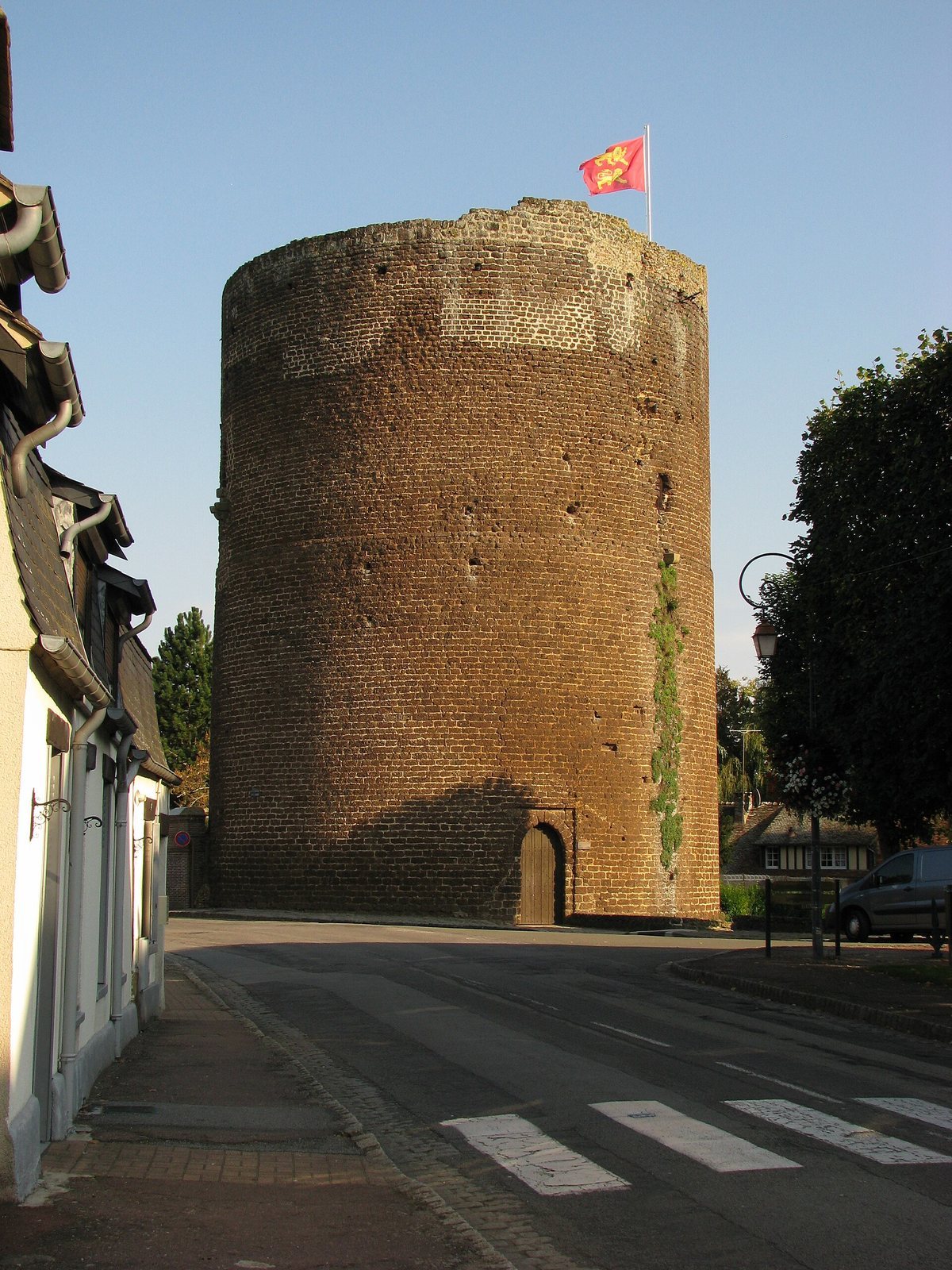
This large, curved-plan keep dates to the thirteenth century and stands at the town’s edge on the left bank of the Avre, about 300 metres south of the Madeleine church. Built of ferruginous conglomerate, a rock made of fragments cemented by iron-rich material, it rises 35 metres and has walls four metres thick. The tower reinforces the town’s fortified perimeter while remaining separate from the enclosure; an external defensive work called the Fauconnerie protected it. Two doors face different sides, one toward the town and the other toward the ramparts.
The tower was originally vaulted. Its upper floors and summit were altered in the nineteenth century, when its crown was renewed. The upper part now has a six-part vault, whose ribs divide the ceiling into six sections.
Town defenses and entrances
Ramparts and moat
Much of the moat survives. Water from the Iton still fills its northern and eastern sections. Several towers along the ramparts remain, including the square-plan Saint-André Tower.
Gates and defensive ditches
A secondary entrance survives at the southeastern corner of the ramparts, within the enclosure of a Benedictine convent, a monastery of the Catholic order whose members follow the Rule of Saint Benedict. A tower defended this entrance. The ditches at the Mortagne Gate, once part of the castle’s defenses, later became a promenade known as Hell’s Mouth. Promenades also follow other old ditches, including those of a false gate used as a defensive decoy.