Château de La Ferté-Vidame: An Eighteenth-Century French Château and Estate


Site at a Glance
- Rating
- 4.5
- Popularity
- Low
- Country
- France
- Primary era
- Early Modern
- External website
- Open
- Eras represented
- Medieval, Early Modern
- Civilizations
- French
- Site type
- Domestic
- Remains
- Castle
On this page14 sections
History
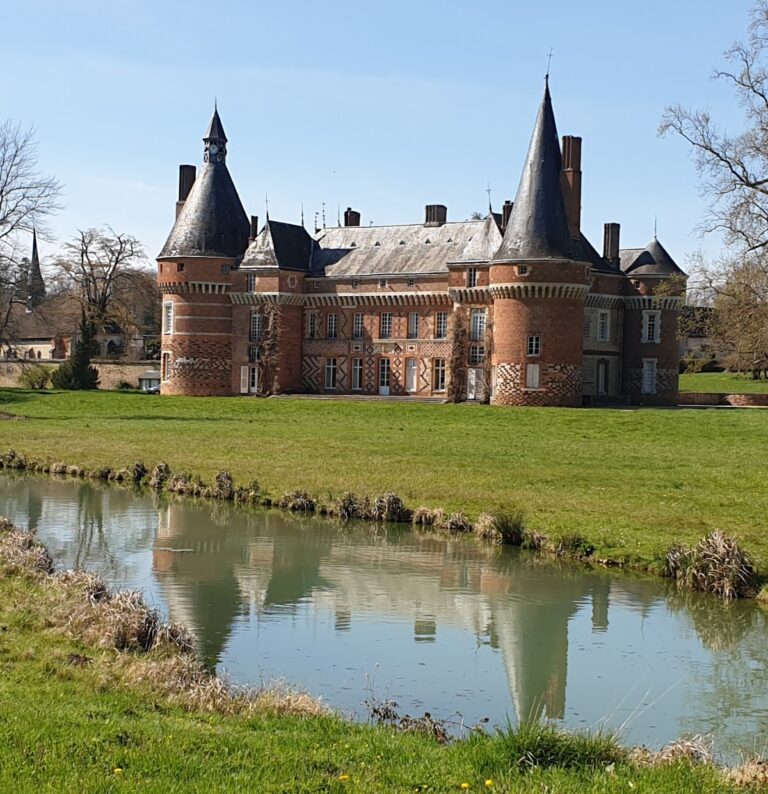
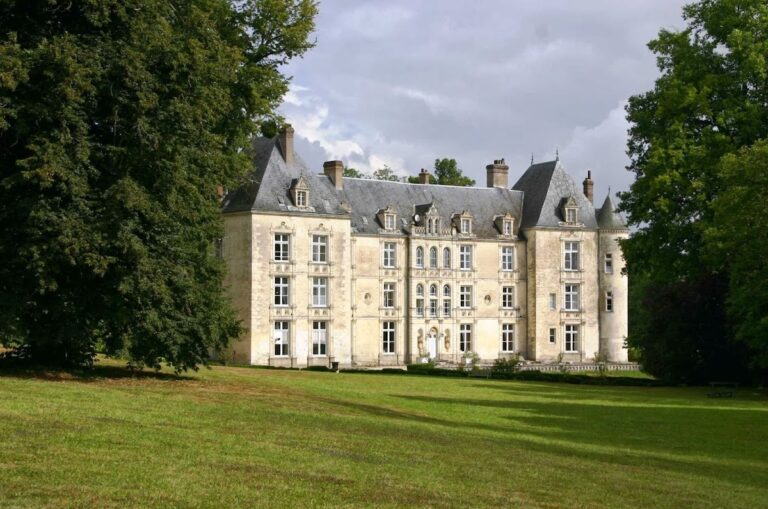
Château de La Ferté-Vidame is a historic château and estate in France, rebuilt almost entirely in 1771 in a highly developed interpretation of classical architecture. Its history extends from a fortress attested in 985 to an aristocratic residence, a hunting estate, a social-reintegration institution, and a protected historic site. The château is also associated with Louis de Rouvroy, Duke of Saint-Simon, who lived there and wrote most of his Mémoires.
Medieval origins and the Saint-Simon family
A castle stood at La Ferté-Vidame by 985. In 1374, the Vendôme family acquired the domain and rebuilt it. The family held the title of Vidame of Chartres, a medieval and early-modern office in which a lay representative exercised military and administrative authority for a bishop. The title later remained attached to the lordship of La Ferté-Vidame.
Claude de Rouvroy, Duke of Saint-Simon and a favorite of Louis XIII, acquired the domain on 19 May 1635. His son, Louis de Rouvroy, Duke of Saint-Simon, continued the family connection with the estate. A courtier and memoirist, he used the château as a residence and composed most of his Mémoires there. His writings provide an important account of the court of Louis XIV and the Regency period.
Laborde’s rebuilding
After Louis de Rouvroy de Saint-Simon died in 1755, the estate passed to his granddaughter, Marie-Christine-Chrétienne de Rouvroy de Saint-Simon, the wife of Charles-Maurice of Monaco, Count of Valentinois. On 21 June 1764, she sold the château and its 900-hectare domain to Jean-Joseph de Laborde, a banker and slave owner. The sale included the title of Vidame of Chartres, which was attached to the lordship.
Laborde commissioned the architect Antoine Matthieu Le Carpentier to rebuild the château almost entirely. Work was completed in 1771. The new residence combined forms associated with early seventeenth-century construction with an original interpretation of classical architecture, a tradition based on ordered proportions, symmetry, and forms derived from ancient Greece and Rome. Laborde spent 14 million livres at La Ferté-Vidame and received Louis XV, the future Joseph II of Austria, and the Duke of Choiseul there. Joseph II later became Holy Roman Emperor, while Choiseul was a leading French statesman under Louis XV.
The Penthièvre sale and revolutionary confiscation
In 1783, Louis XVI compelled the Duke of Penthièvre to surrender the Château de Rambouillet. Penthièvre required La Ferté-Vidame in exchange, and Laborde was forced to sell the estate to him on 4 January 1784 for 5.5 million livres. Laborde retained the title of Vidame of Chartres, together with the château’s furniture, works of art, and park statues, which Penthièvre did not want.
After the Duke of Penthièvre died in 1793, the domain passed to his daughter, the Duchess of Orléans. Because she had emigrated during the French Revolution, her property was confiscated, and the château had already been looted. On 27 March 1798, the estate was sold to Cardot-Villers. He dismantled the château for reusable materials and cut down 31,000 trees in the forest. Unable to pay for the acquisition, he lost his rights to the property. The domain was offered for sale again in June 1803, found no buyer, and remained state property.
Restoration and nineteenth-century ownership
During the Restoration, the period after Napoleon’s fall when the Bourbon monarchy returned to France, the domain was returned to the Duchess of Orléans. After her death in 1826, it passed to her eldest son, Louis-Philippe, later King of the French. He reconstituted the estate, rebuilt the enclosure wall, restored the water features, and restored and enlarged the small château. The 1848 Revolution interrupted this work.
Napoleon III’s regime confiscated the property of the House of Orléans. In 1872, the state sold La Ferté-Vidame to Baron Léon de Dordolot, who used it for hunting with hounds. Dordolot sold the estate in 1879 to Charles Laurent, a Parisian stockbroker. Laurent lived in the small château, enlarged the estate, and undertook restoration work. His son, Roger Laurent, maintained a hunting pack that hunted across a domain of about 6,000 hectares, including a walled park of nearly 1,000 hectares. Driven hunting and shooting brought together figures from finance and politics.
Twentieth-century changes and public stewardship
In 1913, Charles Laurent’s heirs sold the château and park to the Société forestière de Bretagne. The company exploited the forest until 1921, then sold the domain to an industrialist, M. Carpentier. In 1923, Carpentier transferred it to Christian Vieljeux, who sold most of the property to the André Citroën company. The company established a testing center there in 1938.
In 1945, the remaining part of the estate was sold to the Ministry of Justice. It housed Reverend Father Courtois, founder of the Sainte-Marie-Madeleine organization for the social reintegration of women imprisoned for common-law offenses. The organization ceased operating after his death in 1979. In 1991, the state transferred the château to the Department of Eure-et-Loir, which undertook work to make it accessible to the public. Volunteers from the Chantiers Histoire et Architecture Médiévales association took part in a restoration project from 2001 to 2003.
In 2020, the Forêts du Perche intermunicipal authority financed the opening of a 150-square-metre Saint-Simon Museum in the Saint-Dominique pavilion at the entrance to the park. The Maison Saint-Simon could eventually join the Maisons des Illustres network, a French designation for residences associated with notable historical or cultural figures. The château and its ruins, the facades and roofs of the small château, and the entrance grille received French historic-monument protection in 1976. The park and its pavilions received protection in 1991, and the part known as the small château was additionally registered in 2007.
Remains
The surviving site combines the ruins of the great eighteenth-century château with the small château, the park and its pavilions, and the entrance grille. The original medieval fortress was flanked by eight large towers. Its appearance around 1750 is preserved in gouache paintings by Louis-Nicolas Van Blarenberghe, now held by the Museum of Fine Arts, Boston. An elevation of the eighteenth-century château is also preserved by the Museum of Art and History of Dreux.
The great château
Fortress and reconstructed residence
Le Carpentier’s reconstruction retained only part of the feudal keep, which was transformed by later additions. The replacement building was built in brick and stone, rose three storeys, and reportedly contained 167 rooms. Its plan formed a very open trapezoid. Reception rooms occupied the ground floor, while guest apartments were arranged on the first and second floors. The great château is now in ruins.
Domed pavilions and garden front
The central pavilion and the pavilion at the end of each wing carried square-plan domed roofs. On the garden facade, an oval central projection appears to have been inspired by Vaux-le-Vicomte. This section contained a two-storey oval salon topped by a dome, while lower domes covered the lateral pavilions. The former moats had been converted into grassed ditches.
The small château and park
The small château
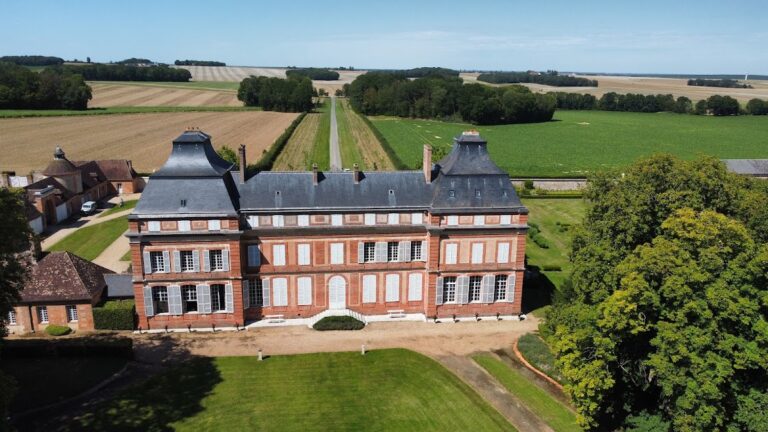
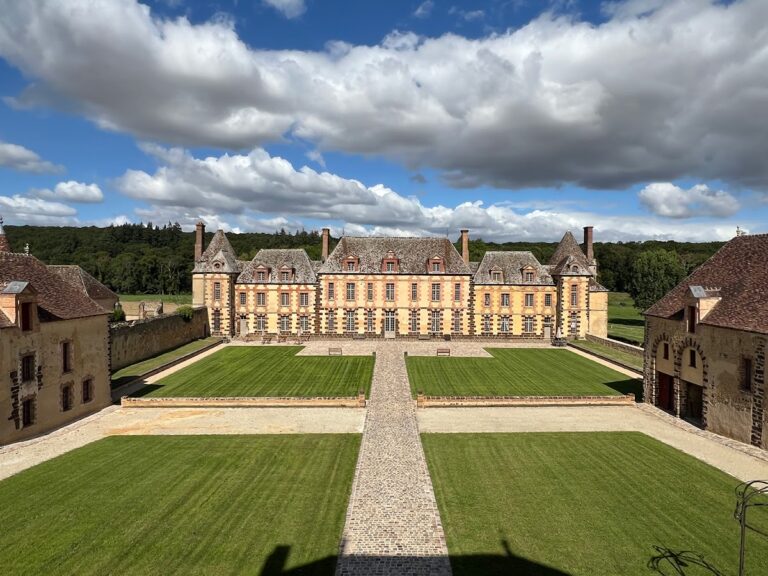
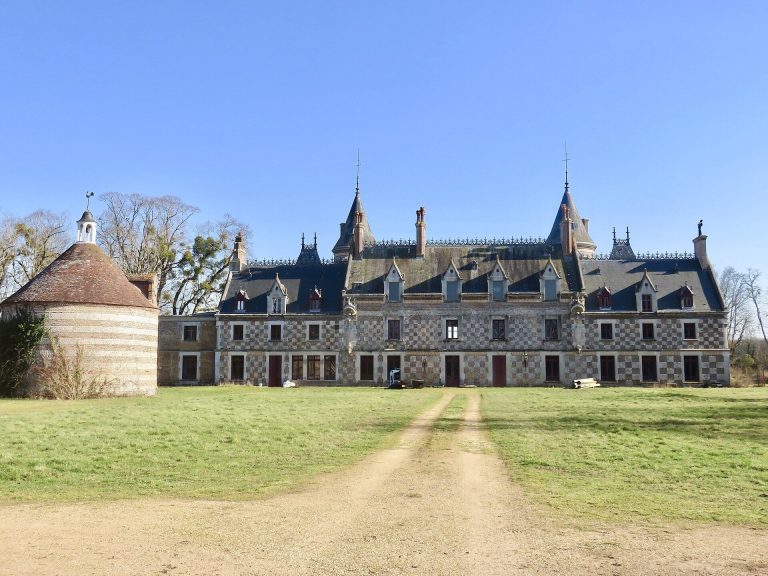
Louis de Rouvroy de Saint-Simon had the stable building constructed around 1718 to 1719. That building is now called the small château. It forms part of the surviving estate, and its facades and roofs are protected as historic monuments. Louis-Philippe later restored and enlarged the building during his reconstitution of the domain.
Park buildings and entrance
The estate also retains the park, its pavilions, and the entrance grille. The park and pavilions received historic-monument protection in 1991. The Saint-Dominique pavilion, at the entrance to the park, houses the 150-square-metre Saint-Simon Museum opened in 2020.
Paintings associated with the château
Jean-Joseph de Laborde is said to have acquired four allegorical paintings by Louis Jean François Lagrenée for the château. They represented architecture, music, painting, and sculpture. The paintings representing painting and sculpture were oval. After Laborde’s death on 14 January 1785, those two works were sold and reappeared at a succession sale in Paris on 16 February 1999.