Dunaverty Castle: A Clan Donald Stronghold in Scotland
Site at a Glance
- Popularity
- Medium
- Country
- United Kingdom
- Primary era
- Medieval
- Eras represented
- Medieval
- Civilizations
- Kingdom of Scotland
- Site type
- Military
- Remains
- Castle
On this page6 sections
History
Dunaverty Castle was a fort of Clan Donald, also known as Clan MacDonald, a Scottish Gaelic kin-based group, at Southend on the Kintyre peninsula in Scotland, United Kingdom. Its history records repeated struggles over control of the castle, from medieval conflicts involving Scotland and Norway to the 1647 siege and massacre.
Thirteenth-century contests
In 1248, Henry III of England authorized Walter Byset to purchase supplies in Ireland for Dunaverty, which Byset had seized and was strengthening. The move may have been retaliation for Alexander II of Scotland offering hospitality to English pirates. That same year, Allan, son of the Earl of Atholl, captured the castle and took Byset prisoner.
In 1263, Alexander III of Scotland placed a garrison at Dunaverty during the Norwegian campaign led by Hákon Hákonarson, king of Norway. The castle later surrendered to Hákon, who granted it to his supporter Dubhghall mac Ruaidhrí. After Norwegian rule in the Hebrides ended following the campaign, Alexander appears to have recovered the stronghold.
Robert the Bruce and the Lordship of the Isles
Robert I of Scotland, widely known as Robert the Bruce, may have taken refuge at Dunaverty in late 1306. The medieval poem The Bruce says that Aonghus Óg Mac Domhnaill sheltered him there for three days before conveying him to Rathlin Island. Other contemporary evidence indicates that Robert already controlled the castle and had acquired it from Maol Coluim in March. English forces arrived in September, but Robert was not there.
In 1493, the fourth and last Lord of the Isles, a Gaelic lordship in the western Scottish islands, forfeited his title to James IV of Scotland. By the following year, James had garrisoned and provisioned Dunaverty. Tradition says that MacDonalds led by Sir John MacDonald, whom the king had recently knighted, retook the castle before James left for Stirling. The governor was killed, and his body was hung over the wall in view of the king and his departing party. MacIain of Ardnamurchan later captured Sir John, who was tried and hanged at Burgh Muir near Edinburgh.
Royal repairs and the 1588 raid
The Crown repaired Dunaverty between 1539 and 1542. In January 1544, a commission issued in the name of Mary, Queen of Scots, ordered the castle’s captain, constable and keeper to hand it over to the Earl of Argyll, along with its artillery and ammunition. In April, Argyll received a 12-year lease covering North and South Kintyre, including the castle.
In October 1588, an English raid against Clan MacDonald activity in Ireland reached Kintyre and Campbeltown Loch. The Earl of Sussex sailed from Dublin aboard the Mary Willoughby with a small fleet. His forces burned Saddell, Dunaverty and Machrimore, then set fire to farms on Arran, Bute and Cumbrae.
Lordship disputes and the 1647 siege
In 1626, the Lordship of Kintyre, a territorial lordship on the peninsula, was re-established for the Earl of Argyll, with Dunaverty designated its principal residence. Argyll granted the lordship to James, his eldest son from his second marriage. In 1635, James issued a charter at Dunaverty granting it to Viscount Dunluce, eldest son of Randal MacDonnell, first Earl of Antrim. The Scottish Privy Council, which advised the monarch and conducted government business, set aside the transfer, apparently after a complaint from Argyll’s eldest son by his first marriage, the Marquis of Lorn. On 12 December 1636, Lorn received a formal royal charter for Kintyre, again naming Dunaverty as the lordship’s principal residence.
During the British Civil Wars, conflicts involving England, Scotland and Ireland, Scottish supporters of Oliver Cromwell’s Parliamentarian side besieged Dunaverty in 1647 under General David Leslie. The MacDonalds surrendered, and 300 people were massacred in an event known as the Battle of Dunaverty or the Dunaverty Massacre. Leslie later became a Royalist. The site is protected in Scotland as a scheduled monument, a legally protected archaeological or historic site.
Remains
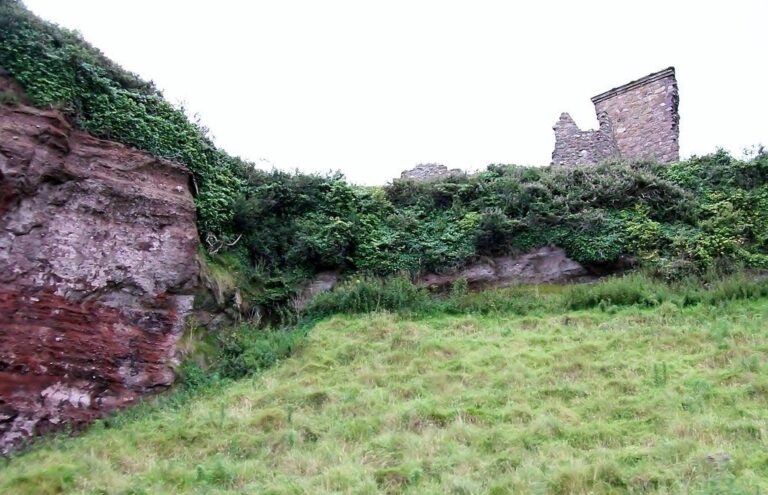
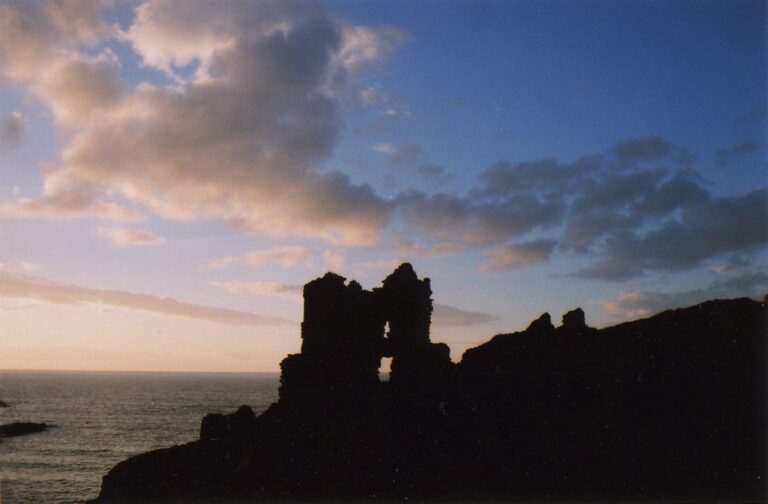
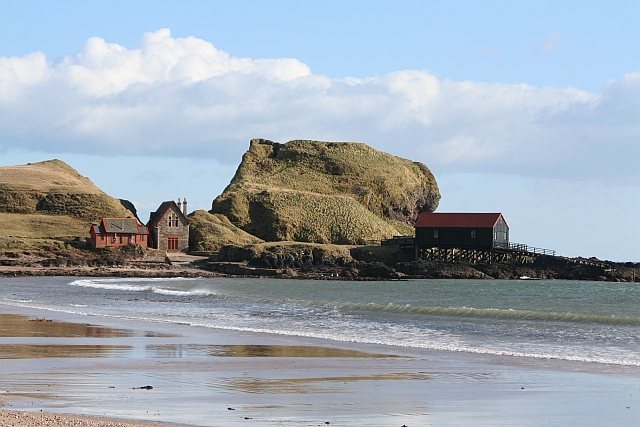
Dunaverty Castle occupied a rocky headland at the southeastern end of Kintyre, with the sea surrounding it on three sides. Approach from the north was possible across a narrow strip of land connecting the headland to the mainland. A drawbridge provided access to the castle. Little of the structure survives, and the ruin is also known as Blood Rock.