Loket Castle: A Romanesque and Gothic Frontier Fortress in Czechia
Site at a Glance
- Rating
- 4.7
- Popularity
- Very High
- Country
- Czechia
- Primary era
- Medieval
- External website
- Open
- Eras represented
- Medieval, Early Modern, Modern
- Civilizations
- Holy Roman Empire, Kingdom of Bohemia
- Site type
- Military
- Remains
- Castle
On this page16 sections
History
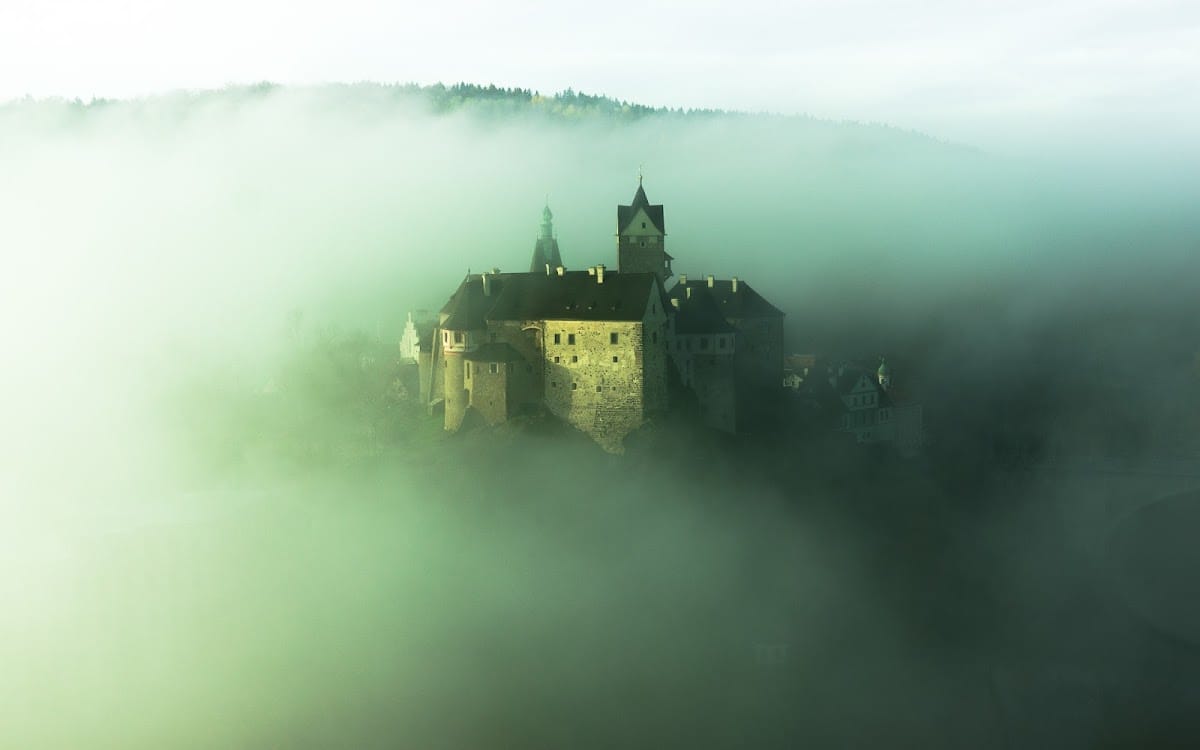
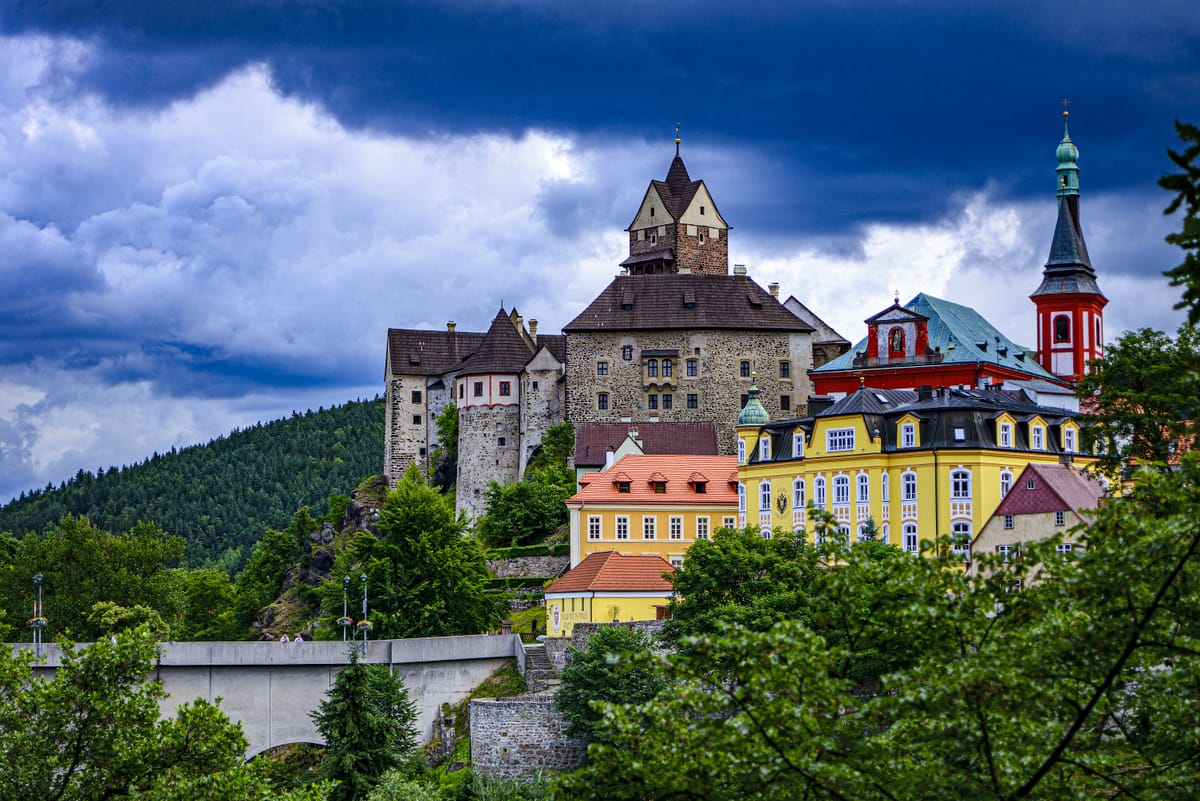
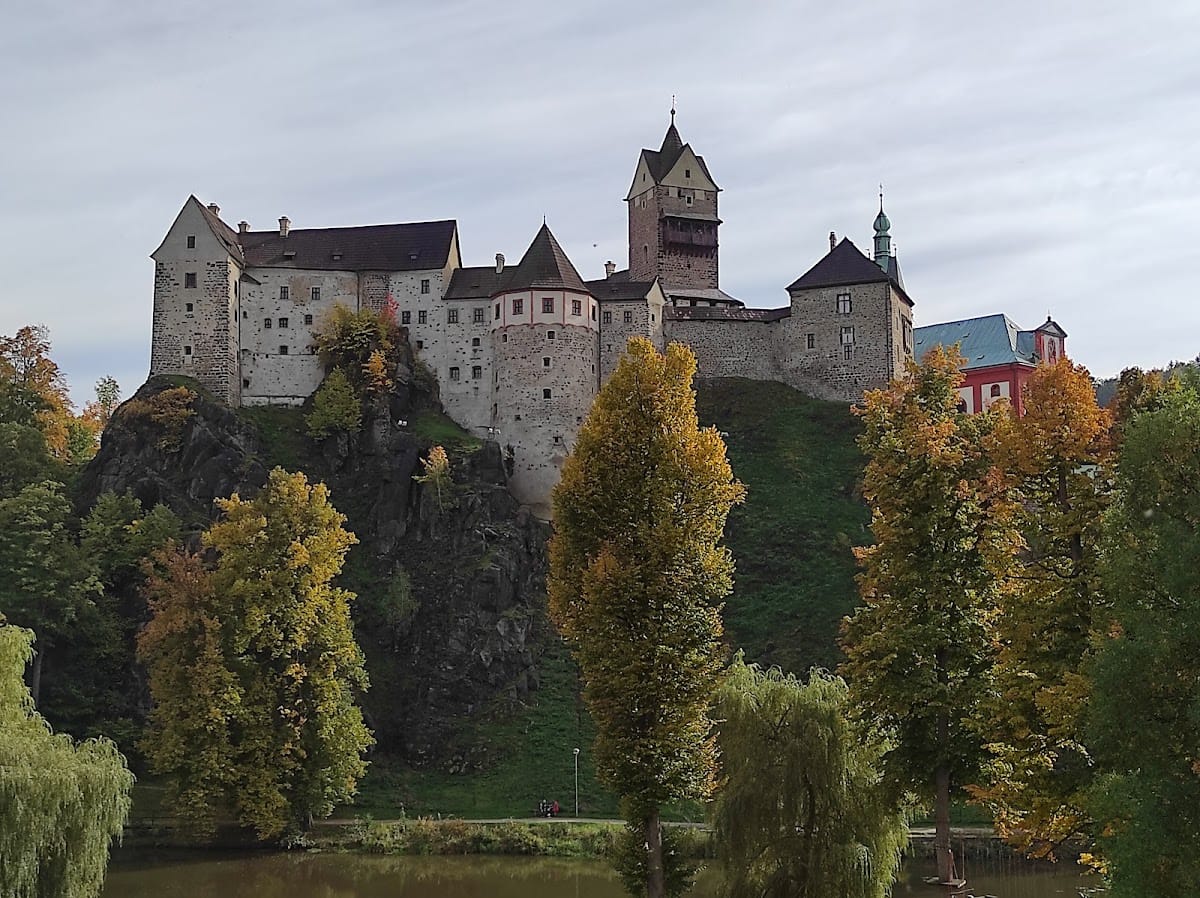
Loket Castle is a Romanesque and Gothic fortress in Loket, Czechia, built by the medieval rulers of Bohemia on a rocky spur above the Ohře River. Its origins reach to the turn of the eleventh and twelfth centuries, and its position protected a merchant route from Prague through Cheb toward Plauen and Erfurt. The castle later became a frontier fortress and the administrative centre of the surrounding region.
Origins and royal rule
The beginnings of Loket Castle remain uncertain. An older German tradition attributes its foundation in the 1170s or 1180s to Cheb ministeriales, officials and military retainers, during the period when the Staufers controlled the Sedlec castellany. Archaeological research published in 2025 places the castle’s beginnings approximately at the turn of the eleventh and twelfth centuries and indicates that it was already a fully stone-built fortress set with mortar. Its early circular chapel, or rotunda, resembles buildings associated with the Bohemian environment, making Přemysl Otakar I a more probable founder, although the question has not been settled.
The first written reference to the castle dates from 1227. A ruler met there with a Dominican monk from Regensburg, who unsuccessfully urged the king to join the Sixth Crusade, a campaign intended to recover Christian control of Jerusalem and the surrounding Holy Land. The two men later prayed in the castle chapel. A royal burgrave, the governor responsible for administration, defence, and jurisdiction, was recorded at Loket in 1234. By that time, a settlement had grown around the castle walls and had developed into a royal town.
King Wenceslaus I visited Loket in 1239 and 1240. The castle was first known to have been rebuilt during his reign, and it was gradually enlarged from the 1250s. Under King Ottokar II, a new defensive wall with semicircular towers strengthened the fortress. Ottokar II also established a fief system around Loket. Small nobles held estates in return for military service at the castle, remained under the authority of the burgrave, and exercised defined hunting and inheritance rights. The system survived later disputes over taxes and jurisdiction, while its fief court disappeared after 1620 and was never restored.
During the reign of Wenceslaus II, burgraves including Frederick Colersky and Hynek Krusina of Lichtenburg administered the castle. Under Wenceslaus IV, Zdimir of Sedlec held the office from 1383 to 1397, followed by Vintir, Albrecht of Kolowrat, and Jan Malerik. Malerik was commissioned to repair the castle between 1413 and 1420. The major medieval transformation took place during the fourteenth century, particularly under Charles IV and Wenceslaus IV, when the earlier Romanesque fortress became a Gothic stronghold with expanded palaces, halls, domestic buildings, and fortifications.
The Luxembourg kings and the Hussite Wars
Loket became closely connected with the Luxembourg royal family. During the reign of John of Luxembourg, Queen Elisabeth of Bohemia stayed at the castle with her children in 1317 and again in 1319. During a conflict with Elisabeth, John occupied Loket with his own troops, sent her to Mělník, and kept their children at the castle. Their son Wenceslaus, later the Bohemian king and Holy Roman Emperor Charles IV, was imprisoned there for two months in a dark chamber.
The castle had been temporarily pledged during the early fourteenth century, but Charles IV redeemed it in 1333. He returned to Loket in 1370, 1372, 1374, and 1376, while Wenceslaus IV stayed there in 1389 and 1398. Charles IV included Loket among the places that should remain permanently in the possession of the Bohemian Crown in the Maiestas Carolina, a proposed fourteenth-century legal code that was never implemented.
The Hussite Wars, the fifteenth-century religious and political conflicts in Bohemia associated with the followers of Jan Hus, brought repeated military pressure. Hussite forces unsuccessfully attempted to capture Loket in 1421, 1427, and 1429. These campaigns were associated with leaders including Krusina of Svamberk and Jakoubek of Vresovice, but the castle remained in royal hands until its transfer to the Schlick family.
The Schlick lordship
On 20 September 1434, Emperor Sigismund pledged Loket, its town, and several associated lordships to his chancellor Kaspar Schlick. The House of Schlick, a powerful Bohemian noble family, held the castle until 1547. The Schlicks used it as a representative family residence and as an administrative centre, while disputes with fief-holders and townspeople repeatedly developed into political and armed conflict.
In 1471, Matyas and Wenceslaus Schlick attempted to sell the castle to Albrecht III of Saxony, but the transaction was prevented. A more destructive episode began on 22 July 1473, when a fire in a house below the castle spread to the fortress. Almost the entire complex burned, while the separately standing Margrave’s House survived. Mikulas Schlick then occupied and defended Loket against supporters of the Plauen family. Schlick forces later expelled their opponents from the town and compelled the remaining inhabitants to submit. The violence also destroyed a church and led to ecclesiastical censure against the Schlicks.
The family divided the castle among three brothers in 1489. Mikulas received the Margrave’s House, Jerome received two houses with a kitchen and cellars and held the burgrave’s office, and Kaspar II received the building known as the Red Chamber. Jerome Schlick was later condemned for the unlawful execution of the fief leader Mikulas Pernsteinar and for attacking the Hýzrl family’s fortress at Chodov. He was killed by robbers while travelling to Hungary in 1491.
Conflict intensified in the early sixteenth century among the Schlicks, the burghers, and the fief-holders. An armed confrontation in January 1504 led to a siege of the castle by fief-holders and townspeople, while Sebastian Schlick’s forces fired into the town. Saxon reinforcements restored Schlick control, and a larger royal siege lasted from 22 July to 28 September 1505. The resulting settlement required the Schlicks to return seized property and respect the rights of the burghers and fief-holders. The alliance formed against them was dissolved.
Sebastian Schlick supported Martin Luther, the German theologian whose reform movement gave rise to Lutheranism, and the new religious movement spread through the region around Loket. After Sebastian’s death, Albrecht Schlick inherited his property. His uncle Jerome Schlick later received Loket, Karlovy Vary, and Kynsperk nad Ohri in an exchange made without the ruler’s initial consent. Jerome joined the rebellious estates in 1546. After the Battle of Mühlberg, a 1547 victory that strengthened the authority of Emperor Charles V over the Protestant princes who opposed him, royal troops captured Loket on 28 April 1547. Jerome’s property, including Loket and its fiefs, was confiscated.
Municipal ownership, prison, and museum
After the Schlick period, royal officials administered Loket, and the castle was later pledged to Henry IV of Plauen. On 29 June 1562, the town received the Loket lordship and associated estates as a thirty-year pledge. The pledge expired in 1592, but municipal administration continued. In 1602, the town paid 1,450 kop of groschen and acquired the castle hereditarily.
Jiří Popel of Lobkovic was imprisoned at Loket in 1606 and 1607. Because the existing accommodation was unsuitable, a new apartment was built for him. Two servants attended him, and six marksmen guarded the prisoner. He died at Loket on 28 May 1607 and was buried in the town church.
During the Thirty Years’ War, the Protestant town supported the opposition to the emperor. After the Battle of White Mountain, Mansfeld’s forces entered Loket. Bavarian troops besieged the town in 1621, and a Bavarian garrison later occupied it. In 1631, the garrison admitted Saxon forces, although imperial troops subsequently forced the Saxons to withdraw. Swedish forces attacked Loket unsuccessfully between 1646 and 1648, though they may have captured it in 1648. The war and the imperial reprisals that followed caused serious economic losses.
After 1620, the town used parts of the castle for economic purposes, including a granary in the old Margrave’s House. A fire on 26 January 1725 destroyed that building and ended the castle’s residential use. A proposal to convert Loket into a prison was made in 1788. The conversion was completed in 1822, and the prison operated until 1948. During the work, difficult-to-repair parts of the complex were demolished, the Stone Chamber palace near the tower was removed, and other buildings were lowered by one storey.
The Ancient Monuments Departments in Plzen administered the castle from 1968. The town of Loket regained it in 1992 and established the Loket Castle Foundation, which has administered the site since 1993. Major reconstruction campaigns took place during the 1980s and 1990s. Loket Castle opened as a museum in summer 1993. It is owned by the town and protected as a cultural monument and national monument.
Remains
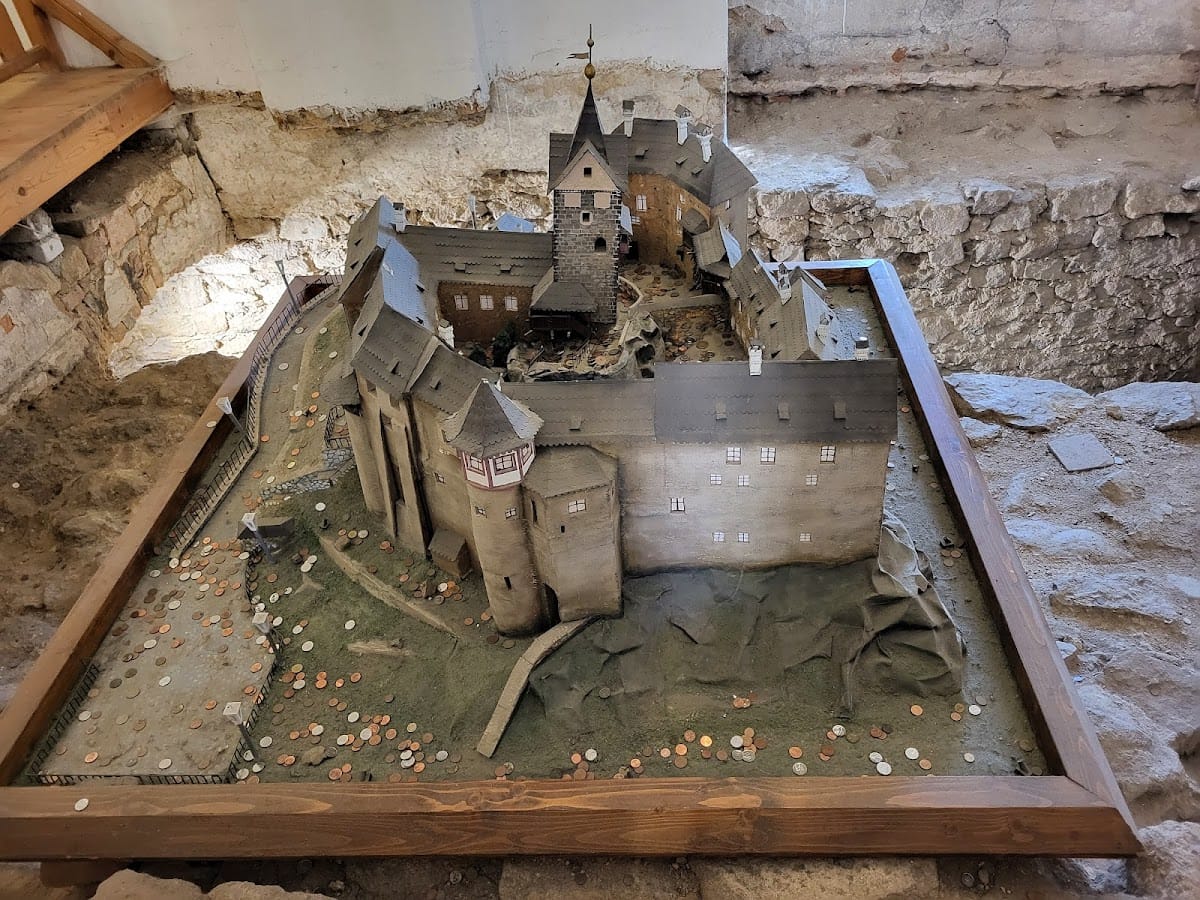
Loket Castle occupies a rocky promontory at approximately 427 metres above sea level, with the Ohře River surrounding it on three sides. The stone complex combines Romanesque and Gothic construction and is divided into nine sections. Its thick walls, towers, palaces, halls, domestic buildings, and later prison spaces preserve the changing functions of the fortress. The Margrave’s House and the main castle tower are among the oldest surviving parts, while the late Gothic rebuilding under Wenceslaus IV shaped much of the arrangement seen today.
Romanesque foundations and the early fortress
Early ramparts and palace foundations
The earliest Romanesque castle contained two towers, a church, and a building on the site of the present Margrave’s House. The church stood below the present castle, where the Church of Saint Wenceslaus now stands, and another tower occupied the northeastern side of the complex. Surviving early elements include the rotunda, foundations of the castle tower, and foundations of the northern palace.
Archaeological work in spring 1993 exposed the original Romanesque rampart, which dates from before 1230. Its walls are approximately 2.2 to 2.5 metres thick and stand directly on the rock. Quarry stone forms the entire structure. The same excavation revealed palace walls from the rebuilding under Wenceslaus and the remains of a Renaissance kitchen dated 1528 to 1536. A rectangular foundation for a heating structure and a worn stone threshold were also found.
The castle rotunda
The rotunda was concealed within the body of a spiral staircase in the northern part of the castle until its discovery in 1966. Its circular nave has an internal diameter of approximately 3.5 to 3.6 metres, an eastern apse with a single window, and surrounding walls about 75 to 80 centimetres thick. The building was incorporated into the main fortification wall. Its granite ashlar blocks, approximately 30 centimetres high and 42 to 64 centimetres long, differ from the rubble masonry of the wall. The rotunda probably dates from the late twelfth century, although its connection with Staufer or Přemyslid building traditions remains disputed.
Gothic and Schlick-period buildings
Palaces and administrative spaces
The principal medieval rebuilding created the castle’s arrangement of palaces, halls, domestic buildings, and defensive works. Between 1434 and 1547, the Schlicks adapted the older Gothic fortress into a more comfortable family residence and administrative centre. The eastern wing received large halls, while other work added economic buildings, a palace with a Gothic oriel, a chapel, and the Burgrave’s House. An oriel is a projecting upper-storey window or enclosed balcony. The palace oriel contains valuable Gothic frescoes.
The southern palace was converted into a large hall, and the eastern palace became the Schlick Archives. The complex also retains a sixteenth-century two-winged palace, a fifteenth-century Burgrave’s House, and a captain’s house. A well on the courtyard side supplied water, which was carried through a passage across the castle. Fortifications with strongholds, prison cells, a torture chamber, wedding and ceremonial halls, and rooms devoted to historical arms and archaeology occupy other parts of the surviving complex.
The Margrave’s House
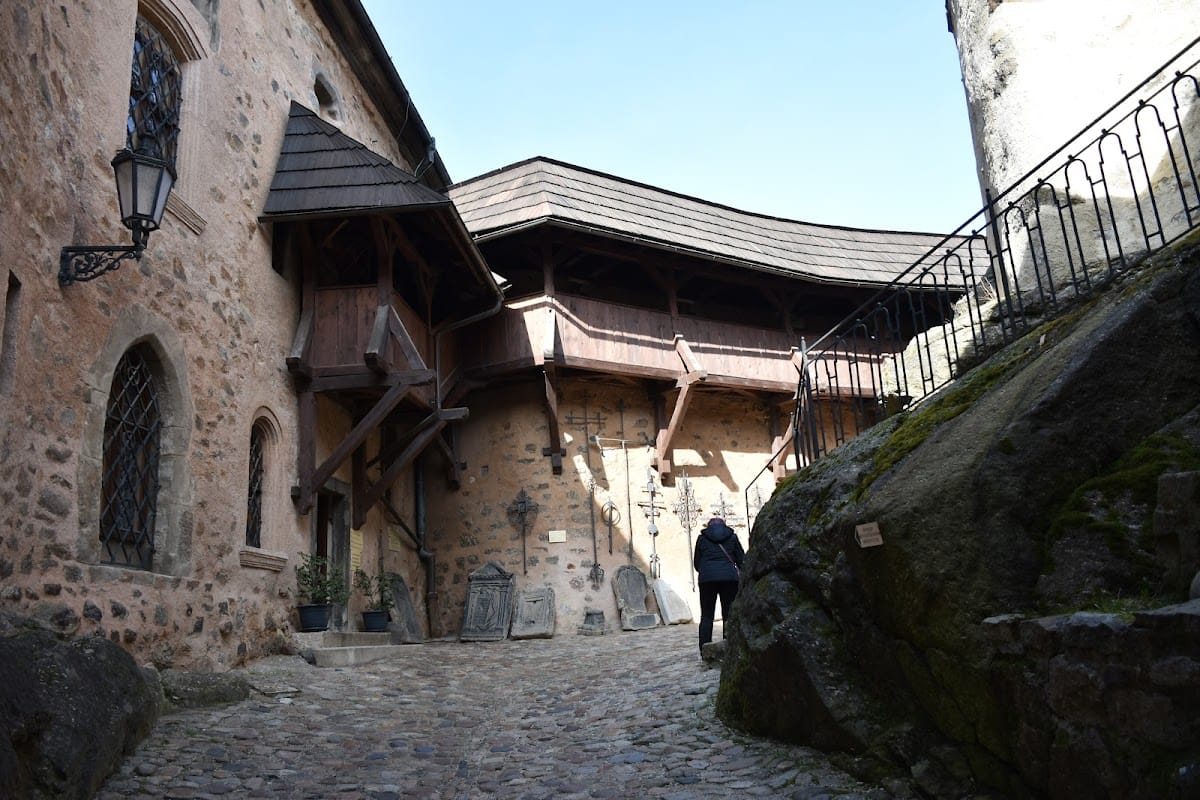
The Margrave’s House is a Romanesque building that acquired its present appearance when it was adapted as the town museum in 1907. Its first floor contains an exhibition of locally produced porcelain, while other exhibitions occupy additional castle rooms. Several tombstones stand in a row beside the entrance. One came from the Renaissance tomb of Rabbi Benjamin in the former Jewish cemetery in the Robic suburb and bears a laudatory poem dating from approximately 1700. The remaining stones came from the former cemetery at Saint John’s Church.
Church, archaeological displays, and prison remains
Church of Saint Wenceslaus
The Baroque Church of Saint Wenceslaus stands on the site of the original Gothic church, which burned in 1725. The replacement was completed in 1734 to a design by Wolfgang Braubock. Its altar paintings are attributed to Petr Brandl, and its two valuable side altars were probably made by the Loket sculptor Jan Wild. The old churchyard behind the presbytery was restored, and a monument to Václav Popel of Lobkovic was erected there. He had been imprisoned at Loket and was buried in the church crypt.
Archaeological and natural-history exhibits
The archaeological hall presents material recovered during the spring 1993 research, including fragments from several reconstruction periods. Among the exhibits is a surviving piece of the Elbogen meteorite, traditionally known as the “Bewitched Burgrave.” One tradition says that it fell in the castle courtyard in August 1422, while another places its discovery in the castle well. The meteorite reportedly weighed about 107 kilograms and was as large as a horse’s head before being cut into pieces in 1812. The largest fragment weighs approximately 80 kilograms and is held by the Natural History Museum in Vienna. Other fragments are preserved in the National Museum in Prague and the Sokolov Museum repository.
Prison and torture exhibition
The former prison preserves spaces associated with the castle’s nineteenth- and twentieth-century penal use. Its exhibition on judicial torture contains medieval torture instruments, life-size mannequins, and sound effects. A bronze statue on a rocky outcrop in the courtyard represents Gottstein, a legendary dwarf described as the ruler of the rocks, underworld, and stones of Loket.