Helfenburk: A Gothic Archiepiscopal Castle Ruin in Czechia


Site at a Glance
- Rating
- 4.8
- Popularity
- Medium
- Country
- Czechia
- Primary era
- Medieval
- Eras represented
- Medieval, Modern
- Civilizations
- Holy Roman Empire, Kingdom of Bohemia
- Site type
- Military
- Remains
- Castle
On this page12 sections
History
Helfenburk is a Gothic castle ruin in Czechia, about 3 kilometres east of Úštěk, whose origins lie in the medieval period. The date of its construction and the identity of its founders remain uncertain. It has been attributed either to the Lords of Klinštejn, a branch of the Ronovci, during the first half of the 14th century, or to the Berka lords of Dubá, possibly as early as the 13th century. A branch of the Berka family later adopted the castle’s name. The site is also known as Hrádek.
Archiepiscopal residence
Helfenburk first appears in connection with its sale to Jan Očko of Vlašim around 1374 or 1375. Jan Očko was the archbishop of Prague, the principal Roman Catholic archiepiscopal office in Bohemia. He transformed the castle into a rural residence and administrative center outside Roudnice nad Labem. Helfenburk also became the center of an estate that included the nearby castle of Hřídelík and associated towns and villages.
Jan Očko substantially enlarged the complex. His successor, Jan of Jenštejn, the third archbishop of Prague, continued to use Helfenburk, probably until about 1400, including after he had lost his office. During his tenure, jewels, relics, and books from St. Vitus Cathedral in Prague were temporarily moved to the castle. A record from 1395 recounts how Jan of Jenštejn nearly fell from a bridge leading from the new tower. The account was written by Peter Clarificator, prior of Roudnice and the archbishop’s personal chronicler.
Conflict and changing ownership
In 1422 Helfenburk was acquired by the burgrave Aleš of Malíkovice. Konrád of Vechta, another medieval archbishop of Prague, later stayed at the castle while hiding from royal hostility. He died there in 1431.
The Hussite Wars, the 15th-century religious and political conflicts in Bohemia associated with the reform movement founded by Jan Hus, brought repeated changes of ownership. Helfenburk passed among Půta III of Častolovice, Jaroslav and Jindřich Berka of Dubá, Jan Smiřický, Jindřich of Rožmberk, and Zdeněk Konopišťský of Šternberk. Zdeněk was a prominent opponent of King George of Poděbrady. After Helfenburk had been pledged to Jan Smiřický, Jindřich of Rožmberk transferred it to Zdeněk for 4,000 kop of Prague groschen.
Royal forces later besieged and captured Helfenburk together with nearby Roudnice. King George then granted the castle to Petr Kaplíř of Sulevice, who resisted raids by Zdeněk Konopišťský. Petr was captured and imprisoned in České Budějovice. He was released only after freeing his servants and surrendering valuables stored at Helfenburk.
Abandonment and decline
William of Ilburk was the last recorded lord of Helfenburk. He also held nearby Ronov, equipped Helfenburk anew, and used it in preference to the more difficult-to-reach Ronov. After William died in 1538, his possessions passed to his daughter Anna and her husband, Heinrich I of Kurzbach. The Helfenburk and Ronov domains remained united until 1591, when Sezima of Úštěk acquired the castle.
By the end of the 16th century, Helfenburk had been abandoned or was occupied only by servants, and it gradually deteriorated. After Sezima’s property was confiscated following the Battle of White Mountain in 1620, the defeat of the Bohemian revolt by forces loyal to the Habsburg monarchy, the territory passed to the Jesuits of Liběšice and became part of the Úštěk estate.
Imperial troops under Marshal Karl Bonaventura von Buquoy plundered and burned the abandoned castle in the early 1620s. The ruin then continued to decay, while its historical name was temporarily forgotten. In 1679 Bohuslav Balbín described it as the deserted castle Hrádek, and oral tradition later called it Affenburg.
Conservation and interpretation
Industrialist Count Josef von Schroll purchased the ruin in 1887 and began securing and adapting it. From 1887 to 1890, he rebuilt the ruined third storey of the approximately 30-metre-high tower and made the tower his summer residence.
During the 1960s, organizations of the Czech Union for Nature Conservation resumed repairs and maintenance under district conservator František Fišer. Volunteers cleared the overgrown castle and carried out archaeological research in the well, recovering numerous finds, including a windlass shaft. Organized volunteer care and guiding began in 1978. Those involved later formed the Hrádek civic association in 1995 and the Hrádek Helfenburk association in 2017. The town of Úštěk now owns the castle.
Helfenburk has been protected as a cultural monument since 1964. It is regarded as one of the best-preserved archiepiscopal castles in Czechia from the period of King Wenceslas IV, who ruled Bohemia from 1378 to 1419, and it has served as an inspiration for Czech painters.
Remains
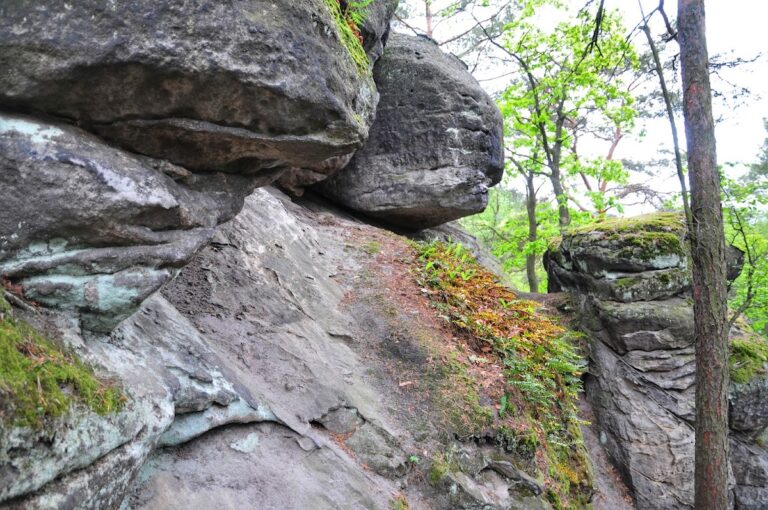
Helfenburk occupies the summit of a sandstone spur projecting into the wooded Hrádecký důl valley. The rock reaches about 310 metres above sea level and rises approximately 70 metres above the valley floor. Parts of the castle were cut directly into the sandstone. The complex developed from an early predominantly wooden castle on the rock plateau into a fortified residence with a stone palace, chapel, service buildings, defensive walls, and a residential tower.
Fortifications and residential buildings
Defensive circuit and entrances
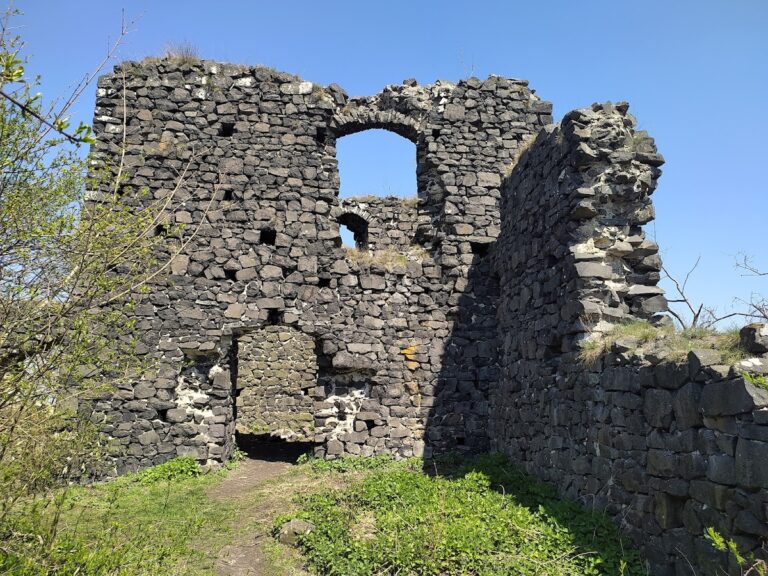
Jan of Jenštejn enlarged the palace and created a new defensive circuit. The enclosing wall, including its battlements, survives in substantial form. The curtain wall, the defensive wall around a castle, and the keep, its principal fortified tower, remain major elements of the ruin. A guard latrine, a small sanitary installation built into or projecting from a defensive wall, is still visible on the battlements.
The entrances were defended by rocking drawbridges and a deep ditch, most of which has since been filled. The castle was divided into an inner core and an outer approach entered through a lower gate. The former main upper gate is reached from within by a wooden bridge. Two large, heavily weathered coats of arms are set into the gate. One, attributed to the Lords of Vlašim, shows two vulture heads; the other bears a transverse bar and represents the Prague archbishopric. The castle researcher Friedrich Bernau used these arms to identify the ruin as Helfenburk.
Residential tower
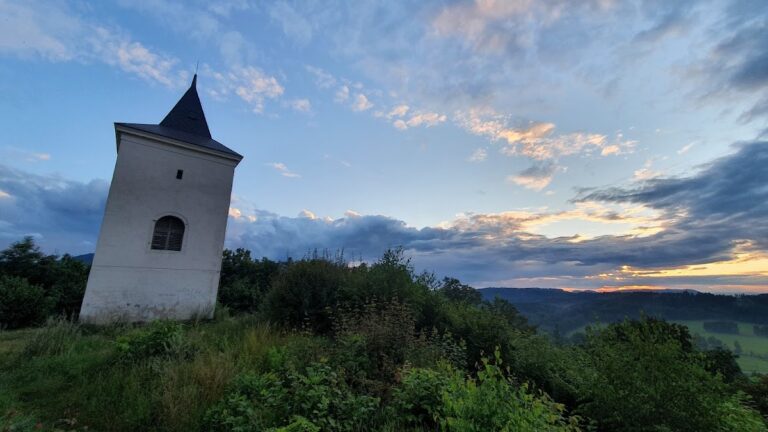
A residential tower stands in a dominant position at the front of the castle. Its preserved three-storey structure is about 30 metres high, with a narrow spiral staircase contained within the massive walls. The staircase connects three residential floors. On the middle floor, four windows are accompanied by built-in masonry seats.
Schroll’s late 19th-century work restored the tower’s ruined third storey. It also created a side entrance because the original medieval entrance led toward the inner part of the castle and a rock containing masonry remains associated with the palace. The summit is reached by 143 steps, and its platform has a protective railing. The tower walkway serves as a lookout over the surrounding forests.
Palace and courtyard
The stone palace formed part of the expansion undertaken under Jan Očko of Vlašim, together with a chapel and several smaller service buildings. Later enlargement under Jan of Jenštejn extended the residential and defensive complex. A small timber-framed house now stands in the courtyard below the tower and provides facilities for the volunteer association.
Water supply and archaeological features
Medieval well
A new well was excavated during the medieval expansion. It was originally about 65 metres deep and was equipped with a treadwheel for raising water. Its remaining depth is now reported as about 30 metres. Archaeological work in the well recovered the original windlass shaft, which is displayed beside a reconstructed water windlass at the well.