Necropoli del Poggino: An Etruscan Burial Ground in Tuscany
Site at a Glance
- Popularity
- Very Low
- Country
- Italy
- Primary era
- Iron Age
- Eras represented
- Iron Age, Classical
- Civilizations
- Etruscan
- Site type
- Burial
- Remains
- Necropolis
On this page9 sections
History
The Necropoli del Poggino is an Etruscan burial ground on a hill near Fonterutoli, in Castellina in Chianti, Tuscany, Italy. The Etruscans, an ancient people of central Italy whose communities flourished before Roman rule, used the hill as a cemetery from the late seventh to the fifth century BC.
The tombs were looted by grave robbers in the past. Tomb 3 is the oldest and largest, built in the late seventh century BC. Part of its burial assemblage, recovered from the rear cell, helped establish its date. Its scale and surviving grave goods suggest that it was built for a powerful local family of princely rank. Tomb 4 is the latest in the cemetery, with finds dating it to the fifth century BC.
Remains
Hilltop layout
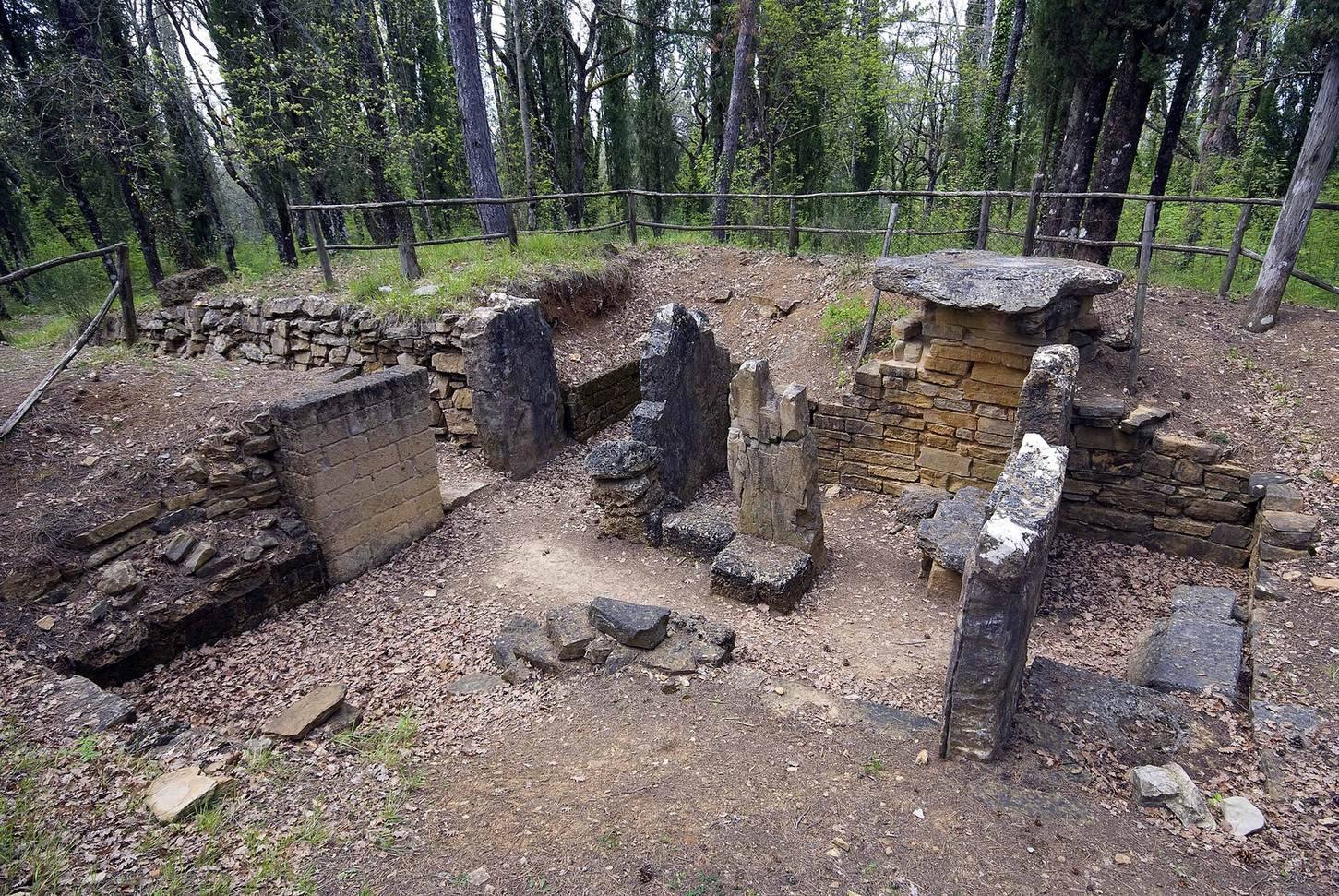
Four monumental tombs are visible on the wooded hill and are linked by a path. Five tombs have been identified altogether: four chamber tombs and one cist-type grave, a box-like burial structure.
Individual tombs
Tomb 1
A humped-profile entrance passage, or dromos, leads into Tomb 1, with its original thresholds still in place. The tomb has three rooms. Its central chamber retains its original dimensions, and the central support pillar has been put back in position. The two side rooms were badly damaged by the time the tomb was discovered, probably through repeated earlier violations.
The roof was probably made from slabs set in steps and supported by the central pillar. The tomb’s stone includes smooth local alberese limestone, which ranges from gray to pale yellow, travertine, a limestone formed by mineral-rich water and probably brought from elsewhere in the Siena area, and a porous, rough limestone. The entrance may have been closed by a stone slab; a hinged opening system has also been proposed, given that tombs could be reused. Two Greek ceramic amphorae, or large jars, date to the middle of the sixth century BC. They use the black-figure technique, in which dark figures appear against lighter clay, and one depicts a banquet.
Tomb 2
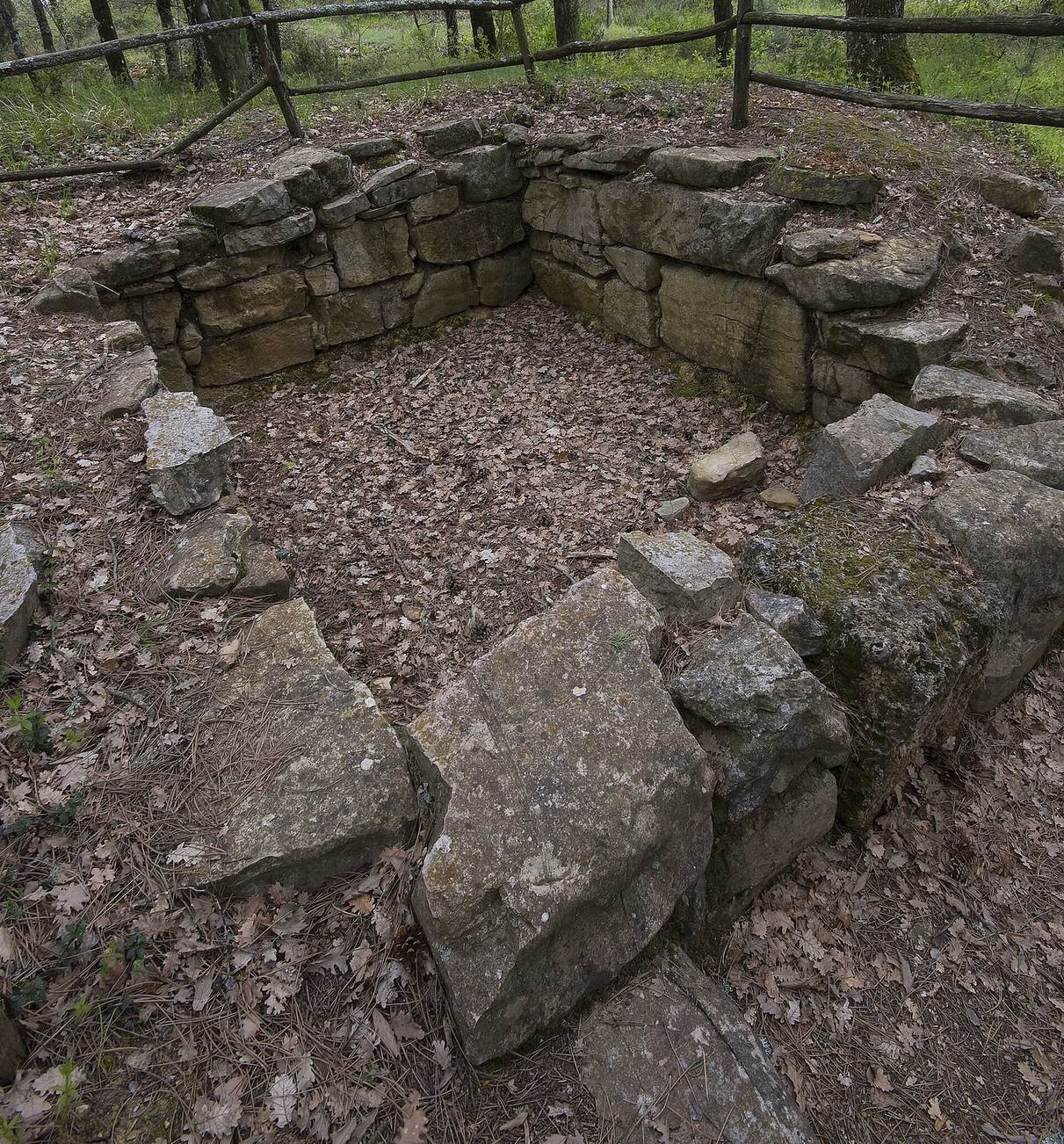
Tomb 2 consists of a single chamber and is smaller than Tomb 1. Two stones forming its doorway are still standing. A burial mound covered the tomb, and its interior probably had a stepped profile.
Tomb 3
A substantial part of Tomb 3’s burial mound survives. Its long entrance passage has a humped profile and leads to a vestibule, beyond which three cells are arranged in a cross. A smaller room lies at the rear, and the entrance threshold is still standing. The two chambers beside the entrance were badly damaged by the time the tomb was discovered.
Travertine was used extensively in the main chamber, especially in the central pillar that supported the dome. The chamber appears to have been altered during the Etruscan period: its left side, where a sarcophagus is thought to have stood, seems to have been added to enlarge the burial space. A doorway framed by two large travertine slabs leads to the rear cell, which contained another burial chamber. Finds from this cell include part of a cinerary urn, a vessel for cremated remains; an iron piece that decorated a wooden ceremonial coffin; engraved ivory plaques; and bronze-vessel fragments. Damaged walls were restored with yellow tuff, a rock formed from volcanic ash, making the restored masonry distinguishable from the original.
Tomb 4
Tomb 4 has a single chamber and a roof probably similar to that of Tomb 2. Travertine was used extensively, and a standing block of the stone helps indicate how the doorway was formed.
Finds
The Chianti Senese Archaeological Museum displays objects from the cemetery, including fragments of glass unguentaria, small containers for oils or perfumes; fragments of terracotta ollae, pottery vessels; pieces of an ivory coffin; and an additional olla fragment.