Charterhouse of Pontignano: A Carthusian Monastery in Tuscany
Site at a Glance
- Popularity
- Medium
- Country
- Italy
- Primary era
- Medieval
- Eras represented
- Medieval, Early Modern
- Civilizations
- Grand Duchy of Tuscany, Holy Roman Empire, Republic of Siena
- Site type
- Religious
- Remains
- Monastery
On this page16 sections
History
Foundation and medieval monastery
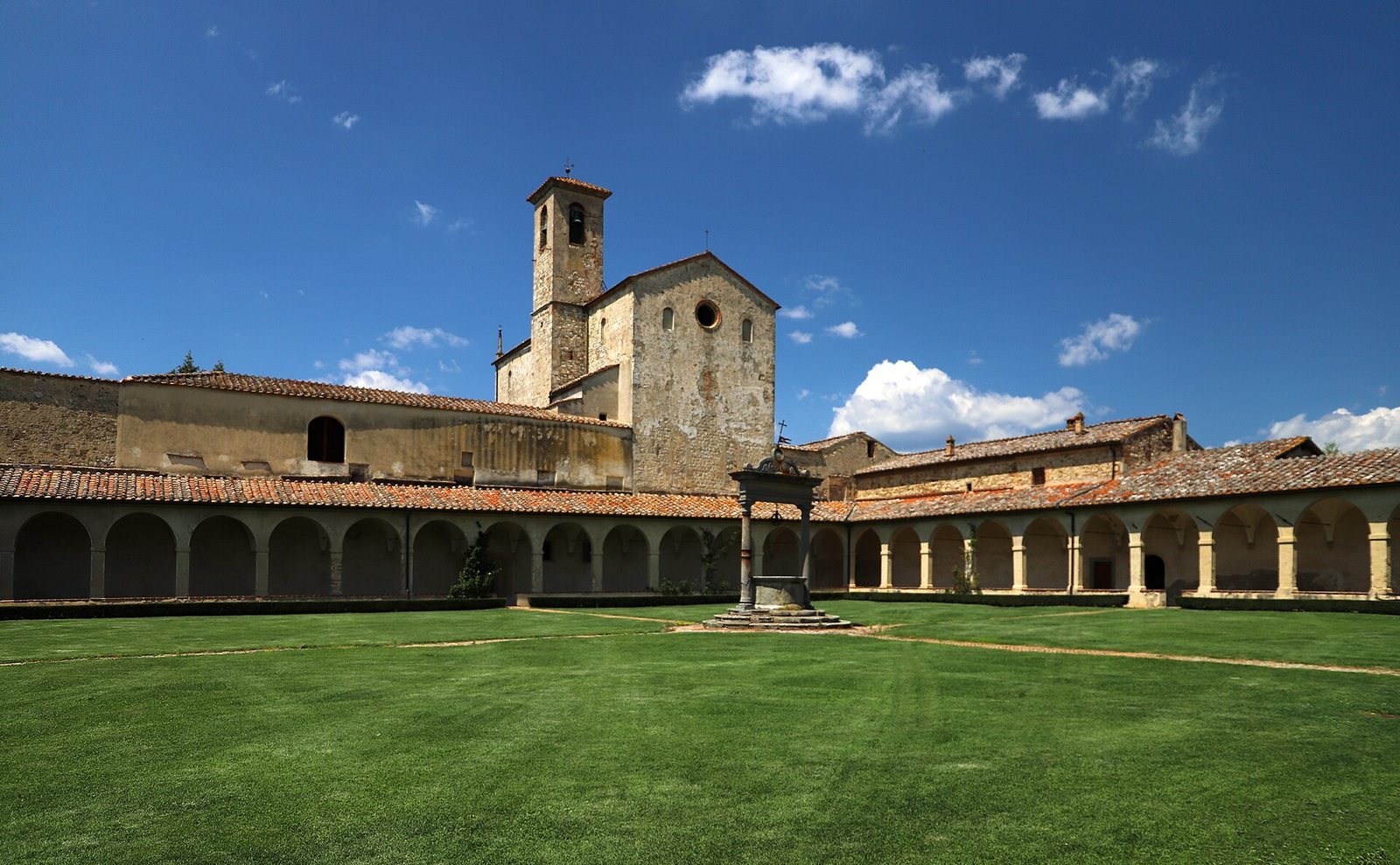
The Charterhouse of Pontignano is a Catholic Carthusian monastery near Ponte a Bozzone, in the municipality of Castelnuovo Berardenga, Tuscany, Italy. Carthusians combined communal worship with a largely solitary life in separate cells. Bindo di Falcone Petroni founded the monastery in 1343. He was provost of Bologna Cathedral and a senior official in the papal chancery, and endowed the new community with property at Cellole and Misciano.
After Bishop Donosdeo Malavolti of Siena approved the project, Petroni entrusted its construction to Amerigo, an Aquitanian Carthusian monk acting for the order’s chapter at Grenoble. The planned community comprised twelve monks and three lay brothers, who carried out practical work and could interact with people beyond the enclosure. In his will of 1353, Petroni left all his property to the monastery.
Stefano Maconi, who had joined the community at Pontignano, served as prior from 1383 to 1389. He also became an inspector for the Italian Carthusian province, a regional grouping of monasteries. Maconi later held senior positions in the order and worked for its reunification; in 1410, he resigned in support of that effort.
In 1383, Siena’s government fortified the monastery against the forces of John Hawkwood, an English mercenary commander active in Italy. A circuit of defensive walls followed in 1385.
War and rebuilding
The war between Siena and Florence in 1554–55 brought heavy damage and looting to Pontignano, leaving the monastery half-destroyed. An imperial army ravaged it again in 1559. Extensive rebuilding and Renaissance-style alterations took place from the later sixteenth century into the seventeenth. The church’s six chapels were combined into one, and the church was reconsecrated in 1607 by Camillo Borghesi, archbishop of Siena. In 1636, Pontignano was united with the Charterhouse of Belriguardo.
Suppression and later use
Monks displaced by the suppression of the Charterhouse of Maggiano found refuge at Pontignano in 1782. Grand Duke Leopold I of Tuscany suppressed Pontignano in the mid-1780s. Camaldolese hermits associated with Monte Celso, from a Benedictine tradition combining communal life with hermitage, tried to preserve the monastery and used it as a refuge. A decree issued by Napoleon, emperor of the French, suppressed it again in 1810 and dispersed the hermits.
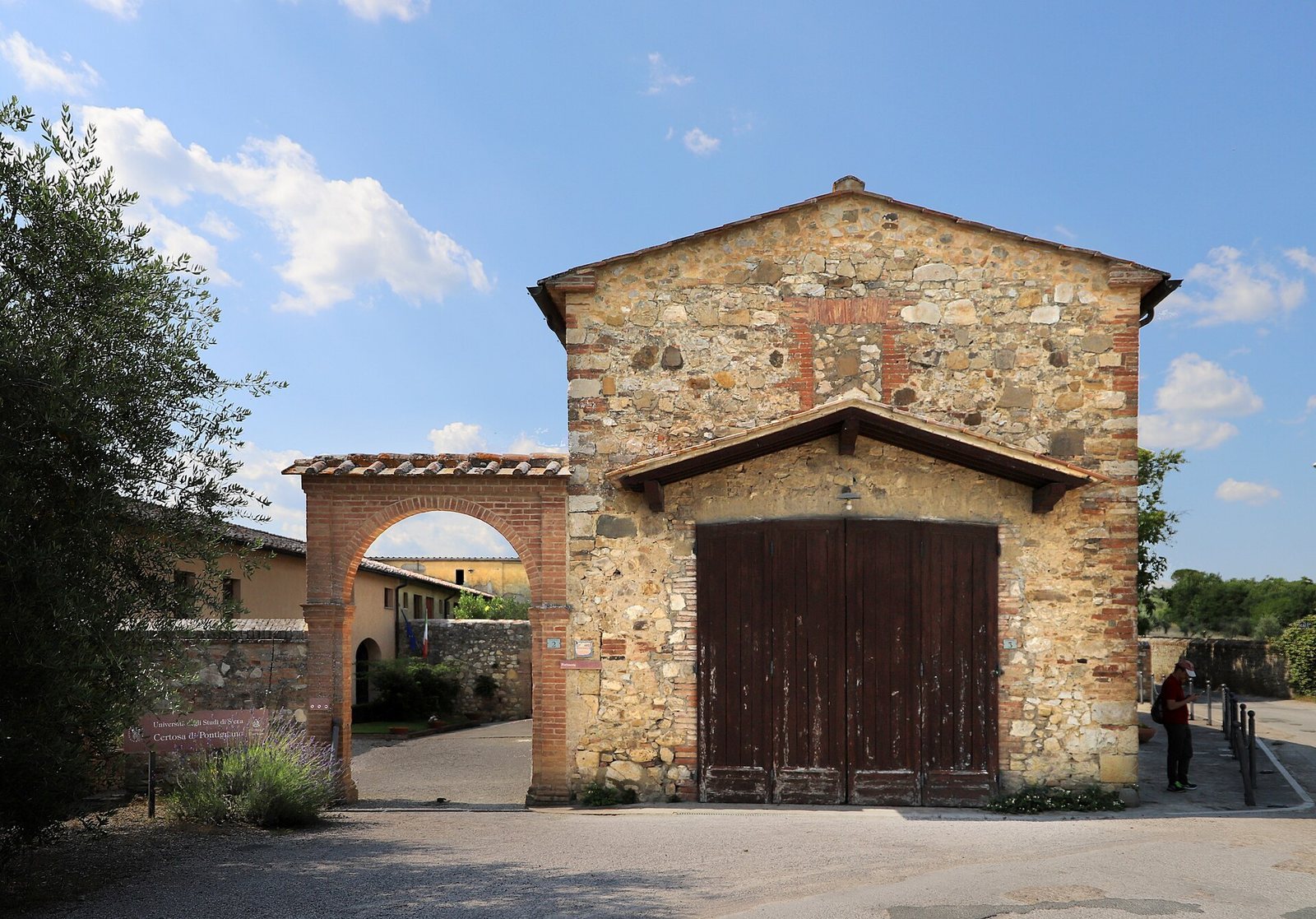
The church passed to the parish, and the transfer of the parish of San Martino at Cellole continued religious activity at Pontignano. The monastery’s lands and remaining property were sold. After changing hands several times, the complex was acquired by the University of Siena in 1959, with the involvement of its rector, Mario Bracci. It became a university college and conference venue.
Remains
Monastic plan and grounds
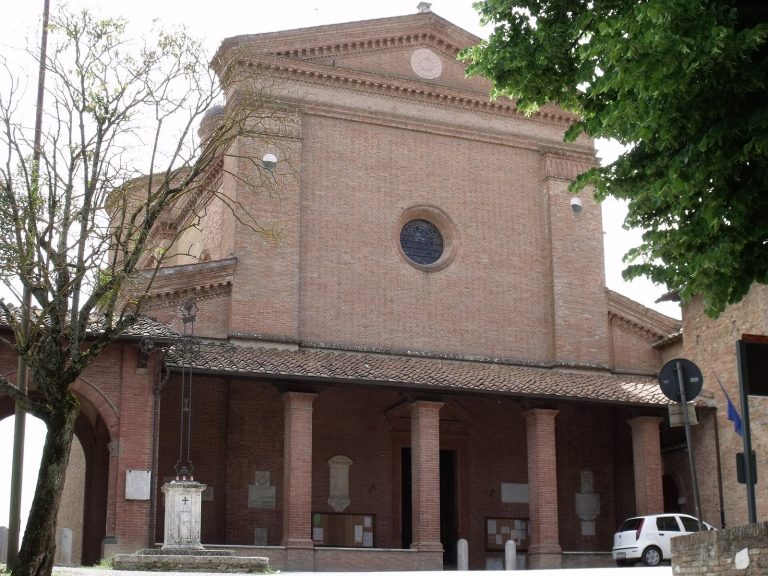
Medieval fabric survives in parts of the complex, especially around the church. Its plan includes four cloisters, arranged for different parts of monastic life and for varying degrees of contact with the outside world.
The four cloisters
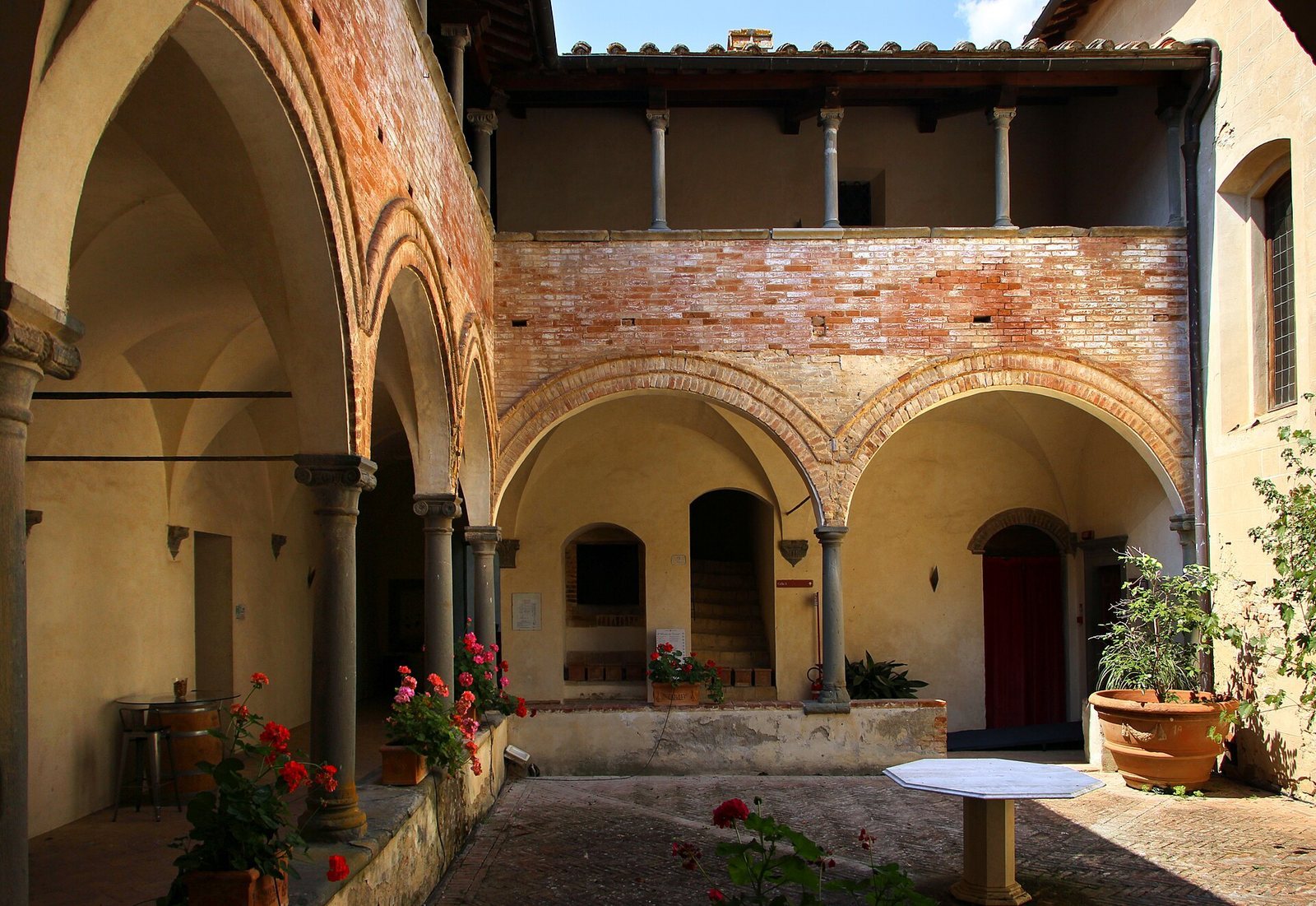
The main cloister, also called the Obediences cloister, served lay brothers who dealt with guests and other outsiders. A second cloister was bordered by the lay brothers’ cells. The Great Cloister belonged to the monks’ enclosed area, with their lodgings around it and a burial ground at its centre. A separate, concealed monks’ cloister gave the Carthusians access to the church, refectory, and other rooms without meeting outsiders.
Buildings and gardens
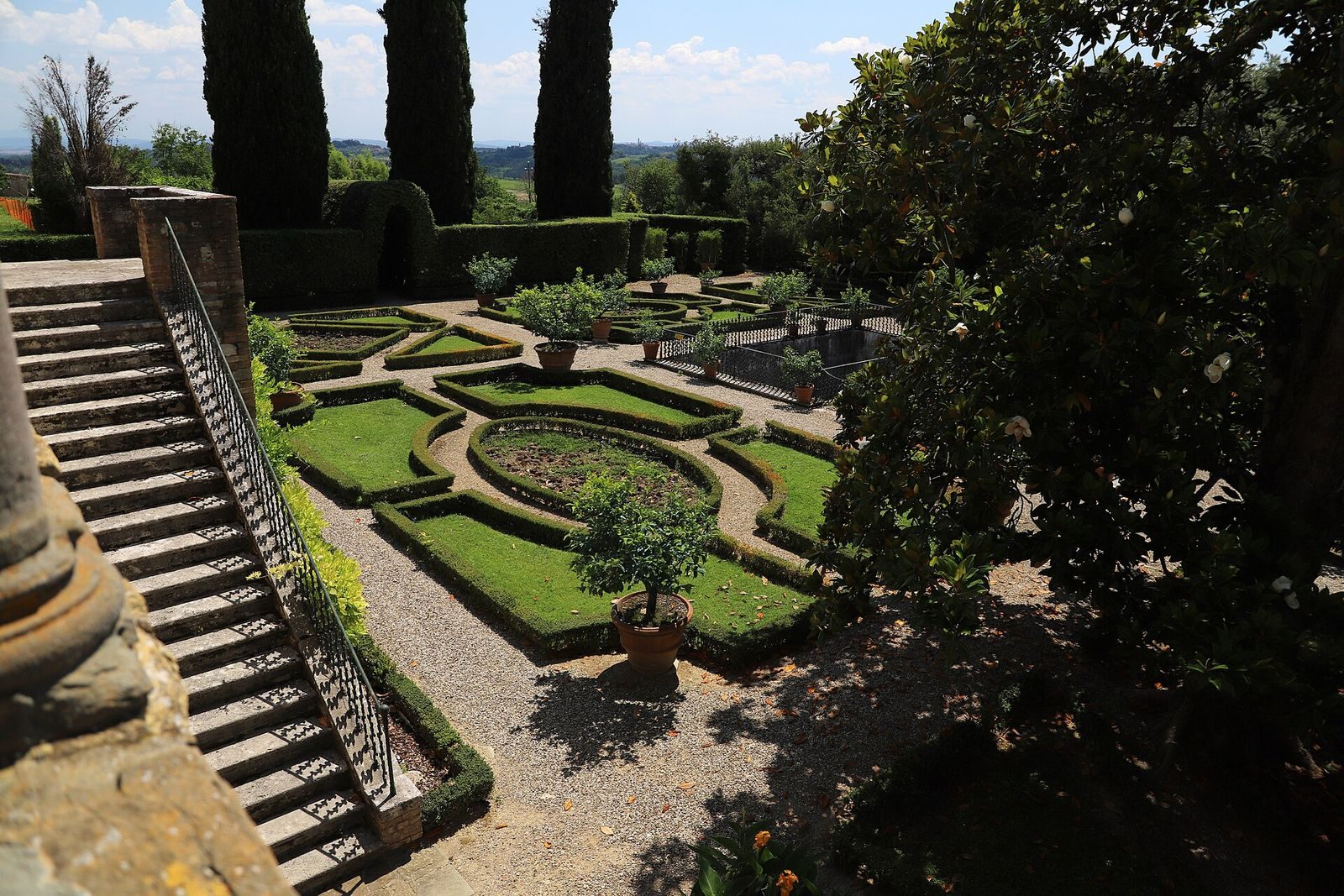
Rebuilt in a late Renaissance style at the end of the sixteenth century, the main cloister contains a well and faces the church. A palace stands along the church’s right side, with an open gallery on two levels facing the garden. The grounds also include a large fishpond and vegetable gardens.
The church
Medieval fabric and presbytery
The church retains parts of its medieval construction, though later changes and rich interior decoration have reshaped it. Its single nave, the main space for worship, is divided into three structural sections, or bays, and covered by two cross vaults, ceilings formed by intersecting barrel vaults. The façade masonry is more carefully finished than the side and end walls, whose surfaces become progressively less regular. At the far end, two rectangular windows have arch profiles drawn from Romanesque practice rather than the forms usual in fourteenth-century Siena.
The church’s presbytery, the area around the main altar, has marble facing completed in 1591. Its carved wooden choir, made by Domenico Atticciati in the early 1590s, contains twenty-six stalls.
Fresco cycle
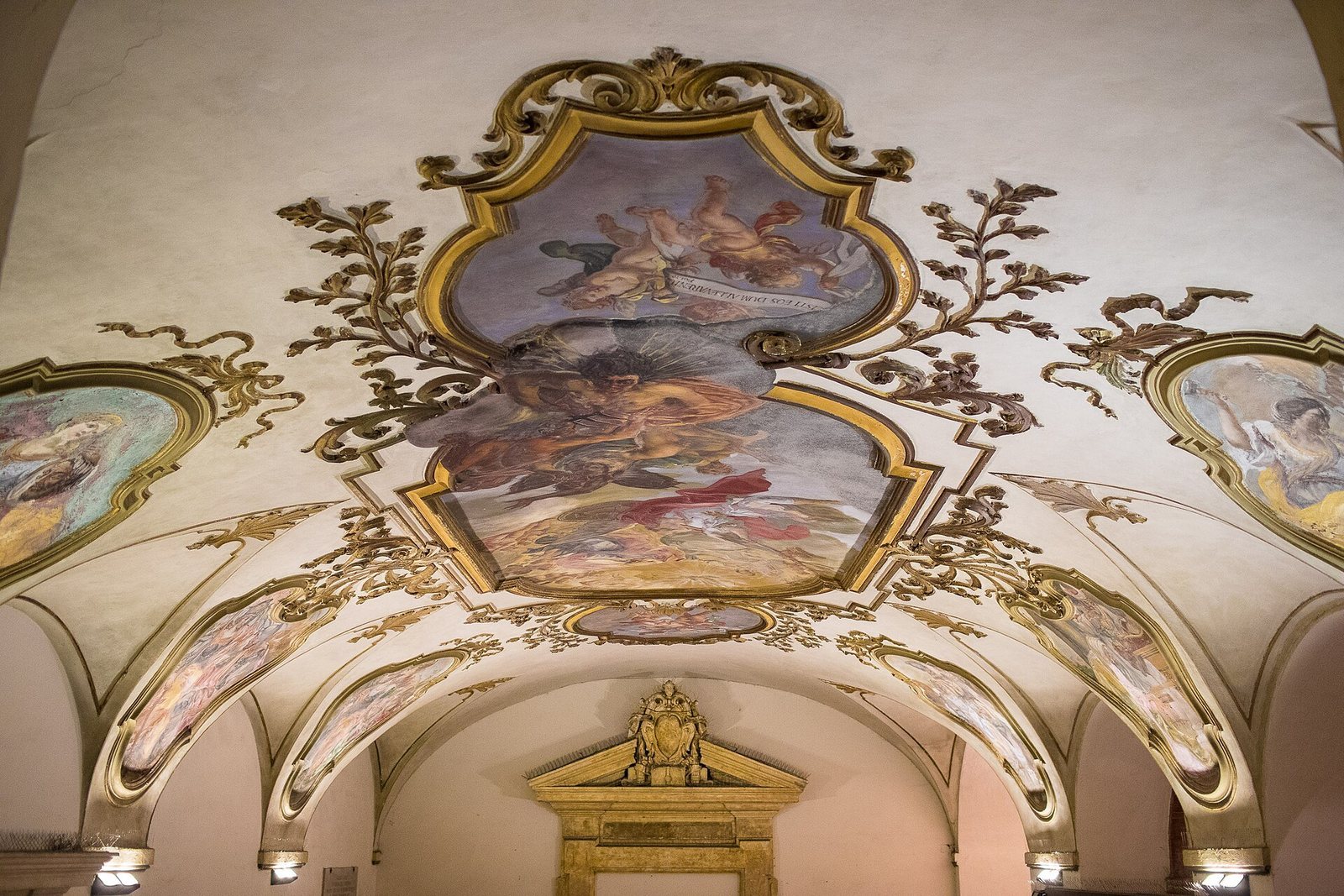
The church’s wall and ceiling paintings date from 1579 and depict the lives of Christ and the Virgin Mary, as well as the Carthusian order. Florentine painter Bernardino Poccetti planned the decorative program and worked with assistants until 1596–97. He was particularly involved at the main altar and in the third bay, and began work in the second bay before leaving it unfinished. Read from the entrance, the vault scenes concern Saint John the Baptist, the Passion of Christ, and the Virgin Mary. Semicircular wall panels above the windows contain Doctors of the Church, Catholic saints recognized for authoritative teaching, alongside Evangelists and Prophets.
Lower down, the wall opposite the entrance carries Stefano Cassiani’s Apotheosis of Saint Bruno, with Saints Peter and Paul. Cassiani also painted Saint Peter giving Saint Bruno the Office of the Virgin, a cycle of prayers devoted to Mary, with Saints Gregory the Great and Augustine. A panel of the Death of Ananias, begun by Poccetti and completed by Cassiani, includes Saints Jerome and Ambrose. Poccetti and his assistants painted the Sermon on the Mount and the Carthusians’ Arrival by Sea, with Saints Mark and Matthew; opposite, Cassiani painted the Washing of the Feet, with Saints John and Luke.
Above the main altar is Poccetti’s Glorification of the Carthusian Order, with God the Father above Saints John the Baptist and John the Evangelist, and monochrome scenes and emblems at the sides. Poccetti also painted the Martyrdom of Saints Peter and Paul and Saint Peter Raising the Son of Theophilus; the martyrdom painting bears his initials. Images of Saints Cosmas and Damian, and Saints Lawrence and Stephen, occupy spaces between the bays. Poccetti and his assistants added symbols of Christ’s Passion and attributes associated with the Virgin Mary to the vaults.
Attributions vary across parts of the decoration. The Passion scenes in the second bay have been linked to a painter from Alessandro Casolani’s circle, and the Baptist scenes in the first bay to Sebastiano Folli. Around 1668, Cassiani completed missing scenes in the first and second bays, adapting them to the earlier work. Orazio Porta, Vincenzo Rustici, Casolani, and Poccetti have been associated with parts of the later Renaissance ceiling decoration; Porta is linked to Saint Peter Healing the Sick. Giovanni Battista Brugieri has been proposed as the painter of the Ananias scene, though that attribution remains uncertain.
Other interiors and paintings
Refectory
The refectory contains Domenico Monti’s Last Supper. It also preserves frescoes detached from the Great Cloister, including scenes of the Passion and the Death of Saint Bruno, as well as lunette paintings removed from the cloister behind the church.
Chapel of Saint Agnes
The Chapel of Saint Agnes, once the prior’s private chapel, has decoration attributed to Apollonio Nasini and dated to about 1740–50. A kneeling Saint Romuald by Antonio Fanzaresi dates to about 1607.
The Cappellone
The large chapel known as the Cappellone served laypeople associated with the Charterhouse and is now a parish church. Francesco Vanni’s Crucifixion stands on its high altar, and two frescoes by Giuseppe Nicola Nasini decorate the chapel. An 1840 inventory also lists a painted crucifix by Vanni in a chapel, stuccowork by Giovanni Battista Ciceri, frescoes by Giuseppe Nasini, and an altarpiece of Carthusian saints: Saint Bruno, the Guardian Angel, and Saint Romuald. The altarpiece is attributed in the inventory to a painter identified as Falzaresi of Forlì.
Paintings in other rooms and cloisters
A Madonna and Child Showing the Rule to Saint Bruno, attributed to Poccetti’s workshop, is in a room of the prior. Another work linked to the workshop, Christ at the Column, is in the monks’ cloister. The minor cloister contains Brugieri’s Christ and the Samaritan, described as a painting for those converting to the faith. A small chapel held Poccetti’s Mystical Marriage of Saint Catherine of Siena and Cassiani’s Dead Christ; the Great Cloister had Poccetti’s Death of Saint Bruno.