Tunaberg Church: A Seventeenth-Century Parish Church in Sweden
Site at a Glance
- Popularity
- Very Low
- Country
- Sweden
- Primary era
- Early Modern
- Eras represented
- Early Modern, Modern
- Civilizations
- Swedish
- Site type
- Religious
- Remains
- Church
On this page14 sections
History
Foundation and early growth
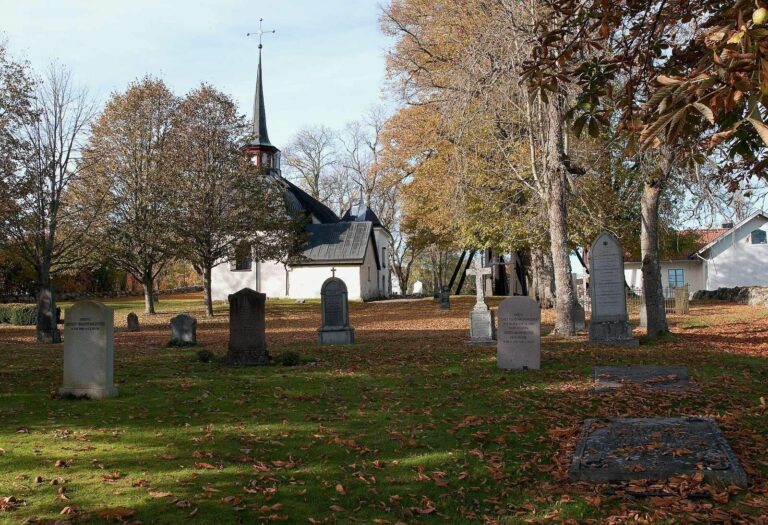
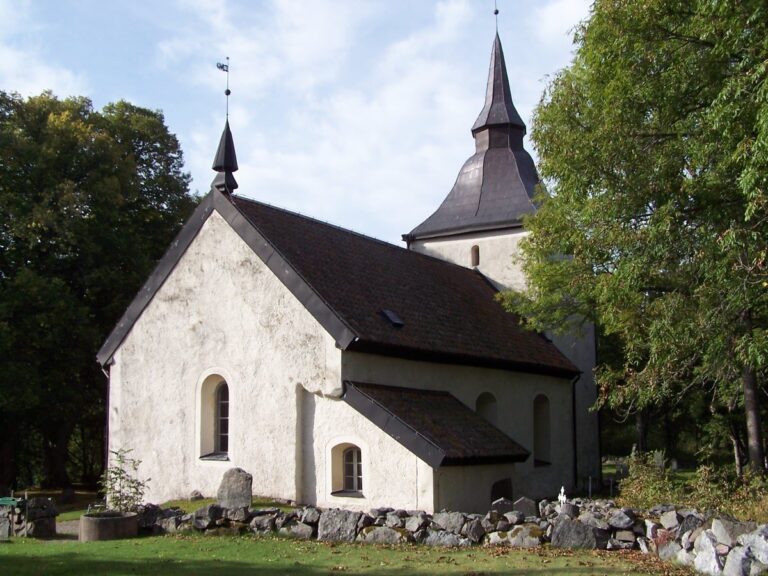
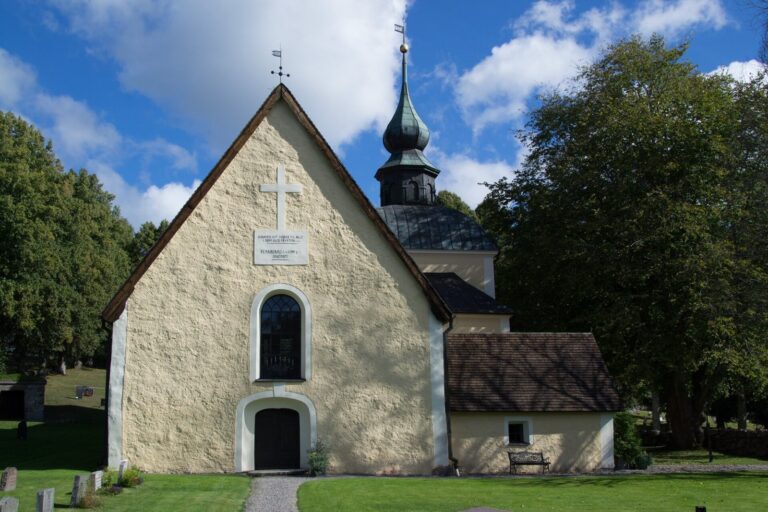
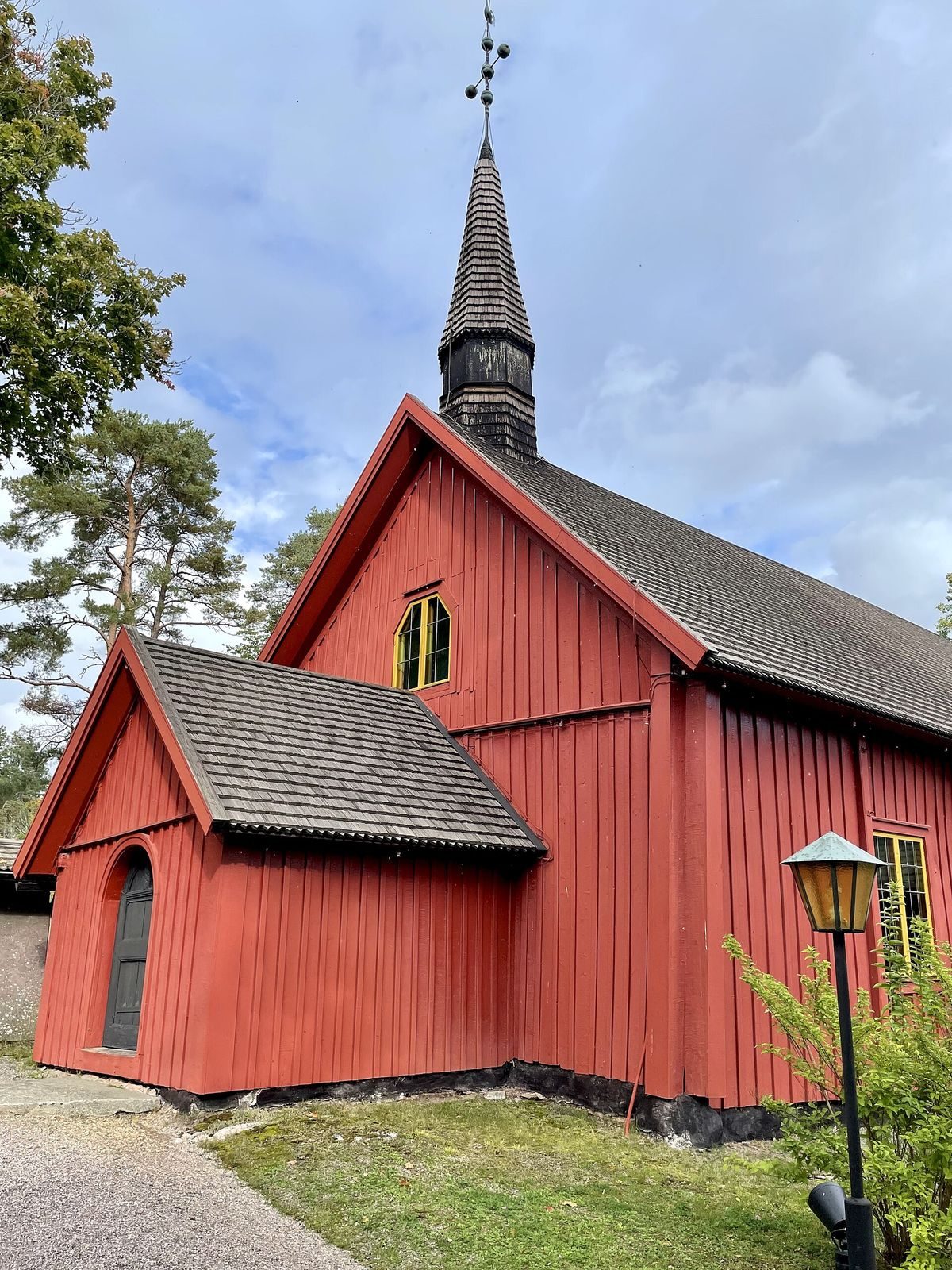
Tunaberg Church is the parish church of Tunaberg Parish in Koppartorp, near Nyköping, Sweden, within the Diocese of Strängnäs. It is thought to have been built in the early seventeenth century, probably during the 1620s. A tradition noted in the 1830s dates the nave to 1620 and says the chancel followed a few years later; the church was probably consecrated in 1620. An earlier chapel may have preceded it, although its location is uncertain. In 1627, Lilla Uttervik was granted as a farm whose income supported a chaplain at Tunaberg, and the church was probably built around that time.
Seventeenth-century expansion
A porch was added at the west end in 1682, followed by an interior gallery in 1685. In 1694, the walls were raised by three courses of logs and the roof was covered with new shingles.
Later changes
A north transept was added in 1779. In 1871, the church’s enclosed pews were replaced with open ones. An image of Christ, described as a tormented depiction of the Savior, was later transferred from the church to the Cathedral Museum in Strängnäs.
Remains
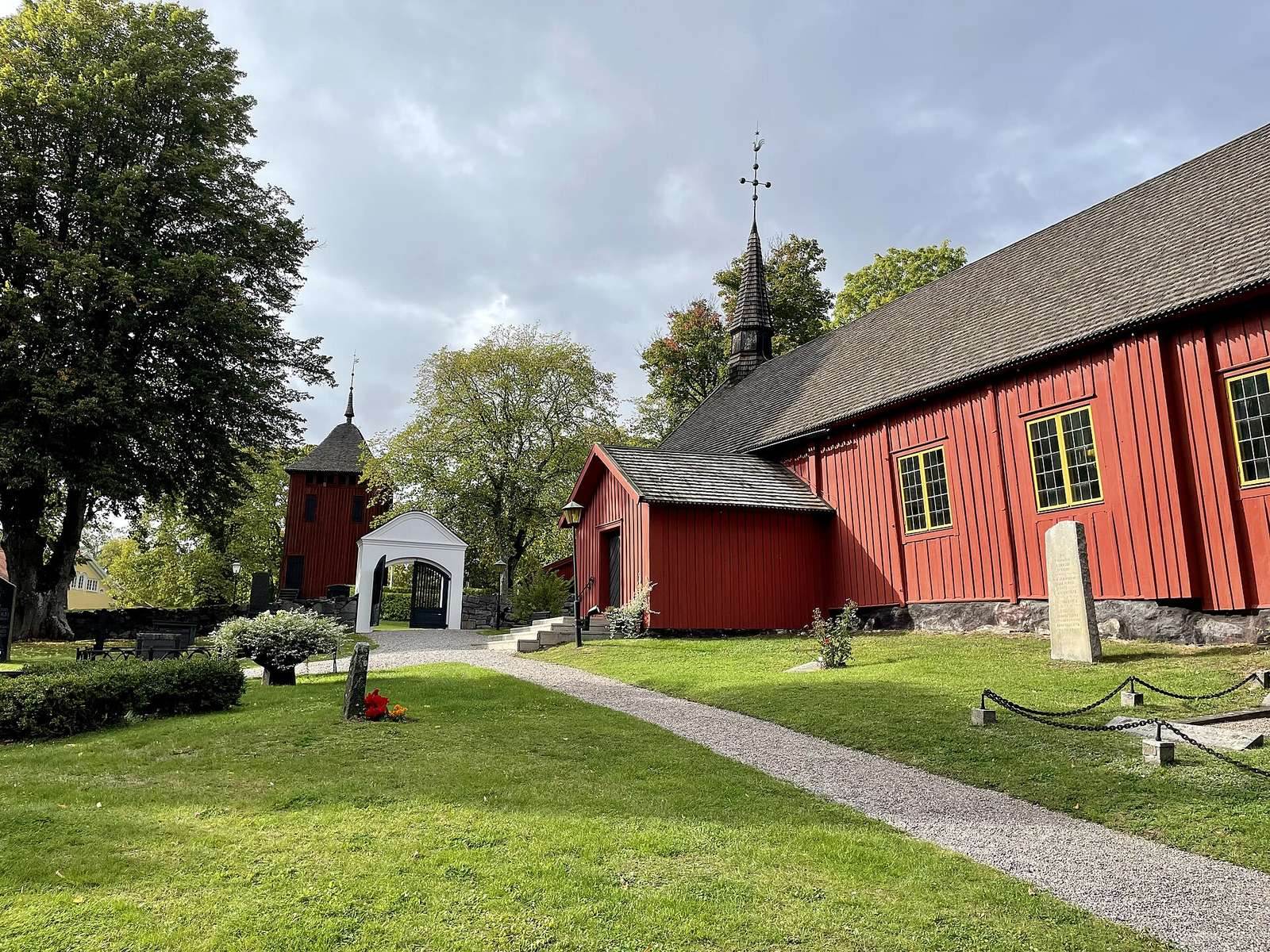
The church is a timber structure made from horizontally laid logs, joined at the corners by notched ends. Its main body comprises a nave and a later chancel, with a west porch, an interior gallery, and a north transept forming successive additions.
Main church and interior
Timber structure and decoration
The nave is traditionally considered the oldest part of the building, with the chancel added afterward. A window opened in 1682 is identified as the present right-hand window. A low, elongated opening in the chancel’s south wall was later blocked. Wall paintings probably date to the late seventeenth century, after the window alterations. The porch ceiling has leaf-scroll decoration signed by Pär O., a painter from Nyköping, and dated 1700.
Furnishings and images
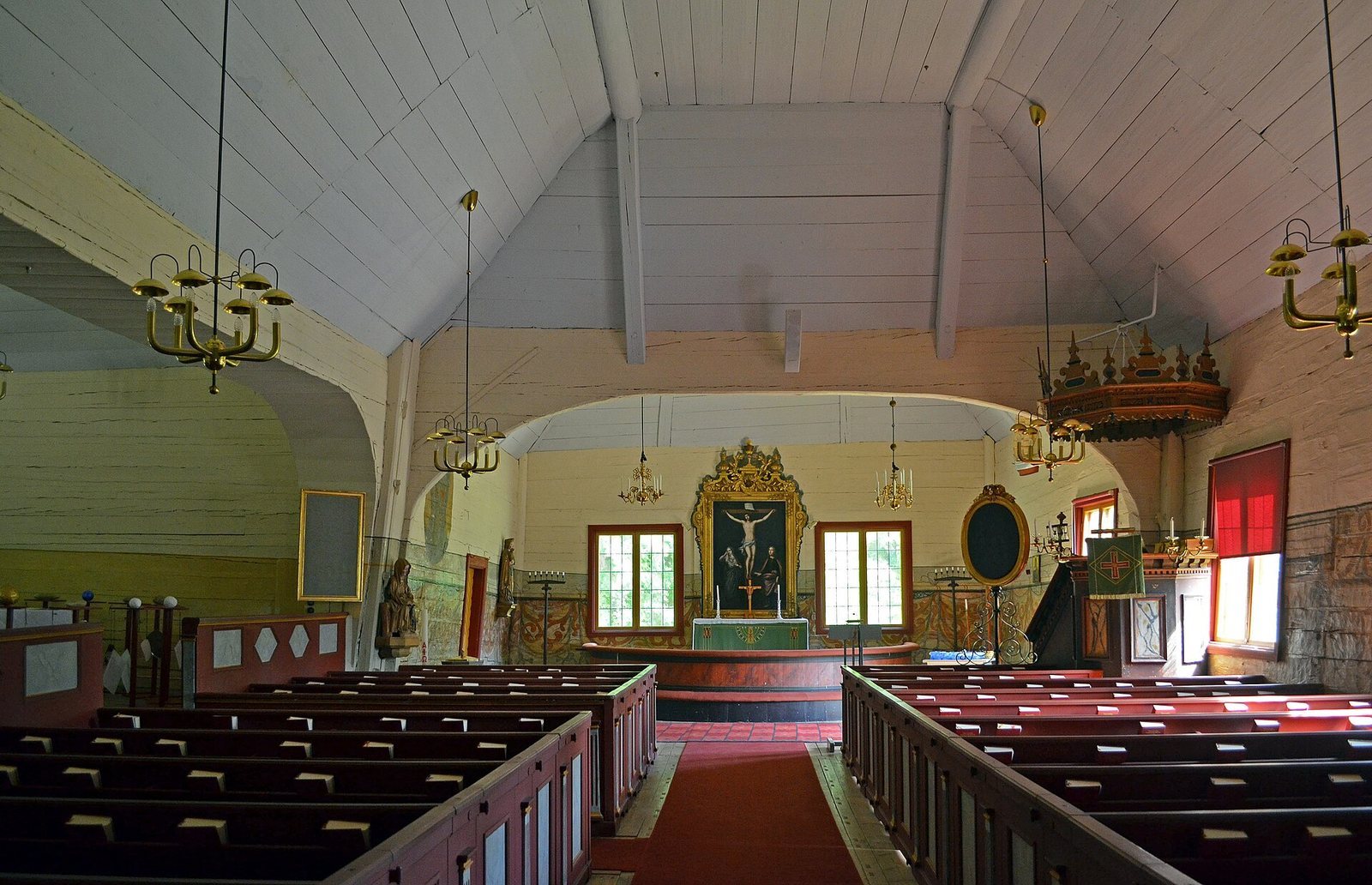
The early seventeenth-century pulpit has a sounding board brought from Mellösa Church in 1680. The board bears the date 1660 on its upper surface. An hourglass in the church may be the one bought in Norrköping in 1728. A surviving pew screen remains from the earlier enclosed seating.
The altarpiece, dating to around 1700, depicts the Crucifixion and was donated by Isac de Besche before 1719. A Madonna image from around 1500 may once have stood at a side altar, which remained in the church until the mid-eighteenth century. An image of Saint Bridget, a fourteenth-century religious figure who founded the Bridgettine order, probably survives from a mid-fifteenth-century high altarpiece. An 1830 inventory describes it seated on a wooden support, possibly part of the original altar structure.
A cut-glass crystal chandelier from the early eighteenth century hangs in the chancel. A baptismal font made of Kolmården marble was added in 1945. The chalice given in 1797 by Gustaf Ulrik Silfversparre, owner of Nävekvarn, was made by P. Enrot. Its foot takes the form of a cross entwined by a serpent. It replaced an older chalice whose upper part had been renewed in 1795.
The church received an altar-front covering, or antependium, in 1753 from investors in Koppartorp’s new copper mine. Collections among workers at Nävekvarn works in 1654 and 1655 paid for two brass chandeliers and a pair of altar candlesticks. In 1799, Silfversparre gave the church seven metal altar candlesticks. A medieval bell associated with Prime, the first of the traditional daily prayer hours, appears in the church’s 1799 inventory, though its origin is uncertain.
A cross rescued from the Swedish church in Leningrad amid the religious persecutions of 1936 is mounted on the north wall of the sacristy.
Churchyard and bell tower
Churchyard enclosure
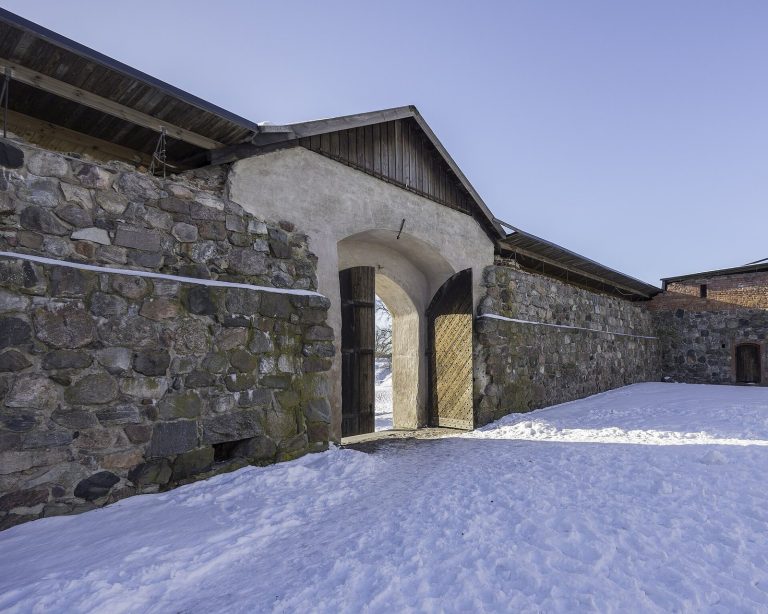
A wall encloses the churchyard, with a gateway built in 1755 marking its entrance. The Sederholm family burial chapel stands inside the cemetery wall and dates to the early nineteenth century.
Bell tower
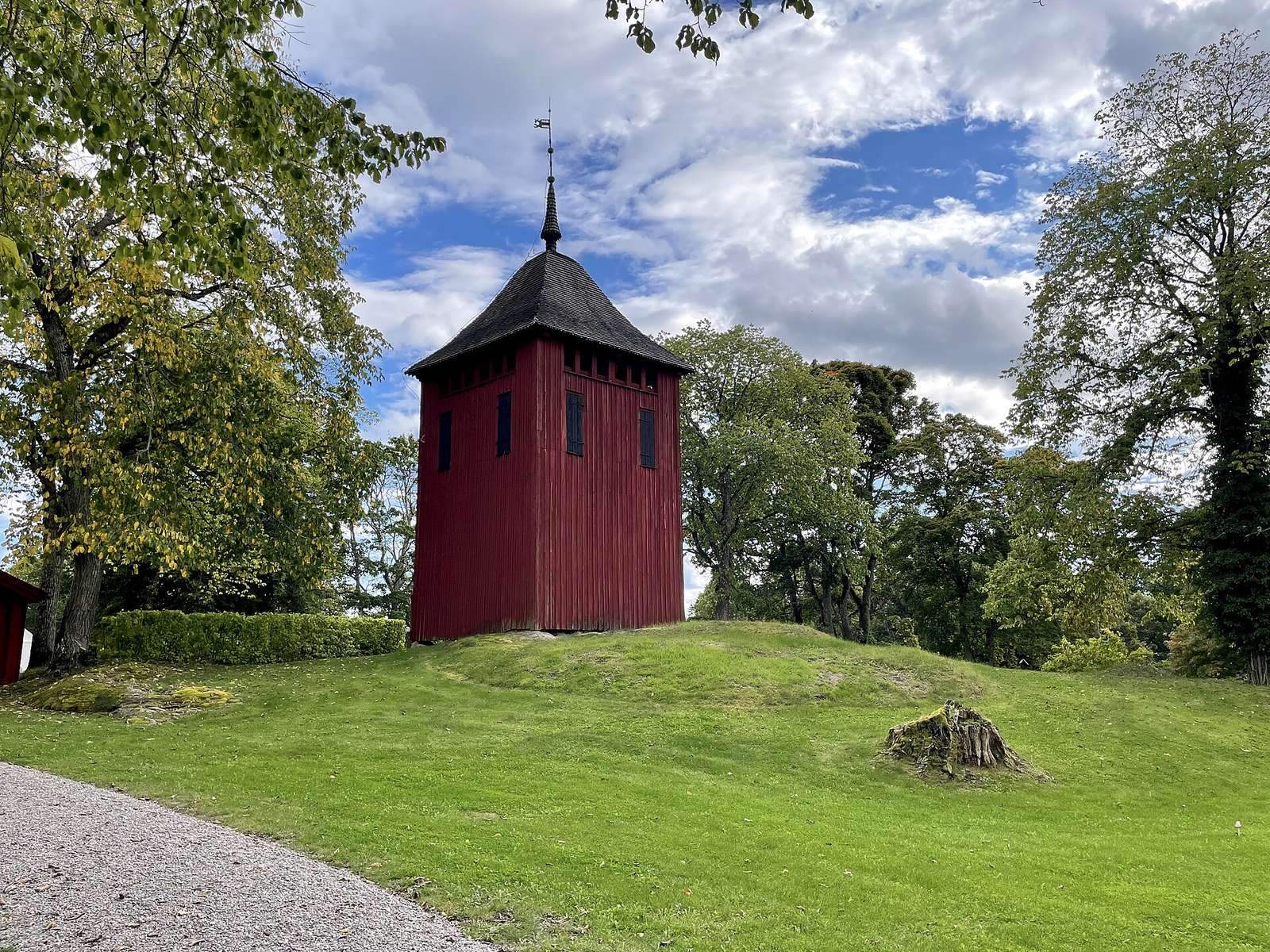
The bell tower stands west of the church. This red-painted wooden structure dates to the seventeenth century. Its weather vane bears the date 1663, which may refer either to the tower’s construction or to a repair.
Bells and organs
Bells
The church has three bells. The smallest was given in 1629 as war booty from Germany and was recast in 1699. The middle bell, cast in 1876 by Bergholtz in Stockholm, incorporates metal from an older seventeenth-century bell. The same foundry cast the largest bell in 1938.
Organs
The church’s organ history includes an instrument built by sexton Anders Klang in 1830 with seven and a half stops, sets of pipes selected by the player. Erik Adolf Setterquist built another instrument in Örebro in 1867, with five and a half stops. E. A. Setterquist & Son made the present pneumatic organ in 1936; air pressure transmits movement from its keys, and the instrument retains the earlier organ’s facade and some of its stops. A separate choir organ, built in 1984 by Grönlunds Orgelbyggeri AB in Gammelstad, uses mechanical action, in which physical linkages transmit key movement.