Saint-Sébastien Dolmens: Chalcolithic Burial Monuments in France
Site at a Glance
- Popularity
- Very Low
- Country
- France
- Primary era
- Stone Age
- Eras represented
- Stone Age
- Civilizations
- Unclassified
- Site type
- Burial
- Remains
- Tomb
On this page8 sections
History
The Saint-Sébastien Dolmens are two prehistoric burial monuments in France. They are associated with the Chalcolithic, or Copper Age, when copper was used alongside stone tools, and with the Bell Beaker tradition, known for its distinctive bell-shaped pottery.
Dolmen 1 was used during two separate periods. Its thin deposits suggest that the total period of use was relatively brief. Dolmen 2 was first used in the Early Chalcolithic and later reused in the Late Chalcolithic.
A fire preceded the discovery of the two monuments in 1970 and 1971. Gérard Sauzade, Jean Courtin and Gabriel Chabaud excavated them.
Remains
Both monuments belong to the eastern Provençal group of passage tombs with square chambers. Each has a short passage opening at the edge of its burial mound. This placement is common in Languedoc but exceptional among small Provençal dolmens.
Mounds and chambers
Dolmen 1
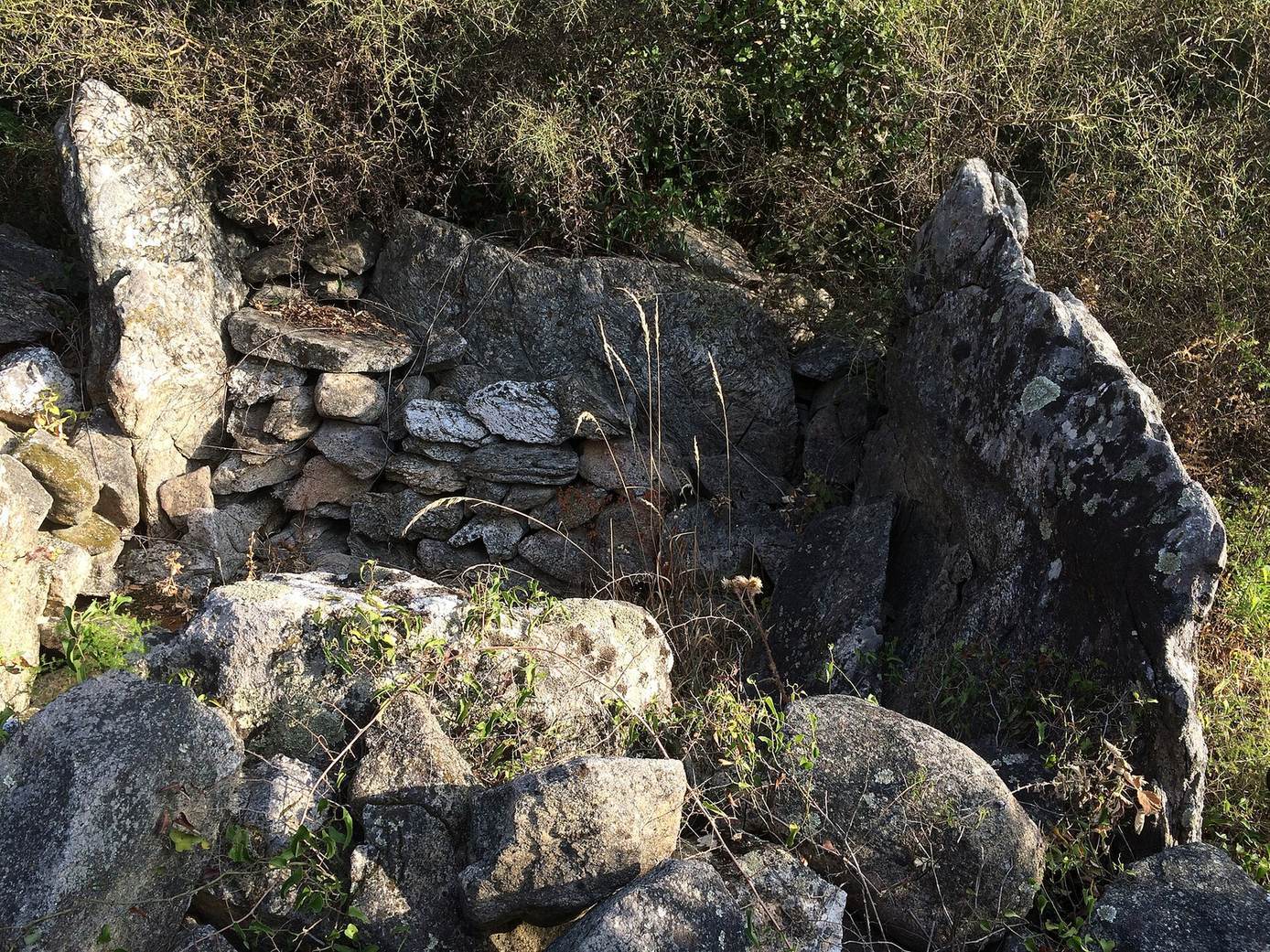
Dolmen 1 stands within an oval mound measuring 9.20 m long, 6.90 m wide and 0.70 m high. Its longest axis runs north to south, and large blocks form the mound. The rectangular chamber is enclosed by seven upright slabs, alongside walls made of stones laid without mortar. Two slabs form the north side, one of them probably reshaped; two more stand at the head end, an unusual arrangement. A single curved slab forms the south side.
Two pillars leaning slightly inward mark the western entrance. The passage measures 1.50 m by 0.80 m and was deliberately blocked with large and small stones. Inside the chamber, a slab measuring 1 m by 0.60 m by 0.20 m stood diagonally on edge. It may have divided burial deposits, although later tree roots could have changed its angle.
Dolmen 2
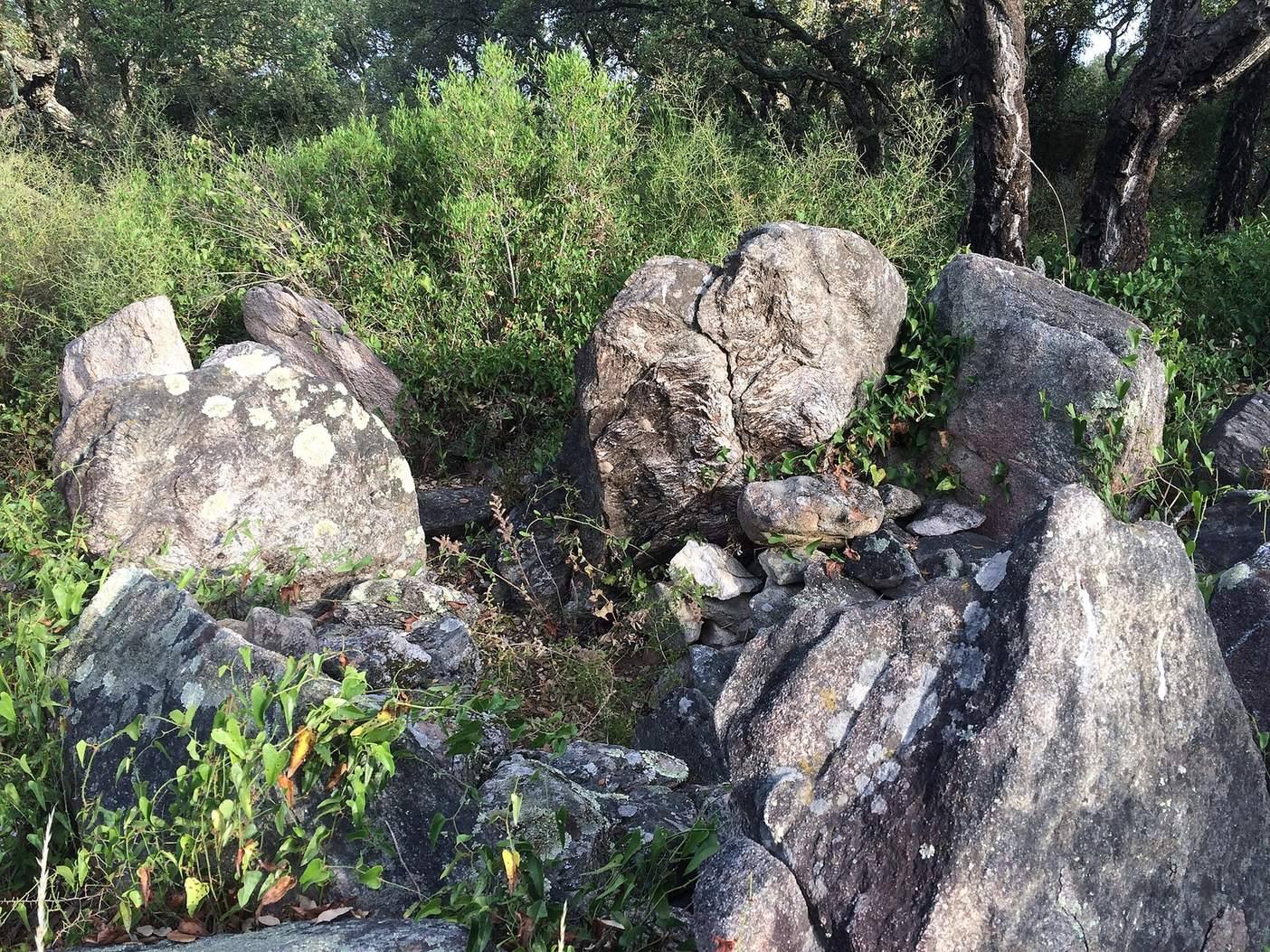
The building slabs of Dolmen 2 are made from local gneiss with eye-shaped mineral grains. Its slightly oval mound, built of irregular blocks, measures 8 m by 7 m and reaches 1.10 m high on the north side. The monument is aligned almost east to west, at a bearing of 260 degrees clockwise from north.
The square chamber lies slightly south of the mound’s center. It measures 2 m on each side and 1.20 m high. Five upright slabs, including a long slab at the head end, and four walls built without mortar define the space. On the north and south sides, a slab sits between wall sections. Two other slabs serve as entrance pillars, with a short passage measuring 1.50 m long by 1 m wide extending beyond them.
An inclined slab measuring 1.30 m by 1.30 m by 0.25 m stood inside the chamber along its south side. It probably served as a chest-like divider for burial deposits and may have been installed during the later use of the tomb. A deliberate covering of stones sealed the deposits.
Burial deposits and objects
Dolmen 1
The first burial layer contained fragments of burned human bone and pottery sherds from a Bell Beaker cup and a globular vessel. A second deposit lay in a hollow in the chamber floor. It included more human-bone fragments and undecorated pottery, among it an angular-profiled bowl and the flat base of a vessel. A quartz pick and four small disc-shaped beads were also among the grave goods.
The Bell Beaker cup was pieced together from about 40 fragments. Its decoration forms three horizontal bands. The upper and lower bands combine hatched designs with stacked triangles, separated by circular bands. The central band is divided into panels with different patterns.
Dolmen 2
Excavation revealed a burial layer beneath a packing of stones. The human bones were burned, and the evidence suggests that bodies and some grave goods were cremated outside the tomb before being placed in the chamber. The pottery represents at least 15 vessels, including a cup with several feet on a raised base, an undecorated conical bowl and a cord-marked vessel. Two baked-clay rolls were also found; their firing resulted from contact with the funeral pyre.
Stone objects include several obsidian arrowheads and 25 flint arrowheads, in leaf-shaped, diamond-shaped and triangular forms. The adornments include 3,900 disc-shaped soapstone beads, mostly 3–4 mm across, with some smaller than 2 mm. Their colors include dark green and whitish; a particularly dense group lay between the chamber’s south wall and the inclined slab.
Other beads are olive-shaped, round or barrel-shaped, and made of beige stone, quartz or soapstone. The assemblage also includes two bone pendants, one pendant of clear rock crystal, a ring fragment possibly made of schist, and a copper bead.