Citadel of St. Tropez: A Pre-Vauban Coastal Fortress in France


Site at a Glance
- Rating
- 4.5
- Popularity
- Medium
- Country
- France
- Primary era
- Early Modern
- External website
- Open
- Eras represented
- Early Modern
- Civilizations
- French
- Site type
- Military
- Remains
- Citadel
On this page10 sections
History
The Citadel of St. Tropez is a pre-Vauban coastal fortress in France, built through successive French fortification projects between the sixteenth and seventeenth centuries above the town and the Gulf of Saint-Tropez. Its development followed the destruction of Saint-Tropez during regional fighting and corsair attacks, and it became part of the town’s defenses, military administration, and later maritime heritage.
Repopulation and Early Defenses
Saint-Tropez was devastated by fighting after the death of Queen Joan I of Naples and by attacks from Barbary corsairs. By 1388, most of its population had disappeared. On 14 February 1470, Raphaël de Garezzio arrived with sixty Genoese settler families to repopulate the town. Jean Cossa, seneschal of Provence and baron of Grimaud, transferred his rights over Saint-Tropez to Garezzio. The settlers received tax exemption, while Garezzio assumed responsibility for rebuilding and fortifying the town and defending the coast between Sainte-Maxime and Cavalaire.
René I of Anjou, Count of Provence, confirmed the arrangement on 18 January 1472. These privileges remained in force until Louis XIV ended them and incorporated Saint-Tropez into the surrounding lands on 20 July 1672. An initial fortified enclosure around the port was followed by a larger bastioned enceinte, a fortified wall system with projecting angular defenses, in 1534. Built as a simple earth embankment, it responded to population growth and helped the town resist the Constable of Bourbon in 1524 and a Barbary attack in 1556, after Hyères and Toulon had been devastated. In 1564, Pierre de Renaud, lord of Saint-Tropez, commissioned the Portalet cannon tower.
The Sixteenth-Century Citadel
The first fortification on the wooded, mill-covered hills above the town and gulf was built in 1583. This earthwork redoubt, surrounded by a ditch, was intended to defend the French coast against pirates, privateers, and the Ottoman Empire. During the French Wars of Religion, the conflicts between Catholic and Protestant forces and their political allies, the Duke of La Valette added an enceinte around Saint-Tropez despite local opposition. The work was intended both to protect the town from invasion and to secure the authority of Henry IV.
The Duke of Savoy attacked Saint-Tropez in 1592. After La Valette’s death that year, the Duke of Épernon repaired and armed the recently built citadel, placing its command under de Noillan and appointing Mesplez as governor of the town. In 1596, the Duke of Guise helped the inhabitants retake the fortress from Épernon’s forces. Because it had served the Catholic League, a major Catholic political and military coalition during the Wars of Religion, the Parliament of Provence ordered its demolition. The inhabitants then demolished it entirely.
The Royal Fortress
At the direction of Henry IV, the royal engineer Raymond de Bonnefons built a new hexagonal donjon, or fortified central tower, between 1602 and 1607. The great bastioned enceinte, its ditches, and its counterscarps, the outer sides of the ditches, were completed during the 1620s. Together they created the surviving pre-Vauban citadel, a fortress built before the standardized defensive system associated with the engineer Sébastien Le Prestre de Vauban.
The defenses were tested repeatedly. The fortress had served against a Spanish threat in 1598, and on 15 June 1637 it resisted an attack by twenty-one Spanish galleys during the Thirty Years’ War, a prolonged European conflict involving France, Spain, and other powers. Four Spanish guns captured during that defense were placed on the citadel’s terrace. During the Fronde, a series of rebellions in France against the authority of the regency and Cardinal Mazarin, forces commanded by Louis-Emmanuel d’Angoulême captured the citadel in July 1652. Royal troops under the Duke of Mercœur retook it for Louis XIV on 8 August, assisted by the inhabitants. Mercœur then entrusted its custody to the Marquis of Castellane-Grimaud, the king’s lieutenant for Saint-Tropez and its citadel.
Military and Administrative Uses
Saint-Tropez’s maritime importance extended beyond the fortress. A royal edict of 1649 established the Lieutenancy-General of the Admiralty of Saint-Tropez, whose jurisdiction extended two leagues around the town. The lieutenant general worked with a royal prosecutor, a secretary, and two sergeants. At the time, the port was the only commercial port between Toulon and Antibes and provided the municipality’s most important source of revenue.
The citadel also became associated with the care and confinement of soldiers. It served as a center for military invalids after 1674. From 1749, it was commanded by Simon Claude Grassin de Glatigny, and an invalids’ company was assigned to it under an ordinance of 1764 that also linked the fortress with the Grosse Tour of Toulon. A chapel dedicated to Saint Genevieve, the Christian saint traditionally regarded as the patron saint of Paris, was established within the fortifications in 1730. It occupied one of the donjon’s towers until 1774, when it moved to a separate building in the eastern part of the complex. That building became a warehouse in 1817.
Decline and Public Heritage
The citadel’s defensive and military importance declined during the nineteenth century. In 1793, during the war between France and England, it protected French ships. During the First World War it served as a prison for soldiers from the Central Powers, and during the Second World War it was occupied first by Italian and then by German forces.
The citadel ceased to belong to the military in 1918 and passed to the state. The donjon was classified as a monument historique, a French legal designation for protected historic heritage, on 12 December 1921. The glacis of the counterscarp was registered on 23 August 1990, and the enceinte was classified on 4 July 1995. The site is recorded under heritage reference PA00081723. The municipality of Saint-Tropez acquired the citadel in 1992.
The donjon became a naval museum in 1958. That museum closed in 2002 when major restoration began, and a replacement municipal museum project was launched in 2008. After ten years of restoration, historical research, and collection acquisitions, the Museum of Maritime History of Saint-Tropez opened on 24 July 2013.
Remains
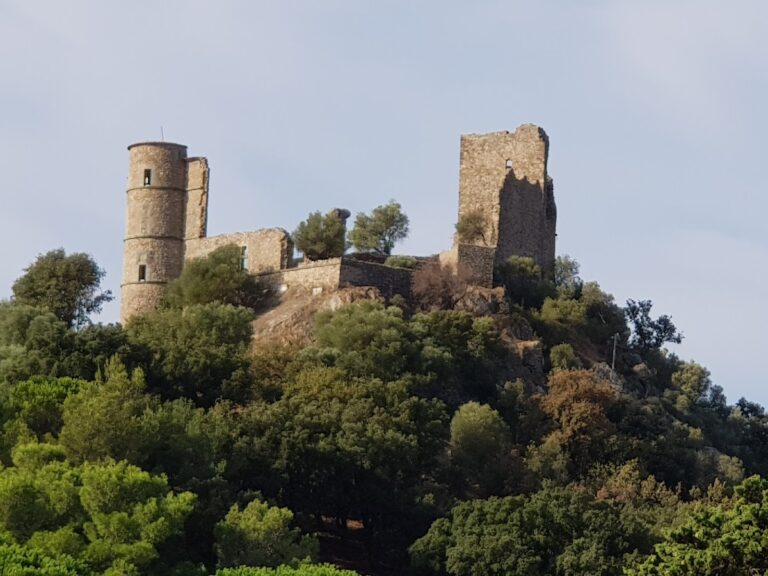
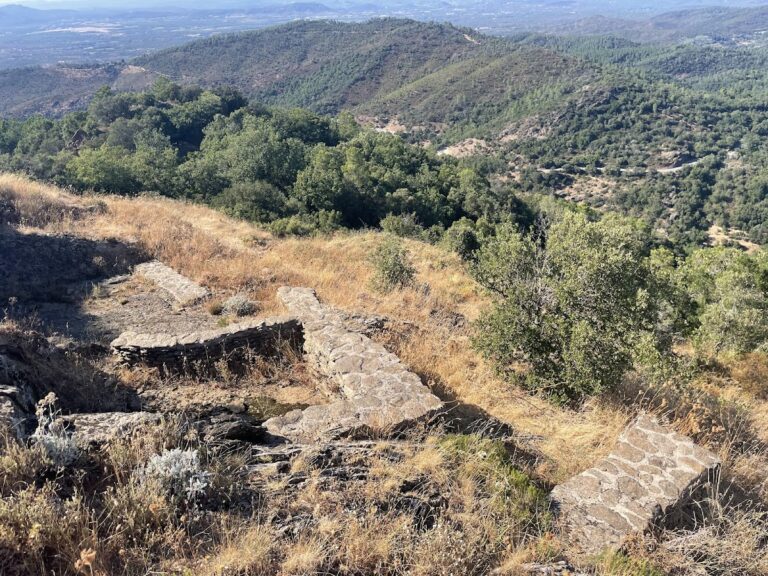
The citadel occupies the hills above Saint-Tropez, overlooking the town and the Gulf of Saint-Tropez. Its surviving defenses combine the earlier port enclosure, later earthwork fortifications, the hexagonal donjon, and the large bastioned enceinte with its ditch and counterscarp system. The earlier enclosure survives in the Tour Vieille, while the elevated works preserve the successive defensive development of the site.
Early Enclosures and Outer Works
The 1534 enceinte was a bastioned plan formed as a simple earth embankment. Its associated Portalet cannon tower, also known as the cannon tower, was built in 1564 by masons from Antibes. The 1583 redoubt formed the first defensive work on the elevated site. It was made of earth and surrounded by a ditch, providing the initial structure from which the later citadel was rebuilt.
The Donjon and Bastioned Fortress
The present donjon is a hexagonal structure built between 1602 and 1607 under Raymond de Bonnefons. A drawbridge gives access to its large inner courtyard. The building is defended by an artillery platform, a prepared position for guns, and three circular turrets. Its own ditch and counterscarp connect the central tower to the wider defensive system.
The larger bastioned enceinte and its associated ditch and counterscarp were completed during the 1620s. The terrace preserves four Spanish guns captured during the defense against the Spanish galleys in 1637. These weapons remain part of the physical evidence for the citadel’s role in coastal defense.
Chapel and Museum
The chapel dedicated to Saint Genevieve was first installed in one of the donjon’s towers. In 1774 it moved to a separate building in the eastern part of the complex, which was converted into a warehouse after 1817. The building’s later form therefore reflects both the religious use of the fortifications and their subsequent military storage function.
The donjon now houses the Museum of Maritime History of Saint-Tropez. The former naval museum presented the town’s naval heritage from antiquity to the contemporary period in about twelve rooms, with engravings, paintings, documents, amphorae, models, furniture, and maritime objects. The current museum focuses on five centuries of Saint-Tropez’s relationship with the sea, including Mediterranean fishing techniques, long-distance voyages around Cape Horn and along the coasts of Africa and India, and steamboat journeys to the Far East. It also presents maritime figures associated with Provence, including Pierre André de Suffren, Hippolyte de Bouchard, and Jean-François Allard.