Cairnpapple Hill: A Prehistoric Ritual and Burial Site in Scotland
Site at a Glance
- Popularity
- High
- Country
- United Kingdom
- Primary era
- Bronze Age
- Eras represented
- Stone Age, Bronze Age, Medieval, Modern
- Civilizations
- Unclassified
- Site type
- Religious
- Remains
- Sanctuary
On this page15 sections
History
Cairnpapple Hill is a prehistoric ritual and burial site in West Lothian, Scotland, about 3 km north of Bathgate. Used for around 4,000 years, from the Neolithic, or later Stone Age, into the Christian era, it may have been comparable in importance to the better-known Standing Stones of Stenness in Orkney.
Neolithic ritual activity
The earliest known activity dates to around 3500 BC. It included hearths and the placement of objects that were probably offerings. A henge, a prehistoric enclosure defined by a bank and ditch, was probably built around 3000 BC for ceremonial use.
Bronze Age burial
During the Bronze Age, when bronze became widely used for tools and weapons, Cairnpapple Hill also became a burial ground. Burials continued for about 2,000 years, although it is uncertain whether this practice grew directly out of the earlier ceremonies. Stone burial mounds, or cairns, were built and enlarged in successive phases, transforming the site into a tomb monument.
Early Christian graves
Four graves once classified as Iron Age are now considered early Christian. Their east-to-west alignment supports a date of about AD 500 to 1000, within the early medieval spread of Christianity in Scotland. They are the latest graves at the site.
Excavation and interpretation
Trees had grown over the hill by the nineteenth century, concealing the site. Archaeologist Stuart Piggott excavated it in 1947 and 1948, making Cairnpapple the first henge in Scotland investigated with modern scientific methods. In 1998, archaeologist Gordon Barclay reinterpreted the site for Historic Scotland.
Cairnpapple Hill is a Scheduled Ancient Monument, a legally protected archaeological or historic site in Scotland. The origin of its name, also given as Cairniepapple, is uncertain. Suggested explanations draw on Brythonic and Goidelic, two branches of the Celtic languages, and include meanings such as cairn of the tent, cairn of the people or cairn of the eye.
Remains
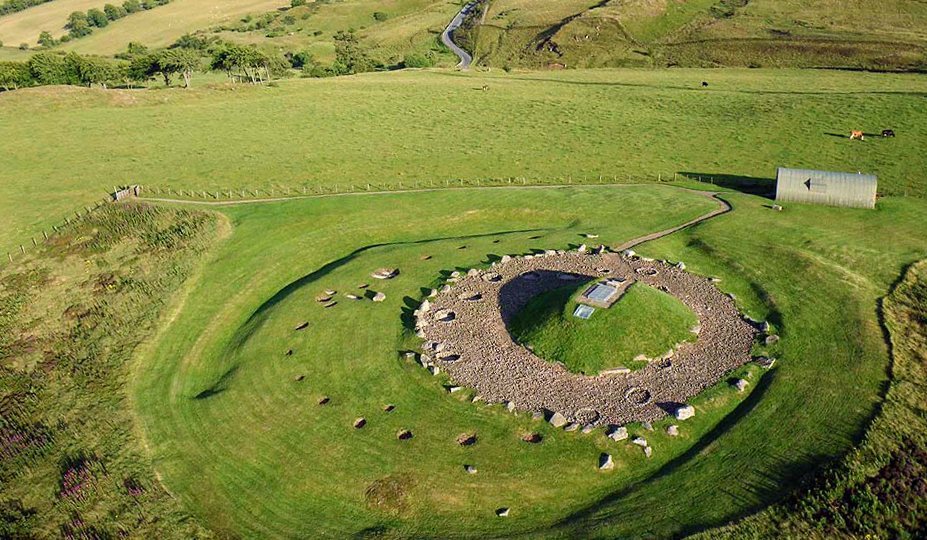
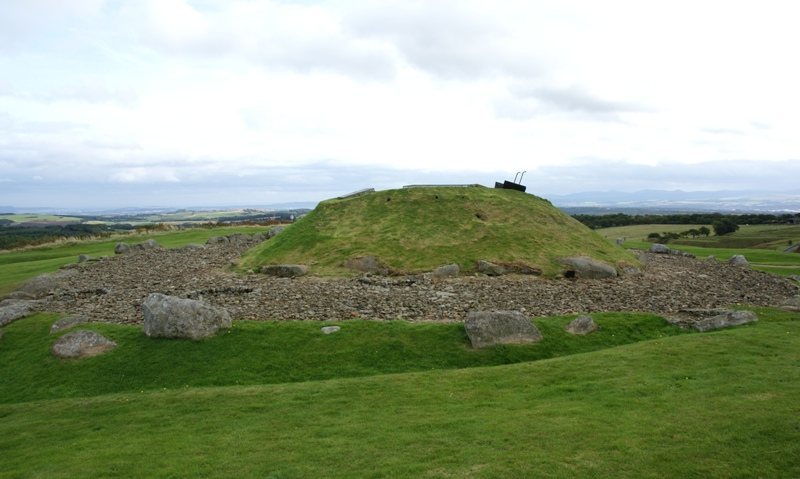
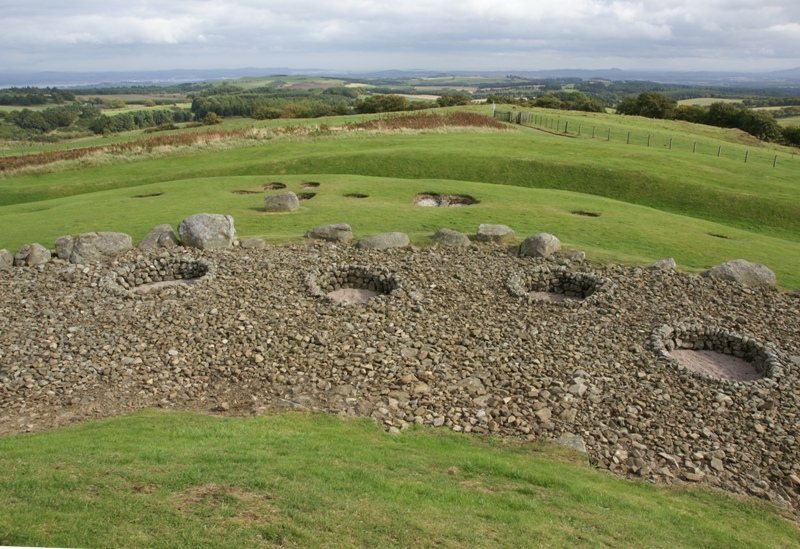
The remains occupy a summit 312 m above sea level in central lowland Scotland, with views from coast to coast. The site brings together a bank-and-ditch enclosure, settings of uprights and successive burial mounds. Some excavated features are marked with gravel, while a concrete dome covers part of the site.
Henge enclosure and ritual settings
Outer enclosure
The henge enclosed the hilltop with an outer bank about 1.2 m high and a ditch cut into the rock. The enclosure measured about 60 m across. Its ditch was approximately 4 m wide and more than 1 m deep, and broad entrances about 9 m across opened to the north and south.
Inner settings and early activity
Within the enclosure, 24 uprights formed an egg-shaped setting around a smaller arrangement of similar uprights. They were probably timber posts, although standing stones are also possible. Postholes to the east may mark a screen built around the time of the northern grave. Six hearths, pottery including fine bowls, and stone axe heads also belong to the early activity at the site. The axe heads came from Cumbria and Wales.
Burial cairns and graves
Northern burial and first cairn
A small mound of stone and clay was added off-centre within the monument. A standing stone about 2 m tall stood to its east, beside smaller stones. Nearby were sockets for three uprights and an arc of seven small pits. Six pits held cremated bone, and two contained remains of bone skewer pins. Traces beneath the mound indicate at least one burial.
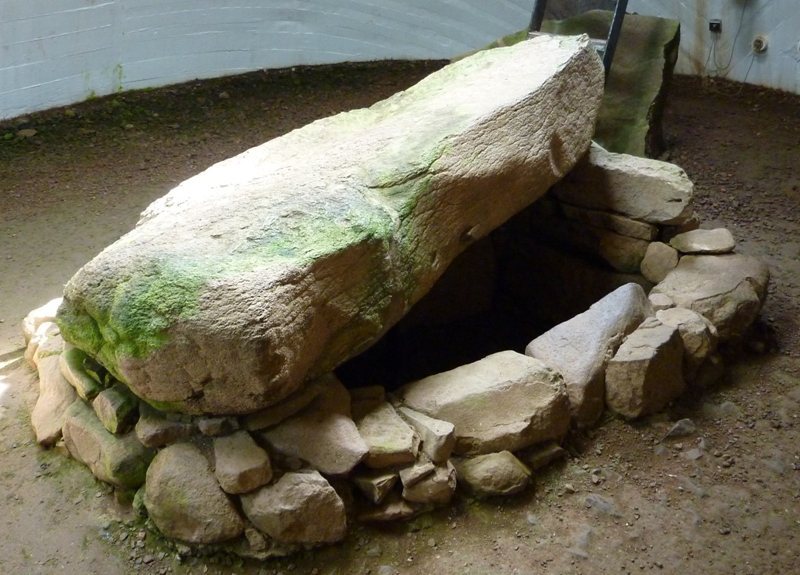
The northern burial structure was cut into the rock and measured about 3.3 by 2.7 m. A large stone about 2.4 m high stood at its western end. One person was laid at full length, probably wrapped in turf or a similar material; a wooden mask may have covered the face. A club and two vessels in the Beaker style, a prehistoric pottery tradition named for its characteristic vessel forms, were also found. The burial dates to around 2000 BC.
Second cairn and cists
A larger cairn about 15 m across and several metres high covered the earlier burial. Twenty-one upright stones edged its perimeter. Two stone-built burial chests, or cists, were incorporated into the mound. One, about 3 m south of the northern grave, held a food vessel, and its capstone had been moved from its original position. A nearby cist contained the cremated remains of one person.
Largest cairn phase
The cairn was later enlarged to about 30 m in diameter, covering the henge’s original bank and ditch. This phase enclosed two cremation burials in inverted urns. An associated grave lay to the northeast within the hill.
Early Christian graves
Four east-to-west graves lie in the eastern half of the henge. Their positions are marked with white gravel, while red gravel marks the 24 postholes of the henge setting.
Protective dome
A modern concrete dome covers part of the excavated area. Its shape reproduces the second cairn, but it rises much higher than the original mound. The dome covers an area once occupied by a solid cairn and includes reconstructed graves.