Kinneil House: A Scottish Hamilton Mansion and Historic Estate


Site at a Glance
- Rating
- 4.8
- Popularity
- Very Low
- Country
- United Kingdom
- Primary era
- Early Modern
- External website
- Open
- Eras represented
- Classical, Medieval, Early Modern
- Civilizations
- Kingdom of Scotland, Roman
- Site type
- Domestic
- Remains
- Elite Residence
On this page15 sections
History
Kinneil House is a historic mansion in Scotland, United Kingdom, developed by the Hamilton family from a fifteenth-century tower house into a symmetrical house of 1677. Its estate combined aristocratic residence, agricultural land, salt production, coal, mining, and a port, while its position near the Antonine Wall connected the site to both medieval Scottish politics and the Roman frontier across central Scotland.
Medieval Estate and Tower House
The lands of Kinneil, Larbert, and Auldcathy were granted to Walter Fitz Gilbert, an ancestor of the Hamilton family, by Robert the Bruce in 1323. A charter of 1474 describes the estate’s castle, land reclaimed from the sea, and saltpans. By the early sixteenth century, Kinneil also had a deer park. A tower house was built during the 1470s, although parts of an earlier castle may have been incorporated into the building that followed. The site may itself have replaced an earlier castle near Snab Brae, remembered in the name Castleloan.
Hamilton Expansion and Political Importance
James Hamilton, 2nd Earl of Arran, expanded Kinneil between about 1550 and 1553. After the death of James V, Arran served as Governor or Regent of Scotland. Building accounts mention timber sent from Leith in 1549 and 1550, foundation work in September 1553, and improvements to the garden, where hedges, marjoram, lettuce, and imported trees were cultivated.
Kinneil became the principal Hamilton residence in eastern Scotland. Coal from the estate was shipped to Leith for Edinburgh Castle, and the family also gained income from its saltpans, mines, and port. These resources strengthened the house’s place within the Hamilton estates, a network belonging to one of Scotland’s major noble families.
French troops led by d’Oysel attacked and burned Kinneil on 4 February 1560. In 1562, James Hepburn, Earl of Bothwell, met James Hamilton, 3rd Earl of Arran, at the house. Arran escaped soon afterward by lowering himself from a window at night with bedsheets. After the Battle of Corrichie in October 1562, George Gordon, the forfeited heir of the Earl of Huntly, was held at Kinneil by Arran’s father, the Duke of Châtellerault.
Conflict, Confinement, and Royal Visits
Kinneil suffered further damage in May 1570, when Regent Lennox used gunpowder against the house after Regent Moray was assassinated at Linlithgow by a Hamilton supporter. In 1579, James VI used military force to reduce Hamilton power. The Duke’s wife, Margaret Douglas, and their daughter Jean Hamilton, Countess of Eglinton, were brought to Kinneil from Craignethan Castle. Their estates and titles were transferred to James Stewart in 1581.
James VI visited Kinneil in 1582 to receive an envoy associated with the Duke of Guise, a leading French nobleman. The king returned at Christmas in 1588 to hold court there. During the political struggles surrounding the Raid of Ruthven, a 1582 seizure of the young king’s person and government by Scottish nobles, the Earl of Arran was confined at Kinneil. James VI later banqueted with him there on 11 November 1583. The captive Earl of Gowrie was held at Kinneil for five days in April 1584 before being taken to Stirling for trial and execution.
Seventeenth-Century Mansion
The Arbour Room was redecorated around 1620 for James Hamilton, 2nd Marquess of Hamilton, and his wife, Ann Cunningham. When Cunningham died in 1644, she left Kinneil, together with its tapestries and furnishings, to her son James, 1st Duke of Hamilton. In October 1641, during the political crisis known as the Incident, the Earl of Argyll, the Marquess of Hamilton, and the Earl of Lanark fled to Kinneil.
William Douglas, 3rd Duke of Hamilton, rebuilt the main house in 1677. The work formed a uniform mansion around surviving fragments of the earlier building, although planned additions were never completed. The Hamiltons later used Kinneil less often as income from the mines and port grew. John Roebuck, founder of the Carron Iron Works, lived at the house in the late eighteenth century, and James Watt worked on improving his steam engine in a nearby cottage. The philosopher Dugald Stewart used the house between 1809 and 1828.
Preservation and Archaeological Investigation
The Hamiltons had abandoned Kinneil by 1936. Bo’ness Town Council began demolishing the house, but the discovery of sixteenth-century mural paintings stopped the work. The Ministry of Works secured the painted wing, recovered the oak-ribbed ceiling of the Parable Room, and arranged for the paintings to be restored.
Kinneil House is now cared for by Historic Environment Scotland and is protected as a Category A listed building, the highest level of listed-building protection in Scotland. Its grounds also contain part of the Antonine Wall, a second-century Roman frontier barrier across central Scotland, together with the only Antonine fortlet whose visible remains survive.
Excavations sponsored by the Inspectorate of Ancient Monuments and the Ministry of Public Building and Works took place in 1960 and 1961. Investigations during the 1970s located the Roman fortlet and two timber buildings. In 2018, nine trenches revealed a metalled surface that may have belonged to the Roman Military Way. A Roman fort near Kinneil had once been proposed, and Sir George Macdonald suggested that a fortlet might stand near the house before the installation was located.
In 1973, an arched stone tunnel measuring approximately 4 by 7 feet was discovered. It extended for about 100 feet from a southerly position to the western gable of the house. Kinneil also has a long-standing supernatural tradition. A White Lady is identified with Lady Alice, or Ailie, who supposedly leapt from the building in the seventeenth century to escape a cruel husband. Maria Edgeworth, an Anglo-Irish novelist, recorded the story in 1823, and it was also associated with the nearby Gil Burn.
Remains
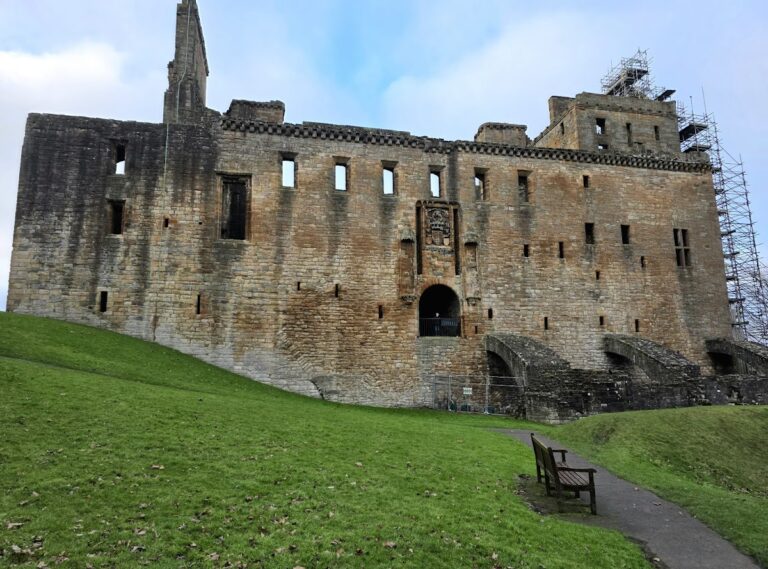
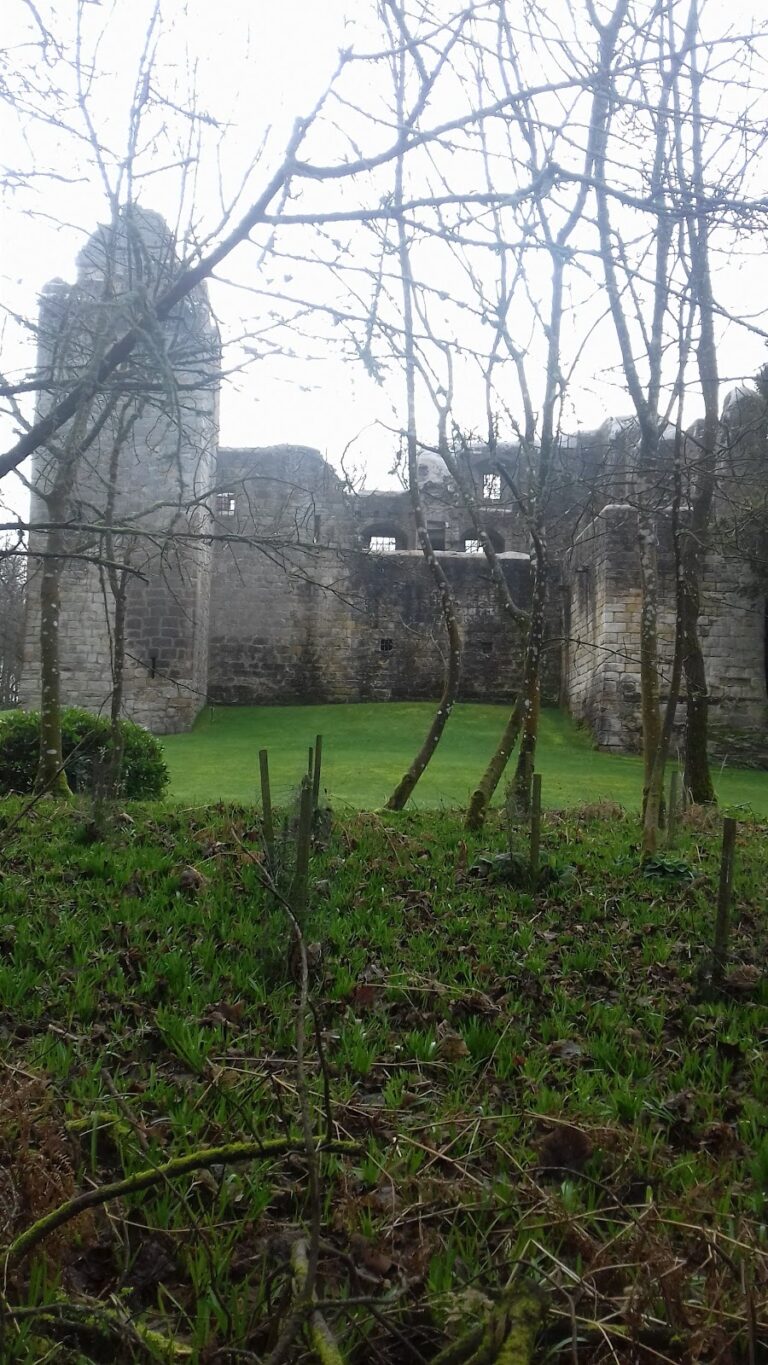
Kinneil House combines a symmetrical seventeenth-century mansion with an east wing from the mid-sixteenth century and surviving elements of an earlier fortified residence. The grounds extend beyond the house to the roofless parish church, the Antonine Wall, and the remains of a Roman fortlet. Together, these features preserve evidence of aristocratic occupation, domestic decoration, religious use, Roman military activity, and later archaeological investigation.
The Mansion and Painted Rooms
Main Block
The main block is a uniform mansion built in 1677 around fragments of the earlier tower house. Stone staircases stand at both ends, and two rows of wide-mouthed gunloops remain visible, especially on the windowless rear elevation. Gunloops are openings through which firearms could be used, and their survival shows that defensive features from the earlier building remained within the later residence. An inventory of 1688 names a Laich Hall at the entrance and a grand stair leading south to an upper dining room. The main house has since been gutted.
East Wing and Painted Rooms
The smaller east wing dates from the mid-sixteenth century and contains two painted rooms. Their former use is uncertain, although they were probably principal bed chambers. The house’s well lies concealed beneath the floor of the wing.
The room now called the Arbour Room has a vaulted ceiling and decoration imitating verdure tapestry, a style of dense foliage and landscape vegetation used as a setting for narrative scenes. Its painted subjects include Samson and Delilah, Abraham and Isaac, David and Bathsheba, and the Temptation of Saint Anthony. The room was redecorated around 1620, almost certainly by Valentine Jenkin, an English painter who was a burgess of Glasgow and painter of the Chapel Royal at Stirling Castle.
The second painted room contains scenes from the Parable of the Good Samaritan, Lucretia, Saint Jerome, and Mary Magdalene. Their subjects have been interpreted as references to the power of women, possibly in connection with Mary of Guise, Mary, Queen of Scots, and the two Tudor queens of England. The original painter is unknown, although the involvement of Guillaume, a French painter working in Edinburgh, has been suggested.
Heraldic Stones
One armorial, a carved heraldic panel, bears Arran’s ducal coronet and the collar of the Order of Saint Michael, a French chivalric order whose honors he received in France in 1548. Another armorial stone carries the Hamilton motto “Through!” and Margaret Douglas’s arms with her motto “Lock Sickar,” meaning secure or steadfast. This stone was formerly set on the north pavilion and is now displayed with other carved stones in a cellar.
Parish Church Remains
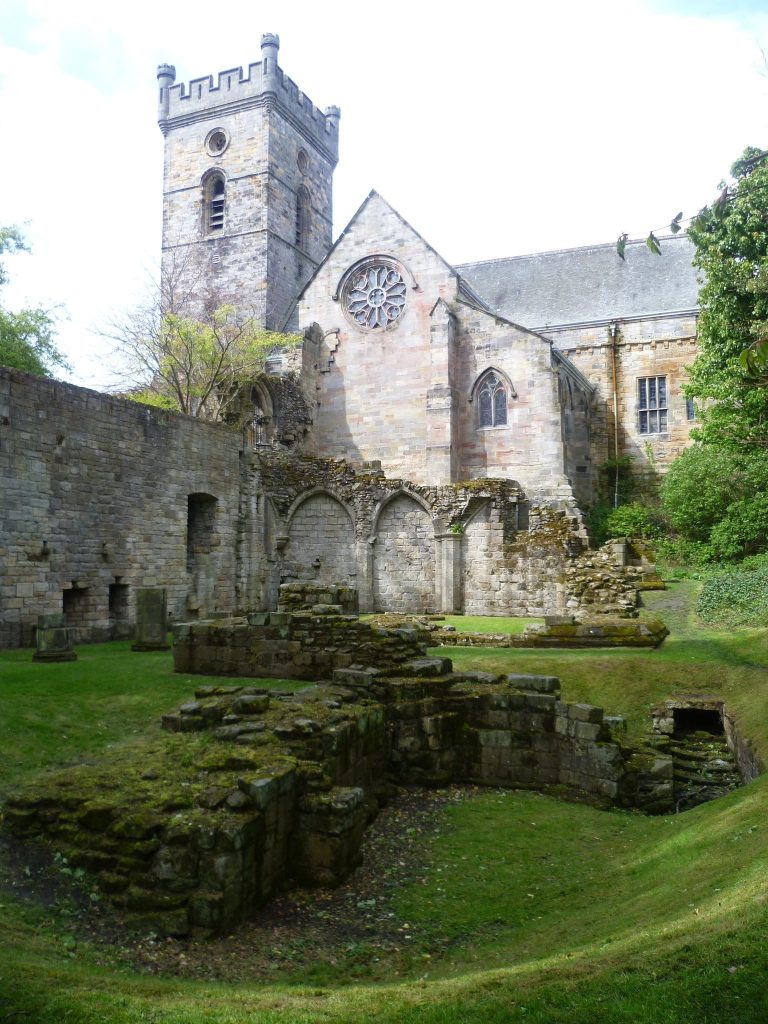
The former parish church stood west of the house across a narrow ravine. It survives as a roofless ruin, with its west gable still standing. A large stone cross from the church is kept with the house. One of the church bells, probably dating from the fifteenth century, is preserved in the nearby Kinneil Museum. Its incomplete inscription in Lombardic capitals names Katherine and mentions the Blessed Virgin; the bell may originally have been one of a pair.
Roman Frontier Remains
Antonine Wall
A section of the Antonine Wall runs through the public park around Kinneil House. A short part of the Roman rampart has been reconstructed. Excavation found laid firestone blocks forming part of the wall base, while only one kerbstone remained from that material.
Fortlet and Military Way
The Antonine fortlet, a small military installation associated with the Roman frontier, lies within the grounds, where its visible remains can be seen. It included two timber buildings. Finds linked with the fortlet include a Roman horse-harness loop, a fine leather shoe, and a single Roman coin. The harness fitting and shoe have been digitally reconstructed, as has the fortlet itself.
Nine trenches opened in 2018 exposed a metalled surface that was well preserved in one trench. This surface may have formed part of the Roman Military Way, the road serving the frontier installations. The surviving evidence adds a route element to the fortlet and wall remains within the wider Kinneil landscape.