Midhope Castle: A Scottish Tower House on the Hopetoun Estate



Site at a Glance
- Rating
- 4.3
- Popularity
- Medium
- Country
- United Kingdom
- Primary era
- Early Modern
- External website
- Open
- Eras represented
- Medieval, Early Modern
- Civilizations
- Kingdom of Scotland
- Site type
- Military
- Remains
- Castle
On this page7 sections
History
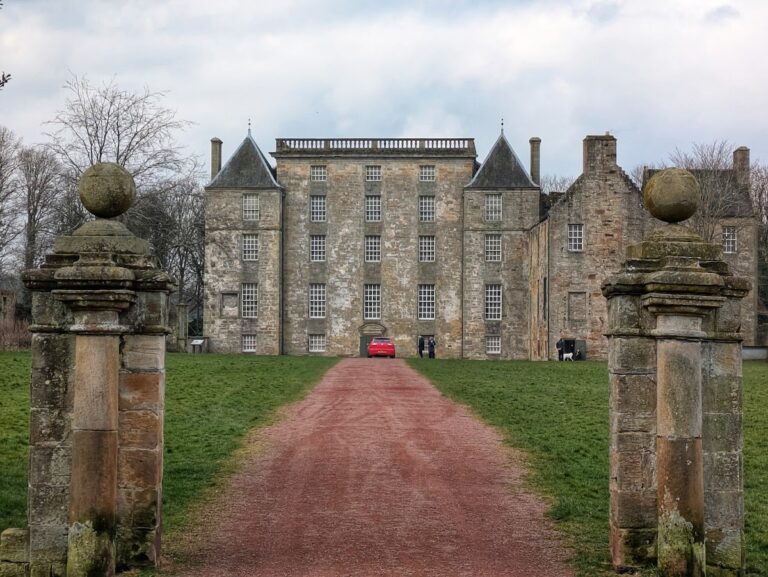
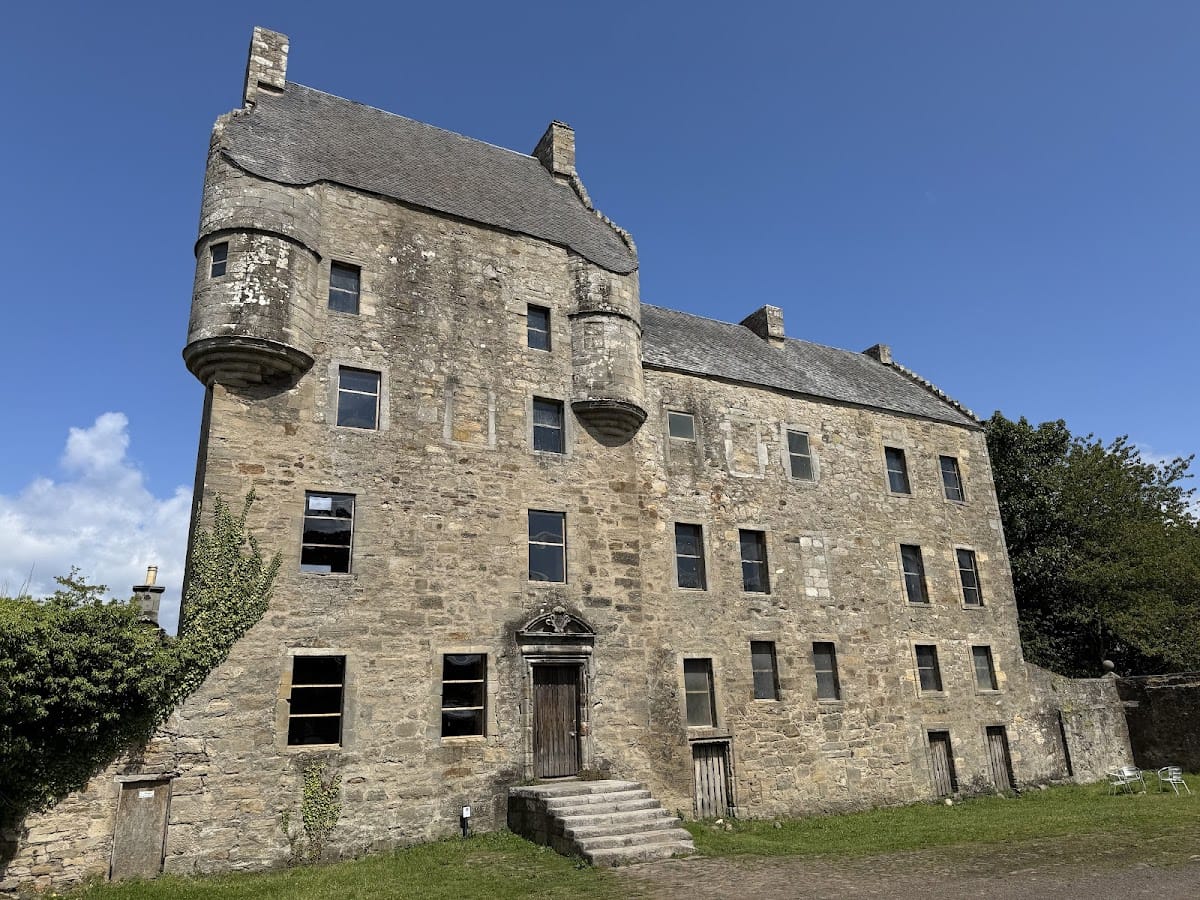
Midhope Castle is a late-sixteenth-century Scottish tower house in the United Kingdom, located at Abercorn near South Queensferry on the Hopetoun estate in West Lothian. Built as a fortified residence, it developed through the ownership of several local families before becoming part of the Hopetoun estate. The ruined building is a Category A listed building and is also associated with the television series Outlander, in which it represents Jamie Fraser’s family home, Lallybroch, also called Broch Tuarach.
The Graham and Martin lands
In the fourteenth century, Midhope was held by Henry Graham of Mannerstoun. When he died without a male heir, the lands passed to his two daughters. One married Robert Livingstone of Drumry and Mannerstoun, while Christian married John Martin of Midhope. Martin held Midhope from the Livingstone family of Drumry.
The Martin family held Midhope during the fifteenth century. John Martin of Midhope was laird in 1438 and is thought to have built the original tower house. His widow, Lady Christian Martin, retained the right to occupy Midhope through a contract with James Livingston of Mannerston.
Sixteenth-century ownership
In 1537, Sir James Hamilton of Finnart received a grant for half the lands of Midhope, half the lands of Mannerstoun, and half of the mill of Abercorn. The grant came from Elizabeth Martin, Lady of Falscastell, who held the lands from John Lindsay, 5th Lord Lindsay of the Byres.
Later in the sixteenth century, Midhope belonged to Alexander Drummond of Midhope, the brother of Robert Drummond of Carnock. Robert served as Master of Work to the Crown of Scotland, the royal official who supervised major building projects for the Scottish Crown. Alexander served the Earl of Huntly, who regarded him as a cousin. On 7 August 1573, Alexander returned jewels belonging to Mary, Queen of Scots, to Regent Morton at Holyrood Palace on the earl’s behalf. A regent governed Scotland for a monarch unable to rule personally. Alexander Drummond was later buried at Airth Old Kirk.
A stone marked “AD 1582 MB” commemorates Alexander Drummond and his wife, Marjory Bruce, daughter of Robert Bruce of Airth. Sir Robert Drummond became laird of Midhope in 1619. A painted ceiling from the tower probably commemorates his marriage to a Hamilton heiress.
Incorporation into the Hopetoun estate
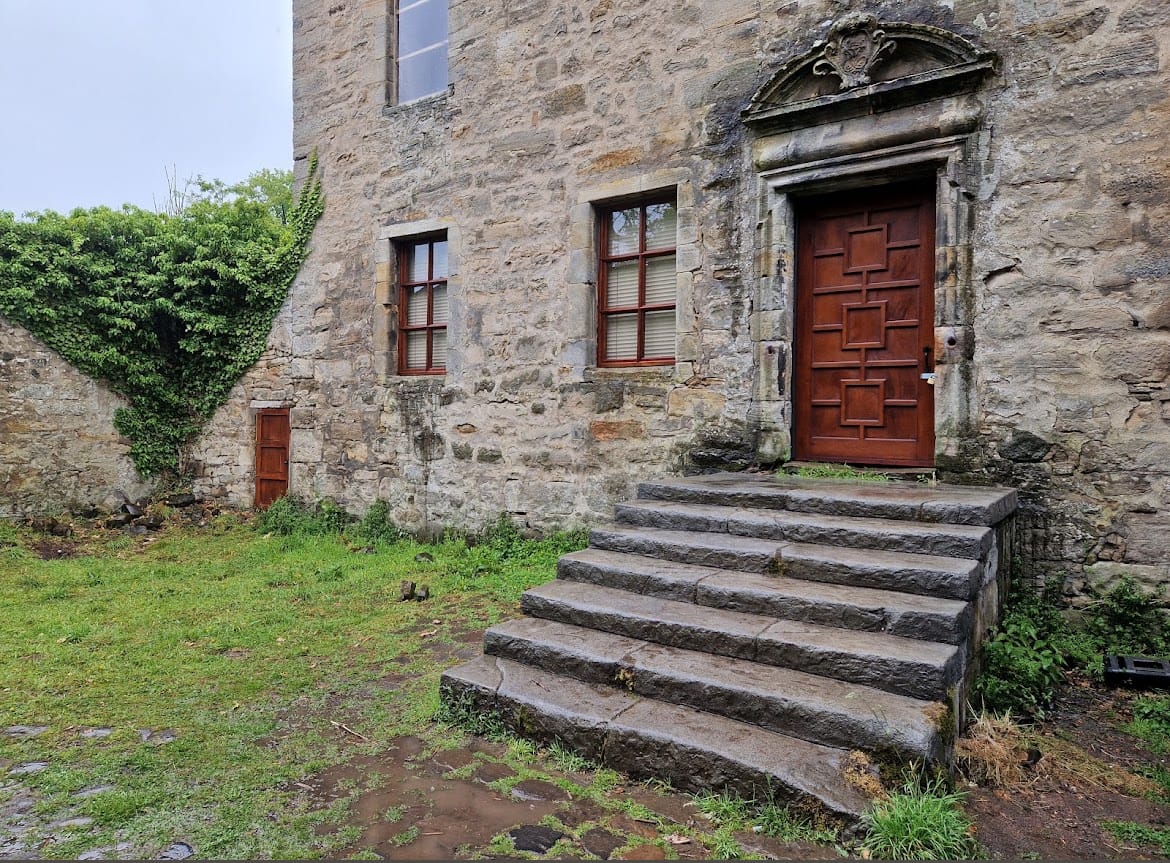
In 1678, the Hope family acquired Midhope and incorporated it into the Hopetoun estate. Major alterations followed. The entrance tower was removed, the eastern extension was enlarged and raised, a new doorway was made, and a small courtyard was created on the south side.
Midhope Castle is now derelict and ruined. Its later fame has been shaped in part by Outlander, where the building stands for Lallybroch, the Fraser family home.
Remains
The surviving castle is a much-altered, five-storey oblong tower house built of stone. Its present form reflects the changes made after the Hope family acquired Midhope in 1678. Those works removed the entrance tower, enlarged and heightened the eastern extension, added a new doorway, and formed a small courtyard on the south side measuring approximately 35 by 19 metres, or 114 by 61 feet.
Painted ceilings
One painted ceiling from the tower survives in the care of Historic Scotland in Edinburgh, the Scottish organization responsible for historic monuments and archaeological sites. It contains cinquefoil motifs, decorative forms with five lobes, and probably commemorates Sir Robert Drummond’s marriage to a Hamilton heiress.
Fragments of another painted ceiling preserve gold stars on a blue-black background. These motifs also appear in the family coat of arms, whose motto was ad astra per ardua.
Dovecot
Approximately 140 metres southeast of the castle stands a large oblong, two-chambered dovecot from the late seventeenth century. A dovecot is a purpose-built structure for keeping pigeons or doves, and this surviving building forms a separate part of Midhope’s historic estate landscape.