Dolmen de l’Hôtel-Dieu: A Neolithic Burial Monument in France
Site at a Glance
- Popularity
- Very Low
- Country
- France
- Primary era
- Stone Age
- Eras represented
- Stone Age
- Civilizations
- Unclassified
- Site type
- Burial
- Remains
- Tomb
On this page10 sections
History
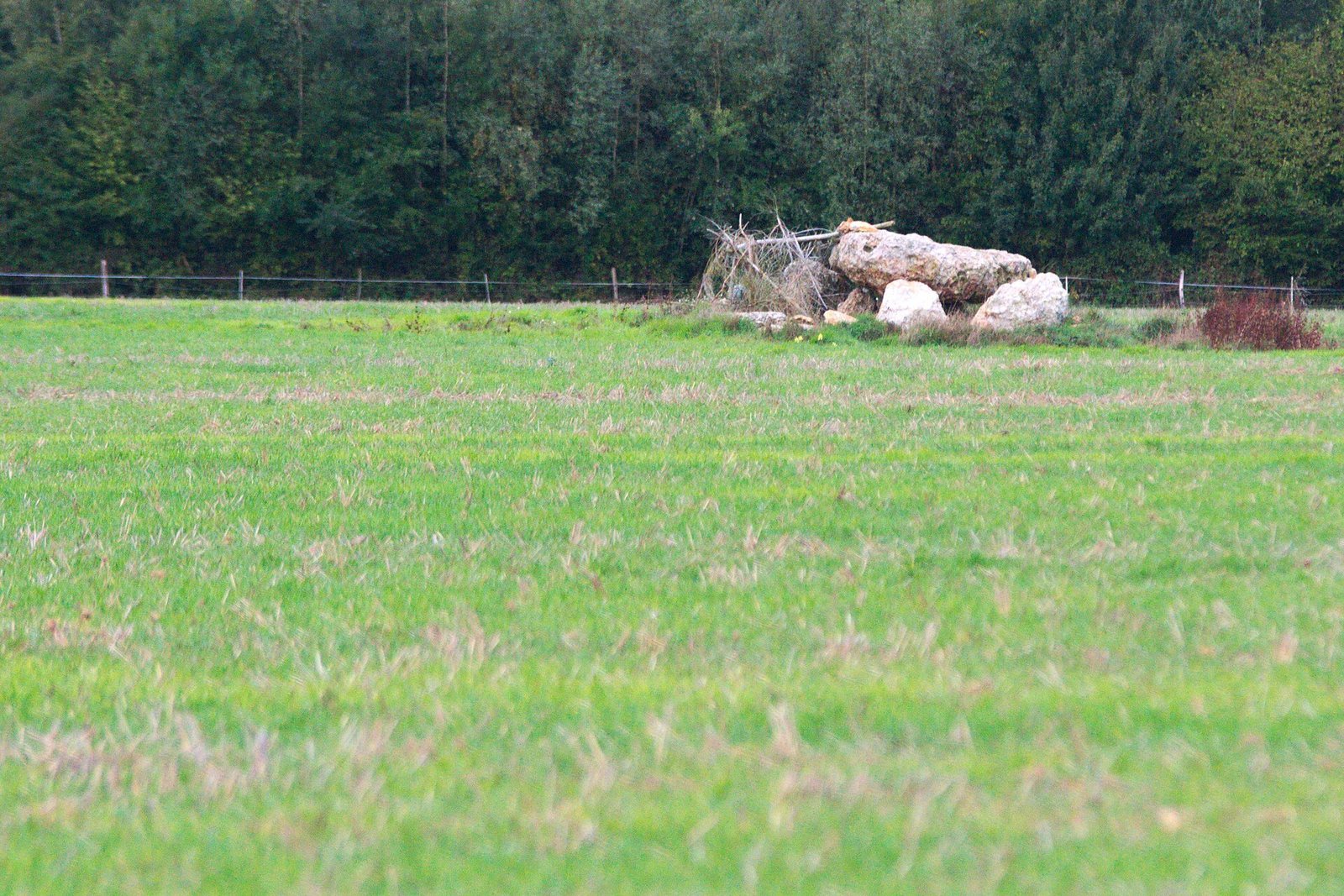
Dolmen de l’Hôtel-Dieu is a Neolithic megalithic burial structure in La Trigale, northwest of Les Ventes, France. A dolmen is a burial monument made from upright stones supporting a large capstone.
Nineteenth-century records
Louis-Léon Gadebled first recorded the monument in 1840, noting two dolmens in the commune of Les Ventes. In 1879, the Vicomte de Pulligny described its capstone as sloping after two supports had disappeared.
In 1896, Léon Coutil mistakenly reported that the dolmen had been destroyed. He returned in 1898, found it overgrown, and cleared the brush. A farmer had piled stones against it while clearing the field. Coutil made a plan and sketch during this visit, which appeared in 1909 in the Bulletin of the French Prehistoric Society.
Protection and excavation
In 1907, Alphonse-Georges Poulain corrected the report of the dolmen’s destruction and urged that it be protected. He also mentioned an oil painting of the monument by M. Papon, who donated the painting to the Museum of Évreux. The dolmen received France’s formal historic-monument protection status by decree on 2 January 1910. Jean-Pierre Watté excavated it in 1967.
Remains
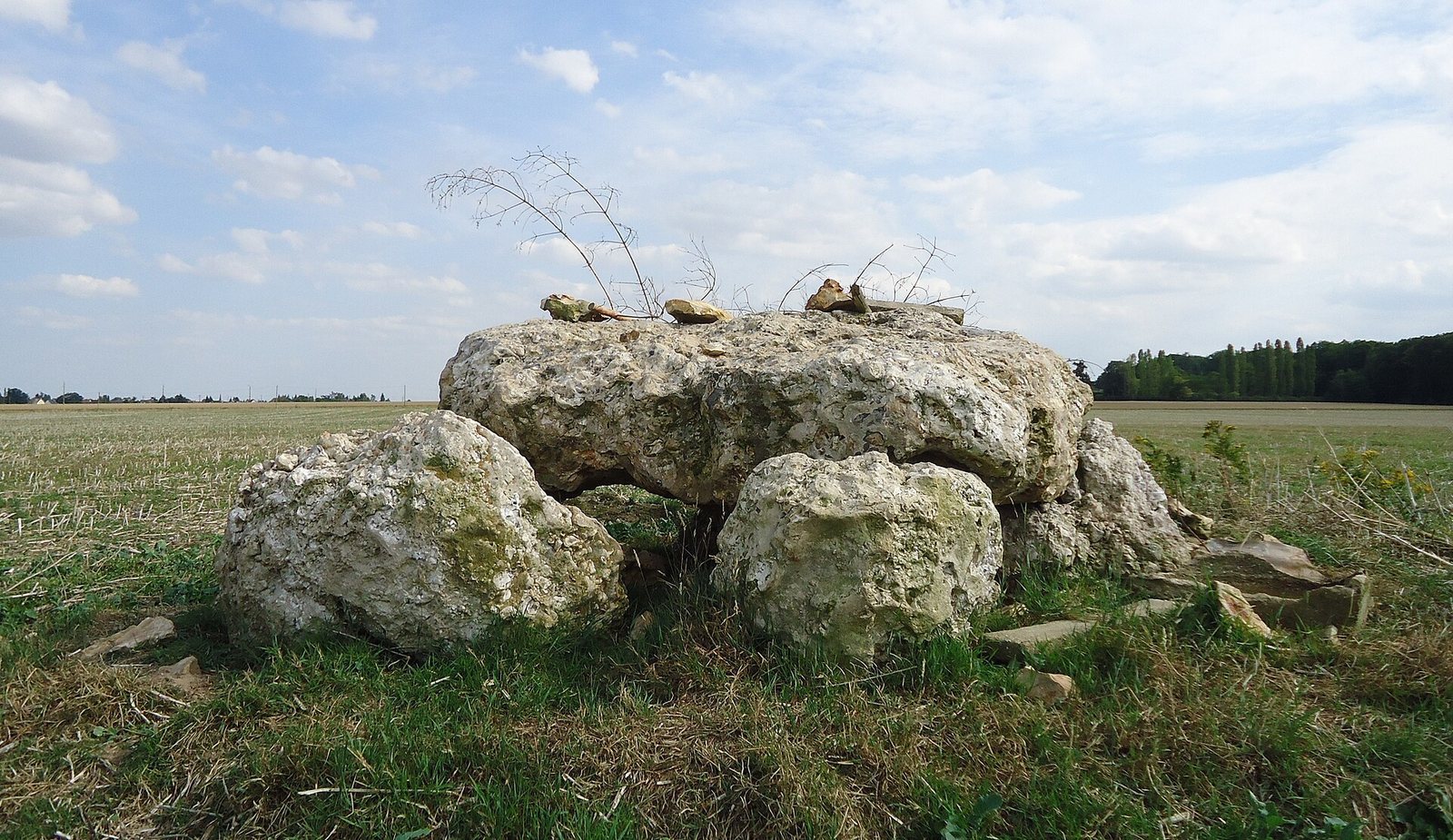
The monument is a low burial structure built around a large capstone, supporting stones, and a paved floor. It stands no more than 1.20 metres high and is also known as the Stone of the Druids.
Stone structure and burial floor
Capstone and supports
The roughly triangular capstone is made of conglomerate, a rock formed from rounded fragments cemented together. It measures about 2.60 by 2.10 metres and is 0.80 metres thick. Seven support stones remain, including one fallen stone measuring 1.90 metres long. The capstone has shifted and rests on only three supports, while the others have moved away over time.
Paving and deposits
The burial floor is paved with cut stones, mostly square and 10 to 40 centimetres across, with a thickness of about 8 centimetres. Some were shaped by repeated small blows, while others show clear wear. A 40-centimetre-thick archaeological deposit lies above the paving. Scattered blocks form an upper layer that may have served to close the burial structure.
Finds from the excavation
Human remains and stone tools
The 1967 excavation recovered bone fragments belonging to two people. Flint objects included trapezoidal arrowheads with transverse cutting edges, a fire striker, a scraper, an axe, and a polished chisel.
Pottery and ornaments
The pottery fragments were each less than 6 centimetres across. They had flat bases and straight or outward-flaring rims, and silica-rich material was present in the clay. Ornaments included a worn shell of the marine dog whelk Nucella lapillus, a bead with a four-sided cross-section, and a pear-shaped bead made of microcrystalline, fine-grained quartz.