Megalithic Tombs near Edendorf: A Neolithic Burial Ground in Germany
Site at a Glance
- Popularity
- Very Low
- Country
- Germany
- Primary era
- Stone Age
- Eras represented
- Stone Age
- Civilizations
- Unclassified
- Site type
- Burial
- Remains
- Necropolis
On this page11 sections
History
The Megalithic Tombs near Edendorf are Neolithic burial monuments in Lower Saxony, Germany, built by communities of the Funnel Beaker culture between 3500 and 2800 BCE. This farming culture of Neolithic northern and central Europe takes its name from the shape of some of its pottery. The two tombs that survive today were part of a much larger burial ground, which contained at least 14 graves.
The graves were spread across several locations rather than concentrated in one group. Grave 2 belonged to a cluster that included graves 3–5, while graves 6 and 7 formed another group about 1.5 kilometres northeast of Edendorf.
In the 1840s, Georg Otto Carl von Estorff, a German antiquarian who recorded prehistoric monuments in the Uelzen area, described nine tombs as still existing and illustrated six. Later, German prehistorian Ernst Sprockhoff assigned numbers 745 and 746 to the two surviving tombs. He numbered five destroyed tombs, previously recorded by von Estorff, 747–751.
Remains
The tombs were built from large stones, forming burial chambers associated with mounds or stone enclosures. The surviving monuments lie at separate locations near Edendorf, and early records preserve details of the arrangement and condition of several other graves.
Surviving tombs
Grave 1
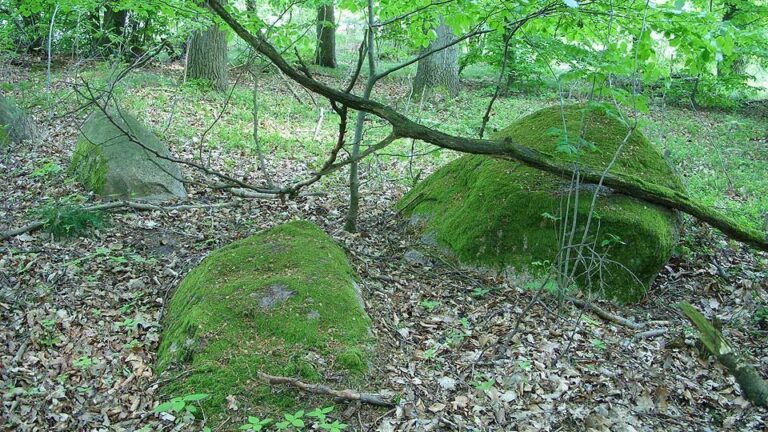
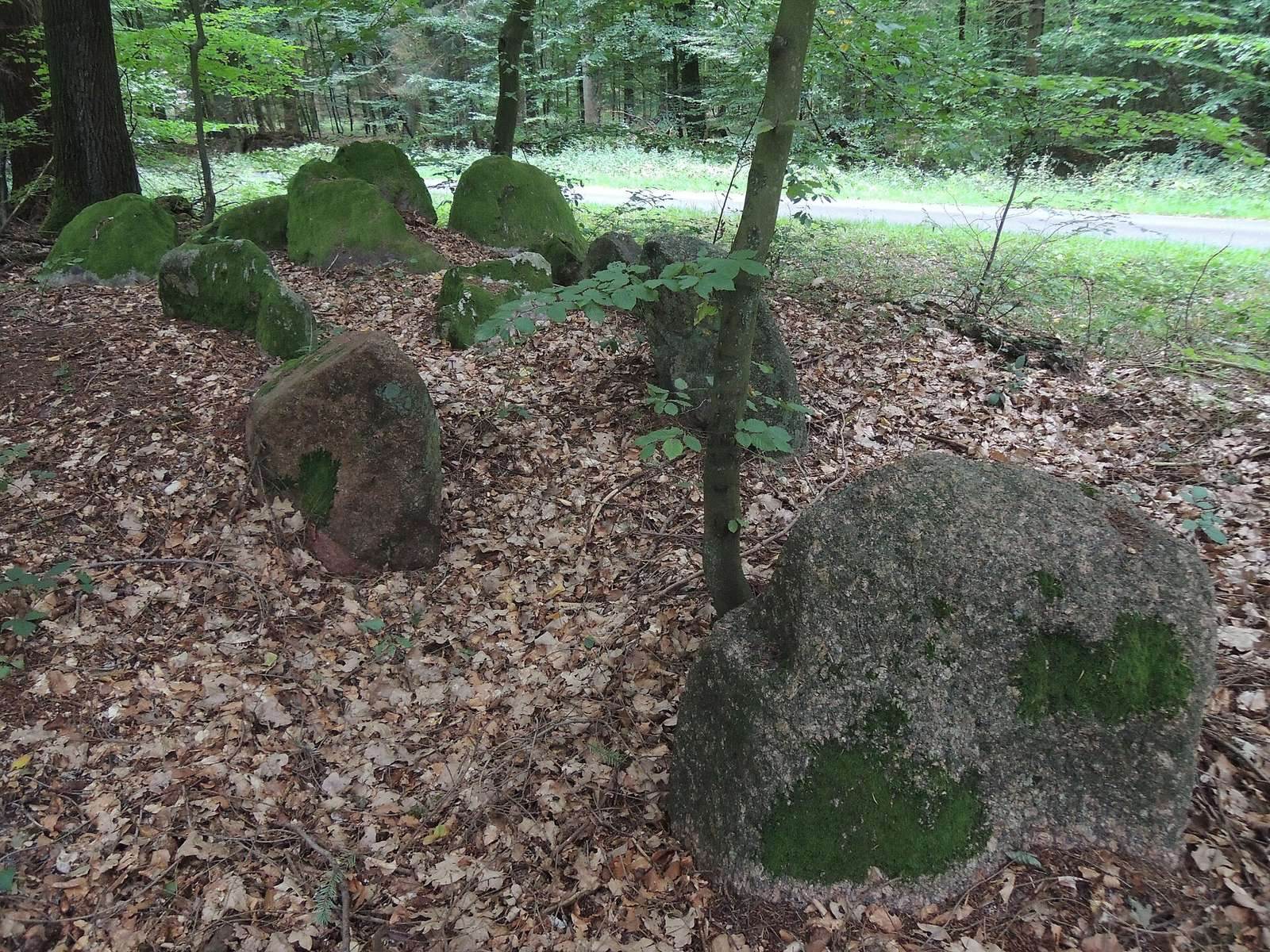
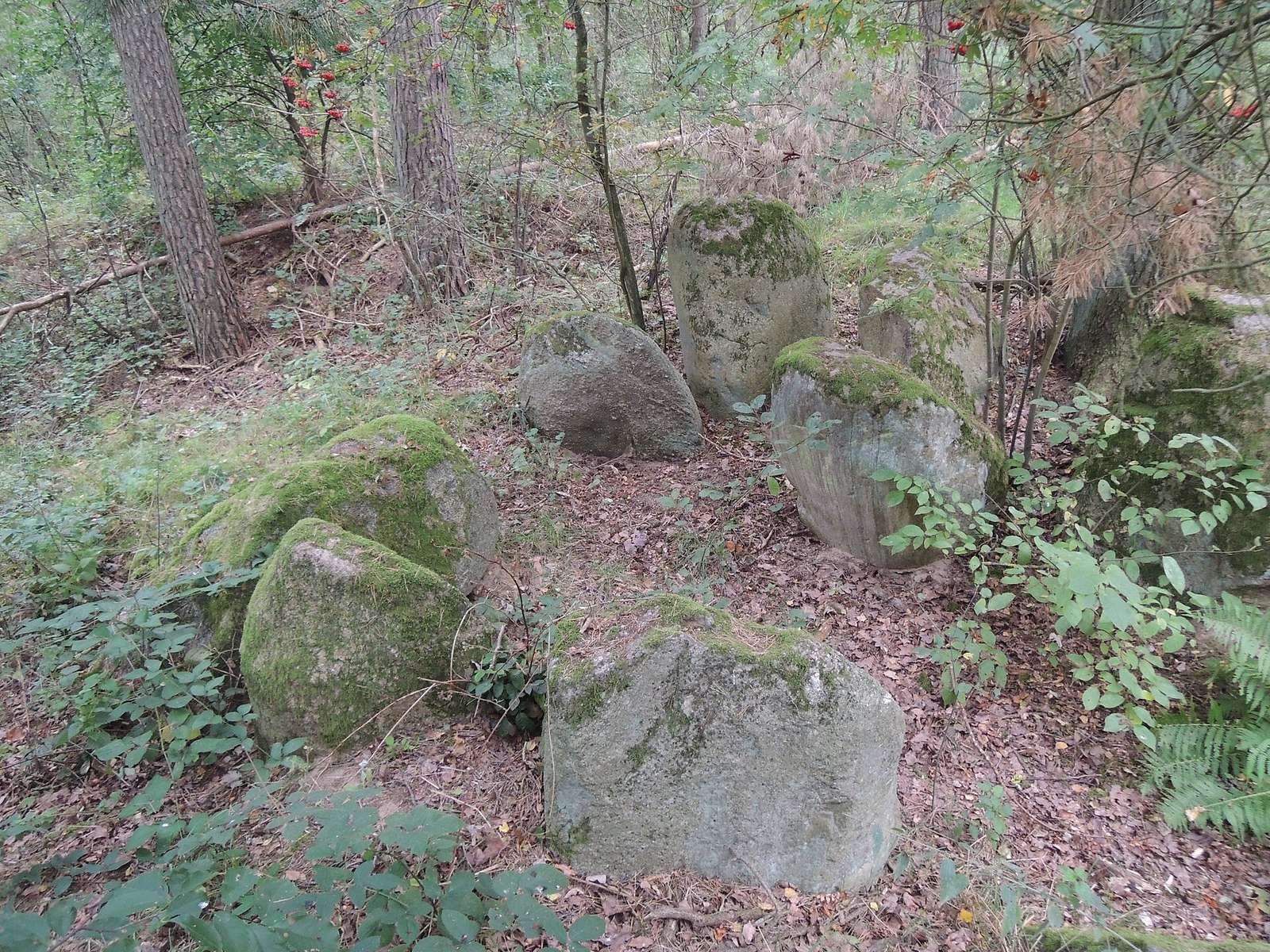
Grave 1 (Sprockhoff 745) stands in woodland northwest of the Solchtorf estate. Its mound runs north to south and is 1.2 metres high. The chamber originally had five pairs of wall stones along its long sides and five capstones. The two end stones remain, along with four wall stones on the west and three on the east. Two stones nearby may have belonged to the missing eastern side. The southern capstone is the only one still present; it is broken and lies inside the chamber.
Grave 2
Grave 2 (Sprockhoff 746), about one kilometre south of Edendorf, is a passage grave, a burial chamber reached through a passage. Its mound and chamber are oriented roughly east to west. Only the middle part of the chamber can be reconstructed; it is 1.4 metres wide, but its length is unknown. Four wall stones survive on the north side, including two still in place. The eastern stone has fallen inward, while the western stone leans outward and has lost its upper part. Three wall stones remain on the south side. A gap between the middle and eastern stones forms the entrance, beside which a pair of passage stones remains. A fallen capstone lies west of the chamber stones. Sprockhoff noted that it had still rested on the chamber in the 1950s; fragments of another capstone lie farther west.
Earlier recorded graves
Grave 3
Grave 3 (Sprockhoff 747) had a north-to-south stone enclosure about 30 metres long, wider at its northern end. Von Estorff’s record showed five stones at that end. Stones were already missing from the south end when he described it, and Sprockhoff proposed that three had originally stood there. A large gap interrupted the eastern side, and a stone at the southwest corner had fallen. The chamber stood at the enclosure’s narrower northern end. By the 1840s it was badly damaged: von Estorff found only the northern end stone, the adjoining western wall stone, and one capstone.
Grave 4
Grave 4 (Sprockhoff 748) had a north-to-south chamber about 9.5 to 10 metres long, with an end stone at each end and probably eight pairs of wall stones along the sides. Two stones on the western side were already missing when von Estorff recorded the tomb. He depicted six capstones, all fallen into the chamber.
Grave 5
Grave 5 (Sprockhoff 749) had a north-to-south chamber about 10 to 10.5 metres long, probably with eight pairs of wall stones along its sides. Von Estorff’s drawing shows that it was already damaged. His record depicts six capstones, one probably still resting on the wall stones; the southern capstone had split. Stones from graves 3–5 remain scattered nearby, but they cannot be assigned to individual tombs.
Grave 6
Grave 6 (Sprockhoff 750) had a damaged oval stone enclosure, 23 metres long and oriented northwest to southeast. Von Estorff depicted a large stone in its northwestern part. It may have marked a chamber covered by a single capstone.
Grave 7
Grave 7 (Sprockhoff 751) had an east-to-west chamber about 9 metres long. When von Estorff recorded it, gaps already interrupted both long sides, the eastern end stone remained in place, and the western end stone had been pushed outward. Of probably six original capstones, four could be identified clearly. Some still rested on wall stones, while the other two were probably broken inside the chamber. Today, only the mound remains. It is 85 metres long and 3 to 4 metres wide.