Megalithic Tombs near Burtevitz: Neolithic Dolmens in Germany
Site at a Glance
- Popularity
- Very Low
- Country
- Germany
- Primary era
- Stone Age
- Eras represented
- Stone Age, Bronze Age
- Civilizations
- Unclassified
- Site type
- Burial
- Remains
- Necropolis
On this page9 sections
History
Neolithic construction and later burials
The Megalithic Tombs near Burtevitz are a group of Neolithic dolmens in Germany. They are associated with the Funnel Beaker culture, a northern European Neolithic culture named for the shape of some of its pottery, and date to about 3500–2800 BCE. A dolmen is a megalithic tomb with a chamber formed by upright stones and large roof slabs. Four tombs survive from a group that may once have included 23.
The tombs were reused for later burials. A burial in Grave 2 belongs to the Single Grave culture, a later prehistoric culture associated with individual burials. Grave 3 also received a later burial. Ewald Schuldt considered it probably Bronze Age, though its date remains uncertain. He suggested it might be close in date to early Bronze Age secondary burials at Lancken-Granitz, and that its mound was probably enlarged at that time.
Mapping, damage, and archaeological study
Swedish cadastral maps made between 1692 and 1709 did not identify the tombs as graves, although some possible locations appear as small patches of trees or shrubs in fields. In the 1820s, Friedrich von Hagenow surveyed the group and marked 23 tombs on a map published in 1829. A list of his records published by Rudolf Baier in 1904 includes only seven, so the group’s original total is uncertain.
Researchers used different names and numbering systems for the tombs. The tomb called Preetz 1 by Ernst Sprockhoff is Burtevitz 2 in Schuldt’s numbering; three tombs also have Sprockhoff catalogue numbers 505–507. Grave 1 was badly damaged in 1926, when its capstones and southeastern endstone were taken for road construction. Sprockhoff measured three tombs in 1931 and reconstructed the chamber of Grave 1.
From July to November 1969, Schuldt and Erika Beltz excavated three tombs. Two were identified as megalithic tombs; the third was initially considered a Bronze Age mound. Anthropologist Hans Grimm examined skeletal remains from Grave 1, and his findings were published in 1984. In 2010, a joint project by the University of Greifswald’s Historical Institute and the German Archaeological Institute carried out magnetic surveys and fieldwalking around Burtevitz and nearby Lancken-Granitz, partly to search for tombs thought to have been destroyed. Excavations continued through 2011 around two Burtevitz tombs and one of their mounds.
Remains
The surviving dolmens
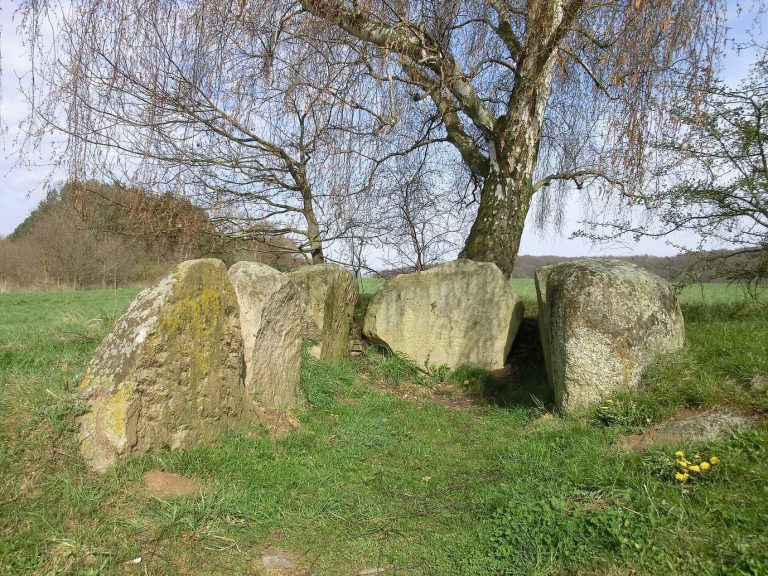
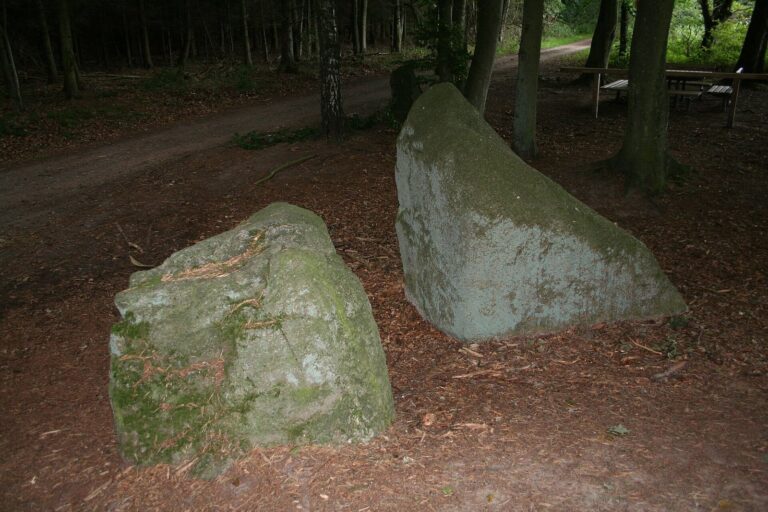
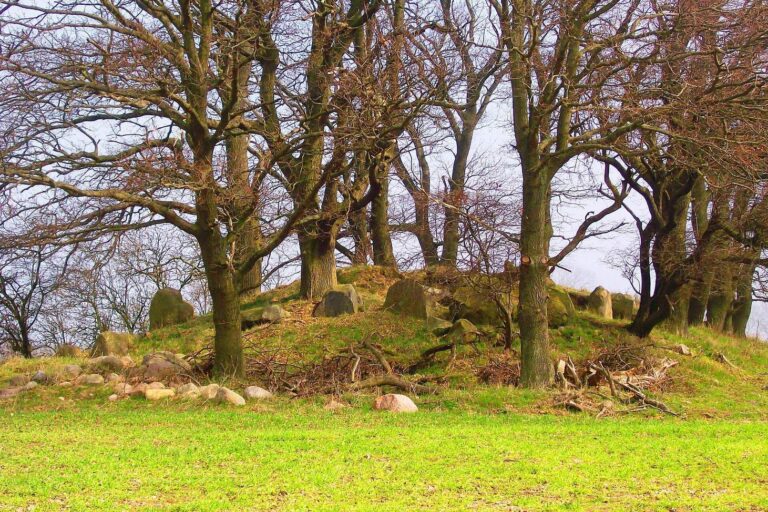
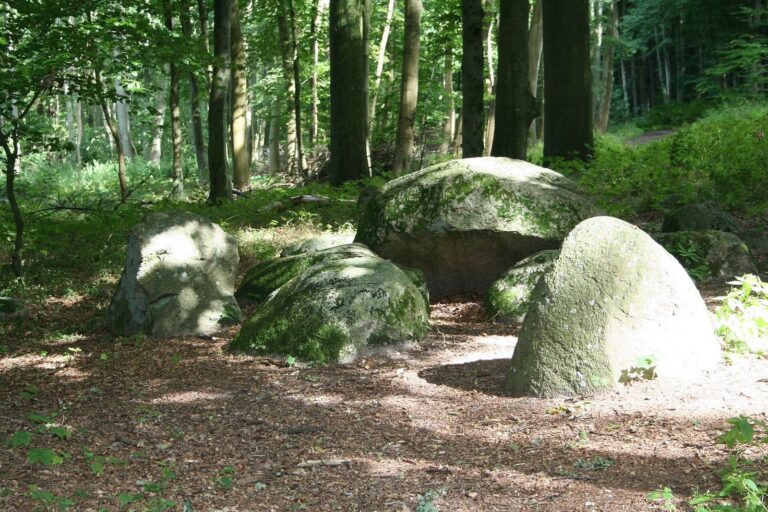
The four surviving tombs are large dolmens. Grave 2 stands at Burtevitz’s western edge, about 30 metres west of the road. The other three lie in a cluster about 840 metres to the northwest: Grave 4 is central, Grave 3 about 50 metres south of it, and Grave 1 about 80 metres east. Four tombs at Lancken-Granitz are about 120 metres northeast of the group; the Dummertevitz tomb is 1 kilometre southwest, and the Garftitz tomb is 2 kilometres northeast.
Grave 1
Grave 1’s chamber measures 4 by 2.2 metres. Excavation confirmed Sprockhoff’s reconstruction of three pairs of long-side stones, an endstone at each short end, and three capstones. The surviving structure retains the three pairs of long-side stones and the northwestern endstone. A fragment remains of the southeasternmost stone on the northeastern long side. Sandstone slabs laid both horizontally and vertically formed dry-stone masonry, in which fitted stones are held together without mortar.
Rounded stones and sandy loam filled the chamber to a depth of about 1 metre; this material contained crosswise arrowheads and pottery sherds. Beneath it was a 30-centimetre layer of brown sand that yielded most of the finds. These included human remains, ceramic vessels, a clay disc, 19 amber beads shaped like double axes and clubs, hammerstones, seven flint axes, two complete narrow chisels and part of another, blades, scrapers, and triangular and crosswise arrowheads. The remains represented an older adult man, a very young child, a child no older than six, and a child aged seven to twelve.
The chamber floor consists of stone paving covered with a 10-centimetre layer of clay; the chamber originally stood 1.5 metres high. A sloping slab and a recess in the paving near the middle of the northwestern long side may indicate an internal division. Another slab stands on the clay floor, leaning against the northwestern endstone, though its purpose is unclear. At the southeastern entrance, setting traces, threshold stones, and small slabs suggest an arrangement with a small endstone on the left and a stone screen on the right.
Grave 2
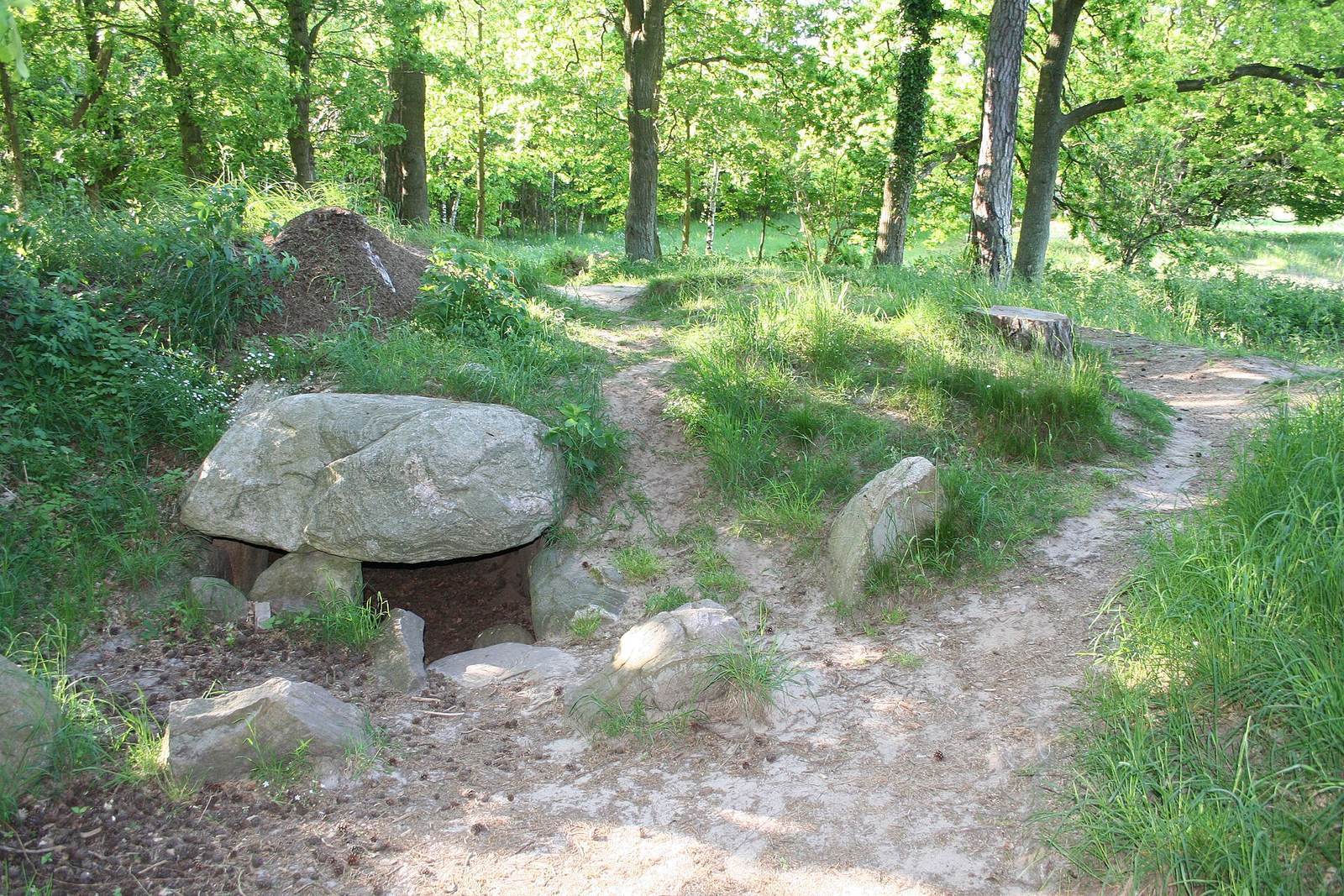
Grave 2 is oriented northeast to southwest. Its chamber measures 4 metres long, 2.5 metres wide, and 1.5 metres high. It was built with three pairs of long-side stones, a large southwestern endstone, and an entrance at the northeastern end. Blasting displaced stones on one long side and broke the endstone into several pieces, which remain roughly in their original position. Dry-stone masonry survives largely intact in the western corner. A threshold stone and part of a wall stone remain at the entrance, whose layout was thought to resemble those of the nearby tombs.
Red-sandstone slabs pave the floor beneath a thin clay surface. Upright slabs along the southeastern wall indicate that the chamber was divided into compartments. Finds above the clay included a flint chisel, two broad spear-shaped arrowheads, a beaker, and sherds from another vessel. Beneath the floor surface were numerous pottery sherds, some arranged in what appeared to be a second pavement. Finds attributed to the original Funnel Beaker burials consisted of vessel fragments and crosswise arrowheads.
Grave 3
Before excavation, Grave 3’s mound measured 12 metres across and 2 metres high. Its stone enclosure probably comprised 18 stones, of which Schuldt found 13. Beneath the sandy surface, a layer of small rounded stones began at a depth of about 25 centimetres, with sand below. Along the chamber, a clay covering contained layers of rounded stones at the level of the wall stones and slabs of different sizes at roof level, filling gaps between the capstones.
The chamber is oriented northwest to southeast and measures 3.7 by 1.8 metres, with a height of 1.3 metres. It has three pairs of long-side stones, a full-sized northwestern endstone, and three capstones; dry-stone masonry fills the gaps between the wall stones. At the southeastern end, a small endstone, 0.6 metres wide, occupies the left half, with the entrance to its right. One wall stone stands on the entrance’s southwestern side. Opposite it, a projecting northeastern corner stone and two upright slab-like stones apparently supported a door slab. The entrance’s red-sandstone roof slab measures 0.8 by 0.5 metres, and two other red-sandstone blocks lie in front. A 0.35-metre-wide stone screen connects the entrance to the chamber.
Ceramic vessels and a thick-necked hollow chisel of light-grey flint lay near the entrance and stone screen. Sand mixed with cremated human remains filled the chamber to its ceiling. Sherds found about halfway up matched pieces from the entrance. Beneath the fill was a partly reddened clay floor, with pottery sherds, a flat flint axe, and several red-sandstone slabs that were probably moved from their original positions as compartment dividers. In the southern part, a 5-centimetre clay surface covered a pavement of red-sandstone slabs.
Grave 4
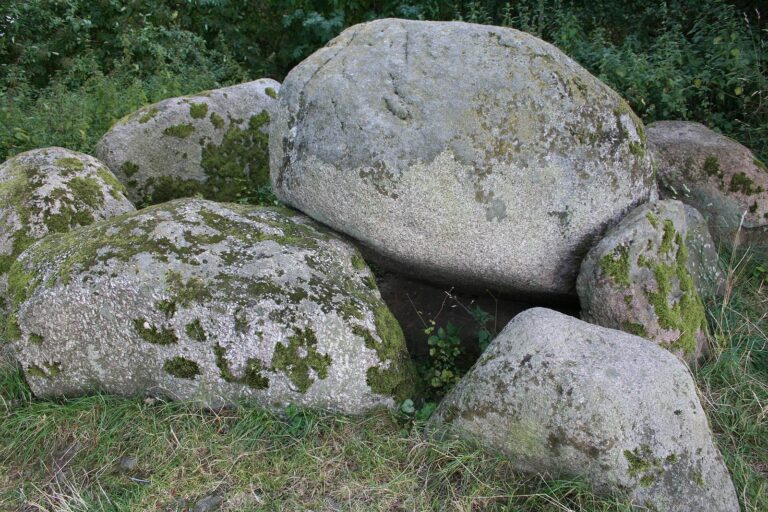
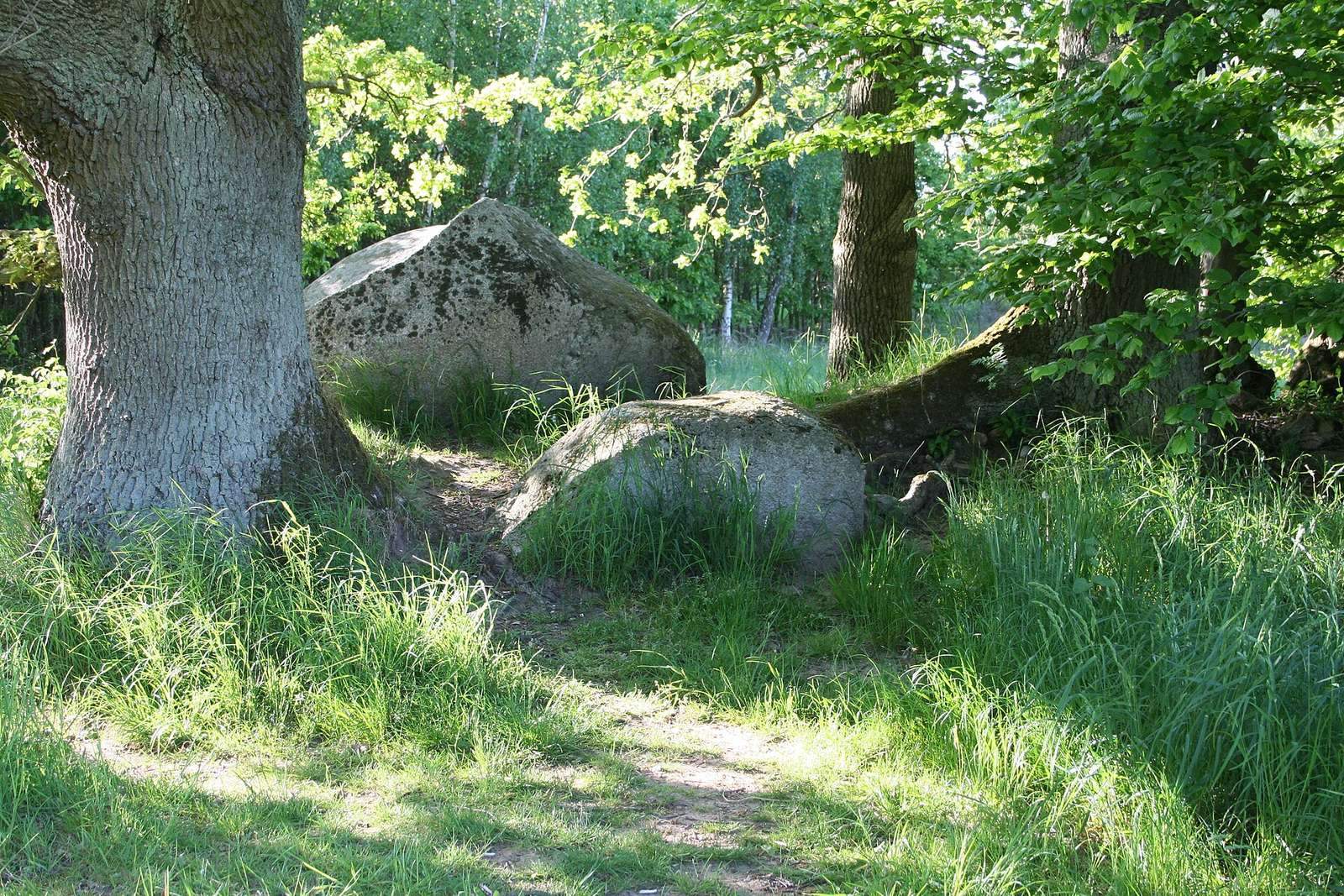
Grave 4 has a circular mound 9 metres across and 0.8 metres high. Its chamber is oriented northwest to southeast and measures about 4.5 by 2 metres. It probably originally had three pairs of long-side stones, two endstones, and three capstones. Two capstones remain in place; the northwestern one measures 2.5 by 1.6 metres and is 1.3 metres thick. Visible wall stones include the southeastern endstone and the two corner stones of the southwestern long wall. Sprockhoff considered the difficult-to-distinguish northwestern endstone likely to have been small and to have occupied only the left half of its short end, as at nearby tombs.