Lancken-Granitz Dolmens: Neolithic Tombs in Germany
Site at a Glance
- Popularity
- Medium
- Country
- Germany
- Primary era
- Stone Age
- Eras represented
- Stone Age
- Civilizations
- Unclassified
- Site type
- Burial
- Remains
- Necropolis
On this page14 sections
History
The Lancken-Granitz dolmens are a group of megalithic tombs near Lancken-Granitz in Germany, about 750 metres southwest of the settlement. A dolmen is a tomb built from large stones. Communities of the Funnelbeaker culture constructed the tombs during the Middle Neolithic, around 3500–2800 BCE. This northern and central European culture takes its name from its funnel-shaped pottery. The tombs served as burial places over many centuries, with evidence of later use extending into the Early Bronze Age.
Neolithic and Bronze Age use
Finds show repeated, and possibly continuous, use of several tombs over long periods. Material associated with the Single Grave culture, a later Neolithic group known for individual burials, indicates another phase of use around 2850–2250 BCE. Some tombs remained in use during the Early Bronze Age, dated here to about 1800–1100 BCE.
The end of use brought changes to individual tombs. After its final use, Grave 2 was filled, covered by a mound, and closed at the entrance. The reason is uncertain; possible explanations include a change in burial practice or the abandonment of the settlement associated with the tomb. In Schmidt’s separate numbering system, Dolmen 6 and its surrounding stone circle were also covered by a mound about two metres high. An excavation in 1969 revealed the tomb beneath it; before then, the mound had been regarded as a Bronze Age burial mound.
Later activity and historical accounts
Finds indicate that people returned to the tombs during the Iron Age, the Slavic period, and the early German period. The Slavic period refers to periods of Slavic settlement and culture in eastern and central Europe; the early German period describes medieval German settlement and political expansion east of the Elbe. In the Late Slavic period, Schmidt’s Dolmen 6 was reused for burial.
Land maps made during a Swedish survey between 1692 and 1709 did not name the tombs, though some locations appeared as small patches of trees and shrubs among fields. In 1730, the writer Ernst Heinrich Wackenroder described the stones as burial places. He also repeated a contemporary belief that pagan people had made sacrifices at such stones, including human sacrifices.
Friedrich von Hagenow, a surveyor and antiquarian, made the first scientific description of the Lancken-Granitz tombs in the 1820s. He identified eight, and his map of 1829 marked the northernmost as already destroyed. Rudolf Baier published Hagenow’s handwritten inventory in 1904. Ernst Sprockhoff measured the four surviving tombs in 1931 and later included them in his atlas of megalithic tombs.
Excavation and modern disturbance
Local teacher Friedrich-Wilhelm Furthmann and his wife helped protect dolmens in the Lancken-Granitz and Burtevitz area during the twentieth century. From July to November 1969, archaeologist Ewald Schuldt led excavations of the four surviving Lancken-Granitz tombs. They were restored soon afterward. The work formed part of a wider programme in which Schuldt’s team excavated 106 megalithic sites in present-day Mecklenburg-Vorpommern between 1964 and 1972. Anthropologist Hans Grimm studied the recovered human remains, publishing his results in 1984.
In more recent times, an East German collective farming organization used the tombs to dump stones cleared from fields. The East German army also used the excavated Dolmen 6 as a shelter. In 2010, the University of Greifswald’s Historical Institute and the German Archaeological Institute carried out magnetic surveys and fieldwalking around the Lancken-Granitz and Burtevitz tombs, including efforts to locate tombs believed to have been destroyed.
Remains
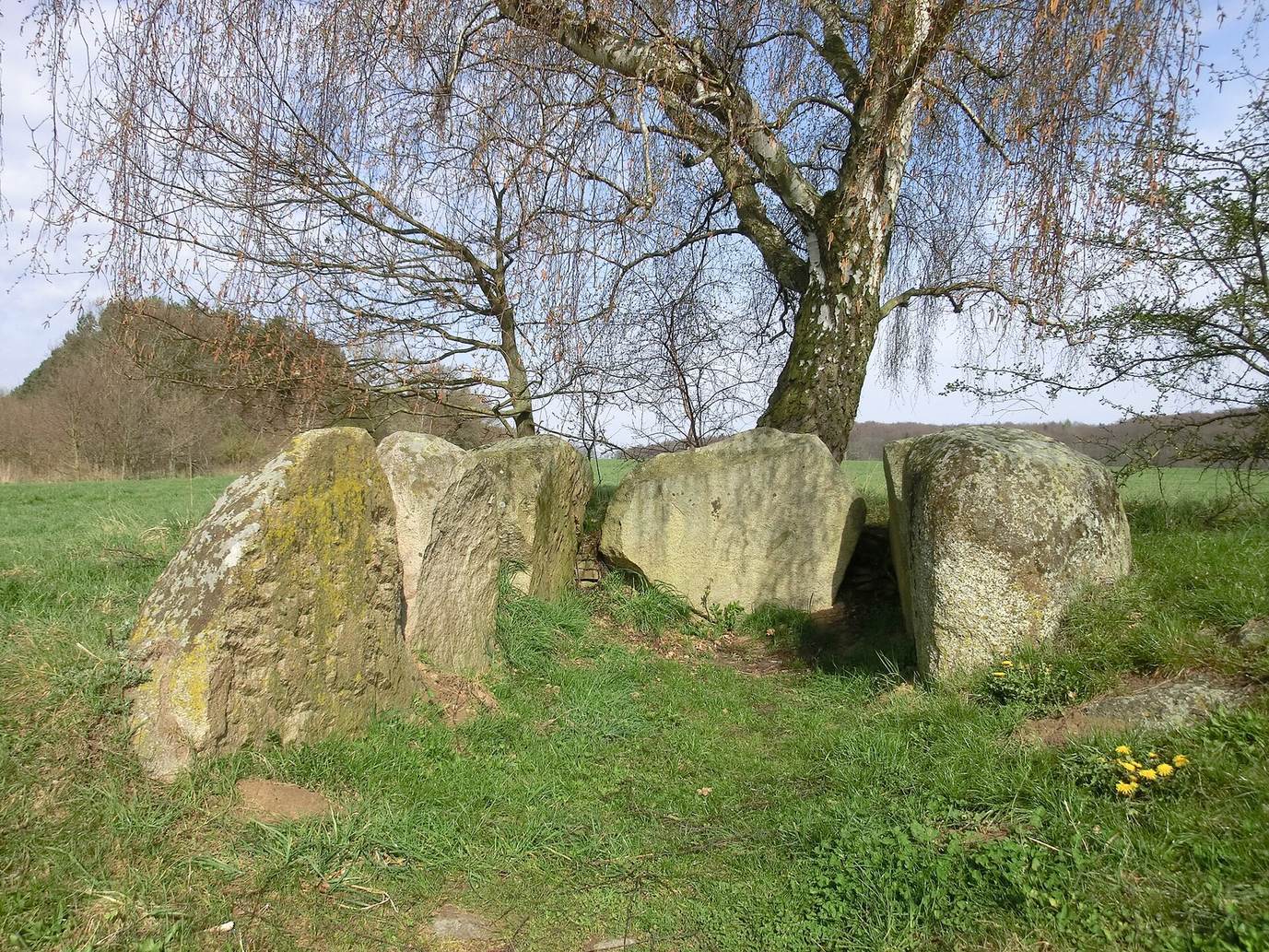
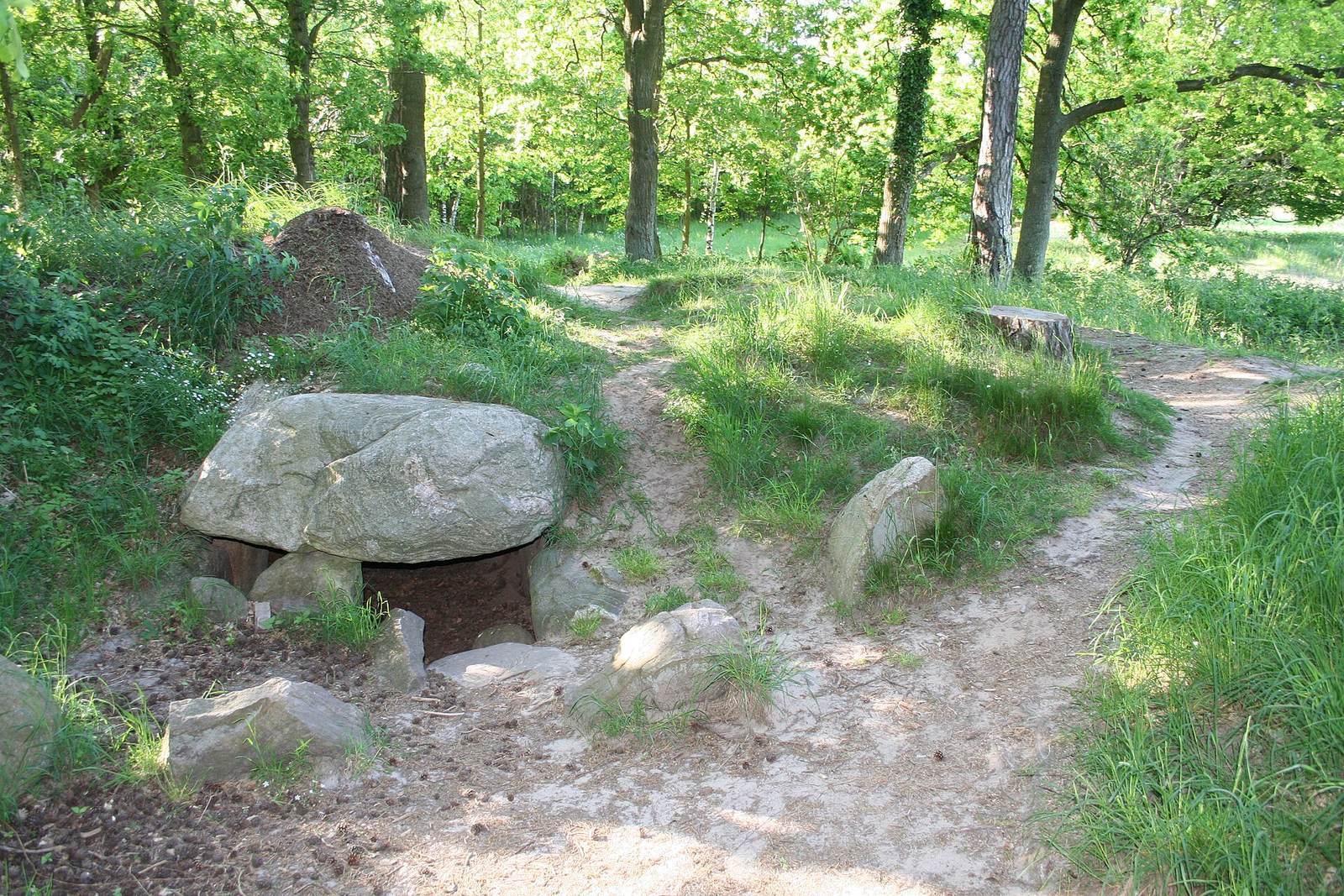
The surviving tombs combine chambers built from glacial erratics, boulders carried and deposited by ice, with red-sandstone slabs and, in places, clay used to fill gaps. Their chambers have broadly similar plans, but the surrounding mounds and stone enclosures vary. A long enclosure is an elongated burial mound bounded by stones; a guardian stone is a large upright stone set at the end of such an enclosure.
Setting and distribution
Graves 1, 2, and 3 form a close east–west group. Grave 1 lies 30 metres west of Grave 3, while Grave 2 is 40 metres east of it. Grave 4 stands 75 metres southwest of the group. Three surviving Burtevitz tombs lie about 120 metres southwest, with a fourth about 800 metres southwest. The Dummertevitz dolmen is about 1.1 kilometres southwest, and the Garftitz dolmen about 1.8 kilometres northeast.
Four destroyed tombs were recorded nearby. One lay just southeast of Grave 4, another about 700 metres east of the surviving group, and two others west and northwest of Lancken-Granitz. The recorded enclosures included oval and trapezoidal forms. The tomb near the surviving group was mapped as an east–west enclosure of unknown size, while an oval enclosure was associated with a tomb 250 metres north of the group.
The four surviving tombs
Grave 1
Grave 1 stands within an east–west enclosure measuring 20 by 7 metres, which slopes down to the west. Seventeen of an estimated original 31 enclosure stones survive. At its northeastern end is a 2.5-metre guardian stone. The low mound is elongated and oval. Near the enclosure’s centre, the chamber is set at an angle to it and measures 4.5 metres long, 2.2 metres wide, and 1.5 metres high. Its wall stones and three roof stones survive. Three wall stones line its eastern side, two larger ones form the west side, and a large closing stone marks the north end.
The entrance faces south and is made from red-sandstone slabs. A closing slab occupies half of the entrance, with a passage just under one metre long, 0.6 metres wide, and 0.8 metres high beside it. Two pairs of wall slabs and two roof stones form the passage. Sandstone laid without mortar fills gaps between the stones and toward the chamber; clay coats parts of this fill. Threshold stones stand at both ends of the passage, parallel to the closing slab.
At excavation, fill reached the chamber ceiling. Upper deposits included clayey sand, thin clay layers, rounded stones, and sandstone slabs. The floor has sandstone paving beneath two smoothed clay layers, with sandstone grit between them. Upright slabs later divided the chamber. One compartment beside the west wall remained intact; marks in the damaged floor suggested an earlier arrangement of three compartments along that wall and one across the north end.
Human bone had largely decayed. Finds included a granite rubbing stone measuring 35 by 17 centimetres, probably used to sharpen tools; 30 amber beads, many shaped like double axes; 55 arrowheads with cutting edges set across the arrow shaft; a battle axe, a comb-necked axe with a raised ridge at the back, two thick-butted axes, a flat axe, 15 blades, and pottery sherds. Bronze objects included a needle with a rolled head, parts of a chain, and a braided-wire finger ring. Many finds belong to the Funnelbeaker culture. The battle axe came from a later Neolithic burial, and the bronze objects indicate Early Bronze Age use.
Grave 2
The largest of the four tombs, Grave 2 occupies an east–west enclosure 30 metres long on a hill that drops steeply northward. Fourteen of its original 25 stones survive. At the enclosure’s west end, the chamber lies across its length on a north–south axis. It measures 4.5 metres long, 2.3 metres wide, and 1.6 metres high. Three pairs of wall stones line its long sides, with a closing stone at the north end. Two of the original three roof stones survive, and sandstone slabs fill gaps between the walls.
The southern entrance has a sandstone closing slab 1.4 metres wide and 0.2 metres thick, beside a passage one metre long, 0.6 metres wide, and 0.7 metres high. Two pairs of wall slabs and two roof stones form the passage. A slate door slab stood between the pairs, with a threshold stone on each side. The passage and chamber floors have thick smoothed-clay surfaces; the chamber’s clay layer is almost 0.2 metres deep. Rounded stones packed the passage’s outer end and the outside of the closing slab, with clay coating the lower part of the packing.
Excavation found the chamber filled to its ceiling. Clayey sand lay above rounded stones and sandstone slabs, with hard sandy clay lower down. Upright sandstone slabs divided the space into six compartments, four along the west side and two along the east. Finds included 21 amber beads, most shaped like double axes; flint blades; six axes; ten lance-shaped arrowheads; 143 transverse arrowheads; a chisel; two hard-stone axes, one double-edged; and sherds from 22 vessels. The arrowheads are the largest number recorded from a single tomb in Mecklenburg-Vorpommern. A later deposit contained a bronze chain and needle. Human remains survived as outlines in the fill.
Grave 3
A few metres west of Grave 2, the more damaged chamber of Grave 3 runs northwest to southeast and measures 3.6 metres long, 1.8 metres wide, and 1.3 metres high. Three pairs of wall stones form its long sides, with a closing stone at the northwest end. Some red-sandstone infill remains. Two of the original three roof stones had fallen into the chamber. After excavation, one, measuring 2.1 by 2 metres, was placed at the north end; the other was too short to rest on the walls and was set in front of the chamber.
The southeast closing slab measures one metre long, 0.8 metres high, and 0.1 metres thick. The passage survives as a threshold stone, a roof stone on its northeast side, and two fallen roof stones found in front. Sandstone slabs and rounded stones packed the outside of the closing slab, with clay around its base. Slate slabs paved the chamber beneath a smoothed clay surface, reddened by fire in places. The fill reached to within 0.4 metres of the ceiling, with rounded stones above clayey sand and flat stones near the floor.
The finds included two amber beads, two flint axes, three transverse arrowheads, ten blades and blade scrapers, a smoothing stone, a grinding stone, a granite rubbing ball, and pieces from at least nine vessels, some nearly intact. Human skeletons had completely decayed.
Grave 4
Before excavation, earth and dense bushes covered Grave 4’s circular mound, which measures 10 metres across and stands 0.7 metres high. Beneath it, the north–south chamber is 3.5 metres long and 1.8 metres wide. It is 1.4 metres high at the north end and 1.1 metres at the south. Three large stones form each long wall, and one large closing stone stands at the north end. That stone and the middle stone of the west wall came from a single glacial boulder. Two of the original three roof stones survive, and fragments of the missing northern one were recovered. Red-sandstone slabs form well-preserved infill between the wall stones, including on their eastern side.
An area measuring 2 by 3 metres immediately south of the chamber contained sandstone slabs laid irregularly, sometimes in several layers, at the original ground surface. Displaced grave goods among and beneath them included decorated pottery sherds, blades, and a thick-butted axe. Two flat blocks found farther south may have formed part of the enclosure.
The entrance faces south and has a short passage measuring 1.2 metres long, 0.6 metres wide, and 0.65 metres high. A small closing stone occupies its western half. Two outer standing stones and two inner wall slabs form the passage, each pair covered by a small roof stone. Sandstone masonry fills the gaps and extends toward the chamber, and a threshold stone stands midway along the passage. Before excavation, sand and large rounded stones filled the chamber. Its floor has thin gravel under smoothed clay, reddened by fire in places. Upright sandstone slabs divided the chamber into five compartments in a later phase; some eastern slabs were subsequently removed to place offerings.
Finds included narrow and hollow chisels, blades, thick-butted and flat axes, transverse and lance-shaped arrowheads, amber beads, pottery, and a smoothing stone. Human remains, including skull fragments, were concentrated mainly in the chamber’s northeast. Most vessels and large flint tools, double-axe-shaped amber beads, and lance-shaped arrowheads belong to the Funnelbeaker culture. Two thick-butted chisels and several amber pendants are associated with the Single Grave culture. A clay ladle and five bowl-shaped vessels date to the Early Bronze Age. Hans Grimm identified the remains of two people: a probably adult male whose age could not be determined more precisely, and a child who probably died at no more than six years old.
Dolmens in Schmidt’s separate numbering
A separate scheme used by Ingrid Schmidt groups seven dolmens in a line northwest of the road between Lancken and Klein Stresow, numbered from northeast to southwest. Dolmens 6 and 7 fall across the district boundary in Burtevitz, so this group includes tombs immediately outside the Lancken-Granitz district.
Stone enclosures
Standing stones form east–west rectangular enclosures around Dolmens 1 and 3, and a 12-metre-diameter stone circle around Dolmen 6. The rectangular enclosures measure 20.5 and 20 metres along their long sides. Dolmen 3 stands at the centre of its enclosure, where 16 stones survive; each long side originally had 13. A guardian stone stands beside its eastern short side. Dolmen 1 lies at the western end of its enclosure, while Dolmen 6 is centred within its circle.
Chambers and finds
In this numbering system, Dolmen 1 had three compartments on each side of its passage. Upright red-sandstone slabs formed the passage and some chamber divisions. Dolmen 2’s chamber arrangement was not established. A small black flintstone, rounded by the sea, came from Dolmen 4.
Dolmens 1–5 yielded numerous arrowheads, and blades came from Dolmens 1, 3, 4, and 5. Dolmen 1 contained two stone axes, while Dolmen 3 contained two more, including an uncommon comb-necked axe. Human skull and bone remains came from Dolmens 3 and 4. The double-axe shape of some amber beads has prompted the interpretation that they may have served a magical purpose. Pottery may have held food, and other organic offerings may have decomposed.