Kinđa: A Possible Burial Mound near Kikinda, Serbia
Site at a Glance
- Popularity
- Low
- Country
- Serbia
- Primary era
- Unclassified
- Eras represented
- Unclassified
- Civilizations
- Unclassified
- Site type
- Burial
- Remains
- Burial Mound
On this page8 sections
History
Uncertain origins and local traditions
Kinđa is an artificial earthen mound near Kikinda, Serbia, whose date and cultural affiliation remain uncertain. It has been proposed as a Sarmatian or Scythian burial mound dating from the third to first centuries BCE, or as a Cuman burial mound of the 13th century. A kurgan is an artificial earthwork covering or marking a grave. No archaeological excavation has tested these competing interpretations.
The Cuman proposal draws on the Cumans’ arrival in Banat in the 13th century while fleeing Tatars, a historical term associated with peoples involved in Mongol-led incursions into Europe. They were the last people known in the region to bury their dead in such mounds. Kinđa has also been described as at least eight centuries old, but that broad estimate does not resolve its date. Local tradition calls it the grave of Attila the Hun, the fifth-century Hun ruler; the burial attribution remains unconfirmed.
The mound’s name is also recorded as Kenđa, but its meaning is unresolved. Kinđa is used for the surrounding tract and Kikinda’s northern suburb. The Kikinda Museum’s archaeological section has presented the mound as one possible origin of the town’s name, alongside other proposed explanations, but this connection is not universally accepted.
Recognition and modern damage
Kikinda’s municipal spatial plan, adopted in 2013, lists Kinđa as an archaeologically important locality. The mound is not state-protected and has not been designated a cultural monument.
In May 2017, Almex Kinđa, an agricultural company that had owned land in the area since 2011, used heavy machinery on the mound. The company apologized, saying it had not known that a special procedure applied, and was warned to take greater care. It said that 10 cubic metres of earth had been moved from a mound estimated at 6,000 cubic metres; photographs indicated that 30–40 percent was missing, and the damage may have reached half the mound. The machinery use was suspected to be an illegal attempt to loot a presumed grave, but the outcome remains unknown.
Remains
Form and setting
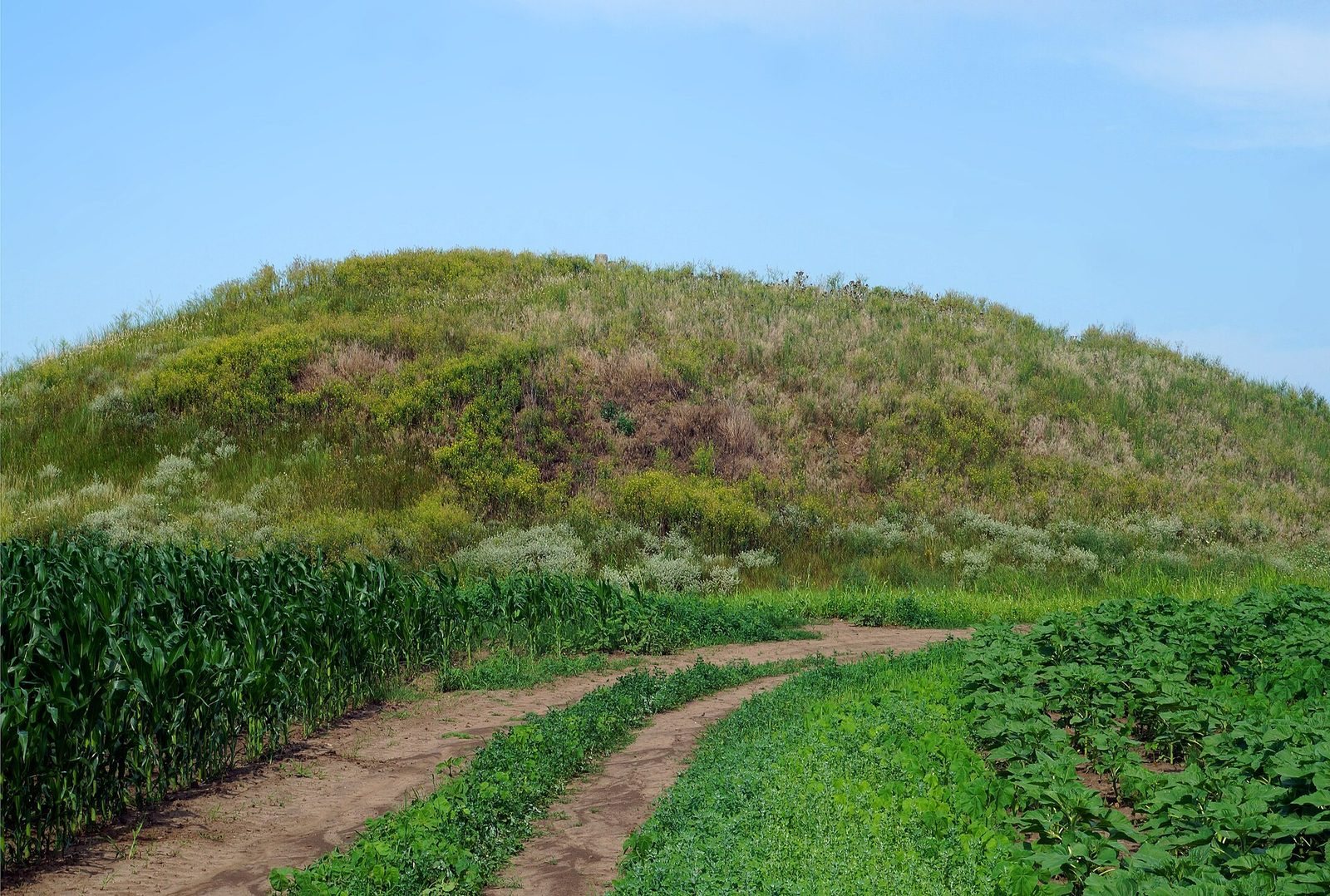
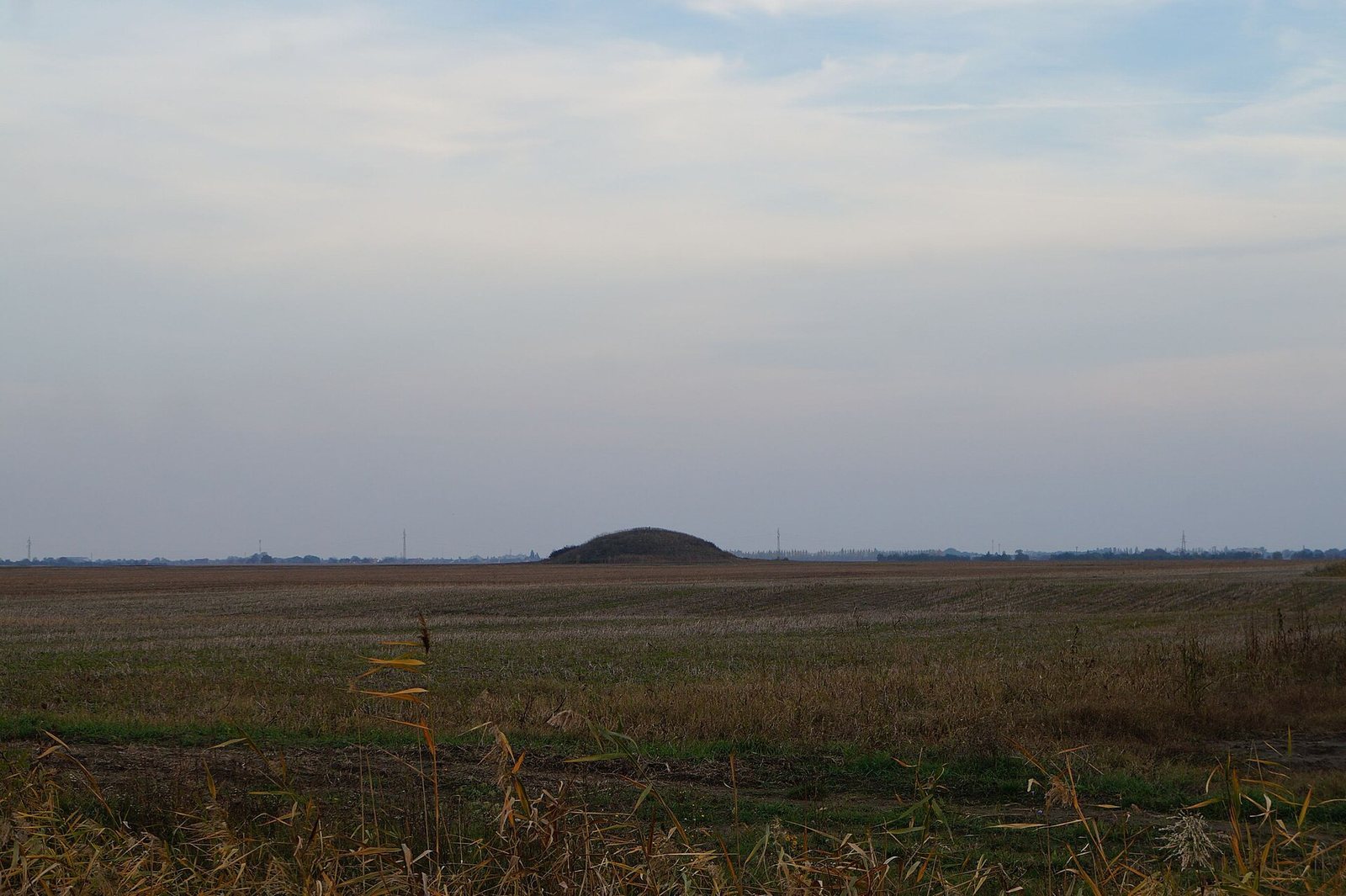
Kinđa is roughly circular, about 50 metres across and 5.3–6 metres high above the surrounding ground. It forms a high point in the exceptionally flat local terrain, though it is not the highest point in northern Banat. The mound stands in low alluvial ground that was once marshland. Waterways meandered through the area, naturally enriching its soils; some were later drained through artificial channels.
Condition and archaeological finds
Before the damage, Kinđa was regarded as one of Serbia’s largest and best-preserved burial mounds, and as the best-preserved mound in northern Banat. Its northeastern side was cut away in a section up to 3.5 metres high; some earth was removed and some flattened, leaving damage considered irreparable. Medieval pottery fragments were found during an inspection.
Vegetation
Native steppe and pasture plants cover the mound, preserving a local reserve of flora displaced elsewhere by intensive agriculture. Crested wheat grass (Agropyron cristatum) grows in small tufts near the summit, where feather grass (Stipa sp.) also grows. Feather grass is now nearly absent elsewhere in Banat. Common couch grass (Elytrigia repens) grows near the approach, while white horehound (Marrubium peregrinum) covers a wider area. White horehound was formerly used to treat lung diseases and coughs. The mound’s foothills had not been cultivated, and established plants on its slope helped limit weeds spreading from surrounding fields.
Nearby archaeological landscape
Other rises around Kikinda, some possibly burial mounds, form part of a rich Copper Age landscape. Five or six nearby mounds are in poor condition and have been reduced by agriculture; the company Kinđa-Agrar, later Almex Kinđa, was partly responsible for damage to some. A lower mound about 500 metres west of Kinđa has been ploughed by heavy machinery. A rise about 2.3 kilometres east may be another mound or earth left by an abandoned oil bore. The earthen fortification of Gradište, an archaeologically important site in the village of Iđoš, is also nearby.