Church of Saint Mary of Eunate: A Romanesque Pilgrimage Church in Navarre
Site at a Glance
- Popularity
- High
- Country
- Spain
- Primary era
- Medieval
- Eras represented
- Medieval, Modern
- Civilizations
- Kingdom of Navarre, Spanish
- Site type
- Religious
- Remains
- Church
On this page9 sections
History
Foundation and pilgrimage
The Church of Saint Mary of Eunate is a Catholic church in the countryside near Muruzábal, Navarre, Spain, built around 1170 in the late twelfth century. Its Romanesque architecture, a medieval style associated with rounded arches and substantial masonry, shows Mozarabic influence, meaning Christian artistic traditions shaped by Muslim rule or influence in medieval Iberia. The church is also classified as early Gothic.
Eunate stands on the Aragonese branch of the Camino de Santiago, a network of pilgrimage routes leading to Santiago de Compostela. This route crosses the Pyrenees at the Somport pass and joins the route from Roncesvalles at Puente la Reina, west of the church. Eunate served as a hermitage, a small place of worship often set apart from a settlement, dedicated to the Virgin Mary. A 1487 record names a religious association devoted to the Virgin of Eunate. People from across the Valdizarbe valley continue to make a traditional pilgrimage to the church. Another proposal holds that it was built to protect pilgrims from robbery.
Debates over patronage and purpose
Since the late nineteenth century, the church’s original patronage and purpose have been debated. A proposed connection with the Knights Templar, a medieval religious-military order, is now generally rejected because no documentary evidence places the order at Eunate. Another theory identifies the church as a hospice or pilgrims’ hospital run by the Order of Saint John of Jerusalem, a religious-military order that also maintained facilities for pilgrims. A 1251 record describes the order granting a roadside hospital to brethren in Obanos, but it is unclear whether that hospital stood at Eunate or Puente la Reina.
A 1520 document from Pamplona Cathedral claims that Queen Antsa, a Basque form of Sancha, ordered the church built and was buried there. The claim is questioned because the document is relatively late and she was reportedly buried at Pamplona Cathedral. The popular derivation of Eunate from Basque words meaning ‘one hundred gates’ is also rejected. It rests on counting 33 arcade arches across three supposed circuits, then adding an entrance. Older forms of the name include Onat, Onate, Unat, and Unate; Basque remained in local use until the nineteenth century.
Protection and restoration
Spain has protected the church as a Bien de Interés Cultural, a protected asset of cultural significance, since 3 June 1931. A restoration campaign in 1940–43 included archaeological excavations outside the surrounding wall. Some elements may have been added freely during this work.
Remains
The church
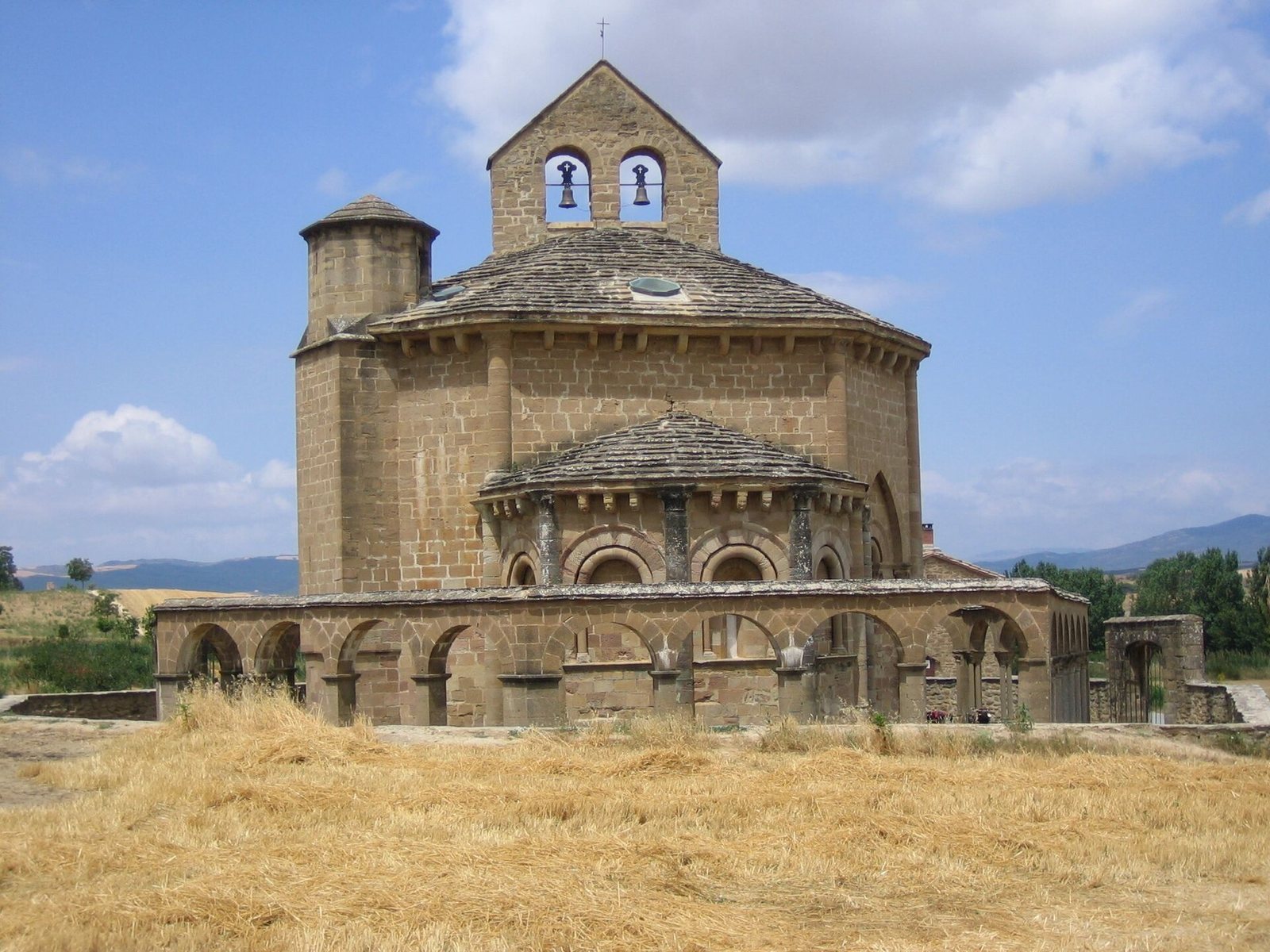
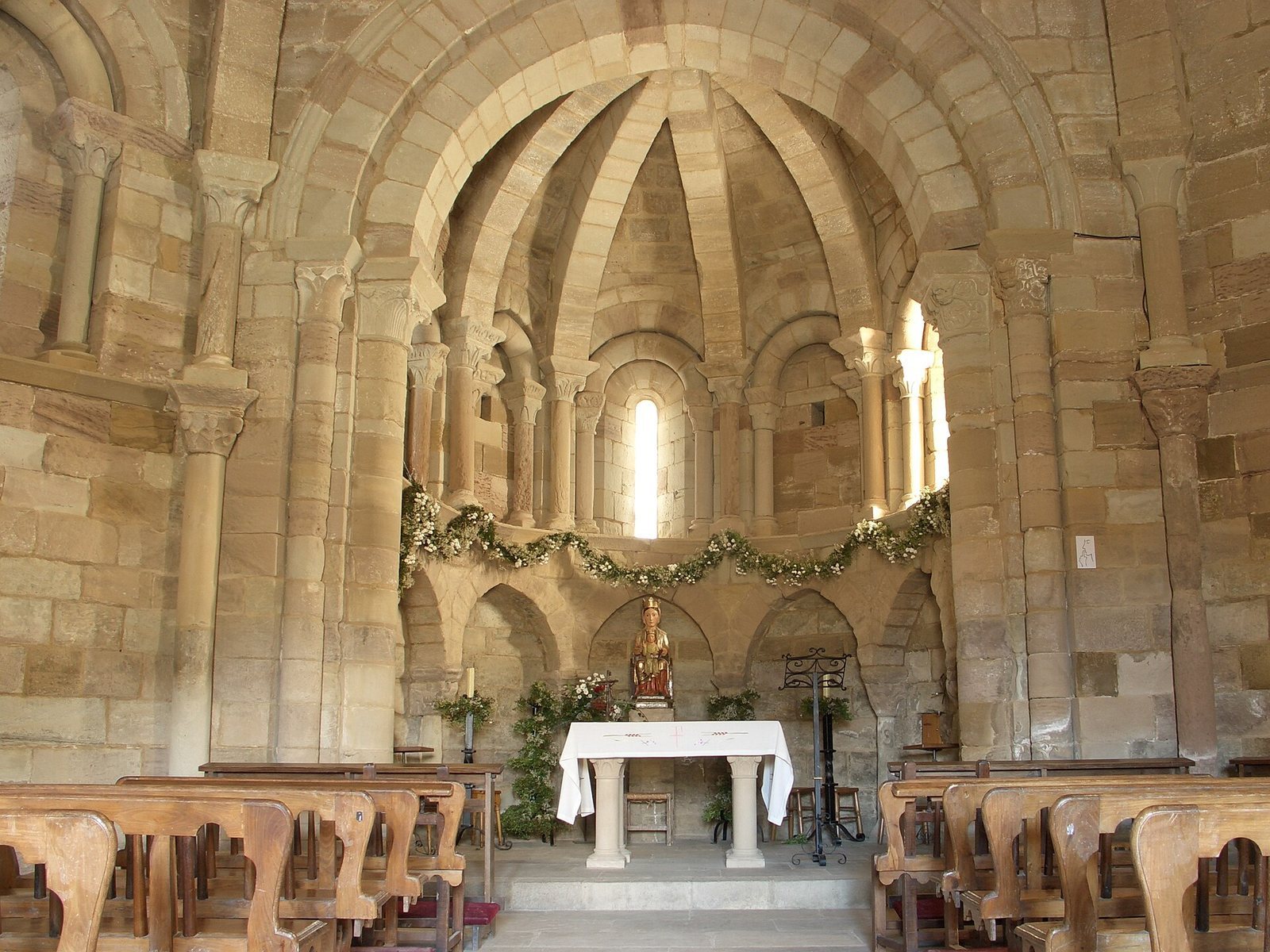
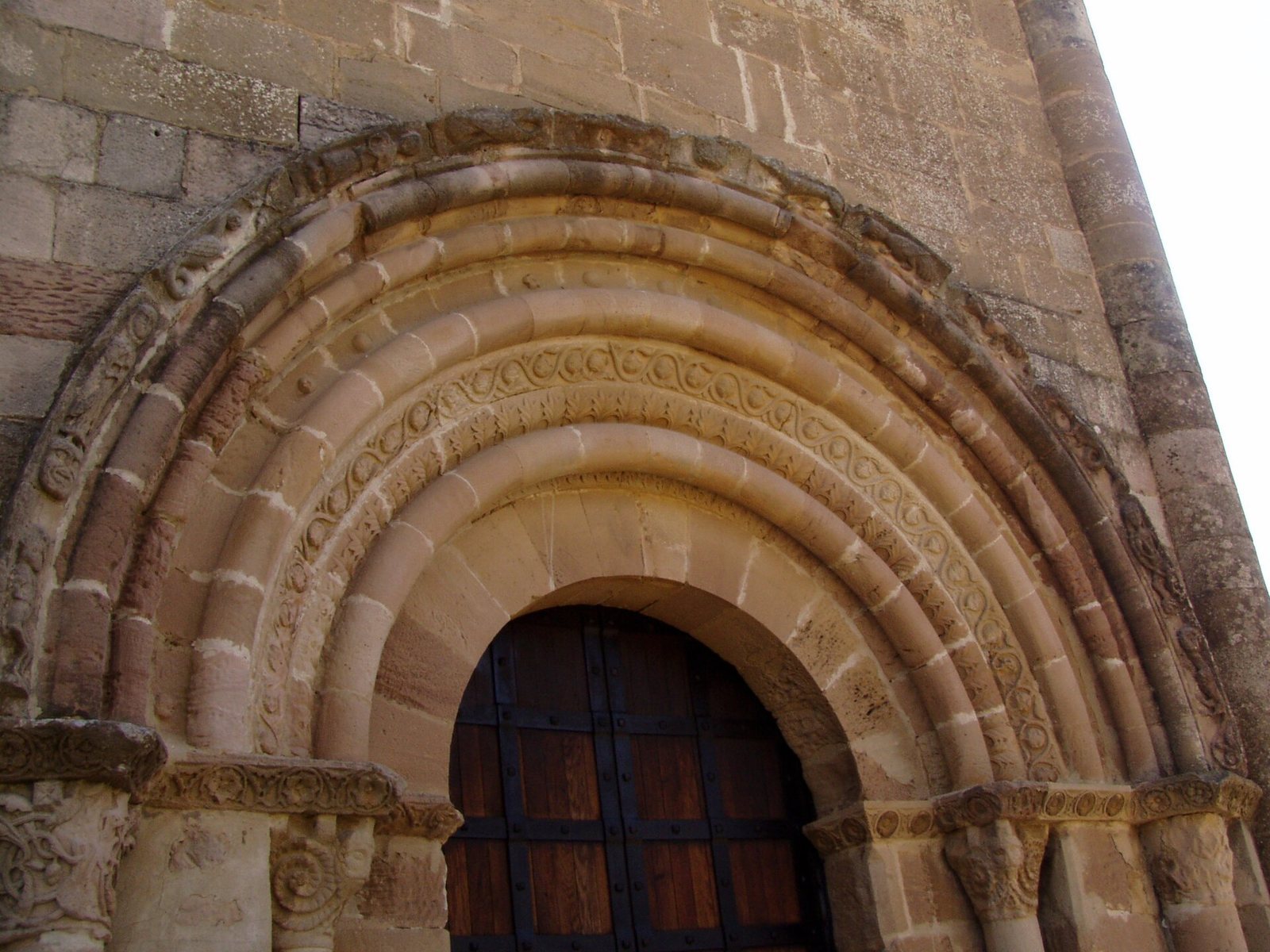
The church is an irregular, slightly asymmetrical octagon, with its choir shifted slightly off the central axis and a column emphasizing each corner. It is built of dressed stone with robust walls. The apse, the curved end of the sanctuary, is semicircular inside and five-sided outside; human faces decorate its projecting corbels, or blocks. Eight ribs rise from supporting piers and meet at the dome, forming a ribbed vaulted ceiling. This arrangement has been linked to Mozarabic influence and compared with art from the Caliphate of Córdoba, a major medieval Muslim state in Iberia. Two doorways and small windows with alabaster panes pierce the building. Its doorways and column capitals, the carved tops of columns, are richly ornamented. Chessboard patterns are a regional Romanesque feature, while the capitals along the ambulatory, a passage around the sanctuary, were rearranged during restoration.
Arcade and enclosing wall
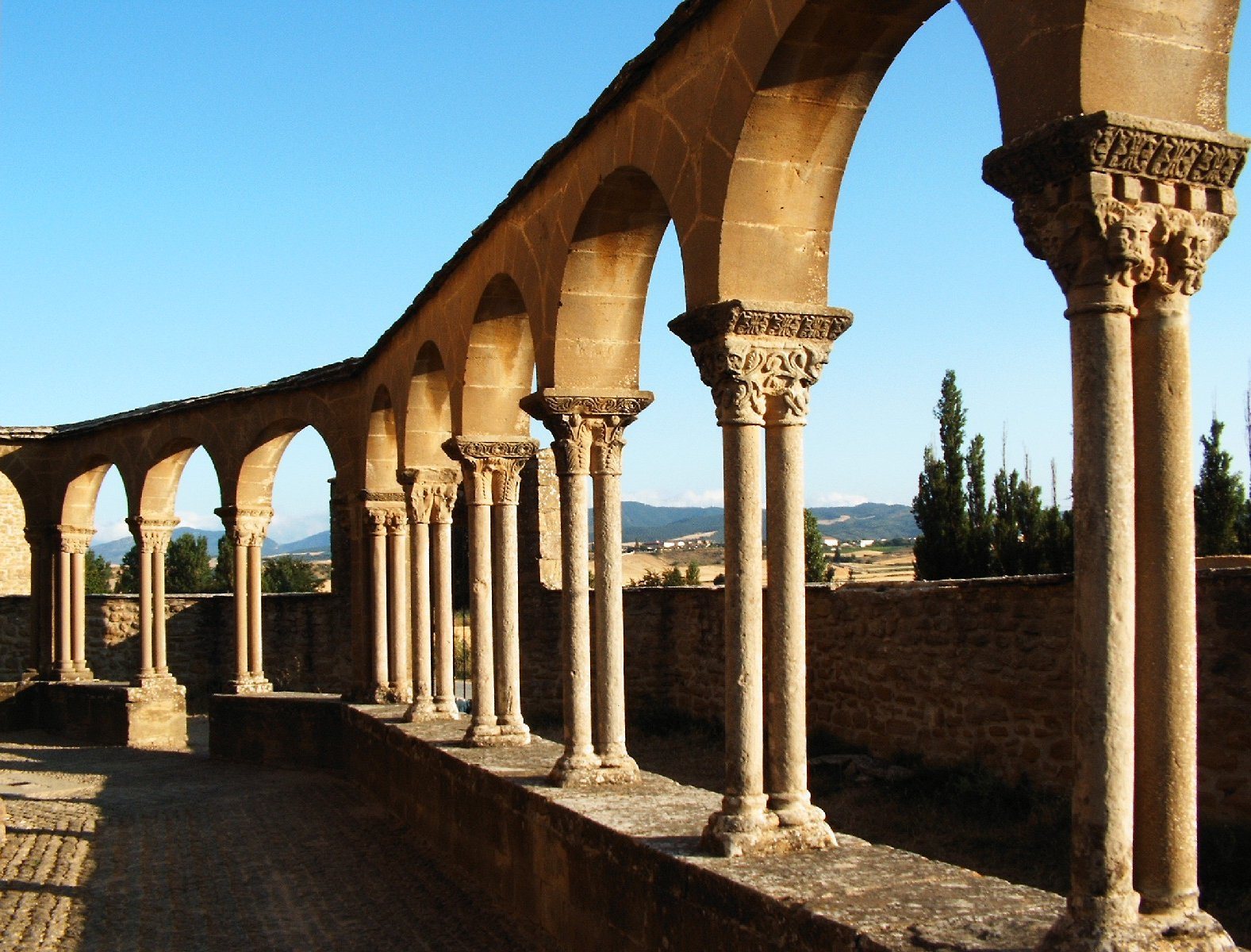
An arcade runs around the church several metres beyond and parallel to its outer wall, forming a circuit of 33 arches. It appears to have been partly rebuilt after the church and may reuse material from a cloister that no longer survives. An irregular octagonal wall encloses the entire complex. A roof may have covered the space between this arcade and the outer wall.
Burials beyond the wall
Graves outside the enclosing wall contain human remains and scallop shells associated with pilgrims travelling on the Saint James pilgrimage route.
Image of the Virgin
The Virgin of Eunate venerated in the church is a replica of a late twelfth- or thirteenth-century Seat of Wisdom image, showing Mary seated with the infant Jesus. The original was stolen.