Boscawen-Un: A Bronze Age Stone Circle in Cornwall
Site at a Glance
- Popularity
- High
- Country
- United Kingdom
- Primary era
- Bronze Age
- Eras represented
- Bronze Age, Modern
- Civilizations
- British
- Site type
- Civic
- Remains
- Megalithic Monument
On this page9 sections
History
Bronze Age origins and later traditions
Boscawen-Un is a prehistoric stone circle north of St Buryan in Penwith, Cornwall, United Kingdom. Its construction dates to the early to middle Bronze Age, about 3,000 to 4,000 years ago, long before the Celtic period. The circle has been proposed as a meeting place for Druids during the Iron Age, the prehistoric era that followed the Bronze Age. Druids were religious specialists and learned figures in ancient Celtic societies, but their supposed connection with Boscawen-Un remains an interpretation.
A Welsh triad assigned to the sixth century names a Gorsedd of Beisgawen in Dumnonia as one of Britain’s three principal bardic assemblies. A gorsedd is an assembly of bards, and Dumnonia was a post-Roman British kingdom thought to have included Cornwall. The founders of Gorsedh Kernow later identified Beisgawen with Boscawen-Un, though the connection is uncertain. In the eighteenth century, Iolo Morganwg compiled a collection of triads that he said drew on manuscripts. Some resemble medieval texts, while others are unique to his collection and are widely regarded as his own inventions.
The name Boscawen-Un comes from a nearby farm and locality. Its Cornish elements are generally understood to mean “the single farm by the elder trees,” although the precise grammatical sense of the final element is uncertain.
Early descriptions and preservation
Around 1589, William Camden described a ring of nineteen stones, spaced about twelve feet apart, with a larger stone inside. In 1749, William Stukeley suggested that a search for treasure might have disturbed the central stone. William Borlase’s 1754 plan showed eighteen stones standing and one fallen.
A Cornish hedge, a traditional earth-and-stone boundary bank, was built through the circle sometime after 1754 and was first mentioned in 1850. Around 1862, landowner Elizabeth Carne arranged for it to be removed and a new hedge to be built around the stones, an early effort to preserve the monument. The area’s first scientific study followed in 1864.
Cornish cultural revival
In 1928, Cornish scholar and language revivalist Henry Jenner founded the Cornish Bard Association at Boscawen-Un and called it Gorsedh Kernow. This modern cultural use drew on the proposed connection between the site and the bardic assembly named in the Welsh triad, rather than establishing that the circle had served that purpose in antiquity.
Remains
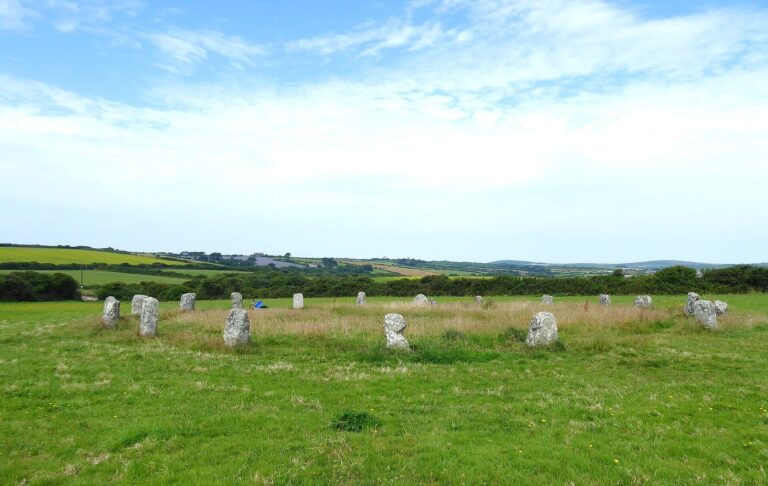
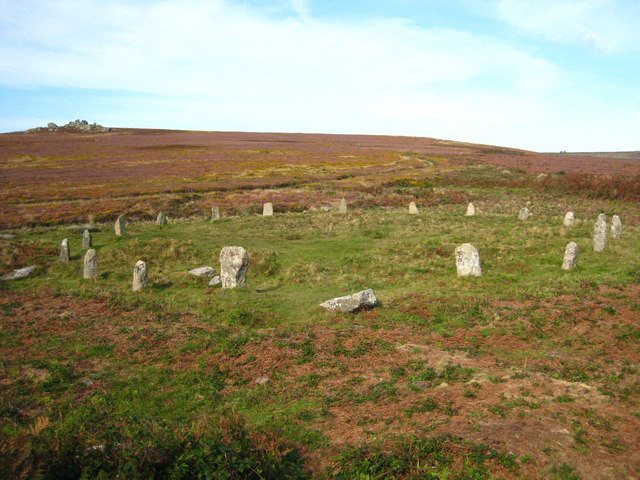
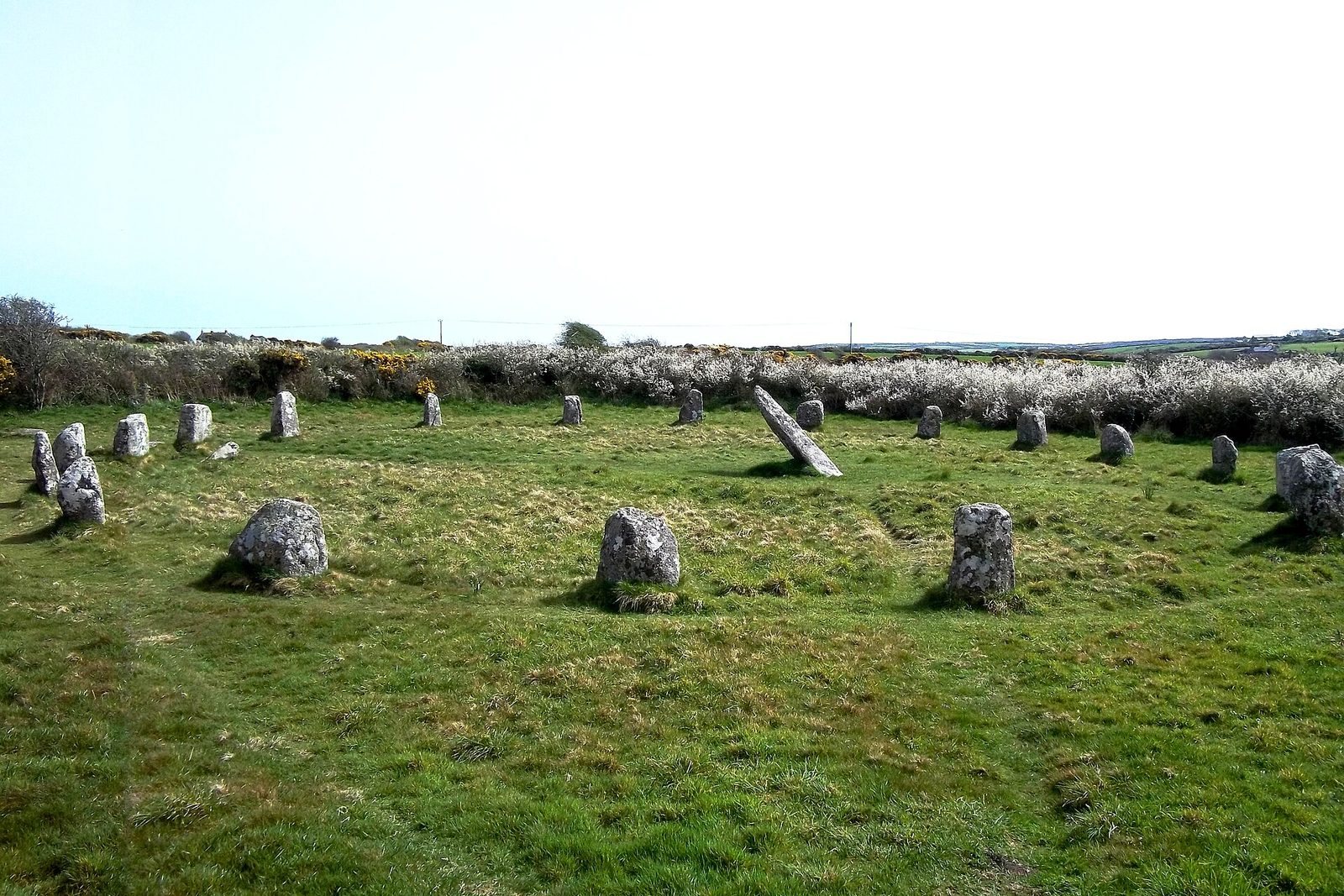
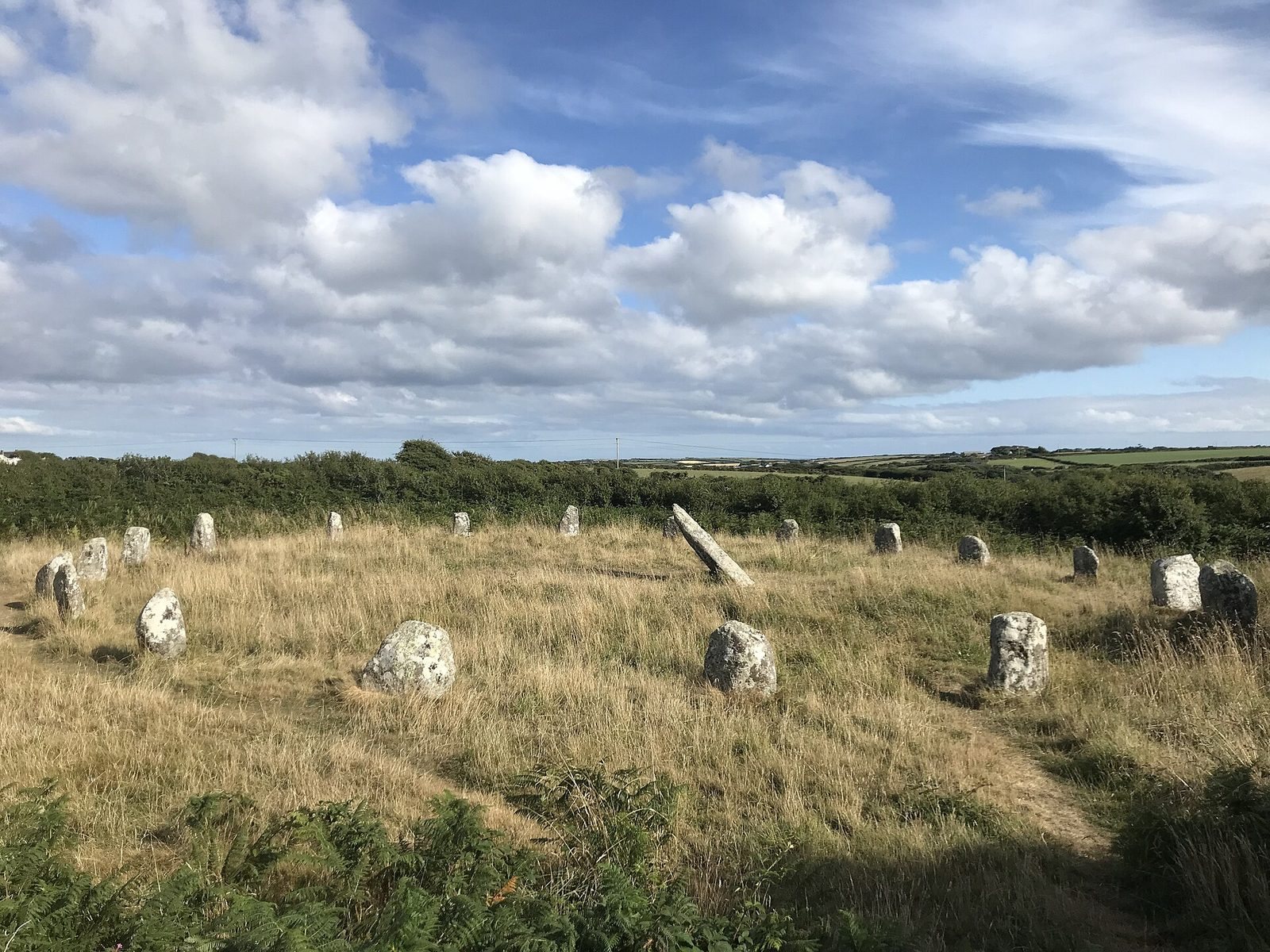
The unusually well-preserved circle has an elliptical plan, with axes measuring 24.9 and 21.9 metres. Nineteen upright stones form its ring around a separate central standing stone.
Ring stones and boundary
Eighteen of the ring stones are grey granite; the remaining stone, made of bright quartz, stands in the southwest. A wide opening on the western side may have been an entrance or may mark a place where stones once stood. At the northeastern edge, two stones lie partly buried and may have formed a burial cist, a chamber built of stone. One of them may bear an axe-shaped carving. The surrounding Cornish hedge encloses the stones.
Central stone and carvings
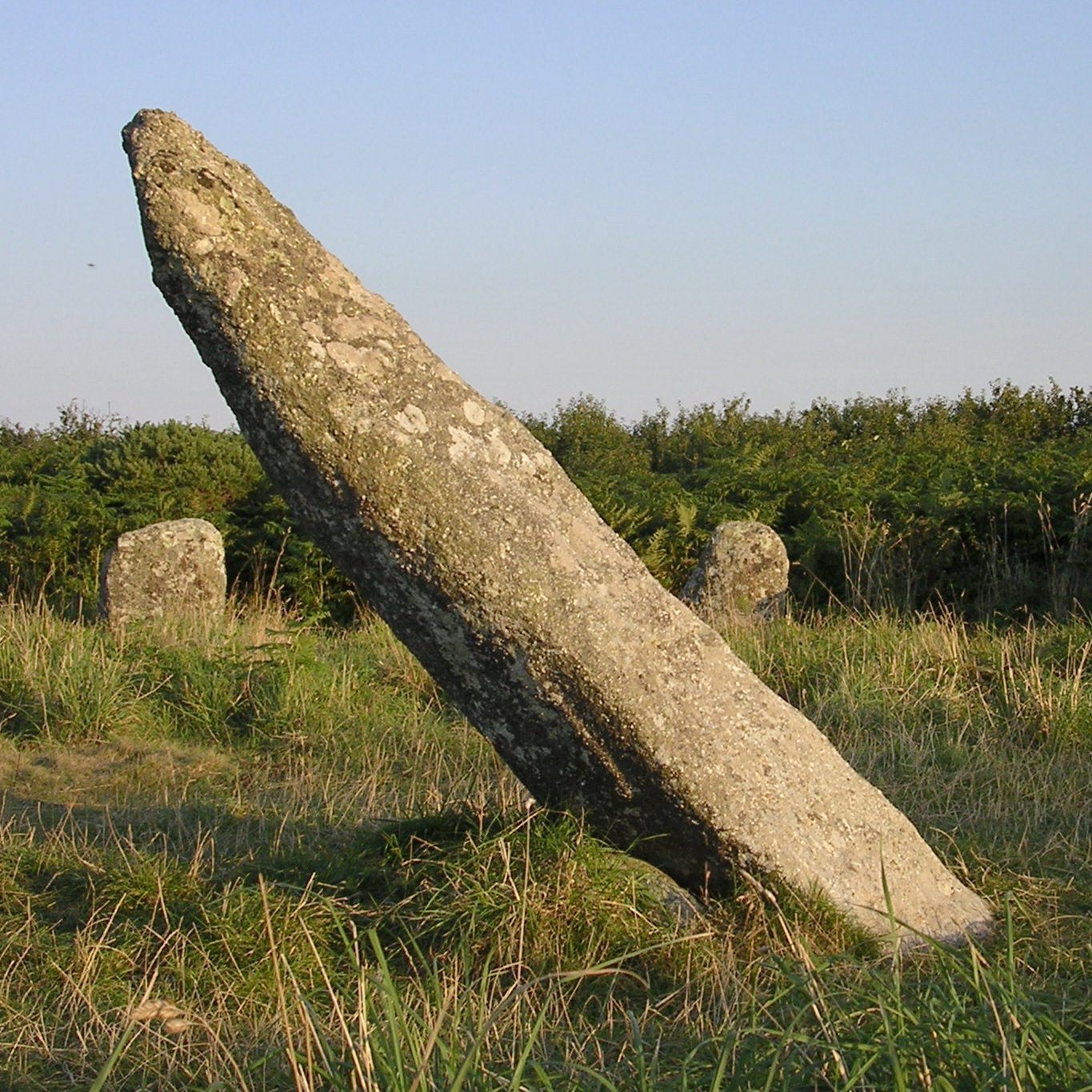
The central stone stands just south of the circle’s midpoint. It measures 2.7 metres in length and leans sharply northeast, leaving its tip about 2.0 metres above ground. Its angle and direction may have been intentional. A petroglyph, or image carved into rock, on the stone has been interpreted as foot-shaped or axe-shaped. The carving receives full sunlight around sunrise at the summer solstice, the longest day of the year, and partial sunlight around sunset at that time.
Orientation and interpretations
The circle is aligned toward the winter-solstice sunrise when viewed from Lamorna Gap. Interpretations of the southwest quartz stone vary: it has been linked to the Sun’s southward movement after All Souls’ Day, a Christian observance commemorating the dead, and separately to the direction of the full moon during a solstice. Some interpretations associate the central stone with a masculine, phallic principle and the quartz stone with feminine powers. These are proposed meanings, not established facts about the builders’ beliefs.
Nearby burial and landscape
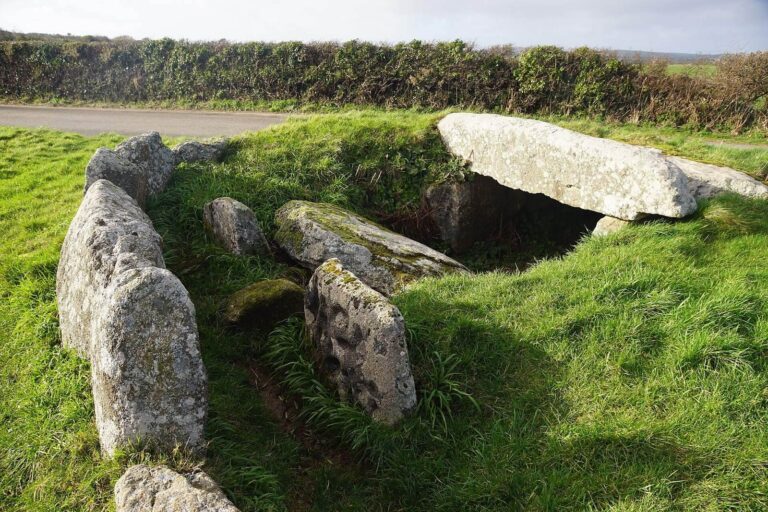
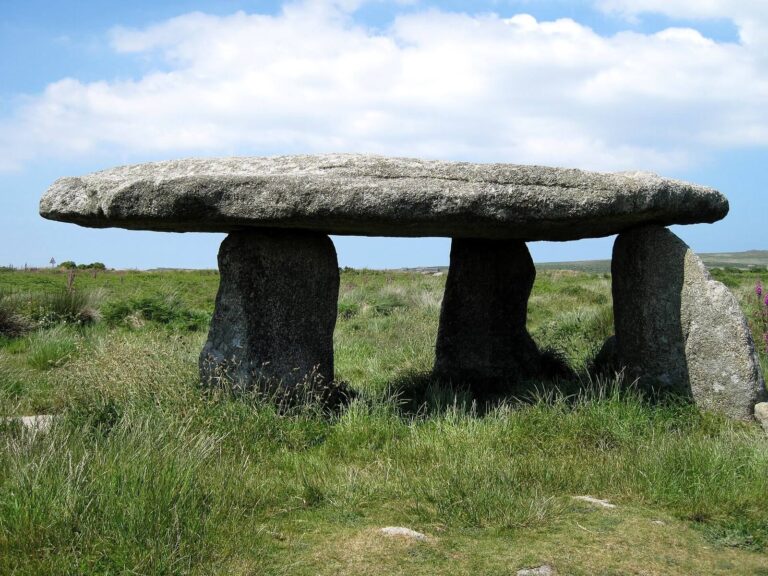
A nearby burial mound containing urns was found during the nineteenth-century study of the area. The Cornish artist and antiquarian John Thomas Blight made an early illustration of the circle, a plan of the mound, and a sketch of an excavated urn. The Merry Maidens stone circle, the two Pipers standing stones, and the sea are visible from Boscawen-Un. Three other stone circles and several megalithic monuments, including quoits, a type of megalithic chamber tomb, lie in the surrounding area. The circle’s position appears to have been deliberately chosen for its setting.