Megalithic Tombs near Nadelitz: A Neolithic Burial Group in Putbus
Site at a Glance
- Popularity
- Very Low
- Country
- Germany
- Primary era
- Stone Age
- Eras represented
- Stone Age
- Civilizations
- Unclassified
- Site type
- Burial
- Remains
- Necropolis
On this page16 sections
History
Neolithic burial and reuse
The Megalithic Tombs near Nadelitz are a group of prehistoric burial monuments in Putbus, Mecklenburg-Vorpommern, Germany. Associated with the Funnel Beaker culture, a Neolithic tradition named for its characteristic funnel-shaped pottery, the 16 tombs date to 3500–2800 BC. At least 13 were great dolmens, a type of megalithic burial chamber, while three could not be classified. Eight survive.
Grave 5 was used in two phases: first for a Funnel Beaker burial, then again in the Late Neolithic, the later part of the Neolithic.
Descriptions and archaeological study
Friedrich von Hagenow gave the first description of the group in 1829. Rudolf Baier published Hagenow’s research in 1904. In 1931, German prehistorian Ernst Sprockhoff made the first detailed survey and measured five surviving tombs. Archaeologist Ewald Schuldt documented the group in 1970 and directed excavations of two tombs from June to September that year.
A regional legend links Grave 7 with Charles XII of Sweden, claiming that the king once ate breakfast on a stone there.
Remains
Distribution and setting
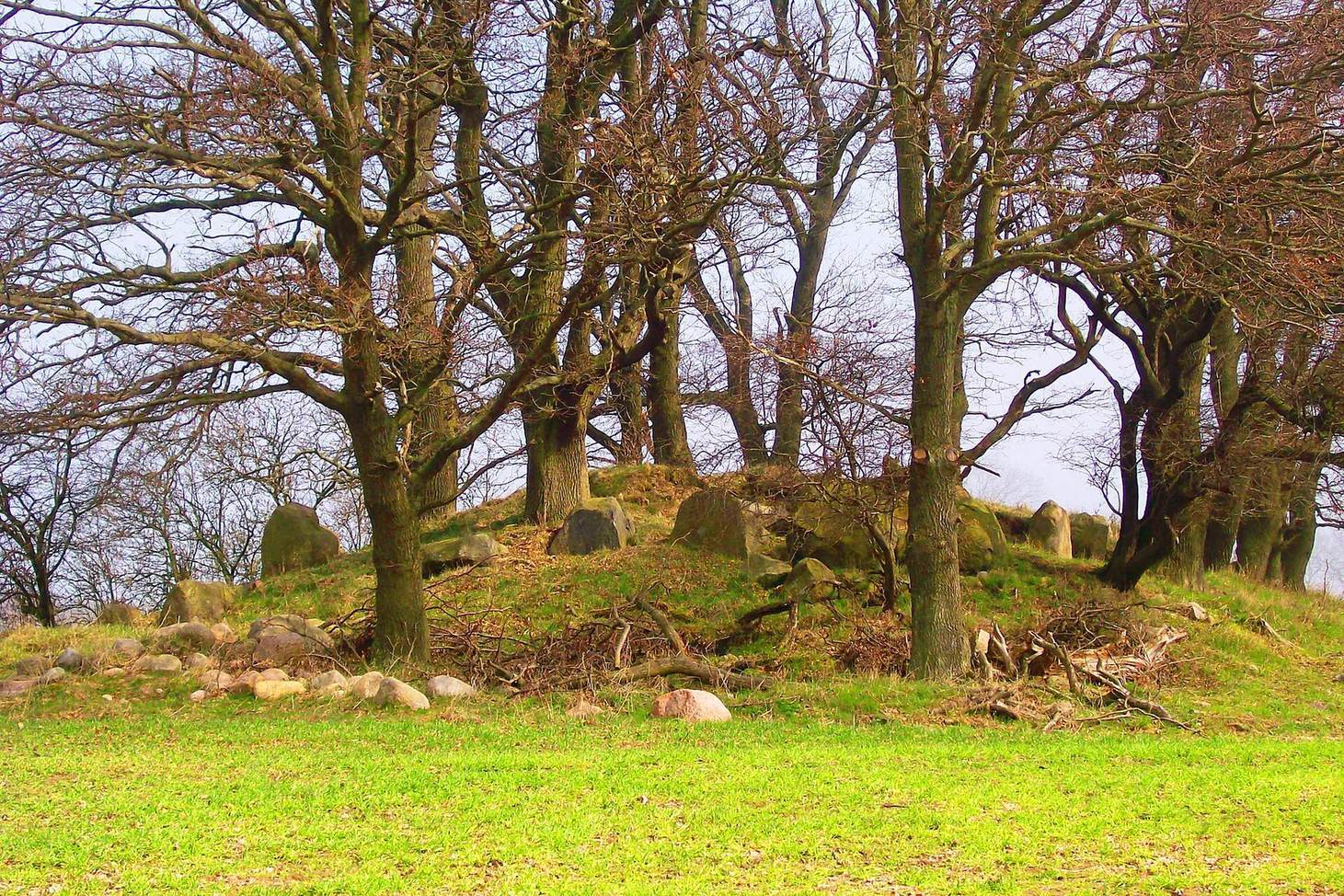
The tombs are scattered around Nadelitz, with elongated earthen mounds, circular mounds, and stone burial chambers. Graves 1 and 2 lie at the village’s southern edge, 110 m apart, with Grave 7 nearby on the grounds of a former kindergarten. Graves 3–5 stand in a field about 1 km east of the village. Grave 4 lies between the other two; Grave 5 is 85 m east of it, and Grave 3 is 80 m west. Grave 6 is 500 m northwest of Graves 3–5, north of the L 29 road. Grave 8 lies 200 m south of them. Several burial mounds are situated south and west of the group.
Other nearby megalithic tombs are found at Seelvitz, Posewald, Dummertevitz, and Lonvitz. The Posewald tomb is 1 km north of Grave 6, the Dummertevitz tomb is 2.5 km east of Graves 3–5, and the tombs at Lonvitz are 2.5 km west of Graves 1 and 2.
Surviving tombs
Grave 1
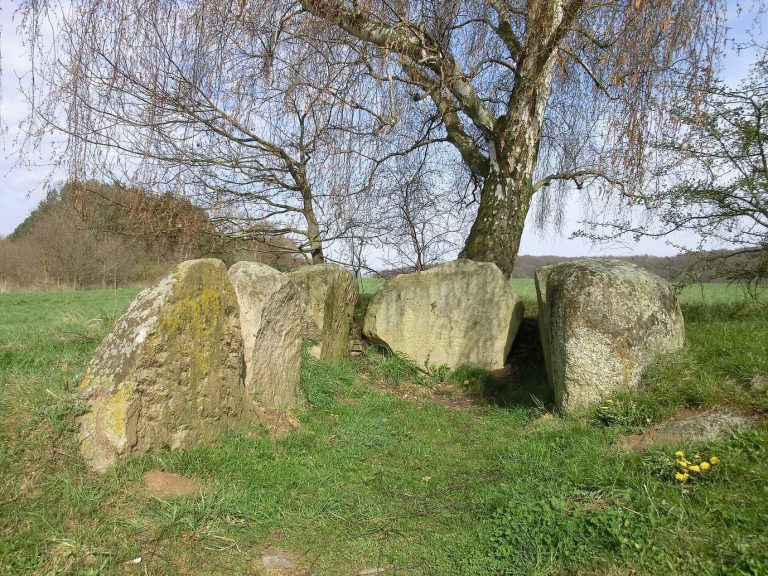
The east–west long barrow, an elongated earthen mound, originally measured 24 m in length. It was 8.5 m wide at the east end and narrowed to 6 m at the west; the mound now reaches 2 m in height. Its stone kerb, a line of stones marking a mound’s edge, survives along the south side and at the east end. The north–south burial chamber stands at the eastern end of the mound. Sprockhoff classified it as an extended dolmen, while Schuldt called it a great dolmen. Sprockhoff estimated the chamber at 2.5 m by 2 m. Two wall stones remain in place on its west side and one on the east. The north end stone has fallen outward, and both capstones have slipped into the chamber.
Grave 2
This long barrow runs northeast–southwest and measures 17 m by 9 m. At its northeast end, one stone, 2.5 m long and 1.8 m wide, is identified as a capstone; three other stones may be wall stones. Sprockhoff left the tomb unclassified because of its condition, whereas Schuldt identified it as a great dolmen.
Grave 3
A low mound 12 m across is covered with numerous stones, most probably cleared from nearby fields.
Grave 4
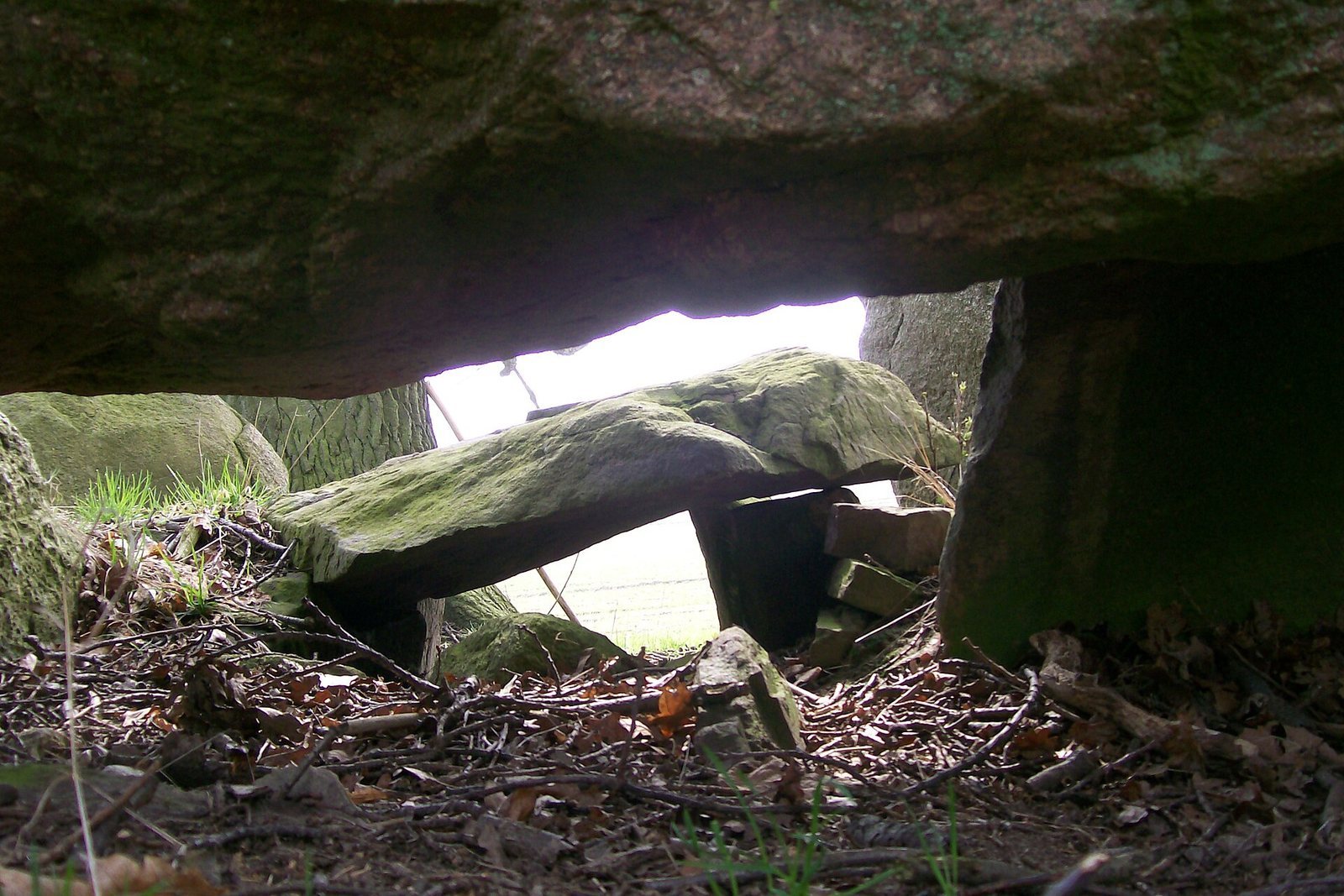
The circular mound is 7 m across and 1 m high, with its chamber set deep within it. Sprockhoff first classified the chamber as an extended dolmen; Schuldt later identified it as a great dolmen. The north–south chamber measures 3.5 m long, 2 m wide, and 1.5 m high. Three wall stones line its east side and two its west, while an end stone stands at the north. These stones remain in place. At the south end, a narrow red-sandstone slab stands to the west, opposite a 0.5 m threshold stone to the east, which marked the transition from entrance passage to chamber. Small red-sandstone slabs found nearby are thought to have formed the vestibule walls. The southern capstone remains, with its western half sunk into the chamber. Excavations recovered pottery sherds and a transverse arrowhead.
Grave 5
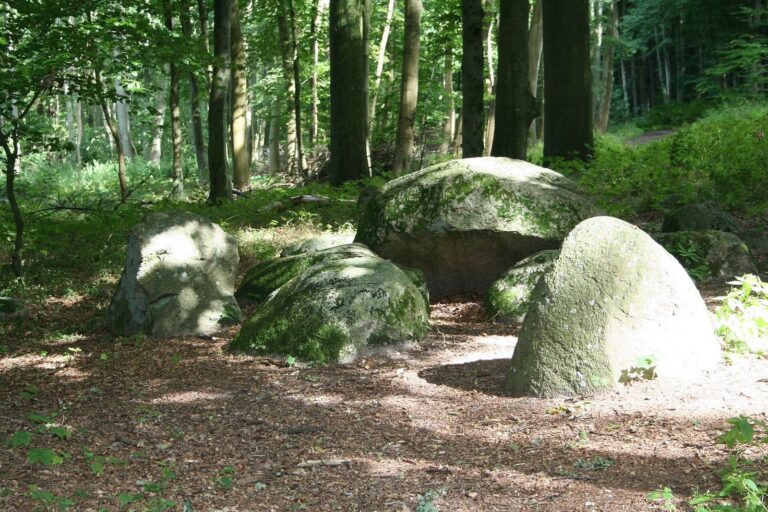
The east–west long barrow measures 35 m in length, 11 m across at its west end and 7.5 m at the east. It reaches a maximum height of 3.5 m. Its stone kerb includes 34 surviving stones, some of which have toppled outward. Four guard stones, separate stones associated with the mound, were also part of the structure; the southwestern one is shattered. The mound consists of sandy soil mixed with numerous rounded stones.
The north–south chamber lies near the western end of the mound and measures about 4 m long, 2 m wide, and 1.4 m high. During Schuldt’s excavation, a clay casing was found around it, extending up to the capstones. A vestibule, or small entrance chamber, at the southern end follows the chamber’s axis and measures 1.1 m long, 0.8 m wide, and 1 m high. The passage has two pairs of wall stones and threshold stones at both ends. Red-sandstone slabs set at an angle over one another closed its outer end.
Three pairs of wall stones line the chamber’s long sides. An end stone stands at the north, while a smaller half-stone occupies the western part of the south end, between the passage and the west wall. Red-sandstone slabs set in clay fill gaps between the wall stones and between the passage and chamber walls. All three capstones were in place when Schuldt excavated the tomb.
Schuldt found the chamber filled to the ceiling. The upper layer consisted of sandy soil over a packing of rounded stones, with some finds in this deposit. Most objects came from the layer below, dark sand mixed with red-sandstone slabs and rounded stones. Beneath these layers lay a clay floor, reddened in several places by fire. Finds included decorated and plain pottery, bowls, small bowls, amphorae, biconical vessels, and funnel-rim vessels. Flint objects included scrapers, blades, transverse arrowheads, and axes. Amber beads, mostly shaped like double axes, were also recovered, along with leaf-shaped daggers and fully retouched arrowheads with deeply indented bases.
Grave 6
The tomb has received little investigation. Three stones visible on its north side may belong to a long barrow.
Grave 7
A flat slab measuring 1.9 m by 0.9 m marks the possible megalithic tomb.
Other tomb forms
Graves 9–14
These tombs were great dolmens set within trapezoidal long barrows, elongated mounds that taper from one end to the other.
Circular-mound tombs
Two further tombs were great dolmens in round mounds enclosed by circular stone settings.