Steingrab im Eichholz: A Neolithic Megalithic Tomb in Lower Saxony
Site at a Glance
- Popularity
- Very Low
- Country
- Germany
- Primary era
- Stone Age
- Eras represented
- Stone Age, Modern
- Civilizations
- German
- Site type
- Burial
- Remains
- Tomb
On this page12 sections
History
Steingrab im Eichholz is a megalithic tomb north of Gnarrenburg in Lower Saxony, Germany. Built as a burial place associated with the Funnel Beaker culture, it dates broadly to 3500–2800 BCE. Deeply incised pottery points to construction near the transition from the fourth to the third millennium BCE.
Neolithic and later burials
The Funnel Beaker culture was a Neolithic society of northern Europe known in part for its pottery and burial practices. The tomb was used by its communities and later by people associated with the Single Grave culture, another Neolithic tradition recognized partly through its pottery and burials. Their graves included beaker grave goods, and this use may have overlapped with the final phase of Funnel Beaker activity. Urn burials from the early Iron Age, a broad period associated with the use of iron, are also represented. Disturbance along the chamber’s south side makes it impossible to determine whether these burials lay inside the chamber or just in front of it.
Damage and investigation
In 1893, researchers Johannes Heinrich Müller and Jacobus Reimers described the tomb as already badly damaged. Two more large stones were removed later. Jürgen Deichmüller investigated the structure in 1968, after which it was restored.
Remains
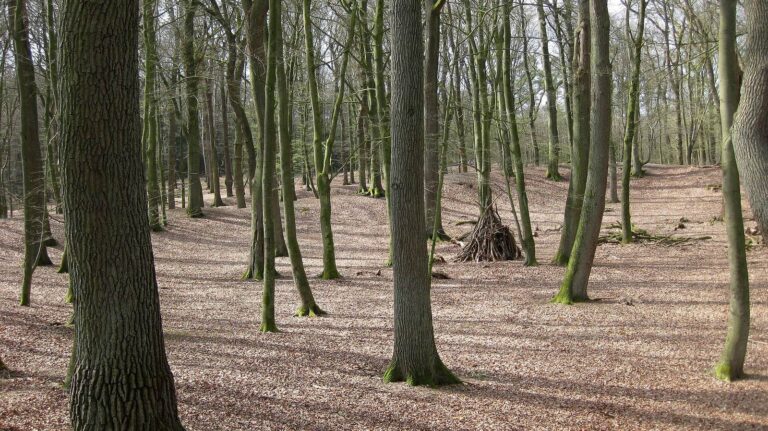
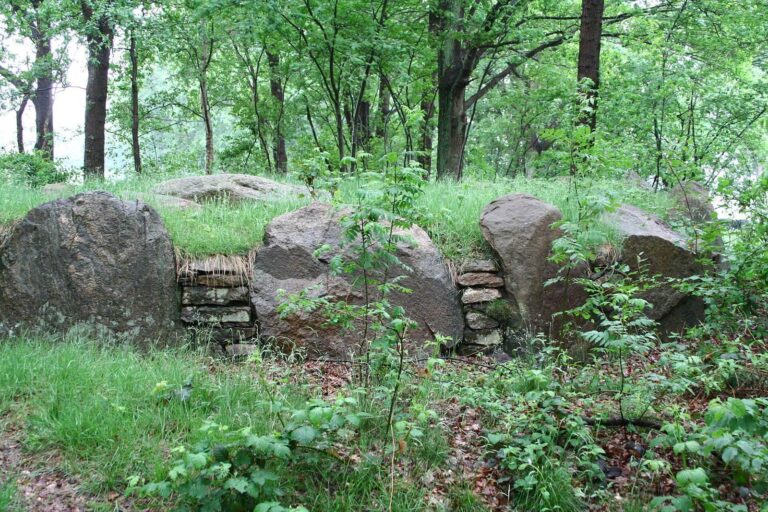
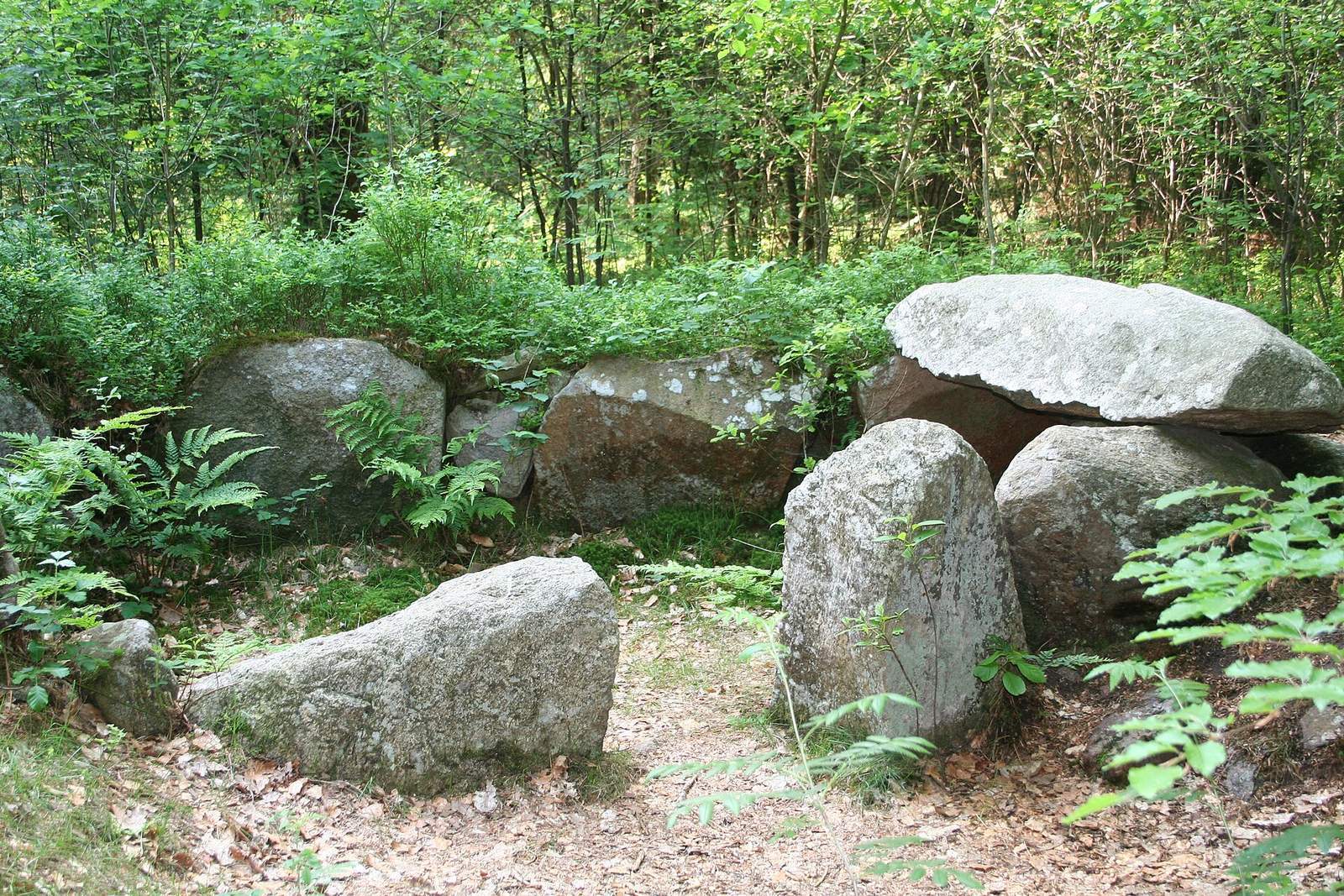
The tomb stands in a pine forest in the Eichholz State Forest, within the Elbe–Weser Triangle. A chamber aligned southwest to northeast lies within a stone-covered mound, which is encircled by an oval arrangement of upright stones.
The burial chamber
Plan and construction
The chamber’s original type is uncertain. It may have been a passage grave, with a chamber reached by a passage, or a great dolmen, another kind of large megalithic burial chamber. Its plan may have been trapezoidal, although irregularities on the north side and the missing southwest end stone make the outline difficult to establish. Four north-side support stones survive; they differ in size and material, and some lean. A large granite block forms the northeast end. The southwest end stone and its setting trace are gone, while a bank of rounded stones runs into the mound’s stone packing. The chamber probably had four capstones. One remains in its original position, and a fragment was placed above the northeast end during restoration.
Interior deposits and finds
The chamber interior has been disturbed on the south, in places down to the floor paving. Elsewhere, its fill reached about 0.50 metres below the tops of the support stones and included loamy sand, pebbles, traces of charred wood, flint and pottery. A humus-rich upper layer approached the tops of the support stones in most places and had also been disturbed. The recovered material was not all in its original position. More than 600 pottery sherds were found, including 524 Neolithic sherds; 456 were assigned to 24 vessels belonging to the two Neolithic cultures. Finds included Funnel Beaker pottery and arrowheads, Single Grave pottery, arrowheads and flint axes, and Iron Age urn fragments. Another 84 sherds were either Iron Age urn fragments or could not be assigned to a culture.
Mound and surrounding stone features
Stone covering
About 6,500 to 7,000 rounded stones formed a covering around the mound and extended over the chamber’s capstones. Excavation evidence indicates that a loamy layer about 0.25 metres thick covered this stone mantle. It probably supported grass or heath vegetation.
Oval stone enclosure
An oval enclosure of upright stones surrounded the mound, an arrangement described as unusual in the region. The surviving stones measure up to 0.70 by 0.40 metres.
Cult niche
Northwest of the stone ring is an elongated, oval half-circle of stones, open toward a large, flat, almost rectangular stone. It is conventionally called a cult niche, but that name alone does not establish that the feature had a ritual function.
Nearby burial mounds
A large mound lies about 50 metres east of the tomb and may also contain a megalithic burial chamber. The two monuments are surrounded by a dozen smaller burial mounds.