Rössen Burial Mound: A Multi-Period Burial Site in Germany
Site at a Glance
- Popularity
- Low
- Country
- Germany
- Primary era
- Bronze Age
- Eras represented
- Bronze Age
- Civilizations
- Unclassified
- Site type
- Burial
- Remains
- Burial Mound
On this page12 sections
History
The Rössen Burial Mound is a prehistoric burial site in southeastern Rössen, Germany. It was used for burials in the Neolithic, the Late Bronze Age and later periods, with evidence indicating repeated funerary activity at the same place.
Neolithic and Bronze Age burials
The oldest burial is Neolithic, but its date within that period is uncertain. Although a flint knife was found with the burial, it did not provide a more precise date. Archaeologists have also identified burials associated with the Corded Ware culture, dated to 2800–2200 BCE, and the Bell Beaker culture, dated to 2600–2200 BCE. These archaeological cultures are distinguished in part by their characteristic pottery.
Archaeologist Nils Niklasson proposed that a small mound first marked the oldest burial, and that a larger mound was later deliberately raised in the same place. He considered the Corded Ware stone cist likely to have been destroyed in prehistoric times. Graves packed with stones from the Late Bronze Age, dated to 1300–800 BCE, may have cut into and partly damaged an earlier Bell Beaker burial. Some unburnt bones found among the stone settings may have come from that earlier grave.
Later burials and the surrounding landscape
Further burials at the mound probably date to the Middle Ages, 500–1500 CE. Isolated finds also raise the possibility that some burials belong to the Roman Imperial period, dated here to 1–375 CE.
The mound lies within a wider area of prehistoric burials. Beside a railway a short distance to the south, Neolithic graves were found along the edges of an earthwork in 1915, before the railway was built. Farther south, excavations in the 1880s, 1890s and 1918 revealed the Rössen cemetery, which gave its name to the Neolithic Rössen culture.
Excavations and local traditions
In the 1890s, Hans von Borries, director of the Provincial Museum in Halle, began an investigative trench on the mound’s western side. The municipality stopped the work. Niklasson led an excavation in 1918 in connection with the opening of the museum’s new building. His team dug a trench 5.5 metres wide from the west toward the mound’s centre, joining the earlier cut before turning southeast to avoid a tree. The excavation did not cover the whole mound. In 1925, Niklasson dug two more trenches, each 3–4 metres wide, from the north and south toward the centre. These produced substantially fewer finds than the western trench.
A chestnut tree on the mound was felled in 1918 to make way for a memorial to those killed in the First World War. The original menhir was later destroyed. Local legend tells that a king’s son lies buried in the mound in a golden coffin. A similar story about a king in a silver coffin is associated with Derfflinger Hill near Kalbsrieth, about 50 kilometres to the west.
Remains
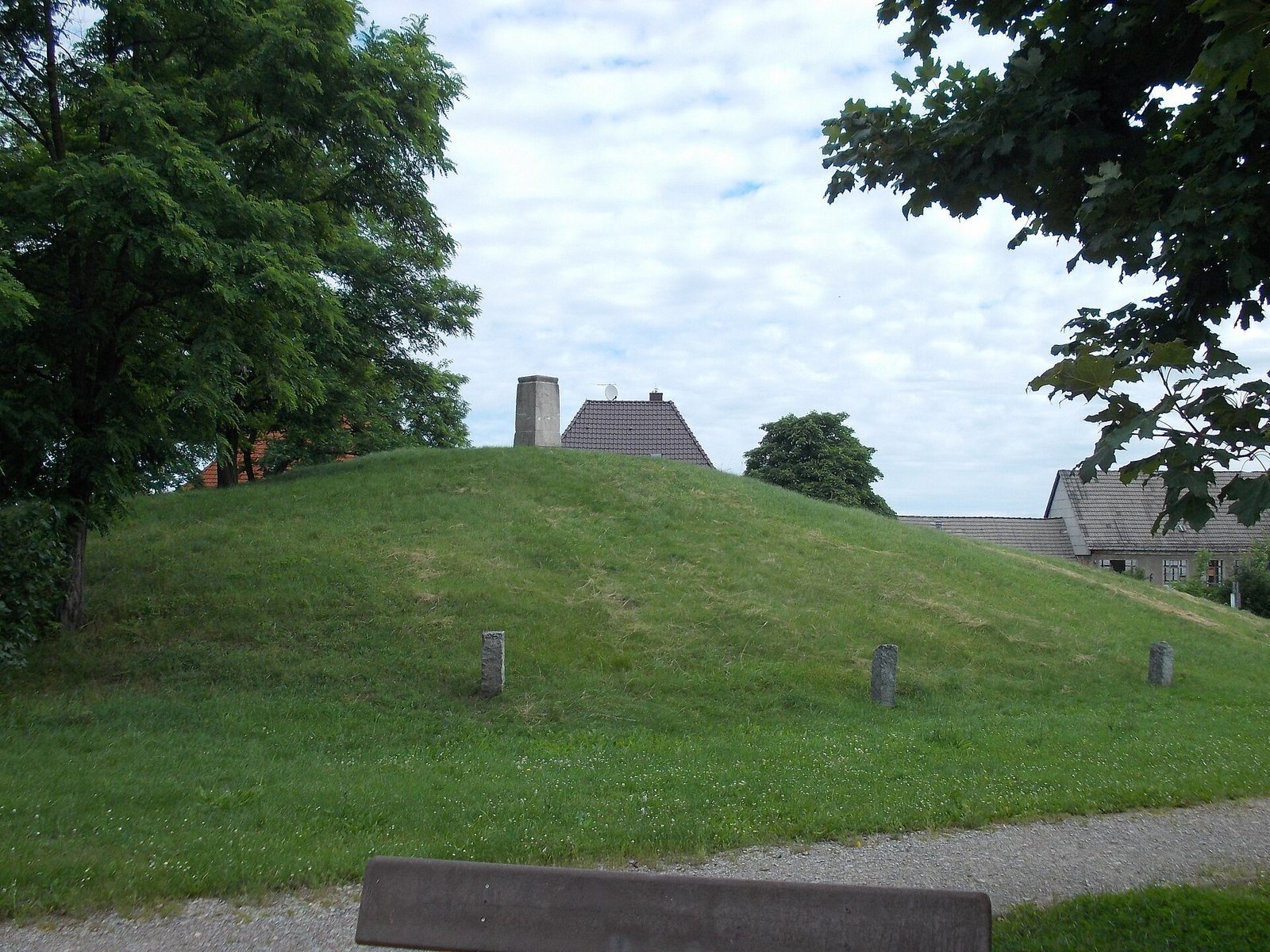
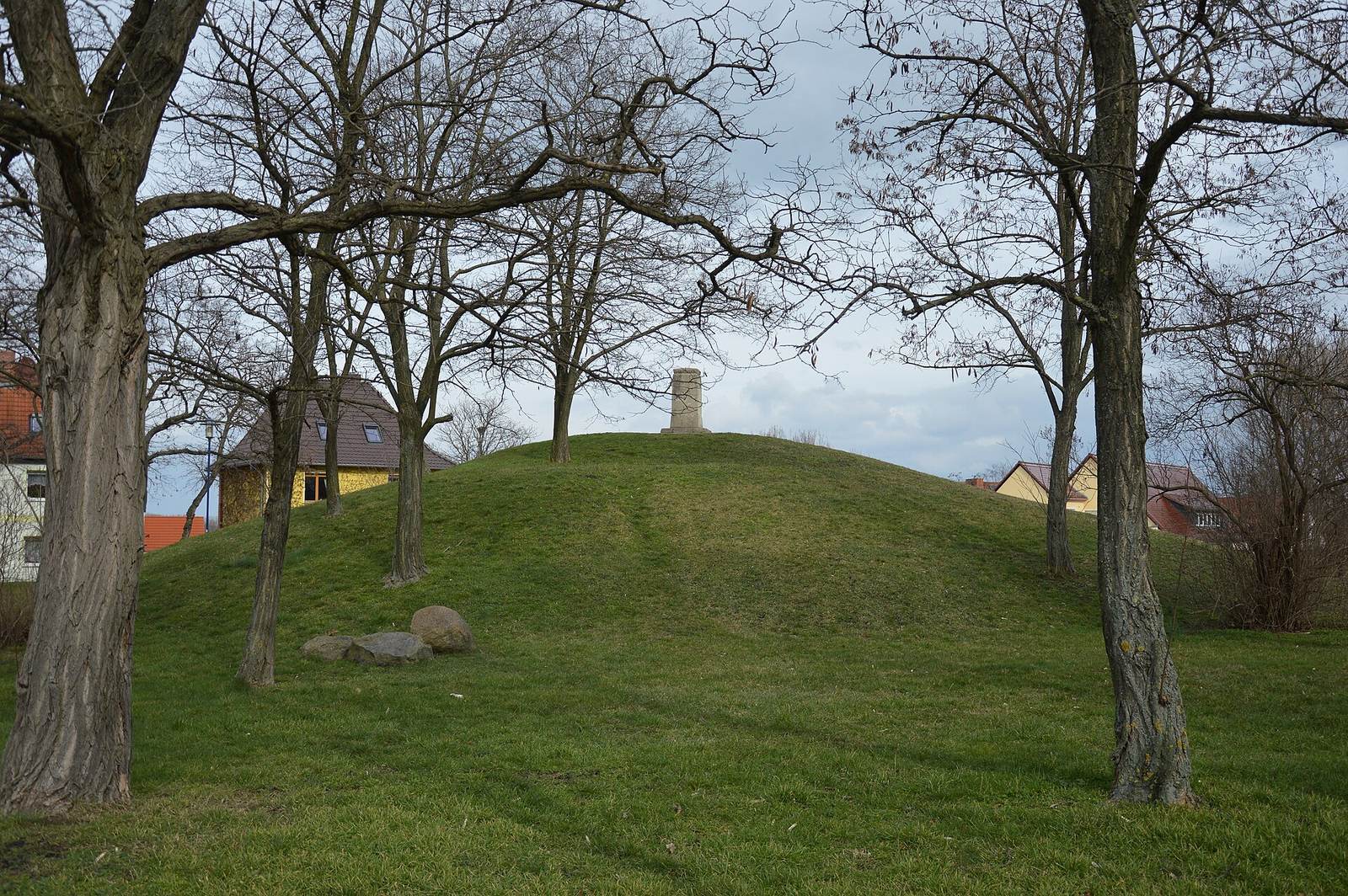
The mound stands in a green space between Am Hügel and Brückenstraße and the Merseburg–Leipzig-Leutzsch railway. Slightly oval in plan, it measures 25 metres east to west and 17 metres across. It rises 2.2 metres above the surrounding ground, or 2.9 metres above the natural gravel beneath it. Its edges slope gradually into the surrounding ground, and a shallow depression marks the summit. Humus, 30–50 centimetres deep, covers the gravel; the mound itself consists of dark, clay-rich humus.
A menhir, or large upright stone, once stood on the summit. Niklasson found it lying beside the mound. It had a square cross-section and measured 1.5 metres in height.
Burials and excavated finds
Oldest burial
Near the centre of the mound, about 0.7 metres below the level of the surrounding ground, a clay floor lay above a poorly preserved human skeleton. The body was aligned east to west, and a flint knife was found with it.
Stone cist
Above the oldest burial, close to ground level, was a stone cist, a burial container built from stone slabs. It measured 1.4 by 0.7 metres. Four sandstone slabs formed its floor, with clay filling the joints. Two wall slabs met at its southeastern corner, and two more stood at the western end of the north side. Two small, undecorated amphorae, typically two-handled vessels used for storage or transport, were found with the cist.
Crouched burial
Southwest of the cist lay the remains of a crouched burial, in which the body was placed with its limbs flexed. The surviving bones included a skull, parts of the upper and lower legs, and several smaller bones. An undecorated beaker was found with the burial.
Western stone setting
One of two stone settings, arrangements of stones associated with burials, lay above the cist and crouched burial. The western setting was aligned north-northeast to south-southwest and measured 2.6 metres long, 1.1 metres wide and 0.8–0.9 metres deep. It consisted mainly of small sandstone pieces. Cremated material and some unburnt bones were found with unornamented pottery sherds and a probable hammerstone, a stone tool used for pounding or striking. A stone 50 centimetres across lay beneath the setting but was probably unrelated to the grave.
Eastern stone setting
The eastern setting, also aligned north-northeast to south-southwest, measured 1.2 by 0.5 metres and was 0.8 metres deep. Its floor was paved with small and medium-sized sandstone slabs. Cremated material and unburnt bones lay inside it, with additional unburnt bones outside. Pottery sherds were found with the setting. A small bronze spiral and a thin bronze sheet probably came from the grave, although both were recovered only after the stones had been removed.
Other burials and finds
Near the mound’s centre, east of the eastern stone setting and just below the summit, was a poorly preserved child burial. Wood remains, a boar’s tooth and a river mussel were found with it, though it is uncertain whether the tooth and shell were grave offerings. Another skeleton lay extended west to east in the southern trench, about three metres from the centre. Several similar graves were later found beside the mound.
Human skeletal remains, cremated material, fired-clay fragments and pottery sherds came from several points in the mound fill; some had been shifted or carried by animals. A bronze eye fibula, a type of clothing-fastening brooch, from the mound is dated to the first half of the first century CE. Finds from the mound are now held in the depot of the State Office for Heritage Management and Archaeology of Saxony-Anhalt in Halle.