Tykocin Castle: A Renaissance Royal Fortress in Poland




Site at a Glance
- Rating
- 4.4
- Popularity
- Medium
- Country
- Poland
- Primary era
- Early Modern
- External website
- Open
- Eras represented
- Early Modern
- Civilizations
- Grand Duchy of Lithuania, Polish–Lithuanian Commonwealth
- Site type
- Military
- Remains
- Castle
On this page12 sections
History
Tykocin Castle is a fifteenth-century royal castle in Poland, founded in the borderlands of the Grand Duchy of Lithuania and later expanded as a Renaissance fortress. Its position near the Narew River gave it military value, while its later royal functions included housing the Crown arsenal, the king’s treasury, and a major library.
The Gasztołd Fortress
In 1433, Jonas Goštautas, also known as Jan Gasztołd, received Tykocin together with Złotoria and the Łopuchowo district. Goštautas was a Lithuanian nobleman and a voivode, a high-ranking provincial governor, of Trakai and Vilnius. A fortress probably arose at Tykocin during this period, when the settlement lay in a politically sensitive border area. Archaeological work has identified a wooden palisade dating from the turn of the fifteenth and sixteenth centuries.
The early fortress passed from Jonas Goštautas to his son Marcin and then to Olbracht Gasztołd, the voivode of Trakai. Around 1519, Kunca, an official of Mikołaj Radziwiłł, the voivode of Vilnius, attacked and burned it. The wooden defenses and Olbracht’s property were probably destroyed, and Olbracht fled with his family.
Royal Expansion under Sigismund II Augustus
The male line of the Gasztołd family ended with the death of Stanisław Gasztołd in 1542. Under the succession law then in force, Tykocin passed to King Sigismund I the Old and later to his son, Sigismund II Augustus, the last male ruler of the Jagiellonian dynasty. Sigismund II Augustus ordered a large expansion between 1549 and 1575.
The royal builder Hiob Bretfus supervised the work. Jan Szymkowicz, starosta of Tykocin from 1554 to 1568, administered construction, while Bretfus later held the same local office until 1571. After Bretfus died, Wojciech Zakrzewski, also known as Wojtal Murarz, directed the building work, with Łukasz Górnicki serving as starosta.
The enlarged castle was not primarily a royal residence. It held Sigismund II Augustus’s private treasury and library, first transferred from Vilnius, together with artillery and the Crown’s principal arsenal. Its cekhauz, an artillery storehouse, was completed in 1569, after which guns were brought from the arsenal in Vilnius.
On 1 September 1572, Jan Tomicki and Piotr Zborowski became administrators of the royal treasury at Tykocin. Jan Chodkiewicz, starosta of Samogitia, and Ławryn Wojna, treasurer of the Grand Duchy of Lithuania, were assigned to assist in strengthening the castle while Tomicki and Zborowski were in Lithuania. On 10 September 1573, a funeral convoy carrying Sigismund II Augustus’s body from Knyszyn to Wawel departed from Tykocin.
Arsenal and Vasa-Era Fortress
King Stephen Báthory placed the Crown arsenal in a building erected under Łukasz Górnicki. It contained 500 guns. During the war with Sweden in Livonia in 1601, under Sigismund III Vasa, siege guns traveled from the Kraków arsenal by the Vistula and Narew to Tykocin. They were then sent onward with artillery from the local storehouse.
Between 1611 and 1632, Sigismund III Vasa ordered a major rebuilding under Krzysztof Wiesiołowski, the starosta of Tykocin. The earlier perimeter defenses were replaced by four large earthen bastions, projecting fortifications designed to deliver defensive fire, linked by curtains, the connecting defensive earthworks between bastions. This transformation created an early-modern fortress.
Sigismund III Vasa and his family stayed at the castle from 14 November 1630 to 8 February 1631 while seeking refuge from an epidemic. King Władysław IV stayed there in May 1633 and ordered Moscow prisoners to be transferred to other castles. He returned to Tykocin in late December 1636.
War and Private Ownership
During the Swedish Deluge, the Swedish invasion and occupation of much of the Polish-Lithuanian Commonwealth from 1655 to 1660, troops allied with Sweden and commanded by Bogusław Radziwiłł occupied the castle. Janusz Radziwiłł died there on 31 December 1655 while troops of the Tyszowce Confederation, a military-political alliance supporting King John II Casimir against Sweden, besieged the fortress.
Bogusław Radziwiłł lifted the siege on 26 February 1656. From April to July, nobles from Podlasie, Wizna, and Łomża under Colonel Samuel Oskierka besieged the fortress. A further blockade began in November 1656, maintained by Swedish troops and Polish supporters, including Aleksander and Mikołaj Lubieniecki, members of the Polish Brethren, a nontrinitarian Protestant movement.
Forces loyal to John II Casimir captured the castle on 27 January 1657. During the assault, the Swedish colonel Erskein blew up part of its walls. Brandenburg-Prussian forces occupied the fortress in late February or early March and returned it in late July or early August of the same year.
On 10 November 1659, John II Casimir granted the Tykocin starostwo, the office and estate administered by a starosta, to Stefan Czarniecki and his wife, Zofia, as a reward for their service during the Swedish war. They took possession on 4 April 1660, and Czarniecki received the lands outright by royal grant on 13 June 1661, transferring the estate from royal to private ownership.
After defeating the Russian army at Polonka in 1660, Czarniecki sent more than 20 captured guns and 7,501 prisoners to Tykocin. Jan Chryzostom Pasek stated that Czarniecki received two million in ransom for the prisoners. Damage from the castle’s capture left two of its four wings in use.
Through the marriage of Czarniecki’s daughter, Aleksandra Katarzyna, the castle passed to Marshal Jan Klemens Branicki. Lieutenant Konstanty Kotowski, who had assassinated Hetman Wincenty Gosiewski, was imprisoned there in May 1662. Samuel Gorzkowski commanded the castle in 1662, Kazimierz Gorzejewski served as sub-starosta, and Burgrave Wawrzyniec Boryński commanded its soldiers in 1676. Between 1674 and 1677, rebellious Lithuanian and Volhynian troops raided the Branicki estates.
Destruction and Reuse
Swedish forces under Charles XII occupied Tykocin Castle in 1702 during the Third Northern War. In November 1705, Augustus II the Strong and Peter the Great met there during the civil war between supporters of Augustus and Stanisław Leszczyński. At this meeting, the Polish king established the Order of the White Eagle, Poland’s highest state order. Polish and Russian forces also began modernizing and enlarging the bastion defenses. Swedish forces regained control of the castle in 1708.
In 1734, during the War of the Polish Succession, Mazovian Confederates supporting Stanisław Leszczyński set fire to the castle and destroyed it. The uninhabited remains then deteriorated. In 1750, Branicki ordered the castle to be dismantled, and local residents reused its materials in new houses. A flood destroyed the remaining ruins in 1771.
After 1769, bricks from the dismantled castle were used to build the Bernardine Missionary monastery complex. During the First World War, after 1915, German soldiers reused surviving wall material for a road to Knyszyn and took earth from two bastions to construct an embankment.
Archaeology and Reconstruction
Systematic investigation began in 1961 and continued through 1963, when soil around the castle was removed and parts of the foundations were reconstructed. Research in 1963 and 1964 established the original spatial arrangement. After Jacek Nazarko of Białystok acquired the former castle site, he planned a new building resembling the fortress of Sigismund II Augustus.
Geotechnical drilling took place in 1999, followed by archaeological excavations from 2001 to 2005 directed by Magdalena and Wojciech Bis of the Institute of Archaeology and Ethnology of the Polish Academy of Sciences. A foundation stone for the new building was laid in 2002. Designed by the Białystok architect Agnieszka Duda, the reconstruction drew partly on preserved fortress plans held in the archives of Saint Petersburg. Archaeologists supervised the work, and finds recovered during construction are exhibited in the local museum. Tykocin Castle is protected as an immovable monument, with registration dating from 1937 and a further entry from 1950.
Remains
Renaissance Castle Plan
The Renaissance castle had a roughly trapezoidal plan organized around a courtyard. Four cylindrical corner towers marked its main structure, whose interiors were richly decorated. A brick perimeter wall stood approximately 15 metres outside the castle and enclosed the complex with four horseshoe-shaped bastions and a moat.
Bastion Fortress
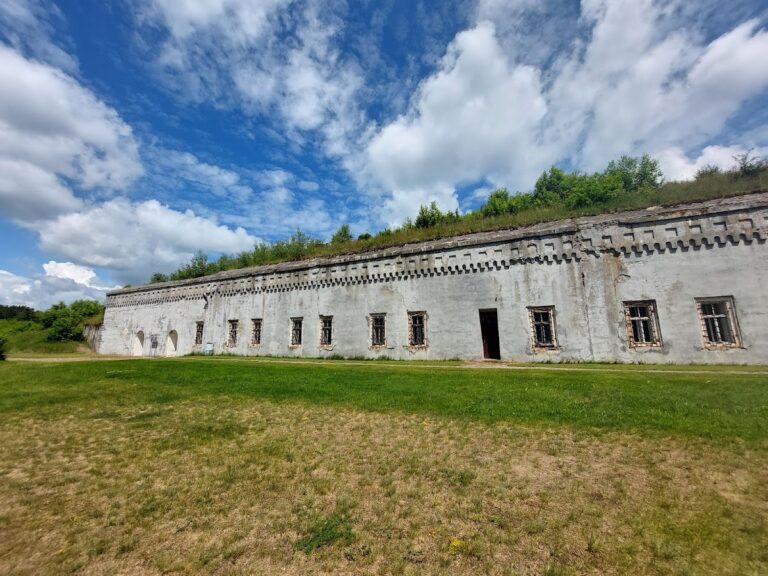
In the first half of the seventeenth century, the brick wall and horseshoe-shaped bastions were demolished and replaced by four large earthen bastions joined by long earthen curtains. The resulting fortified area covered more than 6 hectares, with each side measuring approximately 250 metres. A 1701 inventory listed ten buildings within the ramparts, including an economic residential building, two guardhouses, the artillery storehouse, two granaries, a brewery, and three stables.
Royal Treasury and Interior Collections
The treasury, installed around 1565, occupied about 16 chests and held Sigismund II Augustus’s private jewels and books, initially brought from Vilnius. Its contents included Charles V’s ruby, valued at 80,000 scudos, a diamond medal with the Habsburg eagle and the motto “Plus Ultra,” and a sultan’s sword valued at 16,000 ducats. The collection also contained 30 sets of precious horse trappings and 20 suits of armour, including four elaborate examples decorated with sculpture and silver.
Three hundred and sixty Brussels tapestries commissioned between 1550 and 1560 decorated the castle walls. The king’s possessions were dispersed after his death, while the surviving archaeological evidence and historical descriptions help define the castle’s former role as a royal treasury and arsenal.
Reconstructed Western Wing
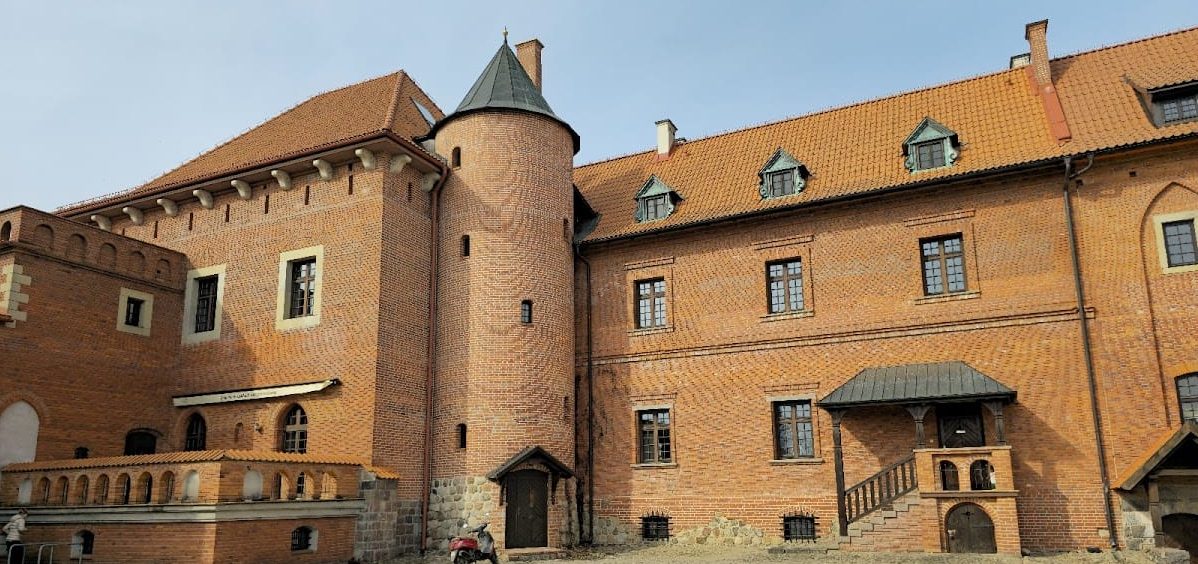
The present complex includes a reconstructed western residential wing based on preserved fortress plans. Its late Gothic appearance is a conjectural interpretation of the former building rather than a fully surviving original structure. The complex also contains a museum, a viewing tower, a restaurant, and guest rooms in the attic.
The museum route includes the castle cellars, which contain the main display, the Glass Hall, and the prison tower known as the Turma, now used as a viewing tower. The Glass Hall contains the “Great Blue” tiled stove, described as the second-largest tiled stove in Poland.