Supraśl Orthodox Monastery: A Historic Orthodox Monastic and Cultural Centre in Poland


Site at a Glance
- Rating
- 4.7
- Popularity
- Medium
- Country
- Poland
- Primary era
- Early Modern
- External website
- Open
- Eras represented
- Early Modern, Modern
- Civilizations
- Grand Duchy of Lithuania, Polish–Lithuanian Commonwealth, Russian
- Site type
- Religious
- Remains
- Fortified Monastery
On this page22 sections
History
Supraśl Orthodox Monastery is an Orthodox monastic complex in Supraśl, Poland, traditionally founded in 1498 by Aleksander Chodkiewicz, Marshal of the Grand Duchy of Lithuania and voivode of Nowogródek. The complex combines Renaissance, Gothic, Byzantine, and Baroque elements and is dedicated chiefly to the Annunciation of the Virgin Mary, with Saint John the Theologian as its second patron. Also known as the Supraśl Lavra, it became an important religious and cultural centre in the Polish-Lithuanian Commonwealth.
Foundation and relocation
The monastic community first formed at Gródek, where its members lived in separate hermitages rather than in a common dormitory. They gathered for services on Saturdays, Sundays, and major feast days. Pafnucy was the first superior, and about 40 monks were associated with the early community. Later traditions place the foundation at 1498, while other interpretations place the community’s formation before 1497, perhaps several decades earlier.
Around 1500, monastic tradition says that the monks travelled by boat along the Supraśl River to the secluded area of Suchy Hrud. They carried a cross said to contain a fragment of the True Cross and stopped at the place where the boat reached the bank. The relic was probably acquired in 1507 or 1508, and the community was at Supraśl by 1510. Another tradition names Joseph, the Orthodox bishop of Smolensk, as a co-founder, while the monastery’s early development is also associated with Joseph Sołtan, Metropolitan of Kiev.
Patriarch Joachim I of Constantinople issued a tomos, a formal decree of an Orthodox patriarch or synod, in 1505. It sanctioned the monastery and regulated its internal life. The monks were to elect their superior from among themselves, remain permanently at the monastery, pray for its founders, and abstain from alcohol. The foundation was intended to strengthen Orthodoxy among people of other faiths. King Alexander Jagiellon also confirmed the monastery’s privileges.
The early community maintained links with Orthodox monasteries in Kiev, Slutsk, Moscow, Serbia, Bulgaria, Greece, and other parts of the Balkans, including Mount Athos. The origins of the first monks have been interpreted in different ways. They may have come from Athonite and Balkan communities, from the Kiev Caves Lavra, or from both traditions.
Religious and cultural development
During the sixteenth century, Supraśl grew into a major centre of Orthodox religious and intellectual life. Its monks collected, copied, compiled, and revised manuscripts, while the monastery’s library expanded from about 200 printed or handwritten books in 1557 to 587 in 1645. The collection included works in Ruthenian, Latin, Polish, Serbian, Bulgarian, and other languages. The monastery’s scriptorium was known for producing and circulating revised versions of manuscripts.
The Supraśl Icon of the Mother of God became a focus of veneration and pilgrimage. It was traditionally regarded as miraculous and associated with the Smolensk Hodegetria, a type of image in which the Virgin Mary presents or indicates the Christ Child. The monastery also fostered devotion to saints connected with Rus, Kiev, Serbia, and other Orthodox lands.
Before 1596, the monks produced polemical writings against Latin Christianity and, less often, Protestant teachings. The monastery initially opposed the Union of Brest, the 1596 agreement through which part of the Orthodox hierarchy in the Polish-Lithuanian Commonwealth entered communion with the Roman Catholic Church while retaining the Byzantine rite. Communities that accepted the agreement became Uniate, or Greek Catholic, while those that rejected it remained Orthodox.
Supraśl’s archimandrite Hilarion took part in the Orthodox council at Lviv in 1595, which supported completing negotiations for the union, and also attended the anti-union council at Brest in 1596. A monk from Supraśl named Isaiah participated in the union council. The resulting jurisdictional conflict continued for decades. Metropolitan Michael Rahoza did not persuade the monks to accept the union, while his successor, Hypatius Pociej, formally announced the monastery’s transfer to the Uniate Church.
Hilarion rejected Pociej’s authority, appealed to the Patriarch of Constantinople, and refused to appear before the metropolitan court. King Sigismund III Vasa sentenced him to exile in 1602, but revoked the order in 1607. Hilarion then returned and organized the monastery’s internal life according to Orthodox practice, although the institution formally remained under Uniate jurisdiction.
Basilian administration and the printing press
After a legal dispute between Krzysztof Chodkiewicz and Uniate Metropolitan Joseph Velamin Rutski in 1631, the monastery accepted the Basilian rule in 1635. The Basilians followed a rule attributed to Saint Basil the Great and administered many Uniate monasteries in the Polish-Lithuanian Commonwealth. Supraśl remained under Basilian administration until 1824.
According to Orthodox interpretations, the change weakened Supraśl’s earlier role as a centre of ascetic spiritual life. The monastery increasingly served as an episcopal residence, while its transfer strengthened Uniate influence in Lithuanian and Belarusian territories and encouraged a stronger orientation toward Latin culture. At the same time, the Basilians enlarged the complex and developed its publishing activity.
A printing press transferred from the Basilian monastery in Vilnius began operating at Supraśl in 1693 through the efforts of Metropolitan Cyprian Zochowski. It produced liturgical books, religious works, calendars, polemical writings, literary works, scientific treatises, and practical guides. Between 1711 and 1728 it issued 65 texts, and over its existence it produced about 500 publications in Polish, Cyrillic, Latin, and Lithuanian. Prussian authorities imposed censorship in 1800 and forced the sale of the press in 1803.
Partitions, Russian rule, and nineteenth-century renewal
The monastery supported the Kościuszko Uprising financially, and its press published proclamations issued by the insurgent authorities. After the Third Partition of Poland, Prussian authorities restricted the community’s activities and confiscated its property in 1796. Supraśl became the cathedral of the Uniate Diocese of Supraśl, established in 1797. The Treaty of Tilsit transferred the Białystok region to the Russian Empire in 1807, and the diocese was abolished in 1809.
The Russian Orthodox Church took over the monastery in 1824, and the Basilian order was dissolved in the Russian Empire in 1839. During the nineteenth century, parts of the complex served as a hospital, textile facilities, and a theological school. Financial problems forced the sale of portions of the library, and closure threatened the monastery in 1873. Archimandrite Innocent Komaniecki secured its continuation and support for new construction.
Archimandrite Nicholas Dolmatov, superior from 1881, directed major renovations, established an Orthodox brotherhood and an orphanage, commissioned the restoration of the Annunciation Church, and built the Church of Saint John the Theologian in 1890. He also founded an Orthodox cemetery at Podsupraśl, where the Church of Saint George was built in 1901. Dolmatov wrote the first comprehensive study of the monastery’s history.
War, destruction, and post-war reconstruction
In 1915, the monks fled into the interior of Russia and took movable furnishings and important liturgical objects with them. The Supraśl Icon was brought to Moscow and disappeared after the Russian Revolution. The cross containing a fragment of the True Cross, a church-shaped reliquary, a silver chalice bearing the Chodkiewicz arms, liturgical equipment, and book fittings were also lost. Only Hieromonk Sava returned after the war.
Polish authorities sealed the Annunciation Church in 1919. The monastery buildings and churches passed among civil administrations, while the remaining buildings were assigned to an agricultural school. In 1925, two buildings and part of the land were leased to the Salesians, who eventually operated an orphanage there. Orthodox petitions seeking the return of the churches continued, but a lawsuit for restitution of the monastery property was dismissed in 1938.
During the Soviet occupation from 1939 to 1941, troops used the Church of Saint John the Theologian as a kitchen and converted the main church into a forge, workshops, and other military facilities. Icons were removed, and the Baroque iconostasis, pulpit, and side altars were destroyed or used as fuel. German occupation authorities permitted Orthodox services to resume in Saint John the Theologian in 1942.
In 1944, before withdrawing, German forces destroyed the Annunciation Church and forced the remaining monks to leave. Archimandrite Isidore, who could not move easily, survived the explosion in the residence of the monastery superior and witnessed the church’s destruction. After the Second World War, the complex housed an agricultural school and later a training centre for agricultural mechanization. The school destroyed the surviving monastery garden when it installed a sports field and allotments. Reconstruction projects began in 1947, and the monastery buildings and Archimandrites’ Palace had been rebuilt by 1955.
Revival and present religious role
From the 1980s, the Polish Autocephalous Orthodox Church gradually recovered the monastery buildings and began conservation and renovation. Archbishop Sawa of Białystok and Gdańsk initiated the revival. Hieromonk Miron Chodakowski arrived in 1984, became superior later that year, and directed the restoration of Saint John the Theologian, the residential and service buildings, and the reconstruction of the destroyed Annunciation Church. His successor, Archimandrite Gabriel, continued the work.
A dispute over ownership of the damaged monastic catacombs lasted between the Orthodox Church and the Basilian order from 1997 to 2005. A regulatory decision of 22 June 2005 returned the catacomb territory to the Orthodox monastery, after which the catacombs were roofed to protect them from further deterioration. A new printing press opened in the south wing in 1999, reviving the monastery’s publishing tradition. The Icon Museum opened in 2006, and the Supraśl Academy began operating in 2008 after its formal establishment in 2004.
Restoration of the Archimandrites’ Palace was completed in 2013, while reconstruction of the main church, including its painted decoration, lasted 37 years and finished in 2021. The church was consecrated on 27 June 2021 and serves as the parish church. Supraśl Orthodox Monastery was recognized as a Polish Historic Monument in 2023. In 2022, eight monks lived there, and the complex remained the seat of the Supraśl Academy, the local Orthodox parish, and the Icon Museum.
Remains
The monastery is a brick-built complex containing the Annunciation Church, the Church of Saint John the Theologian, the Archimandrites’ Palace, Baroque monastic buildings, a gate-belltower, a refectory church, domestic chapels, cemetery churches, and the remains of the demolished Resurrection Church with its catacombs. Its architecture brings together Gothic construction, Byzantine church planning, Renaissance elements, and Baroque additions.
Principal churches
Annunciation Church
The Annunciation Church was conceived as both a place of worship and a defensive structure. Its cross-domed plan follows architectural traditions associated with Kievan Rus while incorporating a Western European basilical scheme. Gothic construction is combined with Byzantine elements. Four corner towers, pointed firing openings, and a defensive gallery with loopholes run around the building above the vaults. Further loopholes occur in the gables, the upper octagonal sections of the towers, and the drum supporting the central dome.
Patterned decoration in two colours of brick enriches the open brickwork. The church’s design has been compared with Orthodox churches in Vilnius, Synkowicze, and Malomożejkowo, as well as with churches in the Masovian region that have round corner towers. The church was destroyed in 1944, but its reconstruction followed designs by architect M. Kuźmienko and was continued by architect Michał Bałasz. Reconstruction of the fresco decoration began in 2016 and was completed in 2021.
Church of Saint John the Theologian
The first church at the relocated monastery was a wooden Church of Saint John the Theologian, built around 1500 or 1501 in memory of Ivan Chodkiewicz, the founder’s father. A fire destroyed it before 1577, after which Saint John the Theologian became the secondary patron of the Annunciation Church. A later Church of Saint John the Theologian was built in 1890. During the Soviet occupation it was used as a military kitchen, and German authorities allowed Orthodox worship to resume there in 1942. Its restoration formed part of the twentieth-century revival.
Resurrection Church and catacombs
The Church of the Resurrection of the Lord was built between 1532 and 1557 as a cemetery church. Beneath it, the catacombs contained 132 niches intended for monks and lay supporters of the monastery. Burials took place in the cemetery south of the monastic buildings rather than in the catacombs. The church was demolished in the second half of the nineteenth century because of its poor condition, and its reconstruction has been planned. The catacomb territory was returned to the Orthodox monastery in 2005 and later received a protective roof.
Later churches and chapels
The Refectory Church of Saint John the Theologian dates from 1888 and was renovated in the second decade of the twenty-first century. It was consecrated on 12 February 2017. The monastery also includes the cemetery Church of Saint Panteleimon, built with nineteenth-century donations, and the Church of Saint George at Podsupraśl, built in 1901. A domestic chapel dedicated to the Supraśl Icon of the Mother of God occupies a building at 3 Maja 13. The south wing contains the Church of Saint Anthony of Supraśl, adapted in 2015 in commemoration of the saint’s martyrdom.
Monastic buildings and grounds
Archimandrites’ Palace
The Archimandrites’ Palace was built between 1635 and 1655. It now contains the Supraśl Academy and the Icon Museum, and its interior restoration was completed in 2013. Thirty fragments of frescoes removed from the ruined Annunciation Church in 1945 and 1946 are exhibited there. These remains are known as the Supraśl frescoes.
Baroque buildings and gate-belltower
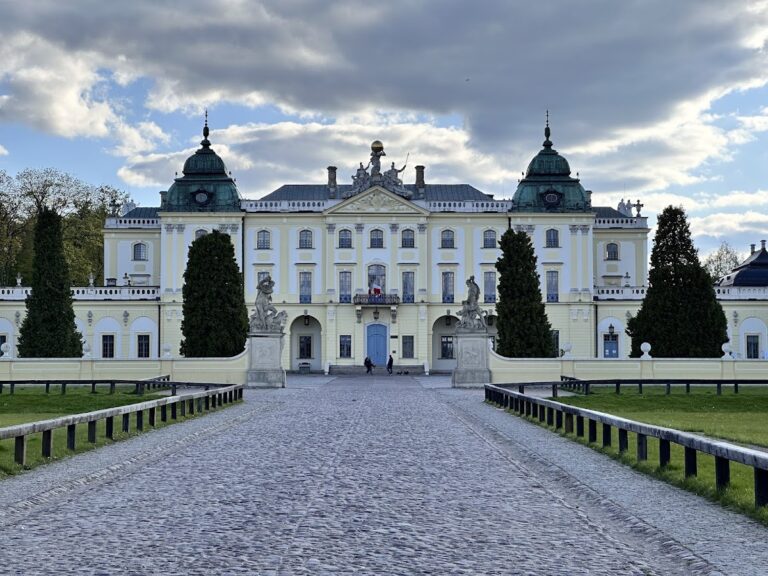
The surviving Baroque monastic buildings were erected during the seventeenth and eighteenth centuries. The gate-belltower was built in 1752 and modelled on the gate of the Branicki Palace in Białystok. An earlier gate-belltower, built between 1695 and 1697, burned in 1702. The later structure once held bells weighing about 2,400, 1,700, and 1,200 kilograms. They disappeared during the First World War. Six new bells were installed in 2001, later increasing the number to eight.
Monastery garden
A garden in the Italian style was laid out beside the south wing at the end of the seventeenth century. It may have survived into the second half of the nineteenth century in a neglected condition, but the agricultural school later destroyed its remains. A modern garden in the Baroque style began to be created in 2006, following a design by Katarzyna Mikołajczyk.
Painted decoration and liturgical furnishings
Frescoes
The Annunciation Church originally contained an extensive fresco cycle. It included scenes from the lives of Mary and Jesus, together with angels, apostles, evangelists, martyrs, monks, early Christian bishops, and prophets. The dome showed Christ Pantokrator, meaning Christ the Almighty or Ruler of All, in a composition modelled on one in the Cathedral of Divine Wisdom in Veliky Novgorod. Other painted areas represented God the Father, the Lord of Hosts, the Holy Spirit as a dove, angels, and Christ the Savior.
The paintings followed a Byzantine-Slavic and Serbian-Balkan manner and were traditionally dated to 1557. Seraphim, saints, and prophets appeared between the windows, while floral ornament, apostles, martyrs, medallions of saints, and two tiers of Gospel scenes filled other areas. The Gospel program concerned the Akathist to the Virgin Mary and the life of Christ, with warriors, saints, and hermits beneath the scenes and in the window arches.
Much of the decoration was covered with whitewash between 1852 and 1859. An attempt to remove it in 1887 caused the loss of a substantial part of the frescoes. Further paintings found behind wooden wall panelling in 1910 were damaged during removal work. After the church was destroyed in 1944, restorers led by Władysław Paszkowski removed 30 surviving fragments in 1945 and 1946. The reconstructed church received a recreated painted program between 2016 and 2021.
Iconostasis
The Baroque interior installed under Basilian administration included side altars and a large seventeenth-century iconostasis, the screen separating the sanctuary from the main body of an Eastern Christian church. Abbot Nikodem Szybiński commissioned it in 1643. It may have been made in Gdańsk or Vilnius, and the attribution to Andrzej Modzelewski remains debated. One interpretation assigns its construction to Johann and Gerard Han of Gdańsk and its gilding to Modzelewski; another places its production in Vilnius.
The iconostasis extended about 12 metres across the church and rose to the vaults. Its side sections were partly concealed by the supports of the central dome, giving the central portion the appearance of projecting toward the worshippers. Three tiers stood within a gilded wooden frame decorated with carved vegetation and small figures. The lower tier contained icons painted on copper sheets, while later icons were painted on canvas. Its program included the Virgin Mary, Christ Pantokrator, the Annunciation, the Archangel Michael, Melchizedek, Saint John the Theologian, Christ the Savior, the Twelve Apostles, God the Father, twelve Old Testament prophets, and the Mandylion.
The original iconostasis, pulpit, side altars, and other furnishings were destroyed during the twentieth-century military occupation. In March 2021, the reconstructed church received a decorated four-tier wooden iconostasis made by the Ukrainian sculptor Oleh Belts of Pochaiv.
Supraśl Icon
The Supraśl Icon of the Mother of God was traditionally identified as a copy of the Smolensk Hodegetria and appeared in the monastery inventory of 1557. The original was taken to Moscow in 1915 and disappeared after the Russian Revolution. A replacement made in 1897 is now kept at the monastery. Modern analysis questions whether the surviving icon derives from the sixteenth century, and a possible connection with the Flemish painter Bartholomeo Pens has also been proposed without certainty.
Library and manuscript heritage
The monastery’s manuscript tradition is represented by the Supraśl Codex, a major medieval Slavonic manuscript associated with the institution. Michał Bobrowski discovered and described it in the nineteenth century. The codex was added to the UNESCO Memory of the World Register in 2007, preserving the memory of Supraśl’s long role in the collection and transmission of religious and literary texts.
Nearby sites