Tykocin Synagogue: A Seventeenth-Century Jewish House of Worship in Poland


Site at a Glance
- Rating
- 4.7
- Popularity
- Medium
- Country
- Poland
- Primary era
- Early Modern
- External website
- Open
- Eras represented
- Early Modern, Modern
- Civilizations
- Polish–Lithuanian Commonwealth
- Site type
- Religious
- Remains
- Synagogue
On this page7 sections
History
Tykocin Synagogue is an Orthodox Jewish synagogue in Tykocin, Poland, built by the town’s Jewish community in the first half of the seventeenth century in a combination of Baroque and late-Renaissance Mannerist styles. Probably constructed after the town fire of 1638 on the site of an earlier wooden synagogue, it was completed in 1642. Tykocin Synagogue is regarded as one of Poland’s oldest synagogues, the country’s second-largest synagogue, and one of the best-preserved seventeenth-century synagogues in Europe.
A center of Jewish learning
During the seventeenth and eighteenth centuries, Tykocin developed into an important Jewish intellectual center. Respected rabbis and Talmudists, scholars who studied and interpreted the Talmud, the central body of rabbinic Jewish legal and ethical discussion, were active in the town. The synagogue served an Orthodox community following the Ashkenazi rite, a traditional form of Jewish prayer associated with communities in Central and Eastern Europe.
In the eighteenth century, a low tower was added to the building’s north-eastern corner. Its lower part served as a prison for members of the Jewish community. The synagogue underwent major repairs in the 1840s, preserving its role as a central communal building while adapting parts of its fabric to later needs.
War, damage, and conversion to a museum
During the Nazi occupation in 1941, the synagogue interior was desecrated and looted, and the building was converted into a warehouse. Its post-war use continued in the same way, including storage of artificial fertilizers. A fire in 1965 caused further damage to the interiors. The synagogue’s library and the Jewish community archives were destroyed, while surviving books were reportedly thrown into a nearby river.
Major repairs and conservation took place from 1974 to 1978. Since 1976, the former synagogue has housed the Tykocin Museum, a branch of the Regional Museum in Bialystok, which was renamed the Podlaskie Museum in Bialystok in 2000. Its exhibitions focus extensively on Judaica and objects associated with Jewish culture. The building is no longer used for worship. Across the street, the former Beit Midrash, or house of study, has also been restored and is used as a city museum.
The synagogue was entered in Poland’s national register of immovable monuments on 24 January 1957 under registration number A-457. Israeli President Chaim Herzog visited the building in 1992. A local tradition connects the synagogue with a rabbi said to have arrived in Tykocin in the late sixteenth century. According to the story, he placed prayers written on amulets in the large chandelier. During a crowded service on the eve of Yom Kippur, the Jewish Day of Atonement, the chandelier supposedly broke loose and fell without injuring anyone, an event attributed to the rabbi’s intercession.
Remains
Exterior and communal spaces
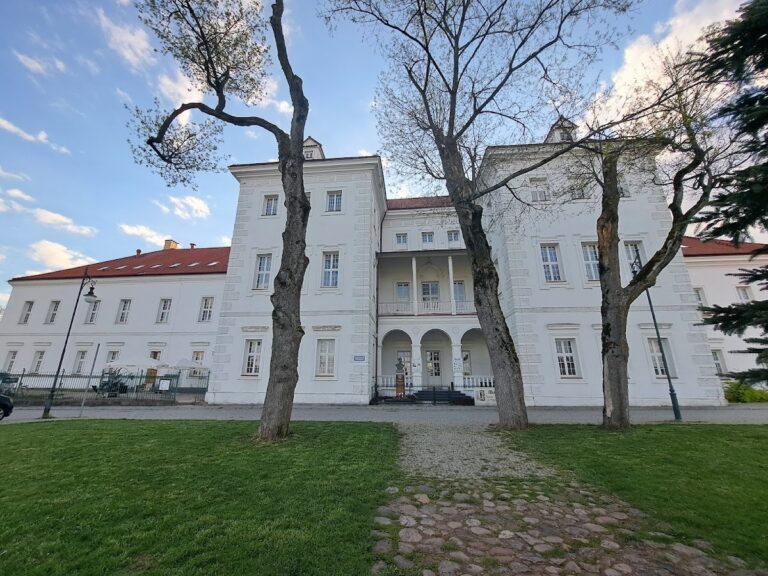
The brick synagogue is a square building measuring 18 by 18 metres. Its architecture combines Baroque and Mannerist elements, including features inherited from the late Renaissance. The design may have been modeled on the fortified synagogue at Pinsk, built in 1640. A high, broken-pitched roof covered with red tiles now shelters the building. It replaced the original roof, which was concealed behind a tall attic wall.
A low tower occupies the north-eastern corner. The lower section is square and the upper section octagonal, reflecting the building’s combination of practical and formal architectural features. The tower originally held the community prison. It now contains a rabbi’s room and a reconstruction of a Passover Seder, the ritual meal and ordered liturgy observed at the beginning of Passover.
Low annexes adjoin the synagogue on three sides. They formerly accommodated shops, study houses, vestibules, and women’s galleries. From these galleries, women could observe services through barred windows. The entrance opens into a large vestibule that once contained the offices of the Jewish communal administration and the community court. An arcaded wall and gateway formerly enclosed the synagogue and neighbouring communal buildings. Foundations of market stalls dating from the first half of the eighteenth century remain visible in front of the building.
The main prayer hall
The main prayer hall is approximately 18.0 by 17.6 metres and rises about 9 metres high. Its square interior contains a nine-field vault, a ceiling divided into nine sections and characteristic of Polish synagogues. The floor is lowered, a feature associated with the Psalm verse, “Out of the depths I cry to you, Lord.”
At the center stands the bimah, the raised reading platform from which the Torah is read. Four massive pillars support it and are richly decorated in a Renaissance manner. Above them, a canopy forms the ceiling of the structure and incorporates a reading table. The elaborate decorative ceiling of the prayer hall was not reconstructed during the late twentieth-century restoration.
Ark, wall painting, and museum collections
The eastern wall contains a richly carved stone Torah Ark, the cabinet where Torah scrolls are kept. Its Mannerist design has two columns and a large upper section with a Torah Crown set in a round medallion. The Ark is covered by a richly woven modern parochet, the curtain placed before the Ark, funded by Poland’s Chief Rabbi Michael Schudrich and the Judaica Foundation.
Colourful polychrome decoration covers the walls. Plant-scroll ornament and images of local and exotic animals accompany large nineteenth-century panels carrying Hebrew and Aramaic biblical quotations and prayer texts. The surviving Ark helps indicate the style of the former ceiling, although that ceiling itself was not rebuilt.
The main prayer hall displays historic Torah scrolls with a crown, Torah shields, prayer shawls, books, tefillin, Hanukkah lamps, menorahs, and spice boxes. Tefillin are small ritual boxes containing biblical passages and worn during weekday morning prayer. The lamps, menorahs, and spice boxes represent different aspects of Jewish ritual practice, including Hanukkah observance, sacred lighting, and the ceremony that marks the end of the Sabbath.