Grachyovka: A Historic Estate in Khovrino, Moscow
Site at a Glance
- Popularity
- High
- Country
- Russia
- Primary era
- Modern
- Eras represented
- Modern
- Civilizations
- Russian
- Site type
- Domestic
- Remains
- Manor House
On this page14 sections
History
Grachyovka is a historic estate in the former village of Khovrino, now within Moscow, Russia. Its land was held from the early fifteenth century, and its present main house is an early-twentieth-century example of merchants’ eclectic architecture, combining elements from different traditions. Over time, the estate passed among noble and merchant families, became a leisure destination, and served as a medical facility.
Early Khovrino and changing owners
In the early fifteenth century, the land belonged to Georgy Safarin, the son of a merchant from Sourozh. Local people called him “Hovra,” a nickname associated with untidiness, uncleanliness, or inattention. The name became Khovrin, the family name, and the village took the name Khovrino. Another tradition claims that the family descended from the Byzantine imperial Komnenos dynasty, but this is presented as an alternative account: it traces a supposed change in the name from Komnenos to Komrin and then Khovrin.
The Tretyakov-Khovrins held the estate in the fifteenth or sixteenth century. At the turn of the sixteenth and seventeenth centuries, their descendant Vasily Tretyakov-Khovrin built a church dedicated to Saint George, a Christian saint, and Khovrino became a village. The church later burned during a period of turmoil, leaving the estate as wasteland.
The next owner, Vasily Sheremetev, was a boyar, a member of the Russian noble elite, and a stolnik, a court official, under Tsar Alexei Mikhailovich. He also served as voivode, a military and administrative governor, of Tobolsk. Crimean Tatars captured him in 1660, and he returned after 21 years. Following his death, Khovrino passed to Prince Yakov Golitsyn as his daughter’s dowry. The Pronsky and Pozharsky families owned it in turn before it entered the crown treasury.
In 1700, Peter I granted the village to his associate Fyodor Alekseyevich Golovin, a descendant of the Khovrins. Golovin was a soldier, diplomat, admiral, and senior military commander, as well as head of the Armory. He concluded the Treaty of Nerchinsk, an agreement between Russia and China, and became the first recipient of the Order of St Andrew, then Russia’s highest order of chivalry. The estate passed to his son Nikolai and remained in the Golovin family for more than a century.
Nineteenth-century rebuilding
In 1811, Ekaterina Baryatinskaya, Golovin’s granddaughter, sold Khovrino to Prince Pyotr Obolensky. Napoleon’s soldiers looted and burned the estate the next year. Unable to rebuild, Obolensky sold the property to Natalia Stolypina. She had a new house built and reorganized the grounds, with a long, broad pond in front of the house, a more compact park, and a semicircular fruit garden shifted to the south.
Factory owner Evgraf Molchanov bought the estate in 1859 and began another major rebuilding, hiring architect Mikhail Bykovsky. He also restored and enlarged the park and improved its water features. The Nikolaev Railway cut through the grounds, and a station platform helped turn the area into a summer settlement. Molchanov built nearby summer houses for wealthy Muscovites to rent, while artists, intellectuals with fewer means, and minor officials lodged in village houses.
Molchanov also decided to replace the old church beside the pond. Bykovsky chose a dry, raised site beside a village road for a new Church of the Sign, named for an Orthodox icon type of the Virgin Mary. Molchanov died a year before the church was completed, and his widow supervised its interior decoration.
Panov, Grachev, and the estate’s social life
Molchanov’s widow sold the estate in 1879 to the merchant Panov, who had made his fortune as a railway contractor. Local peasants threatened to burn the property. Fire destroyed the estate in 1884, although Panov was unharmed; the circumstances of the fire are not established.
Merchant Mitrofan Grachev acquired the estate in 1895 and gave it the name Grachyovka. He cleared and improved the park, renewed service buildings, and replanned the grounds. For a new main house on the site of the burned one, he commissioned architect Lev Kekushev’s design, with Georgy Kaiser carrying out the construction. The design drew inspiration from the Monte Carlo gambling house by French architect Charles Garnier. Grachev died in 1899 before the project was finished; his widow, Varvara Nikolaevna, and son, Semyon, completed the work. The family kept the estate until the Revolution in 1917.
Grachyovka became a popular leisure destination for Moscow’s intellectual and artistic circles. Composer Pyotr Tchaikovsky and writers Alexei Tolstoy and Vladimir Gilyarovsky visited, while painter Kirill Lemokh worked there. Poet Valery Bryusov married Ioanna Runt in the Church of the Sign.
Medical use and changes to the grounds
The Grachev family was expelled in 1918, and the main house became the workers’ faculty of the Petrovsky Agricultural Academy. A workers’ faculty was a preparatory program intended to help workers and peasants qualify for higher education. The academy later took the name K. A. Timiryazev Moscow Agricultural Academy. In 1928, a women’s tuberculosis dispensary opened in the house. Before the Second World War, it became a treatment facility using fermented mare’s milk, then believed to help people with pulmonary tuberculosis. During this period, ponds were drained and some of the park was felled.
Church services continued until 1936, despite the academy’s requests from 1932 to use the building as a student club. The church was subsequently abandoned until 1991 and was fully restored by autumn 2005. During the Second World War, the main house served as a hospital for severely wounded soldiers. After the war, a women’s tuberculosis sanatorium operated at Grachyovka. The Moscow Regional Physiotherapy Hospital moved into the house in 1947 and continues to occupy it.
Khovrino became part of Moscow in 1960. Urban changes badly damaged the park: the cemetery was removed, village houses were demolished, the Likhoborka River was enclosed in a culvert, and the land was levelled for high-rise housing. In 1975, a park monument was installed in memory of Soviet soldiers and officers who died in the wartime field hospital and those killed defending Moscow. Created by G. D. Zhilkin, it is the only monument in Moscow located at the burial place of soldiers who fell in battles defending the city. Grachyovka is a federal-level cultural heritage site, and restoration of the estate began in 2025.
Remains
Main house
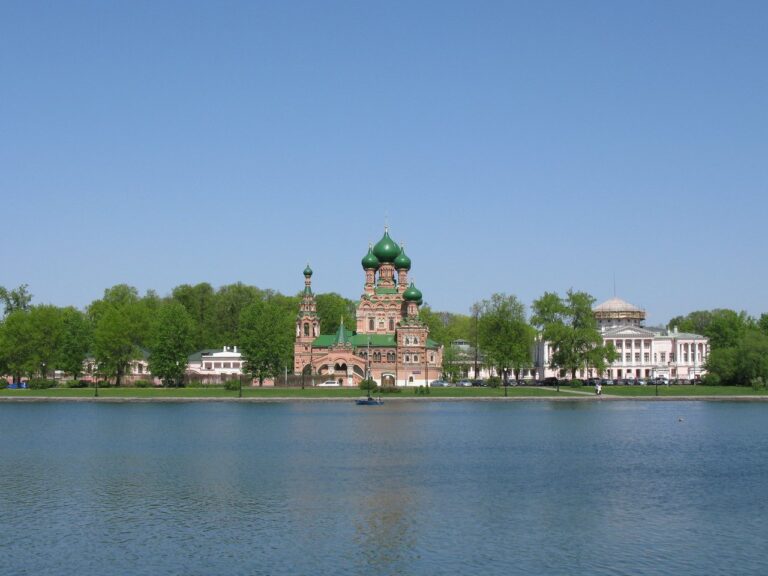
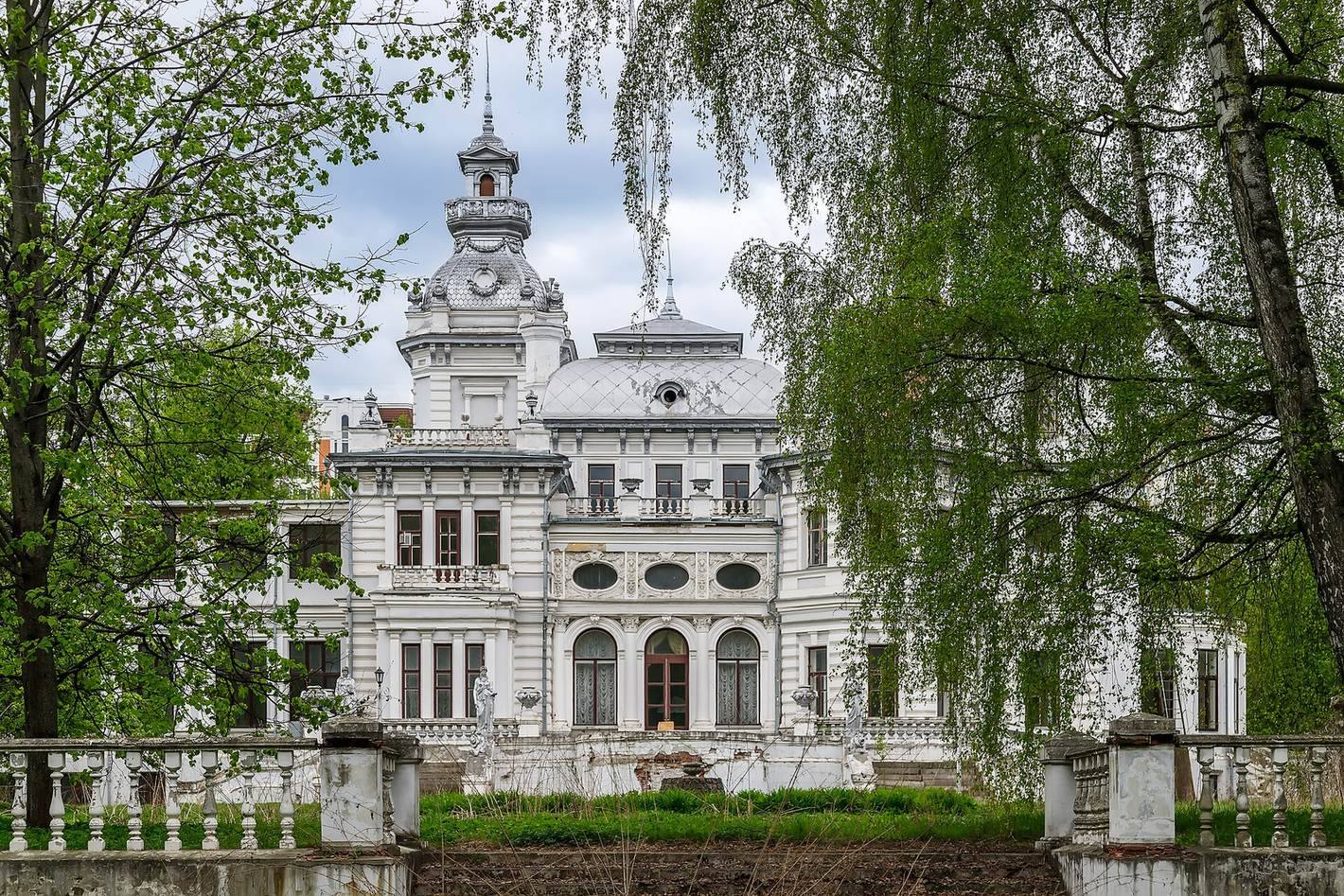
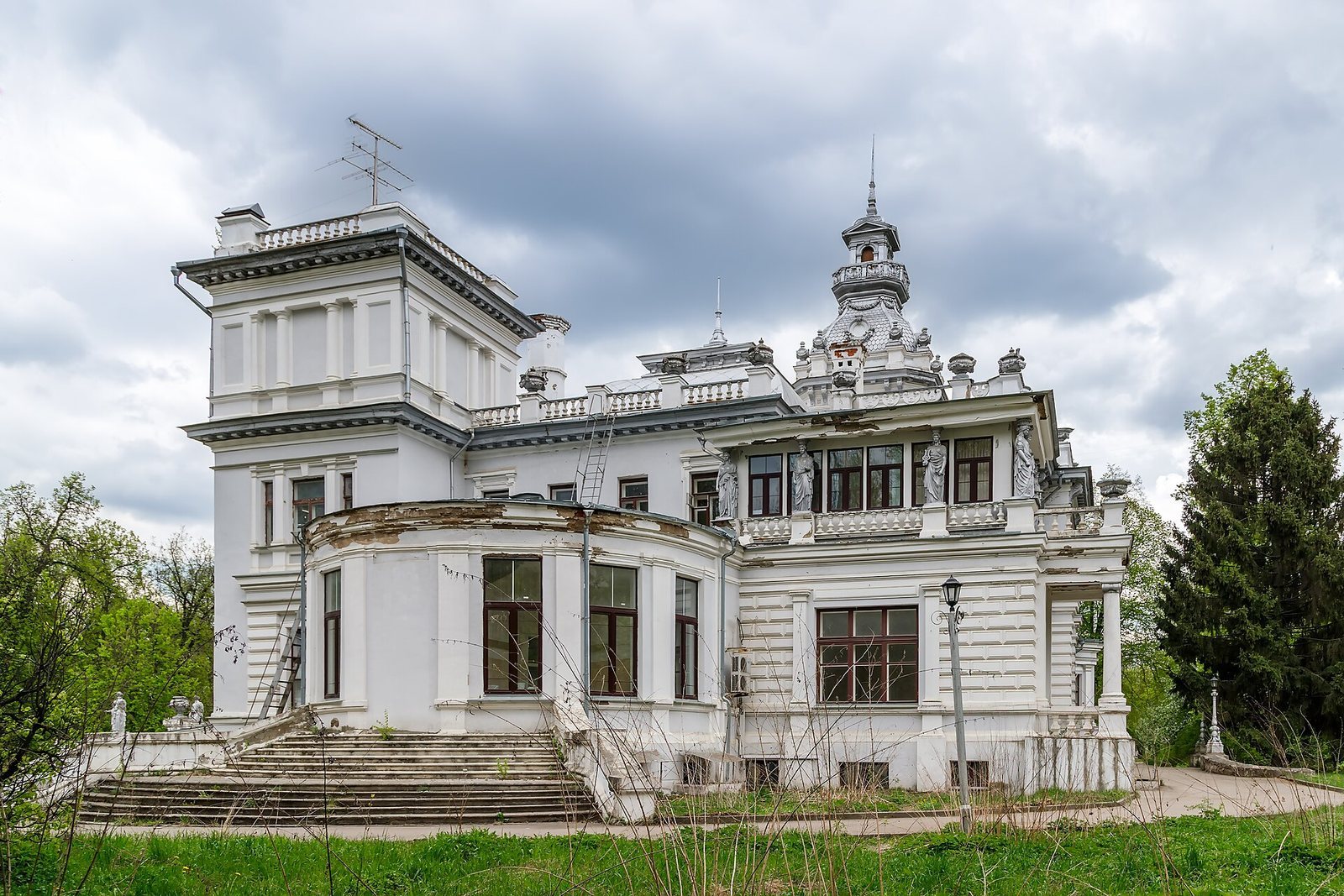
The well-preserved main house, at 2 Klinskaya Street, dates to the early twentieth century. Built by Georgy Kaiser to Lev Kekushev’s design, it reflects merchants’ eclectic architecture. Its exterior combines projecting sections of facade, towers, and faceted domes patterned like scales, with windows projecting from the roof slopes. Sculpted female figures called caryatids serve as supports, and sculpture and stucco ornament cover much of the exterior. The building’s design has been described as French Renaissance or modernist eclecticism.
Estate grounds
Earlier layout
The estate’s historic plan was axial, with buildings and paths arranged around a principal line. A wooden manor house stood at its centre, approached by an alley from the southwest. A fruit garden and a formal lime-tree park, with ordered planting, lay among ponds along the Likhoborka. The Church of the Sign stood to the right of the manor buildings, on an old churchyard where local peasants had been buried since the late fifteenth century.
Grachyovsky Park
In 2017, Grachyovsky Park covered more than 19 hectares and contained two loosely defined areas. The formal part has lime-tree avenues and rows of larches and oaks. The more naturalistic landscape section follows the course of the Likhoborka, now carried through an enclosed channel, toward a small pond. Restored historic arches cross paths in the park, and a colonnade has also been restored.
Church of the Sign
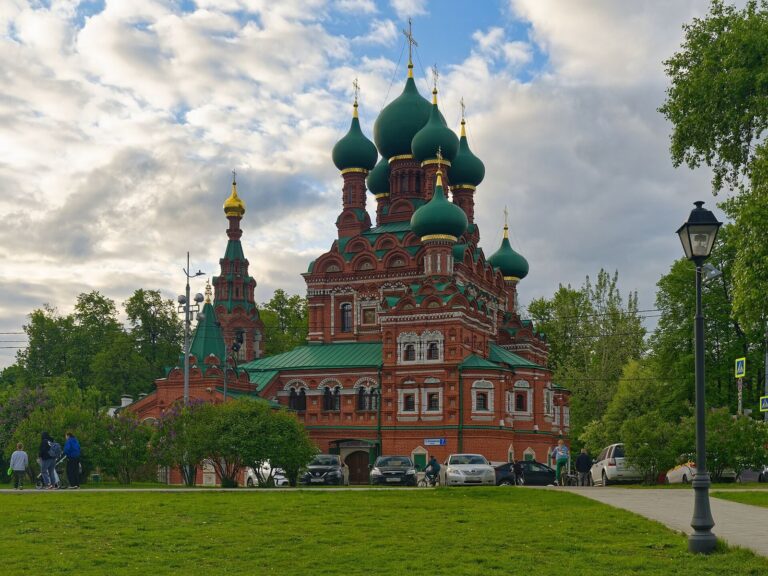
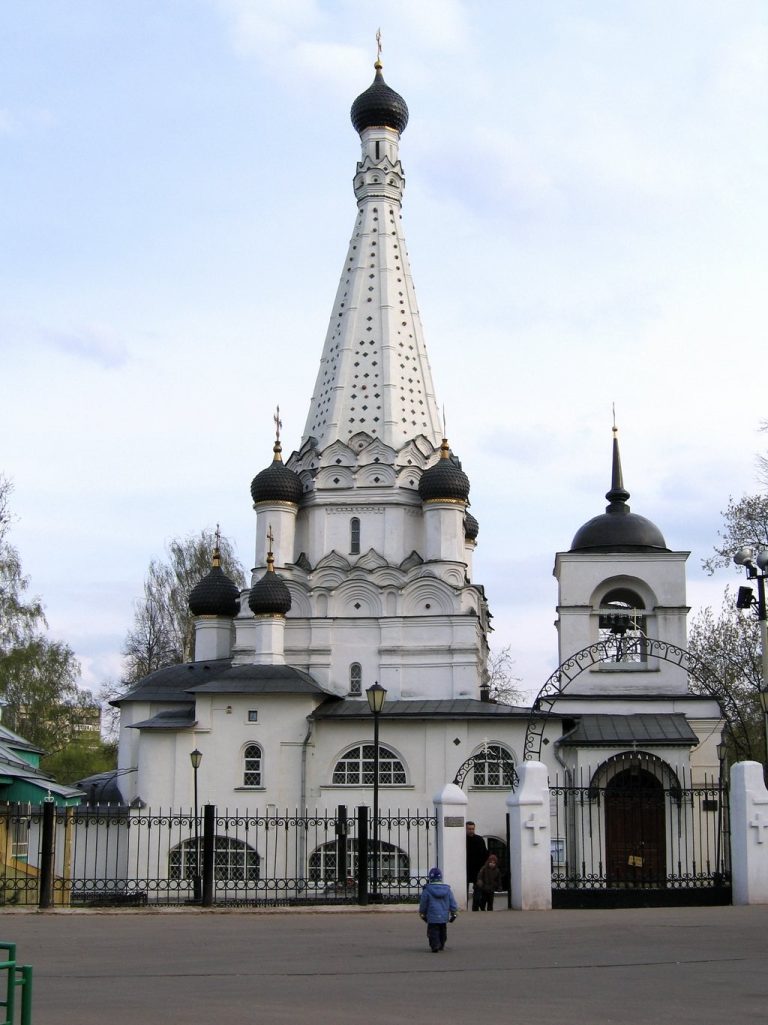
The small church stands on dry, elevated ground beside a village road that curves around the site. Its design combines Moscow Baroque, a Russian Baroque style, with Italian Renaissance forms drawing on classical architecture. The interior included a mosaic floor and walls faced with multicoloured marble. A marble iconostasis, the screen separating the sanctuary from the main body of the church, carried icons painted by Malyshev. The church also had a richly supplied sacristy, a room for vestments and vessels.
Memorial and old oak
War memorial
The monument to Soviet soldiers and officers stands on the Klinskaya Street side of the park, at their burial place.
Old oak
An old oak grows in the park. A plaque installed in September 2020 called it Moscow’s oldest tree and gave its age as 432 years.