Carpi Cathedral: Seat of the Diocese of Carpi
Site at a Glance
- Popularity
- Medium
- Country
- Italy
- Primary era
- Early Modern
- Eras represented
- Medieval, Early Modern
- Civilizations
- Holy Roman Empire, Lombard
- Site type
- Religious
- Remains
- Cathedral
On this page8 sections
History
Carpi Cathedral is a Roman Catholic church in Italy, dedicated to the Assumption of Mary, the Christian belief that Mary was taken into heaven, and serves as the cathedral of the Diocese of Carpi. Construction of the present church began around 1514, following a Renaissance design attributed to Baldassare Peruzzi, an Italian architect and artist.
Medieval foundations
An earlier church stood on the site by 756, when Aistulf, king of the Lombards, built one there. In the medieval period, the location was occupied by a pieve, a church serving a local territory and nearby communities, dedicated to Mary.
Construction and diocesan life
Alberto III Pio, Count of Carpi, patronized the present church. Work continued into the late eighteenth century. The facade was completed in the second half of the seventeenth century, and a dome built in 1768 was lowered in 1771 for structural reasons. An annual service and solemn procession in honor of the Assumption began in 1515 and takes place on August 15, with the bishop officiating.
On December 1, 1779, Pope Pius VI established the Diocese of Carpi and placed it within the ecclesiastical province of Bologna as a suffragan diocese, one belonging to a province led by an archdiocese. In 1855, Carpi became suffragan to the Archdiocese of Modena-Nonantola. The cathedral was consecrated in 1791 by Francesco Benincasa, the first bishop of the diocese. Its cathedral chapter, a body of clergy attached to the church, comprised four senior officers, the archpriest, archdeacon, provost and dean, and seventeen canons, or chapter members.
Later history and restoration
The cathedral became a minor basilica in 1979, an honorary title granted to certain Catholic churches. Episcopal ordinations held there included those of Gaetano Maria Cattani in 1850, Alessandro Maggiolini in 1983 and Douglas Regattieri in 2010. Pope John Paul II visited in 1988 and met with the faithful.
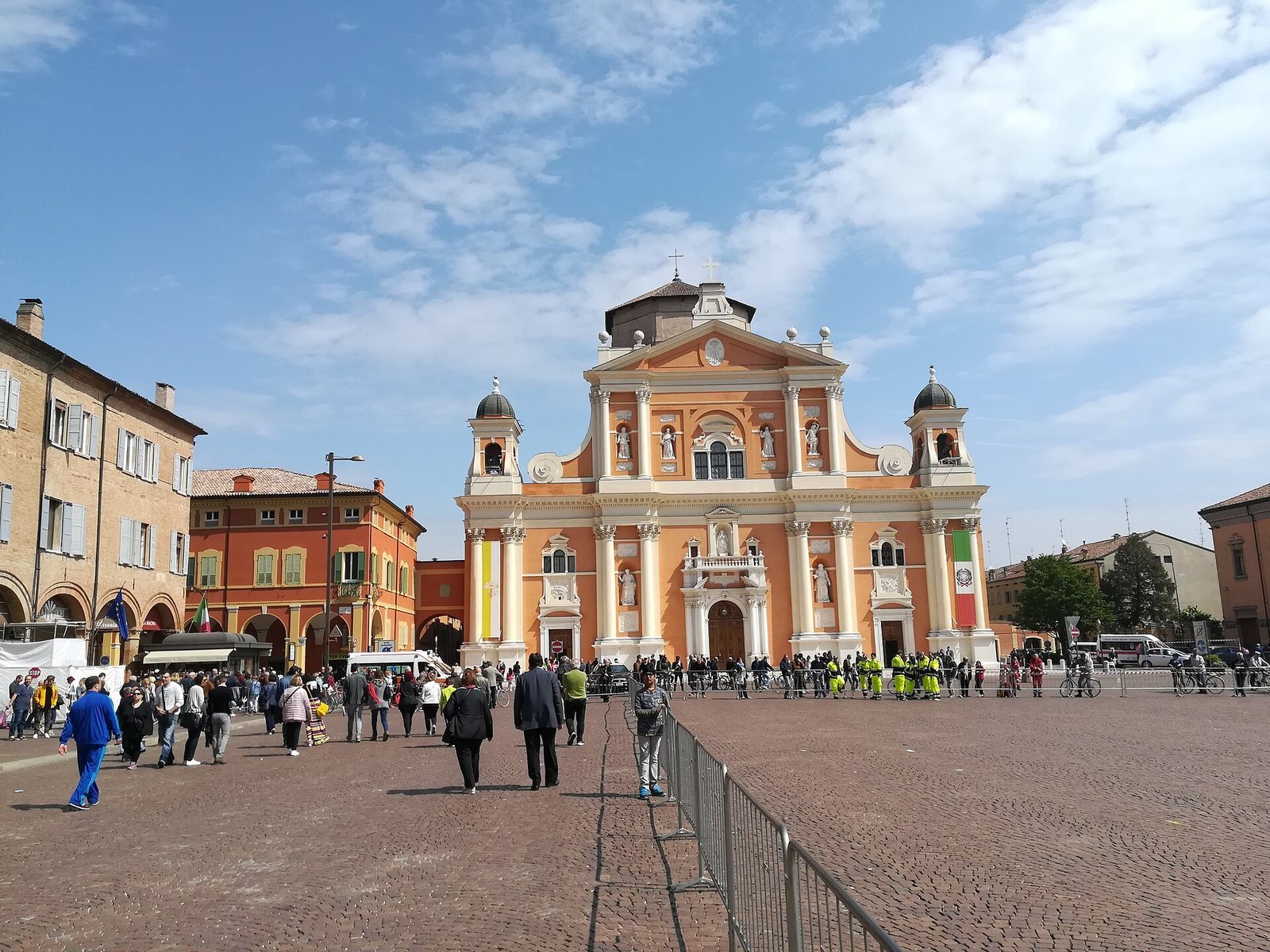
The 2012 earthquakes in northern Italy severely damaged the building. Following major restoration, the cathedral reopened for worship on March 25, 2017, with a new lighting system. The reopening ceremony included the unveiling of a commemorative plaque and the crowning of a statue of the Assumption. A week later, Pope Francis celebrated Mass on the forecourt before a crowd of thousands.
Remains
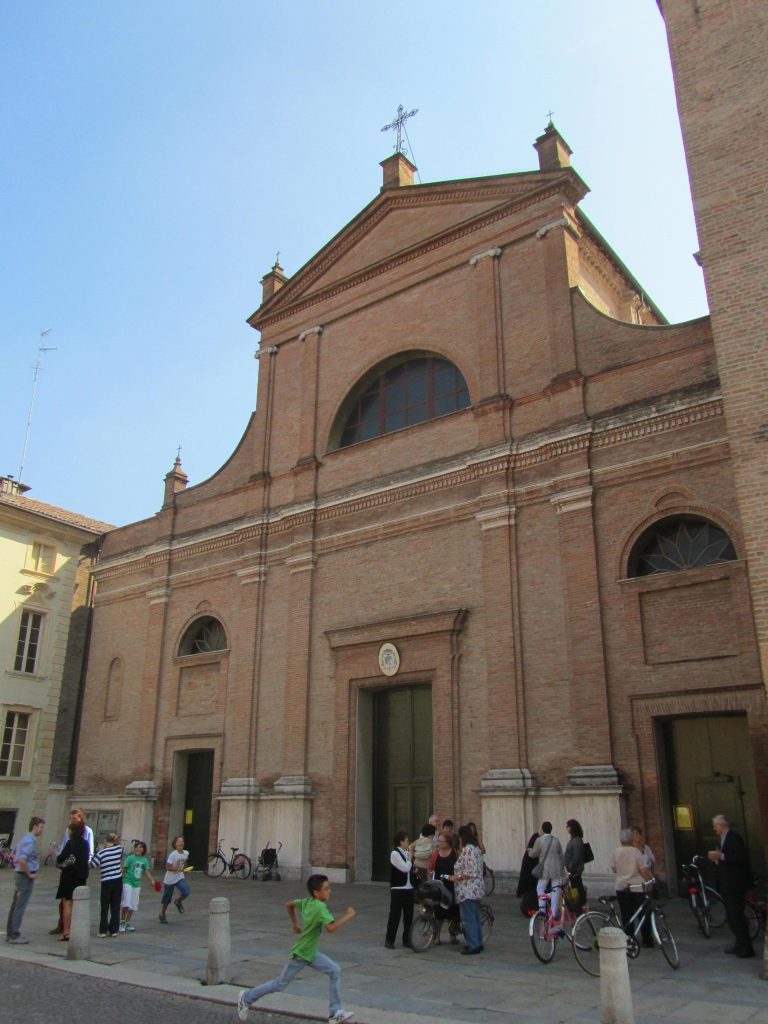
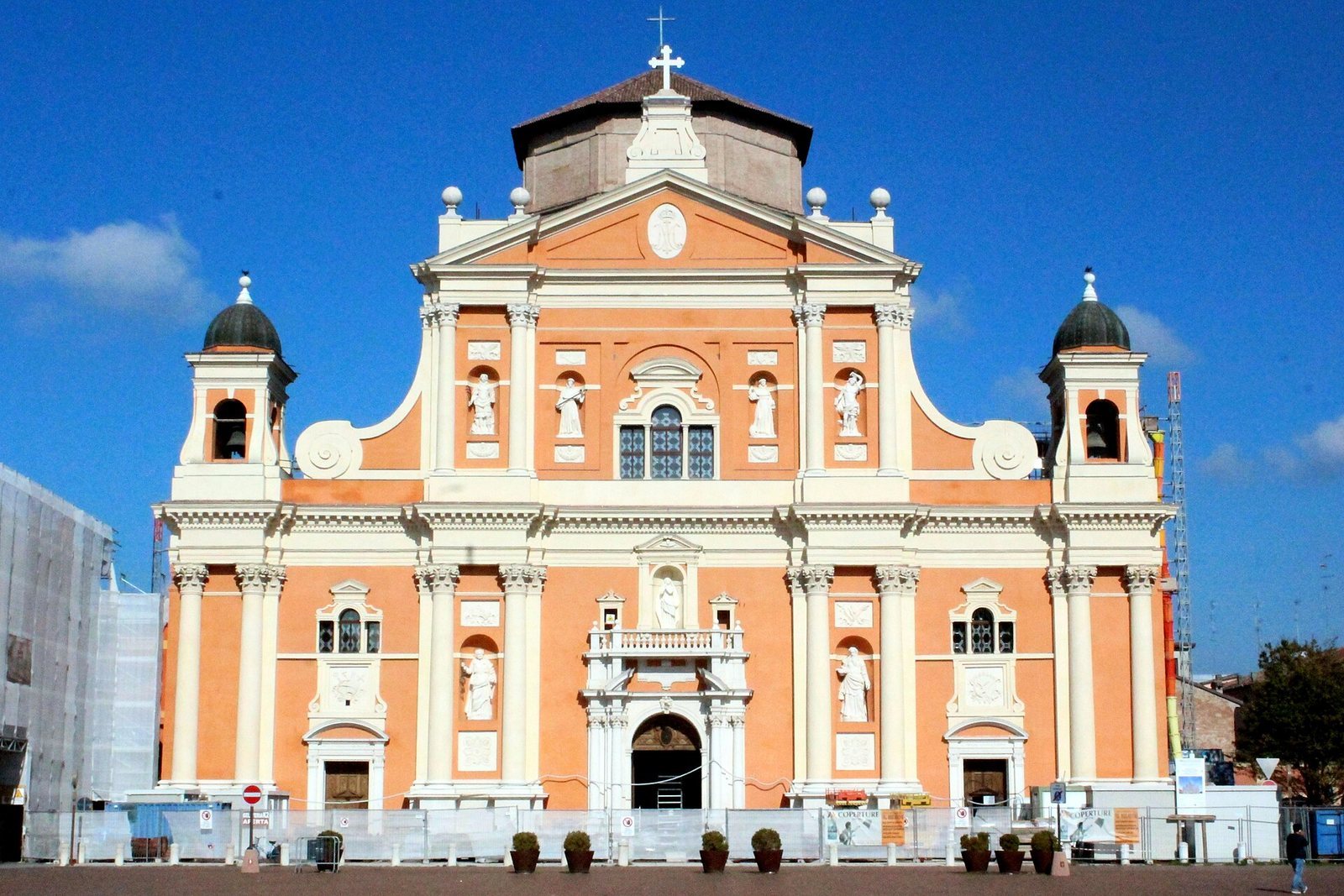
Facing Piazza dei Martiri, the cathedral has a Latin-cross plan, with a long central space crossed by a shorter arm, and an interior divided into three aisles. Its facade has Baroque lines. The building’s layout and design are associated with the Renaissance project attributed to Baldassare Peruzzi, which drew on St Peter’s Basilica in Rome.
Chapels and artworks
The chapels and altars contain artworks and furnishings, most dating to the seventeenth century. Paintings include works by Teodoro Ghisi, Matteo Loves, Luca Ferrari, Giacomo Cavedone and Sante Peranda. The presbytery, the area around the main altar, has been renovated and furnished with new items for worship.
Devotional images and relics
The cathedral holds images of the Assumption of Mary and Our Lady of Sorrows, a statue of Our Lady of Mount Carmel, and a bust of St Valeriano designed to contain a relic. An image called Madonna della Porta, or Gate of Heaven, was moved from Porta Mantova shortly before the gate’s demolition in the early twentieth century. The church also preserves relics of St Bernardino Realino and the principal relic of Odoardo Focherini. A relic is a physical remnant or an object associated with a holy person. Focherini, a resistance fighter against the Nazi regime and a martyr, was beatified in 2013, a formal Catholic declaration permitting public veneration as Blessed; his principal relic was placed in the cathedral in 2017.
Burials and grave slabs
Marble grave slabs commemorating former bishops are in the right-hand aisle, near the chapel of St Valeriano in the church’s crosswise arm. People buried in the cathedral include general and minister Manfredo Fanti (1806–1865), artist Lelio Rossi, and bishops Francesco Benincasa, Carlo Belloni, Giacomo Boschi, Clemente Maria Bassetti, Gaetano Maria Cattani, Gherardo Araldi, Andrea Righetti, Giovanni Pranzini, Vigilio Federico Dalla Zuanna, Artemio Prati and Elio Tinti.