Church of the Assumption in Marwałd: A Historic Parish Church in Poland
Site at a Glance
- Popularity
- Very Low
- Country
- Poland
- Primary era
- Early Modern
- Eras represented
- Medieval, Early Modern, Modern
- Civilizations
- Duchy of Prussia, German, Kingdom of Prussia, Teutonic Order
- Site type
- Religious
- Remains
- Church
On this page11 sections
History
The Church of the Assumption in Marwałd is a Roman Catholic parish church in Poland, probably built in the early 15th century. Its first known written record dates to 1470. In 1525, when the Reformation, a 16th-century movement that led to the formation of Protestant churches, was introduced in East Prussia, the congregation adopted the Protestant confession and became Evangelical Lutheran.
The parish first belonged to the Saalfeld inspection, a regional supervisory district, and later to the Neidenburg inspection. Estate owners at Klonau and Fiugaiken exercised aristocratic patronage over the church.
Parish changes and damage in the 17th and 18th centuries
The church was heavily damaged during the Tatar incursion of 1656 and renewed in 1694. In 1721, the church at Döhlau became a subsidiary of Marwałd, meaning it served a local congregation while remaining attached to the larger parish. The church at Elgenau was transferred from Gilgenburg to Marwałd in 1758 and discontinued in 1767. A lightning strike severely damaged the Marwałd church in 1766.
Parish and community to 1945
In the early 20th century, the congregations of Marwałd, Döhlau, and Marienfelde united under the Marwałd parish. A second pastoral post was established at Marienfelde in 1913. In 1925, the congregations had 3,150 members at Marwałd, 1,175 at Döhlau, and 895 at Marienfelde. In 1903, the Marwałd congregation also established the Good Shepherd, a residential institution for educational welfare that operated until 1945 and became known beyond the region.
Until 1945, the congregations belonged to the Osterode superintendent district, a regional supervisory unit, and church district in East Prussia. They were part of the Province of East Prussia within the Evangelical Church of the Old Prussian Union, a Protestant church body. Before 1945, Roman Catholic residents of Marwałd and its surroundings belonged to the parish at Pronikau. The church was renovated and repainted in the 1930s under the direction of a church architect from Rastenburg.
Postwar Catholic parish
After 1945, the flight and expulsion of the local population brought the Protestant congregation to an end. Newly settled Polish residents, almost all Roman Catholic, took over the church, which underwent a major restoration to accommodate changed liturgical practices.
The church is dedicated to the Assumption of Mary, the Catholic teaching that Mary was taken body and soul into heaven. An independent parish was established at Marwałd on 22 February 1972. It belongs to the Grunwald deanery, a regional grouping of parishes, in the Archdiocese of Warmia, a major territorial jurisdiction of the Catholic Church, whose seat is in Olsztyn. The parish also includes the church at Elgnowo.
Remains
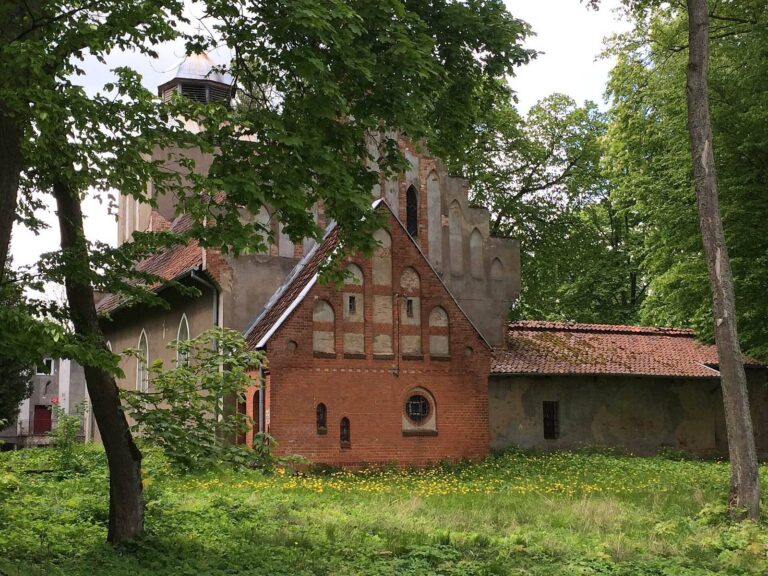
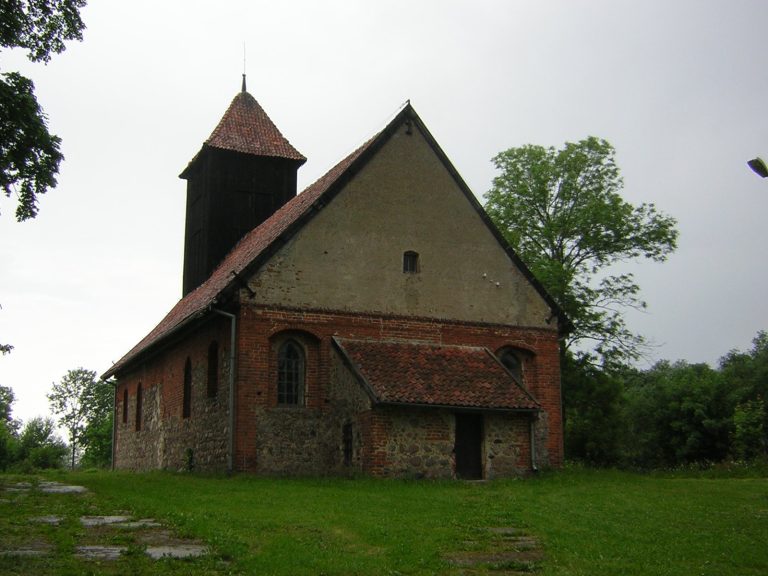
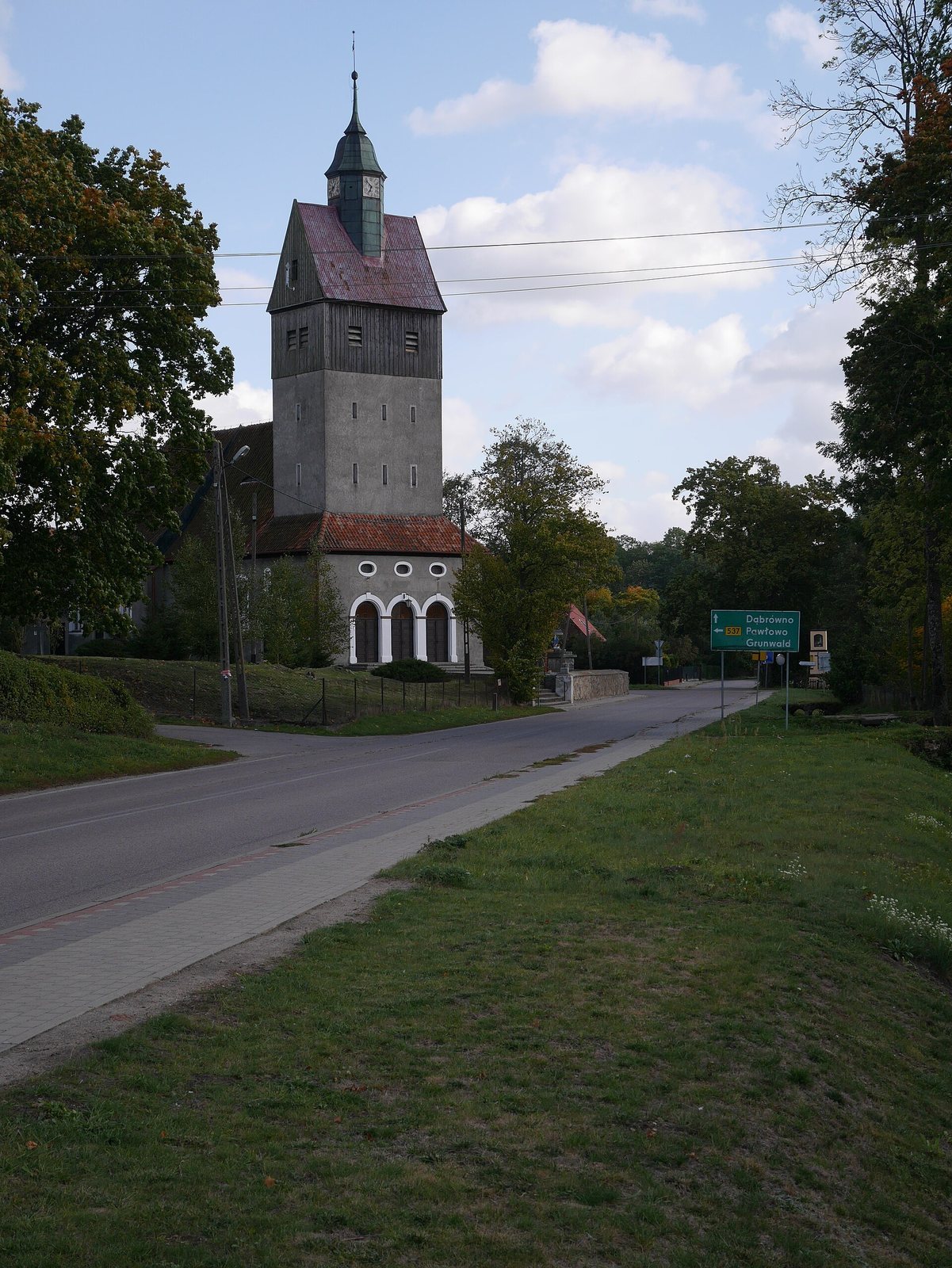
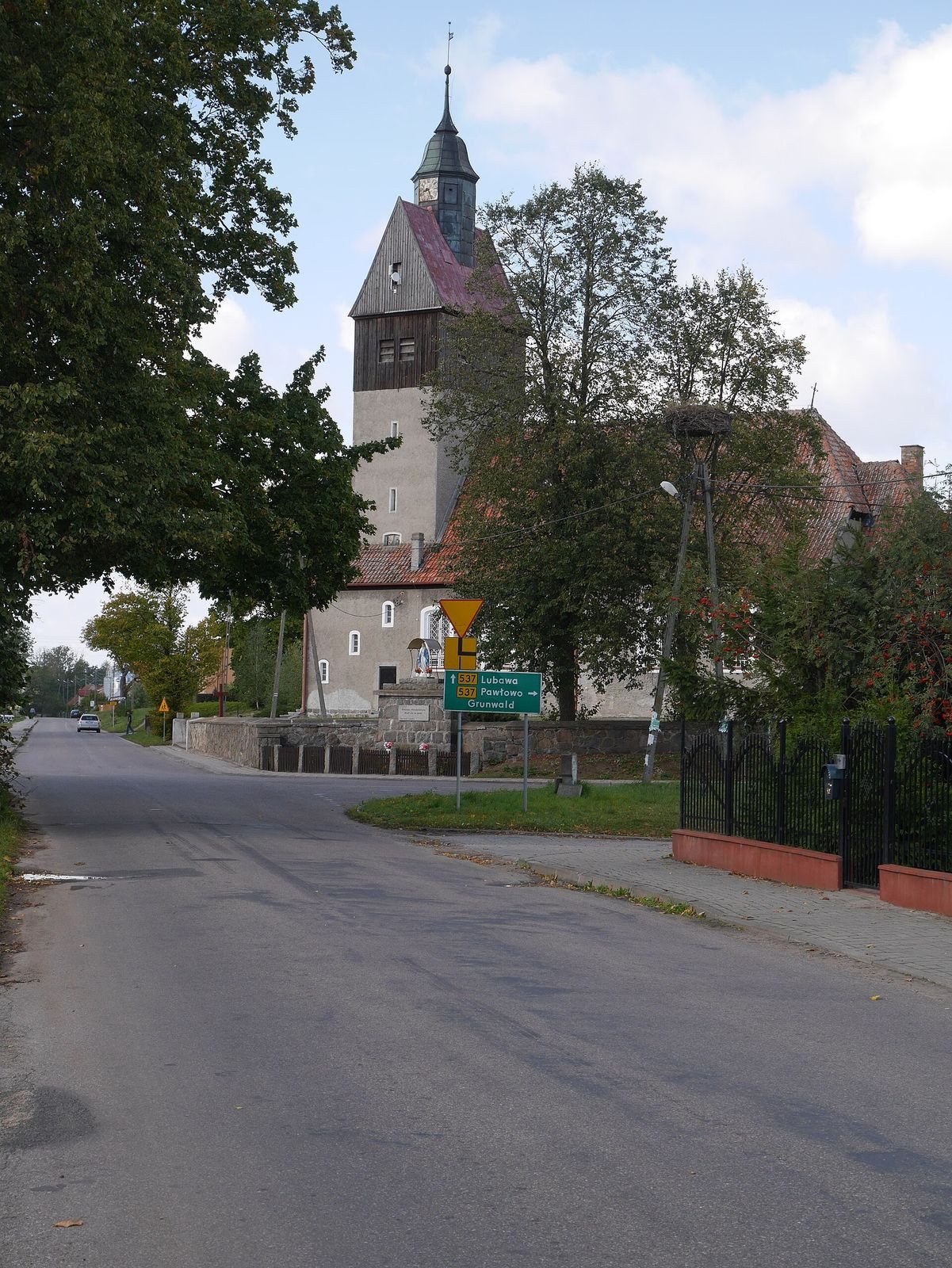
The church stands in the center of Marwałd beside the main road. It is a fieldstone building with foundations dating to the early 15th century; it was renewed in plastered fieldstone in 1694.
Church architecture
Extensions and tower
A western extension was added in 1876. The church’s massive tower dates to 1905, when the area around the altar was also enlarged.
Nave and galleries
The central nave has a barrel vault, a continuous arched ceiling, while the side galleries have flat ceilings.
Furnishings and cemetery
Furnishings
The altar and pulpit were assembled from components dating to around 1730 and originally formed a single ensemble. They were separated after 1945. An early 18th-century baptismal angel, a figure designed to hold or suspend a baptismal basin, is among the church’s furnishings, alongside a brass basin from the 17th century. The organ was built in 1843, and the two bells, cast in 1751, form the church’s peal.
Evangelical cemetery
The pre-1945 Evangelical cemetery remains beside the church. It is heavily neglected, with most graves overgrown and abandoned.