Our Lady of Consolation Church in Dylewo: A Historic Place of Worship
Site at a Glance
- Popularity
- Very Low
- Country
- Poland
- Primary era
- Early Modern
- Eras represented
- Medieval, Early Modern, Modern
- Civilizations
- Brandenburg-Prussia, German, Kingdom of Prussia, Teutonic Order
- Site type
- Religious
- Remains
- Church
On this page9 sections
History
Our Lady of Consolation Church in Dylewo is a church in Poland whose origins probably reach back to the fourteenth century. It served an Evangelical congregation for centuries and became a Roman Catholic church after 1945. In its earlier history, Dylewo was known as Döhlau.
Medieval origins and the Reformation
A church probably stood in Döhlau by the fourteenth century. Its earliest known mention comes from 1501, when it received a bequest of a gold communion chalice. The congregation existed before the Reformation, the movement that established Protestant churches in Europe, and became Evangelical afterward.
Destruction and the Evangelical parish
The Tatar invasion of 1657 destroyed the church. The Evangelical congregation rebuilt it toward the end of the seventeenth century. In 1721, Döhlau was a dependent congregation affiliated with Marwalde, first within the Saalfeld ecclesiastical district, or inspection, and later within the Neidenburg district. Marwalde, Döhlau, and Marienfelde subsequently formed a church union with separate parish districts. Its two pastoral posts were at Marwalde and Marienfelde.
In 1842, Captain Kern, the local estate owner and church patron, began an extensive restoration. During the work, King Frederick William IV of Prussia, who reigned from 1840 to 1861, passed through Döhlau after visiting the nearby Tannenberg battlefield. At the request of local residents, he wrote a message for the church tower’s top ornament, expressing the hope that God’s word would endure in the church and surrounding area. He dated it at Hohenstein on 24 July 1842.
By 1925 the parish had 1,175 members and its own parish nurse. Until 1945, it belonged to the Marwalde-Döhlau-Marienfelde church union, the Osterode superintendent’s district and church district, the East Prussian Church Province, and the Evangelical Church of the Old Prussian Union, a Protestant church body in Prussia. Flight and expulsion of the local population ended the Evangelical congregation.
Change of denomination after 1945
Before 1945, Roman Catholics in Döhlau and the surrounding area belonged to the parish at Gilgenburg in the Diocese of Warmia. After 1945, Polish newcomers took over the formerly Evangelical church, which passed to the Roman Catholic Church. It now serves as a branch church, attached to Szczepankowo parish, in the Grunwald deanery of the Archdiocese of Warmia. Later repairs adapted the building to Catholic liturgical practices.
Remains
Architecture and furnishings
Church building and additions
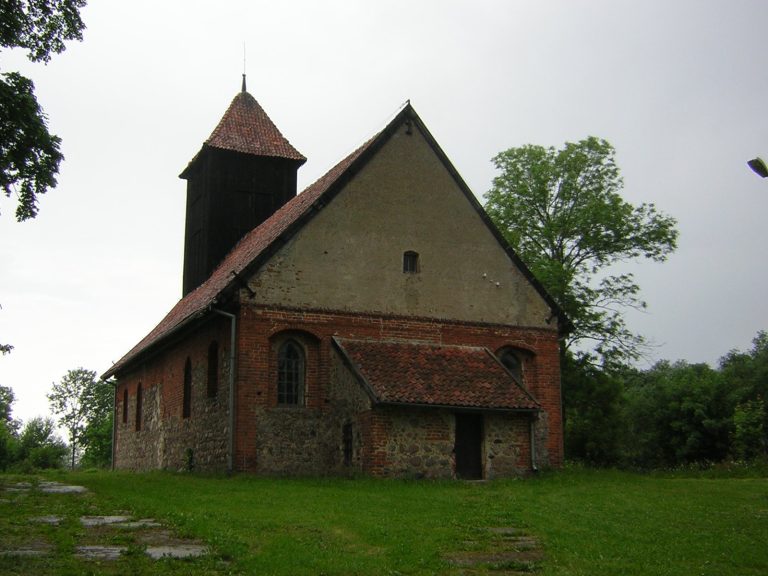
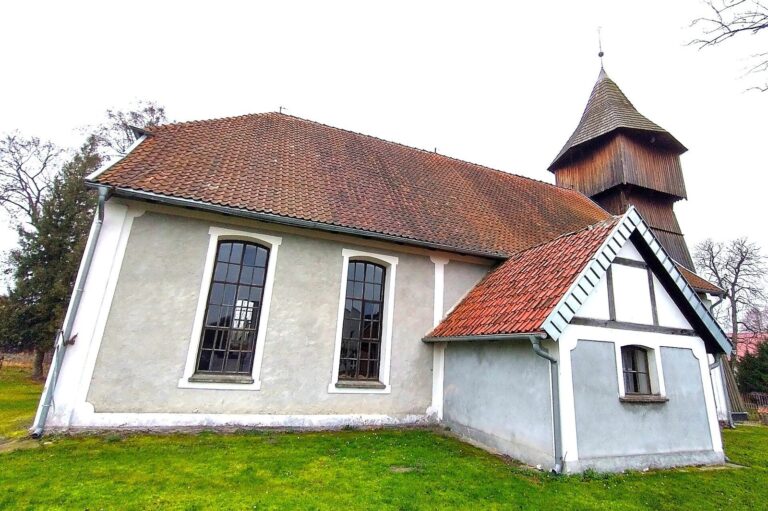
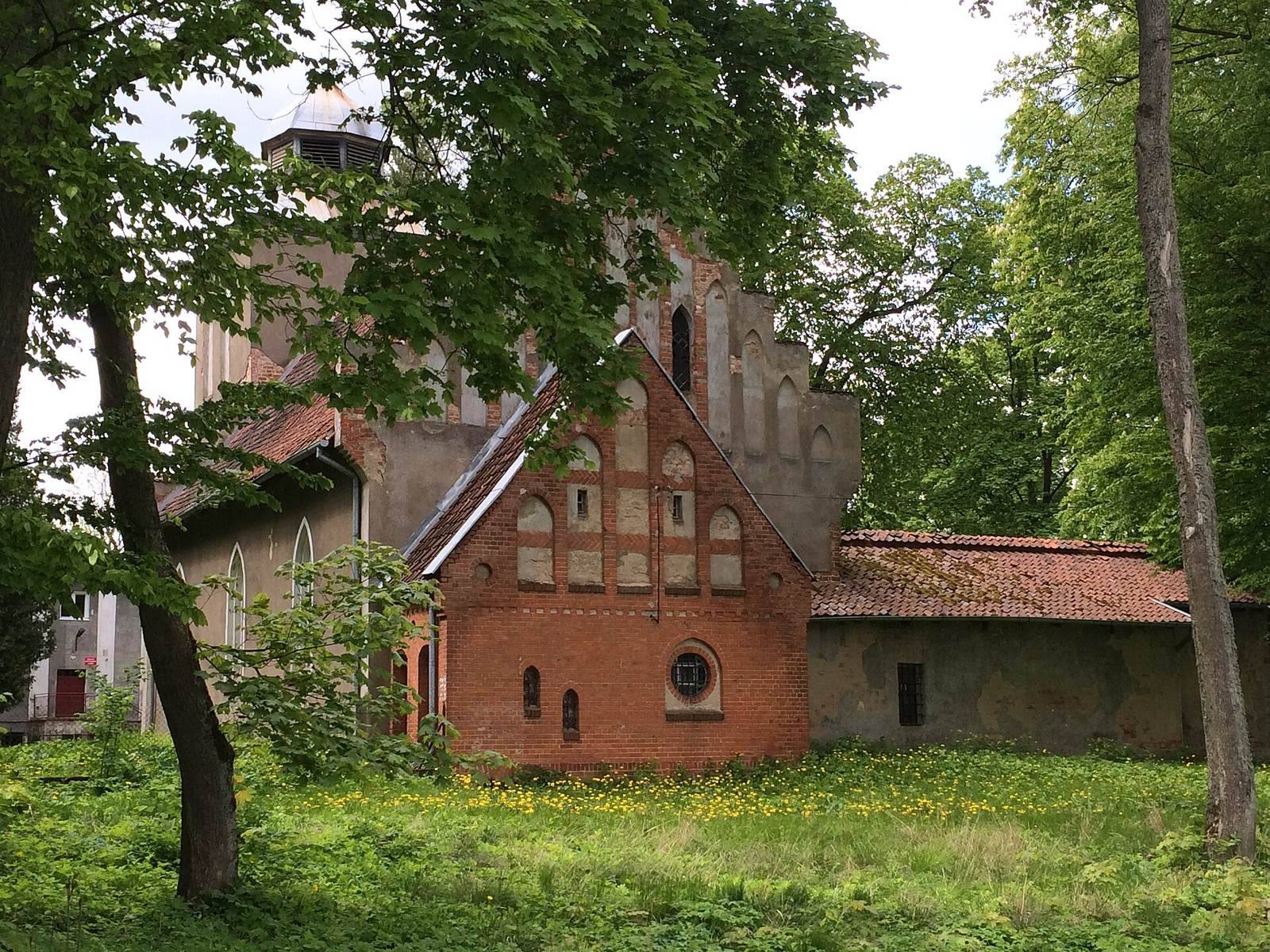
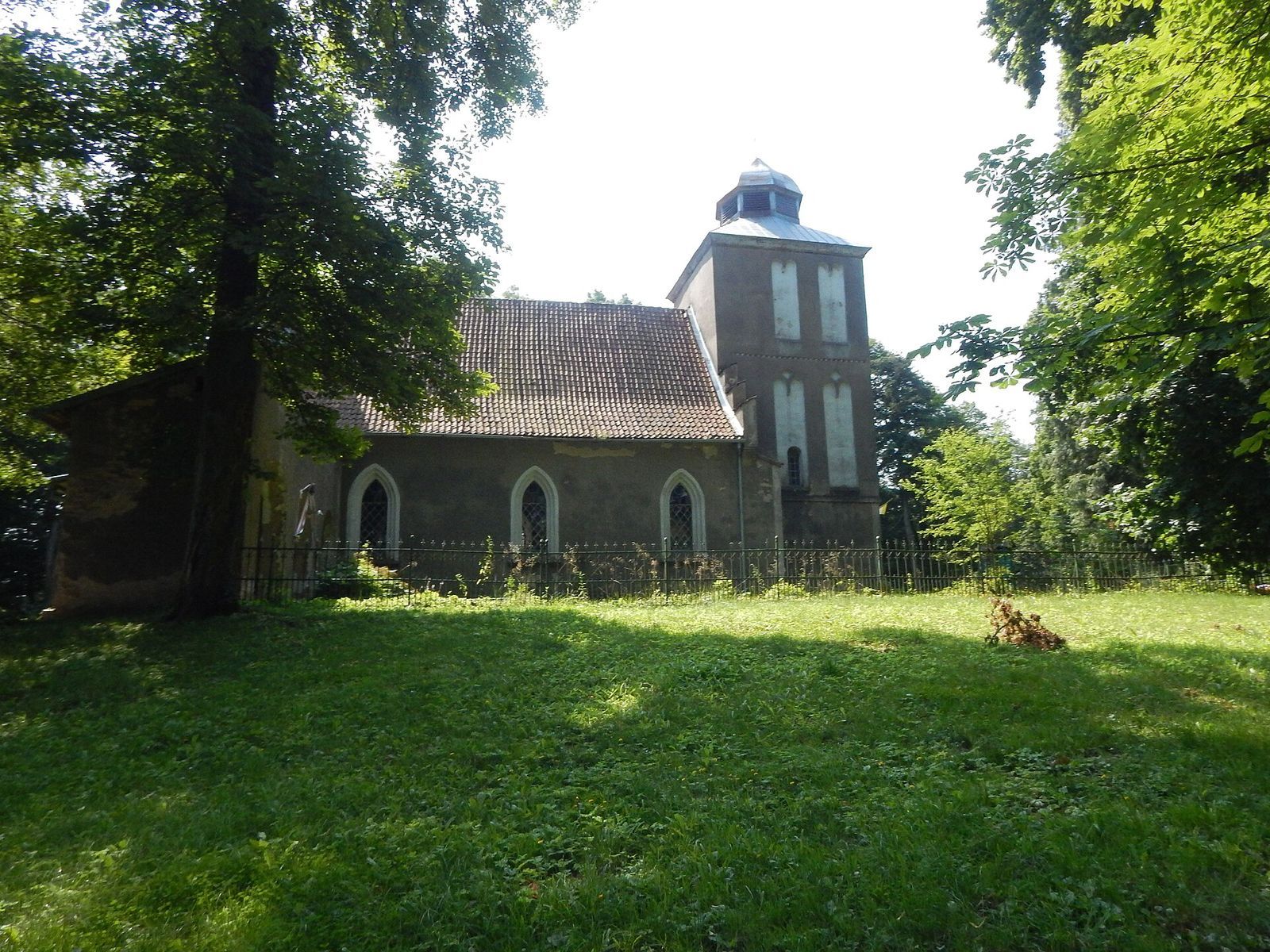
The brick church stands in the center of Dylewo, west of the village street and north of the junction leading to Miejska Wola. A tower rises at its western end. The tower was probably rebuilt toward the end of the seventeenth century, incorporating parts of its fourteenth-century predecessor.
A burial chamber, or crypt, was added in 1908, and a sacristy, a room for preparing services and storing religious items, was built on the east side in 1914. The interior has a flat wooden ceiling divided into recessed panels.
Interior furnishings
Some of the furnishings came from the earlier church. In 1739, Joachim Kapitzki assembled the altar and pulpit from older components; the two were later separated. A baptismal angel, a furnishing associated with the baptismal rite, dates to 1700. A bell was cast for the church in 1850, and an organ was installed in 1854.
Marble bust
The vestibule contains a marble bust of Franz Rose, the estate owner who lived from 1854 to 1912. Italian sculptor Adolfo Wildt made the bust.