Holy Trinity church in Leszcz: A Medieval Brick Gothic Church in Poland
Site at a Glance
- Rating
- 4.7
- Popularity
- Very Low
- Country
- Poland
- Primary era
- Medieval
- Eras represented
- Medieval, Early Modern, Modern
- Civilizations
- Kingdom of Prussia, Teutonic Order
- Site type
- Religious
- Remains
- Church
On this page10 sections
History
Holy Trinity church in Leszcz, Poland, is a medieval brick Gothic church associated with the period of the Teutonic Order. Its construction probably dates to the 1320s, shortly after the village was founded, although its origins are also placed more broadly in the fourteenth century. Historically known by the German name Heeselicht, it has served different Christian communities during the region’s religious and political changes.
Medieval origins and the Reformation
A Christian congregation existed at Heeselicht before the Reformation, the sixteenth-century movement that led many communities in central Europe to adopt Protestant forms of Christianity. The congregation adopted the Protestant confession during the Reformation, and the church then served the Protestant parish of Heeselicht in the former Osterode district of East Prussia.
Changes in parish administration
At the beginning of the sixteenth century, Heeselicht was incorporated into the Saalfeld ecclesiastical inspection, an administrative district for church oversight, and initially had its own pastorate. Its status was later reduced. In 1781, the church became a branch church of Gilgenburg in the Neidenburg inspection. A branch church depends administratively on a larger parish rather than functioning as an independent parish with its own principal pastor.
During the final years before 1945, Heeselicht formed an association with Gilgenburg, while the pastoral seat remained at Gilgenburg. Heeselicht retained its own parish district and the patronage of the local estate owner. The owners of the Seemen estate appointed the clergy of the Gilgenburg parish alternately for Gilgenburg and Heeselicht. In 1925, the Heeselicht parish had 1,100 members. Until 1945, it belonged with Gilgenburg to the Hohenstein superintendent district, the Osterode church district, and the East Prussian church province of the Church of the Old Prussian Union.
Postwar religious transition
Before 1945, the Catholic inhabitants of Heeselicht belonged to the parish of Gilgenburg in the Diocese of Ermland. After the Second World War, the former Protestant church was transferred to the Roman Catholic Church in Poland. It was dedicated to the Holy Trinity, the Christian doctrine that one God exists in three persons, the Father, the Son, and the Holy Spirit, and was adapted for changed Roman Catholic liturgical requirements.
The former Protestant congregation in the village, then called Leszcz, disintegrated after the war because of the flight and expulsion of the local population. The church now functions as a branch church of the Roman Catholic parish in Dąbrówno, within the Grunwald deanery of the Archdiocese of Ermland.
Remains
Building and setting
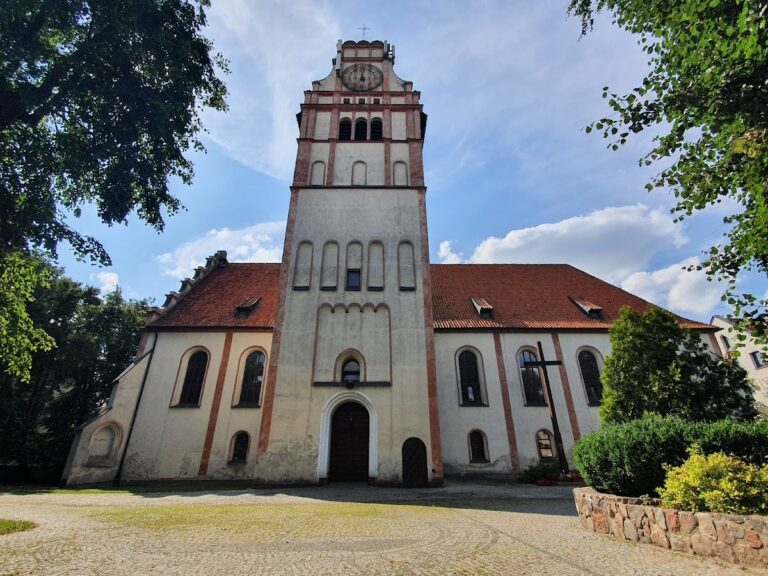
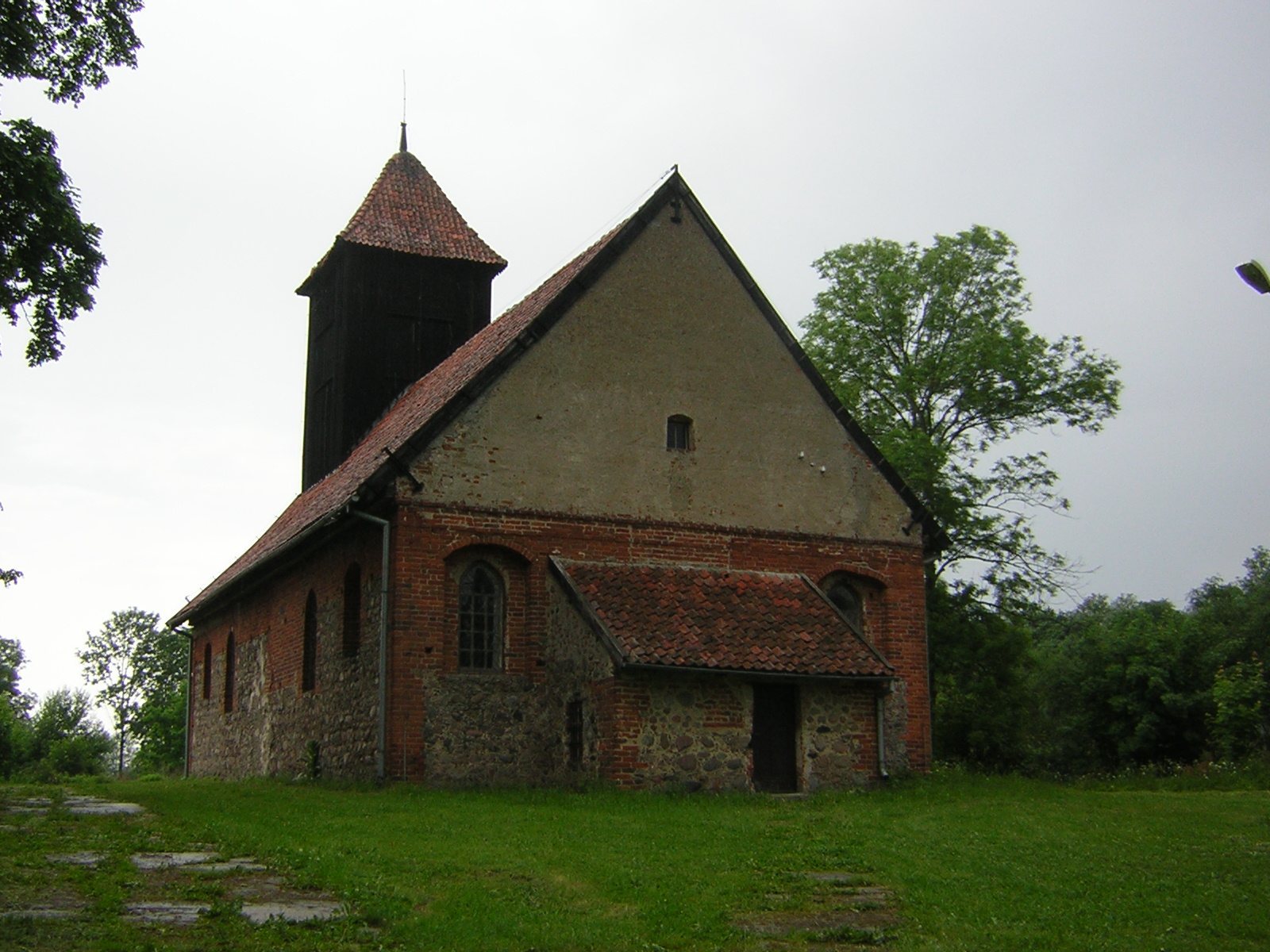
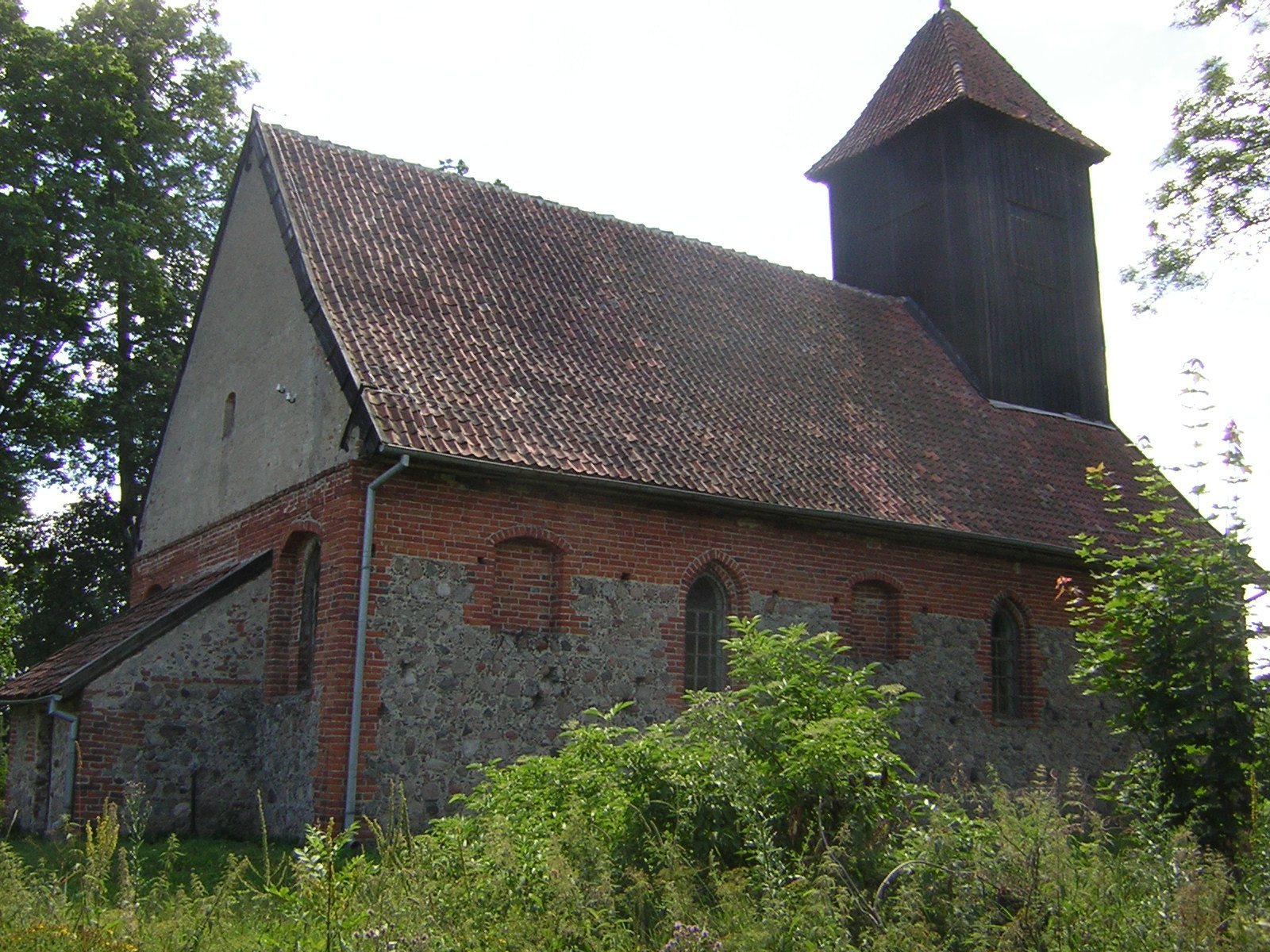
The church stands in the center of Leszcz, on the west side of the main road. The village lies on the eastern shore of Great Damerau Lake. The building is a simple brick Gothic structure on fieldstone foundations, with no separate choir. Its form reflects repeated remodelling over the centuries. The original tower was replaced in 1828 by a wooden roof turret, which remains part of the church’s present external form.
Interior and furnishings
Ceiling and painted decoration
The interior is covered by a flat wooden ceiling dating from the eighteenth century. The ceiling was originally painted, and remnants of this decoration survive.
Altar and pulpit
The altar and pulpit were made around 1720. They form a unified ensemble within the interior, linking the church’s furnishings to its period of Protestant use.
Organ and bells
An organ built in 1841 forms another surviving element of the interior. The church also has two bells.