St Anthony’s Church in Ortisei: A Roman Catholic Church Dedicated to Anthony of Padua
Site at a Glance
- Popularity
- Low
- Country
- Italy
- Primary era
- Early Modern
- Eras represented
- Early Modern, Modern
- Civilizations
- Austria-Hungary, Austrian Empire, Habsburg, Holy Roman Empire
- Site type
- Religious
- Remains
- Church
On this page11 sections
History
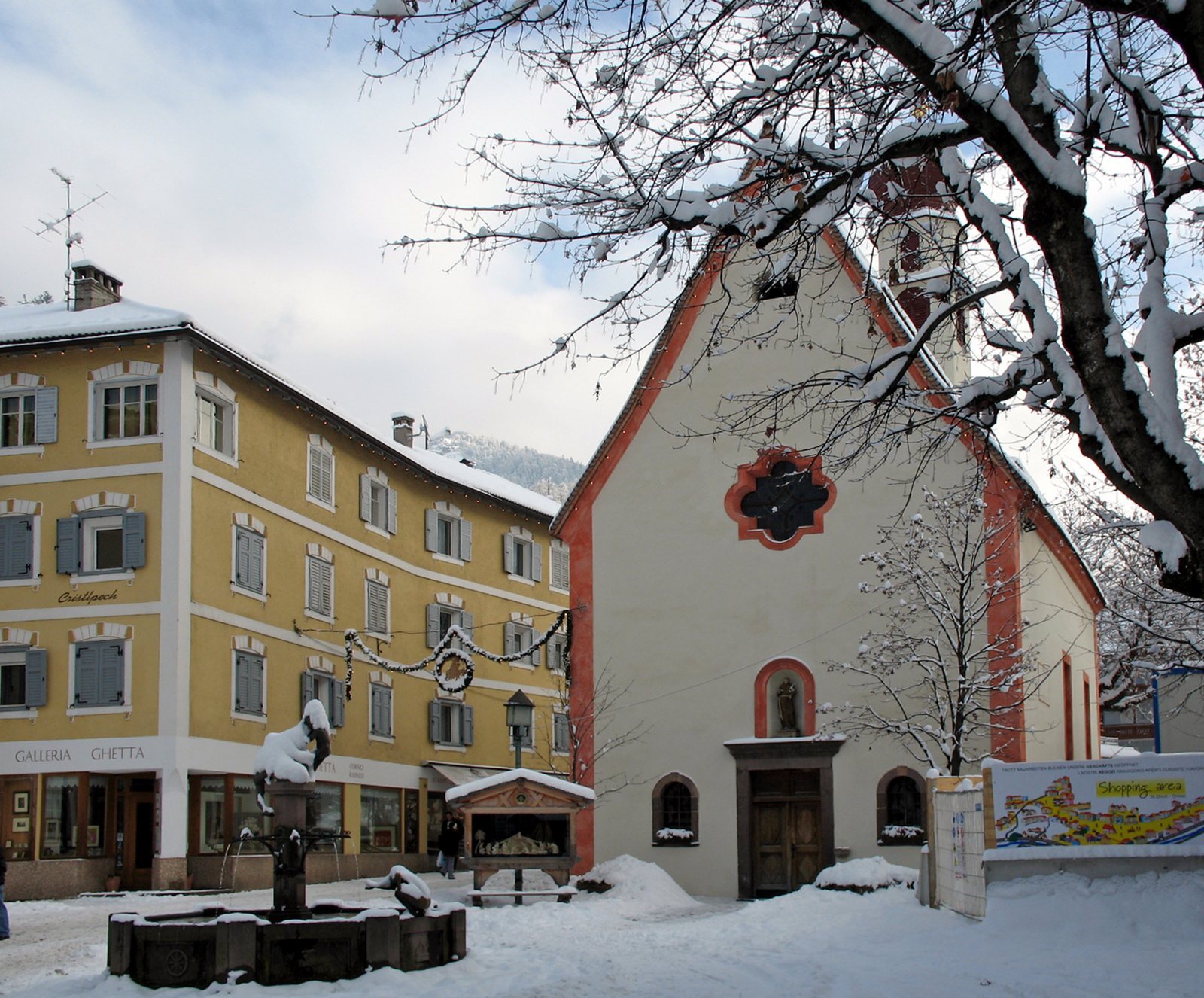
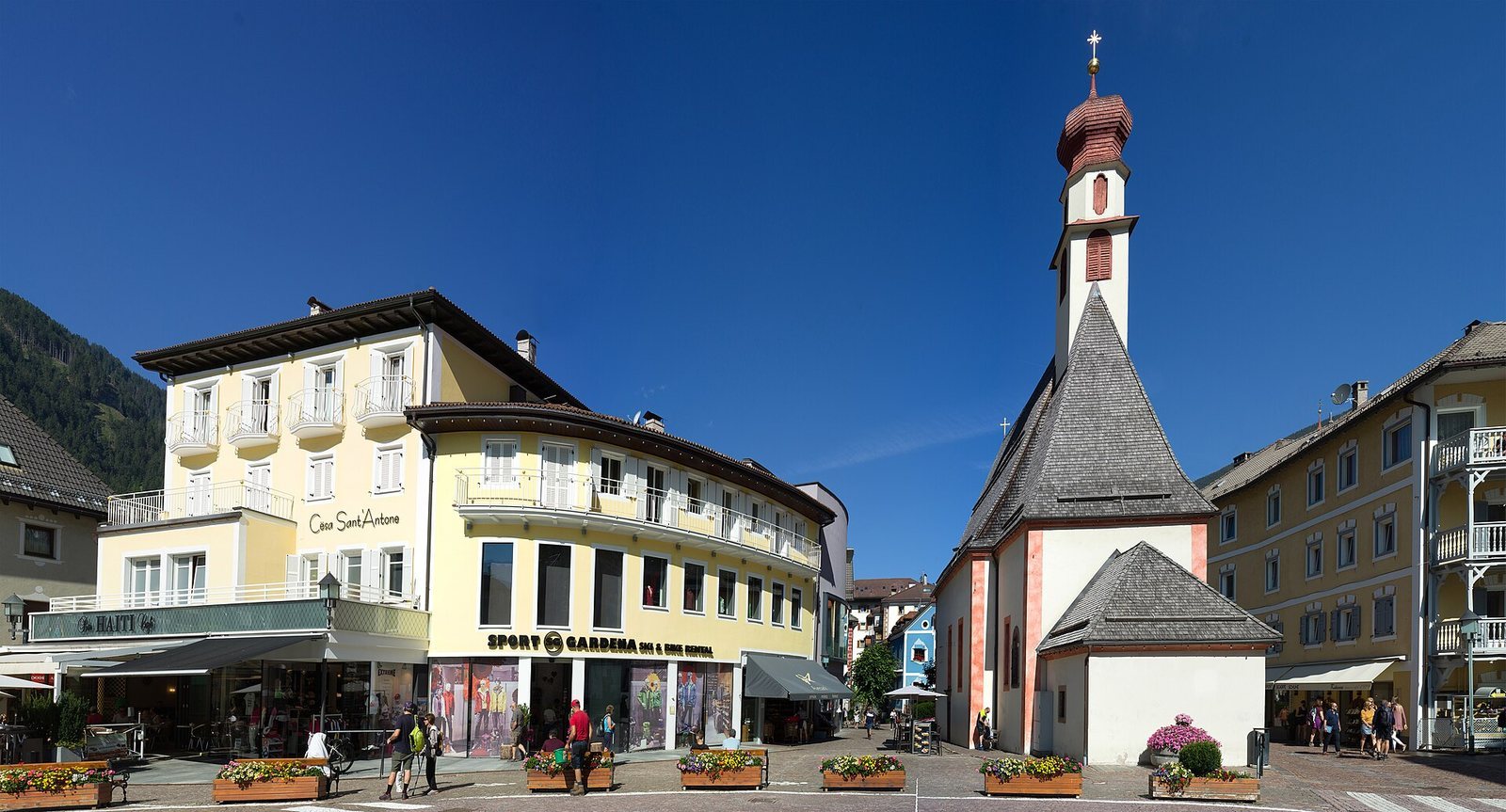
St Anthony’s Church in Ortisei is a Roman Catholic subsidiary church in Italy, dedicated to Anthony of Padua, a thirteenth-century Franciscan friar and preacher. It belongs to the Diocese of Bolzano-Bressanone and stands at the center of St Anthony’s Square, named for the church. The present building, erected from 1673 to 1676, combines Renaissance design, a revival of classical forms, with Baroque ornament, a later style known for elaborate decoration.
Early record and construction
An entry in the archive of St James’s Church places St Anthony’s in 1430 and describes it as a benefice church, associated with an endowed ecclesiastical office whose holder received income. Master builder Jakob Oberhofer of Klausen built the present church. Paulinus Mayr, Bishop of Brixen, consecrated it in 1680. The construction cost was 1,533 Rhenish gulden and 42 kreuzer, historical monetary units.
Restoration and later use
Franz Prinoth paid for a restoration in 1874, and restorer Viktor Pitscheider de Menza carried out further work in 1959. Volunteers from the St Ulrich rifle-company association and private donors supported a thorough restoration from 1985 to 1986. Protestant services were also held in the church for several years around 1990. The church is protected as a monument in South Tyrol.
Remains
Plan and exterior
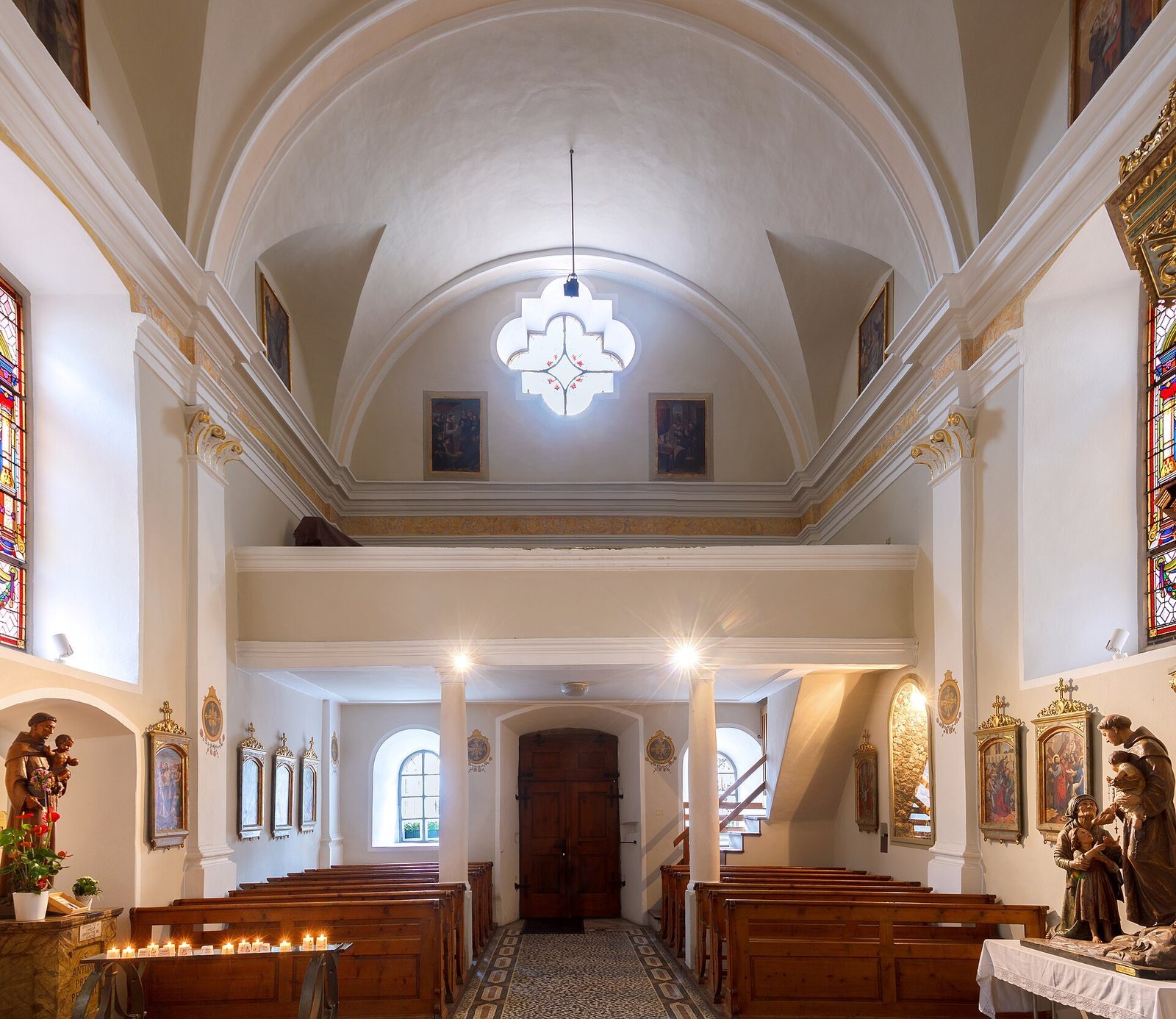
The church has a simple gabled form beneath a steep roof, with one nave, the main body of the church, covered by a barrel vault, a continuous arched ceiling. A rectangular apse, the area at the altar end, supports the bell tower. The building measures 12.10 metres long and 7.2 metres wide; its onion-domed tower is 29 metres high and holds three bells. The plain façade has a rectangular entrance between two windows, with a statue of Anthony in a niche above. Higher up, a four-lobed window and a round opening align with the entrance. A painted sundial and a niche holding a Baroque statue of St John Nepomuk are on the south wall.
Interior
Altars
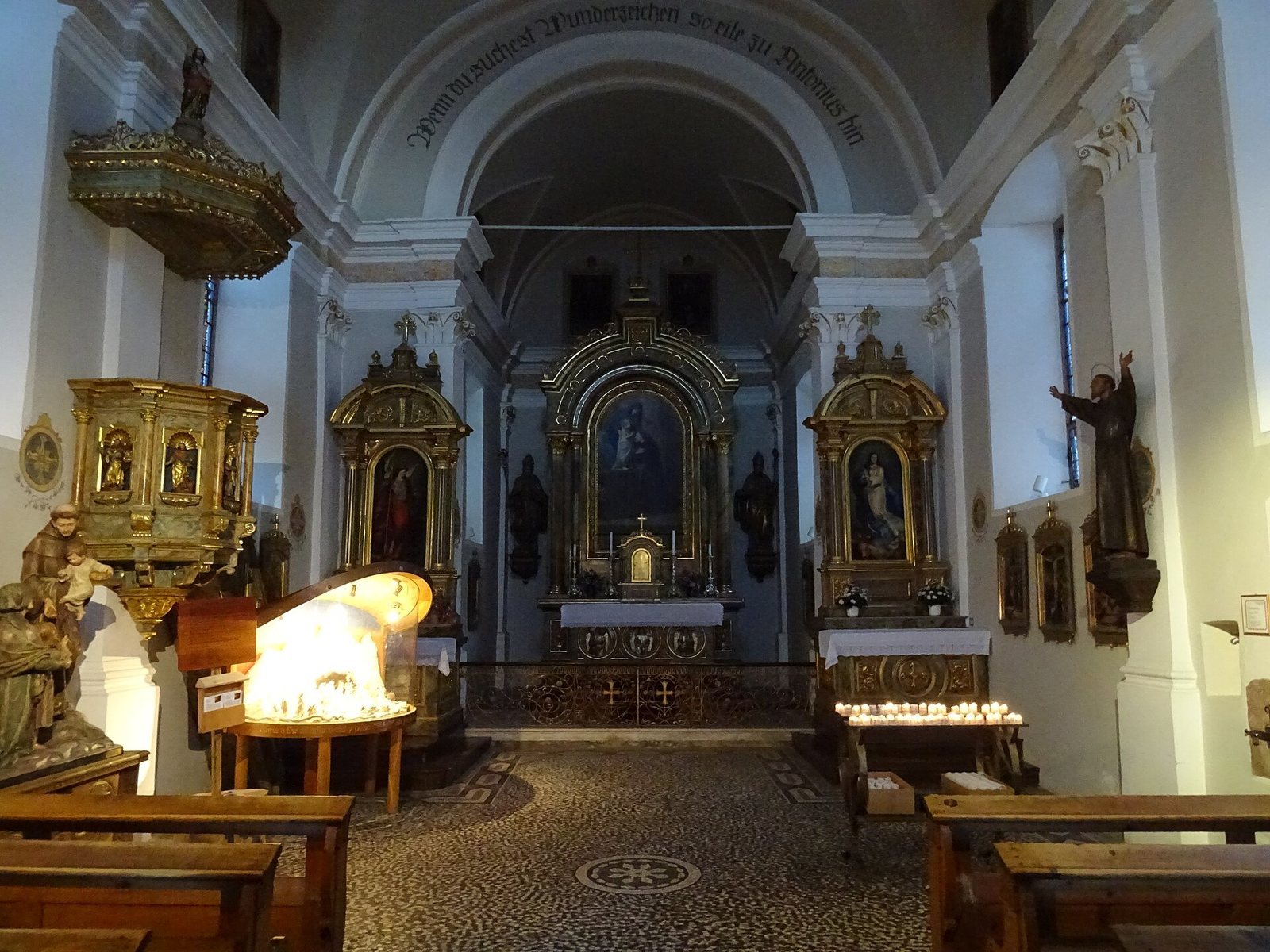
The main altar is Neo-Romanesque, a later revival of the medieval Romanesque style. Its painting by Swiss artist Melchior Paul von Deschwanden, dating to around 1850, shows Anthony at prayer. Two statues of Saints Ulrich and Rupert, signed by Johannes Vinazer and dated 1684, stand beside it. They had been in the main church of St Ulrich until about 1850. The two side altars also date to around 1850. Josef Moroder-Lusenberg painted their images of the Madonna on the right and the Archangel Michael on the left. Four carved angel heads in their decoration are attributed to a member of the Vinazer family in the seventeenth century.
Pulpit and paintings
The Baroque pulpit has four niches containing figures of the Evangelists. Twelve seventeenth-century paintings of episodes from Anthony’s life and miracles hang above its projecting horizontal molding. Their painter is uncertain. Josef Miller of Gufidaun has been proposed, while another attribution names Dengler, perhaps Tegler, of Villnöss.
Lourdes grotto
To the left of the entrance, a grotto made from rocks and crystals collected on Mount Sëuc was created by Ortisei benefactor Sebastian Senoner. It contains a Madonna by Ferdinand Demetz and a statue of Bernadette by Jocl Crepaz.
Sculpture and devotional works
Interior works include a statue of St Francis by Ludwig Moroder, dated 1914, and a statue of Anthony with the Christ Child by Pauli Moroder, painted by Max Stuflesser. Donated in 1945, the latter expressed its donor’s gratitude for returning home after imprisonment by the Germans during the Second World War. Vinzenz Moroder-Resciesa made a relief of the Trinity in 1910. A separate composition by Jocl Crepaz shows Anthony giving bread and was donated by Pepi Rifesser. The church also contains wooden statues by local sculptor Martin Vinazer.
Painted glass
Six painted glass windows and a glass rose window above the entrance bring figurative decoration to the church. On 28 August 1874, the Tiroler Glasmalerei & Kathedral Glas-Hütte received an order for seven Renaissance-style figurative windows. The Insam-Brida family or business donated the windows, and the rose-window inscription credits the firm. The figures include St Anne with the child Mary, St Benedict of Nursia with a book, snake, pelican, and raven, St Joseph with the Christ Child, St Francis of Assisi, two angels carrying instruments of Christ’s Passion, and two angels with a papal tiara and lily.