Church of the Immaculate Conception in Mazzarino: A Franciscan Church and Center of Marian Devotion
Site at a Glance
- Popularity
- Very Low
- Country
- Italy
- Primary era
- Early Modern
- Eras represented
- Medieval, Early Modern, Modern
- Civilizations
- Italian, Kingdom of Sicily, Spanish
- Site type
- Religious
- Remains
- Church
On this page13 sections
History
The Church of the Immaculate Conception is a Roman Catholic church in the historic center of Mazzarino, Sicily, Italy. Its origins likely lie in the fourteenth or fifteenth century, while its construction was completed in 1575. Its architecture combines Renaissance and Sicilian Baroque styles. The church belongs to the Diocese of Piazza Armerina and is affiliated with the Mother Church of Santa Maria della Neve. Its dedication refers to the Catholic belief that Mary was preserved from original sin from the moment of her conception. The church became favored by the Branciforti family and was closely associated with Franciscan life and Marian devotion.
Franciscan origins and Marian devotion
The church was associated with Friars Minor from 1574. By 1604, Minor Conventual Franciscans, a branch of the Franciscan order, lived in the adjoining convent. An institution called the Opera del Miseremini, whose Latin name means “have mercy,” was established in 1592. In 1604, the friars also supported the founding of the Congregation of the Sons of Mary Immaculate, a confraternity, or lay devotional association. Its main purpose was to encourage devotion to the Immaculate Virgin, and its members were responsible for celebrating her feast.
The church was first dedicated to Mary as Our Lady of the Chain. During the 1640s, the friars and Prince Giuseppe Branciforti helped change its dedication to the Immaculate Conception. On 5 October 1642, Sicily’s viceroy, Alfonso Henriquez de Cabrera, the monarch’s senior representative, ordered the feast to be celebrated with full solemnity. The local church authority in Syracuse notified the Conventual Franciscans of the instruction on 19 November. Branciforti established an annual fair lasting fifteen days to coincide with the feast.
Patronage, chapels and eighteenth-century work
Marino and Giovambattista Triolo founded the Chapel of Purgatory by notarial act in 1666. In Catholic belief, purgatory is a state of purification after death before entry into heaven. Historian P. G. Ingala attributed the chapel’s construction to proceeds from the annual fair. It became one of the church’s principal altars and remained so until its demolition in the twentieth century. Branciforti joined the congregation in the mid-seventeenth century. In 1669, he granted it privileges known locally as the Franchiggia and Giuoco, commissioned a small painting of Saint Cajetan from Provenzali, and arranged for an altar to be established for the saint. He also placed the congregation’s debts under the responsibility of his governor, Giordano La Torre.
By notarial act in 1688, Vincenzo Triolo gave the church relics of Saints Vitus, Prosper, and Felix. He also paid for and supervised construction of the bell tower. At his direction, a priest named Rizzo made a papier-mâché head of Our Lady of Sorrows. During the eighteenth century, several church administrators arranged improvements. The notary Antonino Riccobene organized general flooring work, while Don Salvatore Padellaro and Don Angelo Catania also undertook work on the building.
Restoration and the confraternity in later centuries
Canon Antonino Privitelli, who administered the Chapel of Purgatory from 1798 to 1808, commissioned a wooden statue of the Immaculate Conception in 1805. In 1811, the church’s administrators received permission to carry it in procession through Mazzarino. The statue of Our Lady of Sorrows was sold to the confraternity dedicated to her in 1813 and again in 1841. Canon Salvatore Bonaffini, church administrator from 1814 to 1849, led an extensive restoration when the building had fallen into severe disrepair. He added side altars, restored the high altar, and commissioned a wooden high altar from Corrado Leone. Giovanni Nobile of Ragusa painted it. Ignazio Gatto made the church organ in 1837, and Canon Luigi Cutrera later arranged for marble paving.
Canon Rocco Bognanni administered the church from 1870 to 1916 and oversaw major restoration and refurbishment. Work in 1870 included attention to the stained-glass windows and the creation of the first processional float for the statue. Trees were planted in the open space before the church in 1878, and local people paid for the old bell to be recast in 1883. In 1917, the confraternity drafted a second historical statute, clarifying its rights and adapting them to changing circumstances. Don Antonio Li Destri served as temporary commissioner from 1927 to 1928. Canons Bognanni and Quattrocchi later administered the church, with Quattrocchi remaining in charge throughout the Second World War.
After the war, the confraternity declined, with the downturn becoming more pronounced in the 1960s. Its administrative bodies had lapsed from the late 1950s, and the feast continued without bearers carrying the statue on their shoulders. The confraternity was reorganized in 1992 and remains active.
Remains
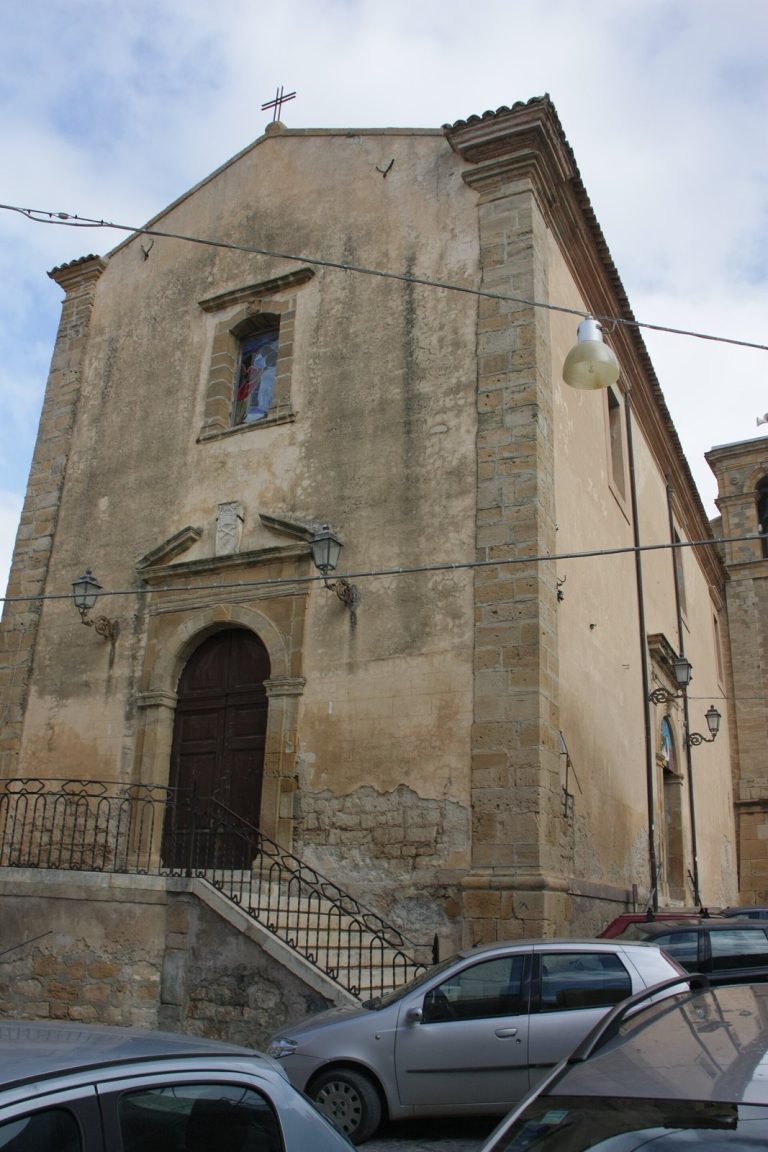
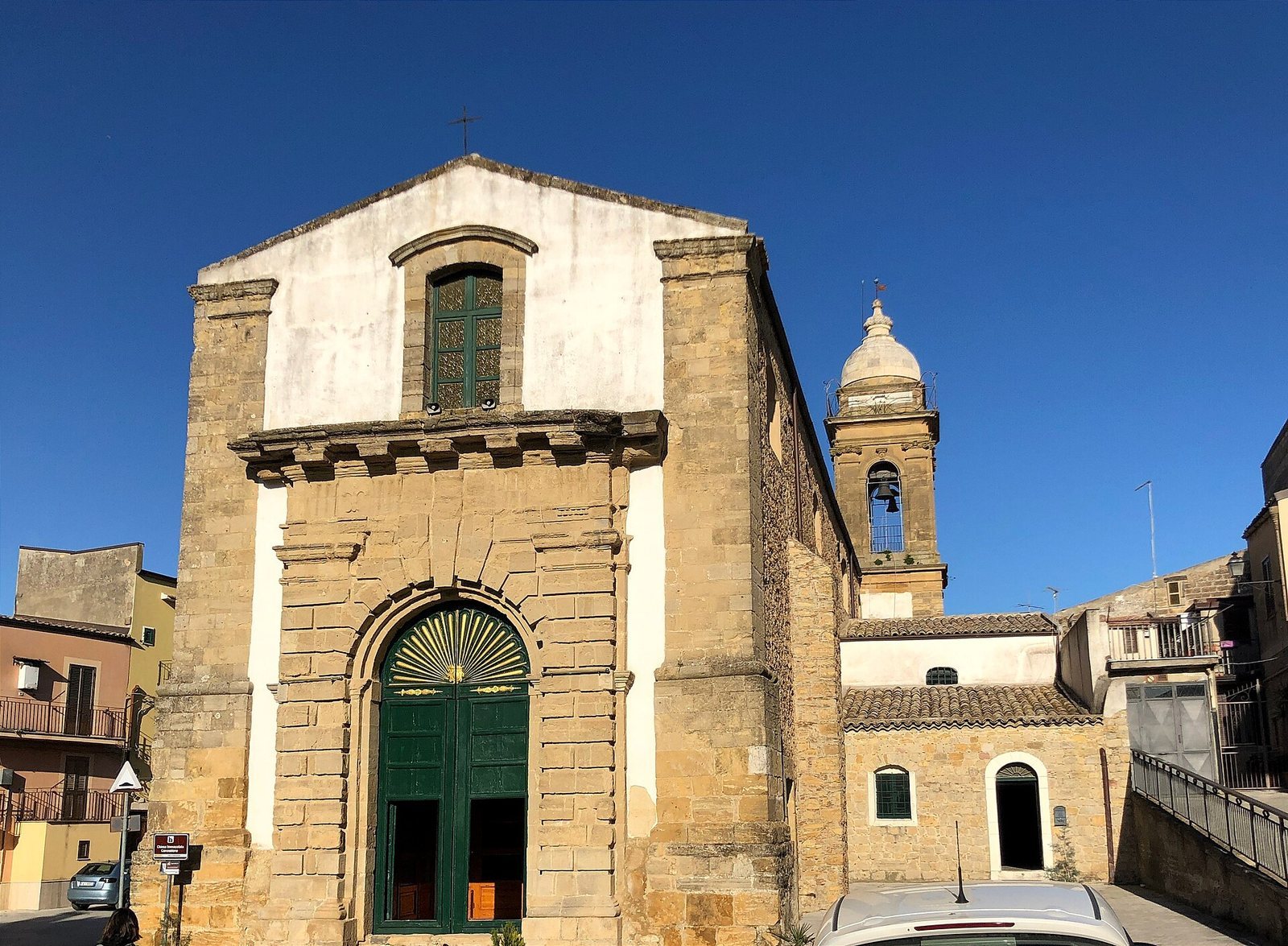
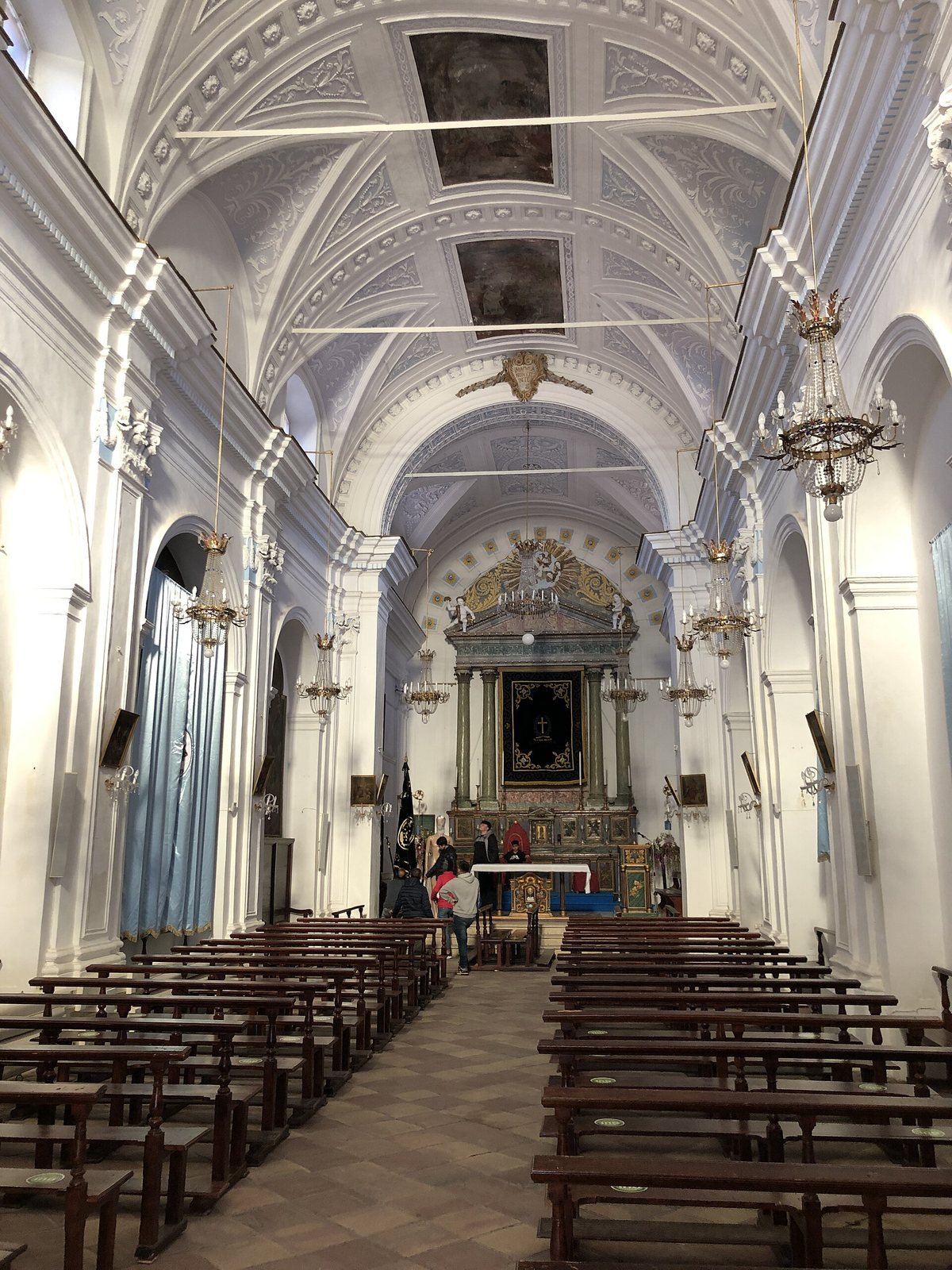
The church has a single nave oriented westward, a sacristy, and a room used by the confraternity. Its exterior includes a shrine-like facade and a square-based bell tower, while the interior is distinguished by stucco decoration and a barrel-vaulted ceiling.
Facade and bell tower
Facade
The facade is arranged like a small shrine and has rusticated masonry, with roughened faces and pronounced joints. A large portal dominates the front. Flat projections resembling columns flank it, and a horizontal band in the Doric style tops it. A round-arched window sits above. The portal, built in 1870, remains visible.
Bell tower
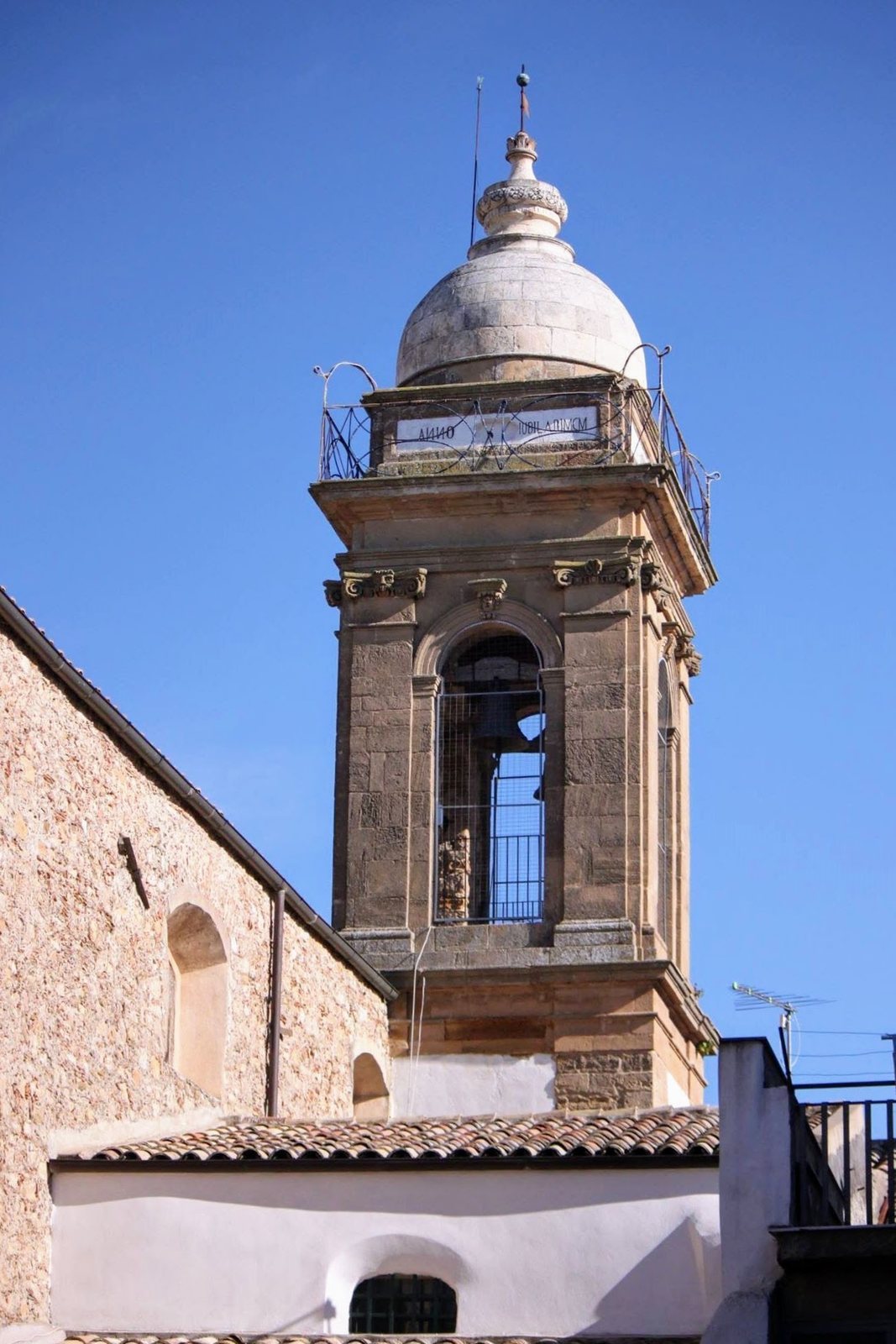
The bell tower rises from a square base and has a bell chamber with round arches. Its covering is a barrel vault, a continuous arched ceiling, made of Melilli stone, named for the Sicilian town of Melilli. A dome completed in 1900 rests on a square drum, the raised structure that supports a dome. Inscriptions mark its four sides: “ANNO IUBILARI MCM” on the south, “ANNO 1900” on the west, “LAUS GLORIA” on the north, and “DEO DEI PAREQUE B. M. V. I.” on the east.
Nave and furnishings
Nave and stucco decoration
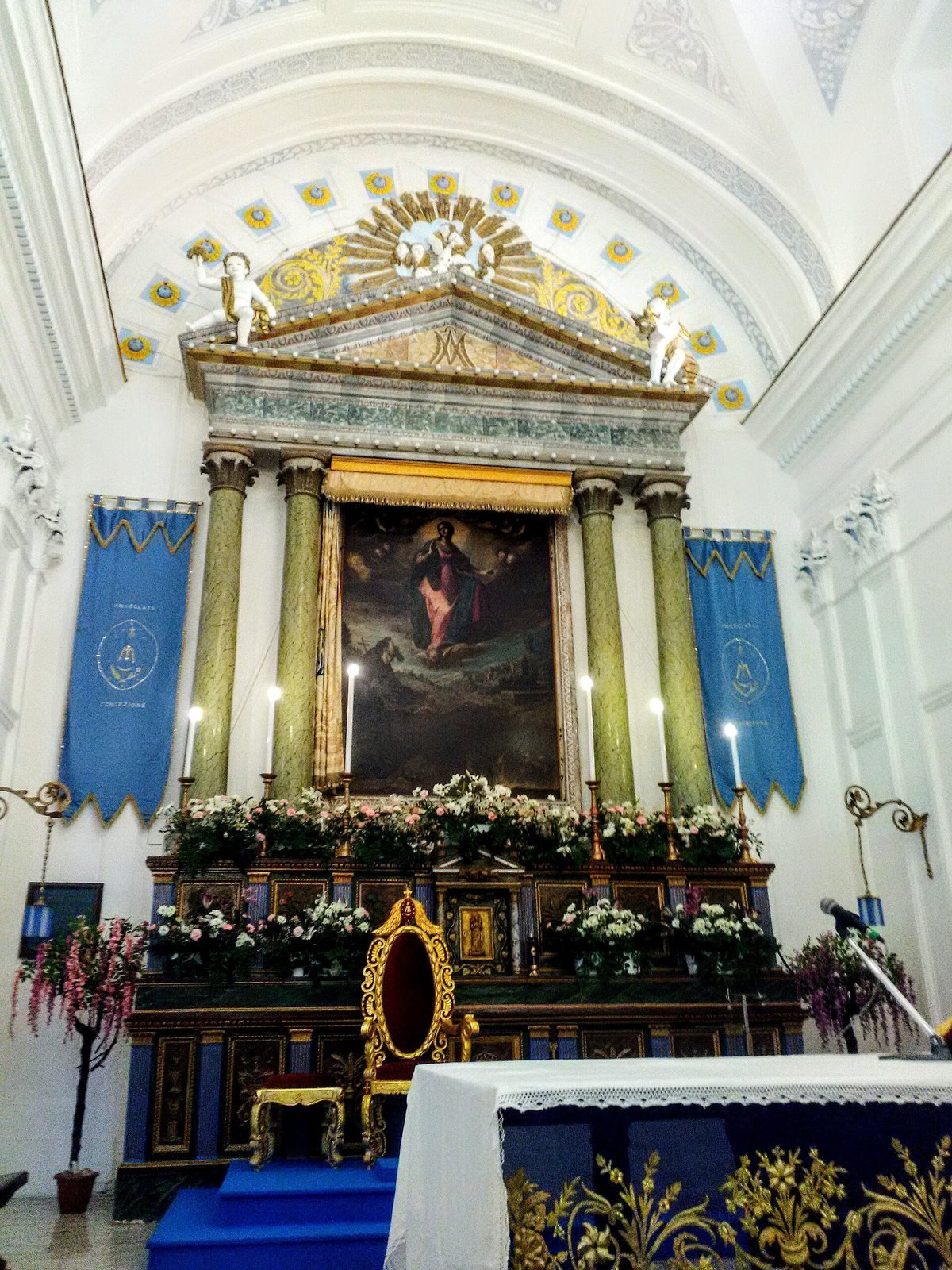
The nave’s side walls are articulated by five arches corresponding to the altars. Pilasters, flat vertical features resembling columns, and attached wall supports carry late Sicilian Baroque stucco decoration. The barrel-vaulted ceiling is also stuccoed and bears paintings by Giacomo Tinnirello.
High altar and painting
The high altar displays Filippo Paladini’s canvas of the Immaculate Conception, with Saint Francis interceding for souls in purgatory. Paladini included a self-portrait in a Franciscan habit. The inscription reads Philippus Paladini Florentinus pingebat, anno 1606. The high altar is made of inlaid, gilded wood by Corrado Leone and was painted by Giovanni Nobile of Ragusa. Two pairs of columns support its triangular pediment, the gable-shaped upper section.
Side altars and surviving images
The church’s earlier arrangement included seven altars, counting the high altar. The first altar on the right was dedicated to Saint Thomas the Apostle and had a painting by Tommaso Pollace, with an inscription naming the painter and giving the year 1608: “Thomas Pollace Panorm.us pin.ebat anno 1608.” The second right-hand altar was dedicated to souls in purgatory and had a painting by a painter from Catania. The third was dedicated to Saint John the Baptist and had a painting by Pollace. On the left, the first altar honored Saints Crispin and Crispinian and also had a painting by Pollace. A niche at the second altar holds a statue of Saint Vitus, and a life-sized carved crucifix remains at the third.
Statue of the Immaculate Conception
A small chapel in the inner sanctuary houses the wooden statue of the Immaculate Conception made by Filippo Quattrocchi in 1805.