Brauroneion: Sanctuary of Artemis on the Athenian Acropolis
Site at a Glance
- Popularity
- Medium
- Country
- Greece
- Primary era
- Classical
- Eras represented
- Bronze Age, Classical
- Civilizations
- Ancient Greek, Mycenaean
- Site type
- Religious
- Remains
- Sanctuary
On this page12 sections
History
Foundation and rebuilding
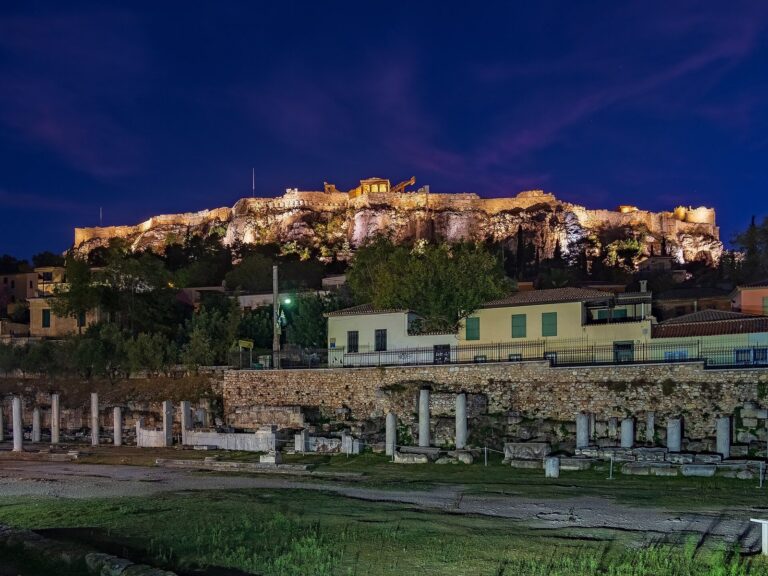
The Brauroneion was an ancient Greek sanctuary of Artemis Brauronia on the Acropolis of Athens, Greece. Rebuilt in the fifth century BC during the Classical period, its monumental arrangement is generally dated to about 430 BC. Its foundation is traditionally linked to Peisistratos, an Athenian tyrant who ruled in the mid-sixth century BC, although its precise construction date has not been established.
The Acropolis sanctuary may have served as an urban branch of Artemis’s principal sanctuary at Brauron, about 30 kilometres away on the east coast of Attica. Peisistratos came from Brauron, a connection that may help explain the tradition linking him to the shrine. The earliest buildings were destroyed by the Persians during the Greco-Persian Wars, the conflicts between Greek states and Persia. The sanctuary was rebuilt in the fifth century BC as part of the wider renewal of the Acropolis associated with the Parthenon. A further stoa was added during the time of Mnesicles, the architect associated with the Propylaea, the Acropolis’s monumental entrance. The complex’s final form is not precisely dated.
Rites and traditions
Artemis Brauronia was associated with the protection of women, pregnancy, childbirth, and marriage. The exact ceremonies at the Acropolis sanctuary are uncertain, but inscriptions indicate that people made offerings there, particularly offerings connected with women. The Brauronia, or Arkteia, included a procession between the Acropolis and Brauron. The festival is described as taking place every four years, while the selection of participating girls followed a five-year rotation. Girls aged five to ten performed ritual dances and made offerings in saffron-colored garments, and were called “bears.” They are also described as living at a sanctuary during festival rites. Celebrations connected with the cult took place at several locations in Attica.
A cult legend explained the bear rite through the killing of a bear at a sanctuary and a plague that followed. An oracle then demanded that a girl be sacrificed; Artemis accepted a goat in her place and required girls to serve as “bears.” Another tradition connected Iphigenia with Brauron, where she was said to have escaped sacrifice when a deer was substituted for her. Traditions also distinguished the offerings at the two sanctuaries. At Brauron, women’s garments were dedicated for those who died in childbirth; at Athens, clothing was offered in connection with women whose deliveries ended safely. Euripides’ tragedy Iphigenia among the Taurians also refers to garments dedicated at Brauron for women who died in childbirth.
If worship at the Brauroneion continued into the fourth century AD, it would have ended under late Roman edicts that prohibited non-Christian worship.
Remains
Sanctuary plan and architecture
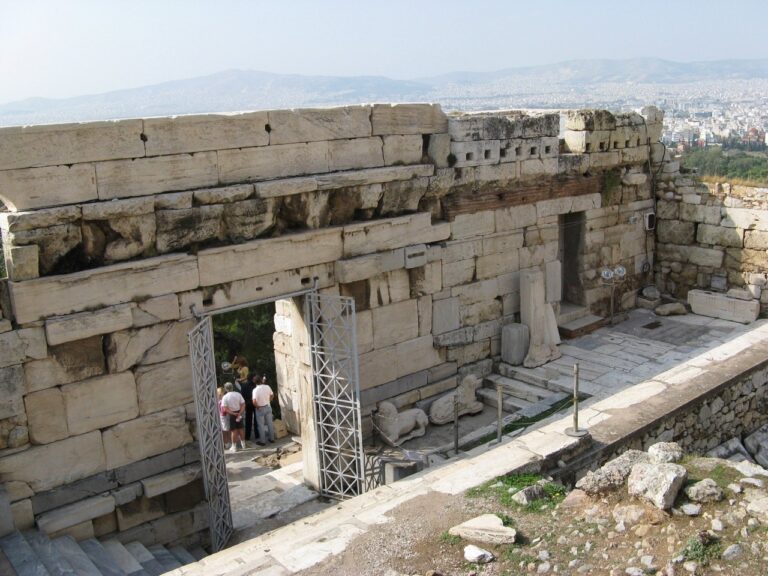
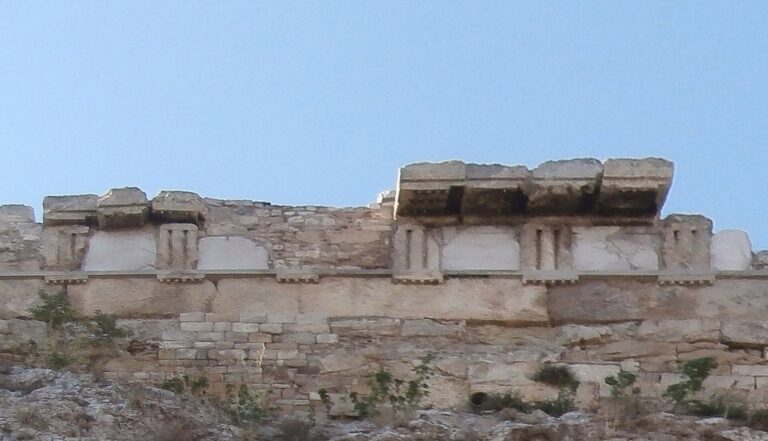
The sanctuary occupied the southwest corner of the Acropolis plateau, between the Chalkotheke, a bronze storehouse, and the Propylaea. Its irregular enclosure stood in front of the southern Acropolis wall and opened to the north. Within its unusual trapezoidal plan, a long Doric stoa, or roofed colonnaded walkway, served the sanctuary’s cultic function and faced an inner court.
Main stoa
The principal stoa measured about 38 by 6.8 metres and had two projecting wings, each about 9.3 metres long. Together, the wings framed the inner court. This arrangement formed the main architectural group within the precinct.
Eastern stoa and rooms
A second stoa stood east of the main complex, north of its eastern wing. It was about 17.5 metres long and had five Doric columns facing west. Reconstructions also propose a portico and several rooms in this part of the sanctuary, though their functions remain uncertain.
Enclosure and sacred precinct
Seven steps cut into the bedrock mark the entrance to a small sacred precinct near the enclosure’s northeast corner. The steps and northern enclosure were probably built by Mnesicles while the Propylaea was under construction. The western part of the sanctuary has not survived; it stood above remains of the Mycenaean fortification wall. In the east, foundations cut into bedrock and a few limestone architectural blocks remain, along with a small altar.
Sculpture and inscriptions
Cult images and marble head
Pausanias, a Greek travel writer of the second century AD, identifies an image of Artemis at the Acropolis sanctuary as the work of Praxiteles, a major Classical Greek sculptor. He distinguishes it from an old wooden image kept at Brauron. Fourth-century BC inscriptions refer to two cult statues at the Acropolis sanctuary, and one of the statues is dated to 346 BC.
A marble head found in the sanctuary area in 1839 is now displayed at the Acropolis Museum. Its three braids are associated with children’s hairstyles. The head may have belonged to a statue of Artemis made with a stone or ivory head and limbs and a wooden torso. Its identification with the large cult statue attributed to Praxiteles remains an interpretation.
Trojan Horse and other sculpture
Pausanias describes a bronze Trojan Horse associated with the sanctuary. The larger-than-life-size sculpture showed Greek heroes peering from within, including Menestheus, Teucer, and the sons of Theseus. An ancient commentary on Aristophanes names Chairedemos as its dedicator, while an inscribed base on the Acropolis names both Chairedemos and the sculptor Strongylion. A reference in Aristophanes places the statue no later than 415/414 BC.
Pausanias also describes a statue by Kritios of Epicharinus running in armor. Fragments found in the sanctuary area have been linked to this work, although Pausanias does not explicitly place the statue inside the precinct.
Treasury inventories
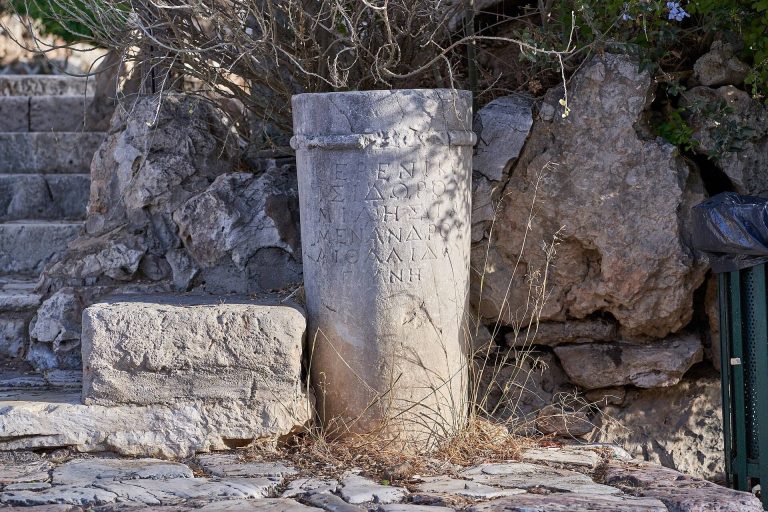
An inscribed upright stone slab preserves treasury inventories arranged in a regular grid. The lists include women’s garments and offerings made of gold and bronze. They preserve records of the objects dedicated to Artemis at the Acropolis sanctuary.