Santo Spirito: A Catholic Parish Church in Perugia
Site at a Glance
- Popularity
- Low
- Country
- Italy
- Primary era
- Early Modern
- Eras represented
- Early Modern, Modern
- Civilizations
- Italian, Papal States
- Site type
- Religious
- Remains
- Church
On this page24 sections
History
Monastic origins
Santo Spirito is a Catholic parish church in Perugia, Italy, dedicated to the Holy Spirit and part of the Archdiocese of Perugia-Città della Pieve. Its present building was rebuilt from 1579 to 1689 to a design by Francesco Vezzosi of Pistoia. A Benedictine women’s monastery probably stood beside Perugia’s ancient Etruscan walls from the eleventh century, although references to the community begin in the thirteenth. The monastery was dissolved in the fifteenth century, and its building passed to the Minim Fathers, a Catholic religious order founded by Francis of Paola and distinct from the Franciscans.
Rebuilding and religious change
The Minims rebuilt the church over more than a century, beginning in 1579. Its design followed principles associated with the Council of Trent, the sixteenth-century Catholic council whose reforms shaped church practice and architecture. In 1798, during the short-lived Jacobin Republic of the French Revolutionary era, religious congregations and orders were suppressed. The Minims returned after the Restoration, the return of pre-Napoleonic governments, but their renewed presence did not last.
After Italian unification, the Pepoli decree of 1861 expelled the Minims again. The convent passed permanently to the state and became Perugia’s Women’s Normal School, a teacher-training institution, in 1863. It later housed another teacher-training institute and is now the Assunta Pieralli State High School. The church was also taken into state ownership and used to store army provisions. About fifty years later it was consecrated as a parish church, taking the title of the nearby San Giacomo delle Cinque Piaghe in Porta Eburnea, which had ceased to function as a church.
Burials and the survival of the artworks
Before the Napoleonic edict, the church served as a burial place. Its tombs were associated with the Graziani, Bourbon di Sorbello, and Della Penna families, the Goldsmiths and Silversmiths guild, and the Minim friars. Napoleonic commissioners removed the church’s silver and bells but left its other artworks. Commissioners of the new Italian state also left the works in place. Their survival was attributed to a Vasarian outlook, influenced by Giorgio Vasari, that prized Raphael and Michelangelo while assigning little artistic value to later work, particularly art made in provincial settings. Two late-seventeenth-century paintings by Mattia Batini, formerly hung on the nave wall near the entrance, were stolen in 2010.
Remains
Plan and exterior
The brick church covers 675 square metres and follows a Latin-cross plan, with a long nave crossed by a transept. The nave is divided into three bays, or sections, and covered by barrel vaults, continuous arched ceilings with classical architectural lines. Each bay corresponds to a chapel and altar on either side. The transept sits within the rectangular footprint of the building. This arrangement, also used at San Filippo Neri, was intended to improve acoustics and support participation in choral singing.
Facade
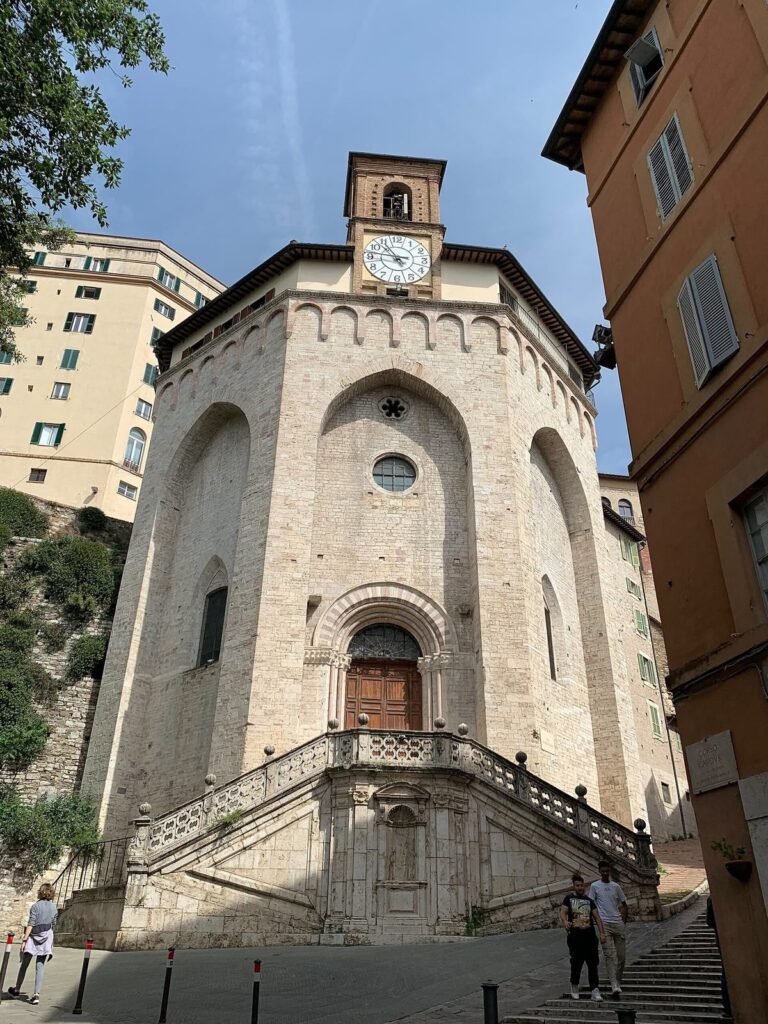
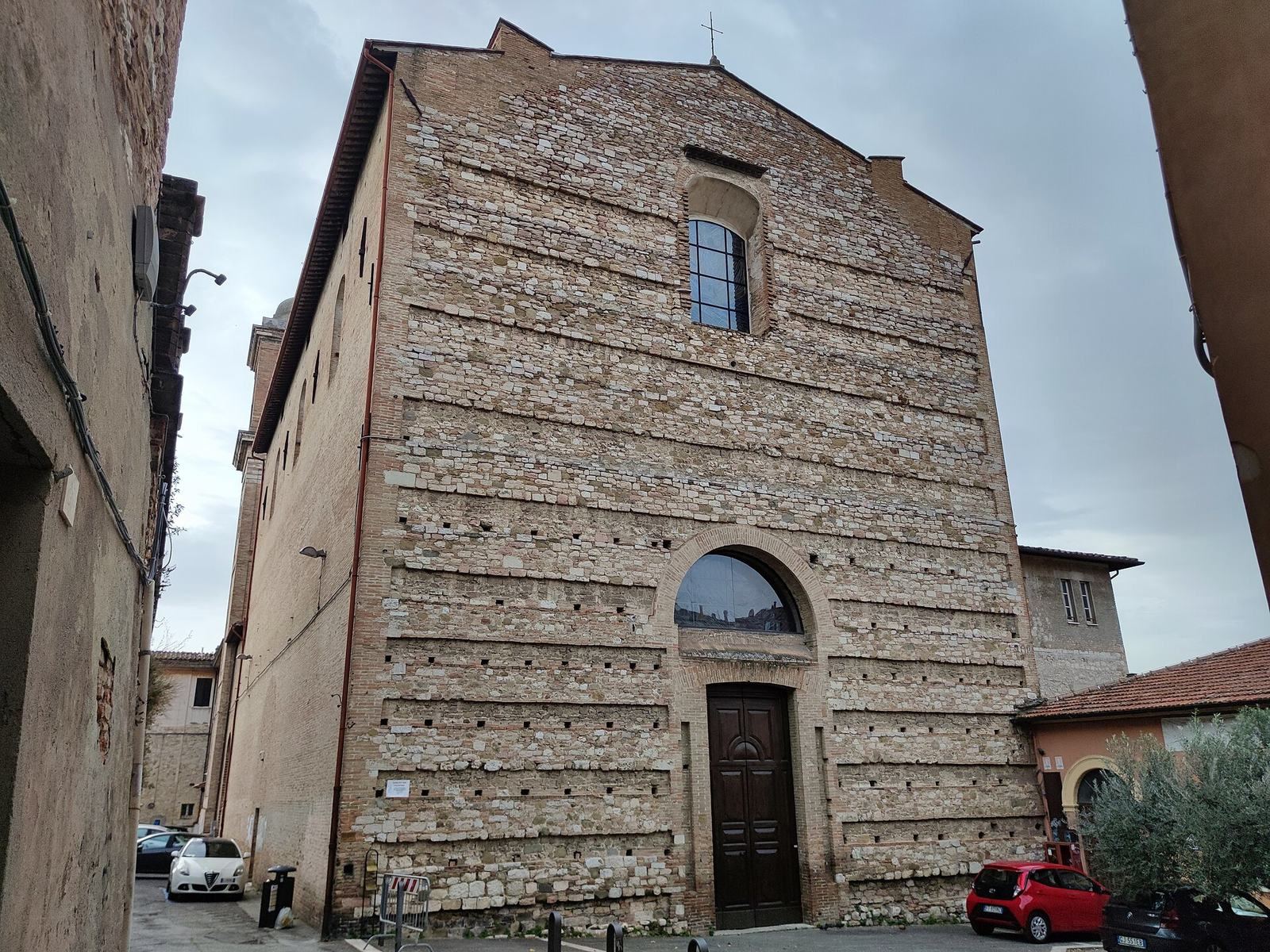
The north-facing facade has a gabled outline. Its brickwork retains projecting bands intended to hold a stone or marble facing, giving the exterior evidence of the original plan for its finish.
Bell tower and side entrance
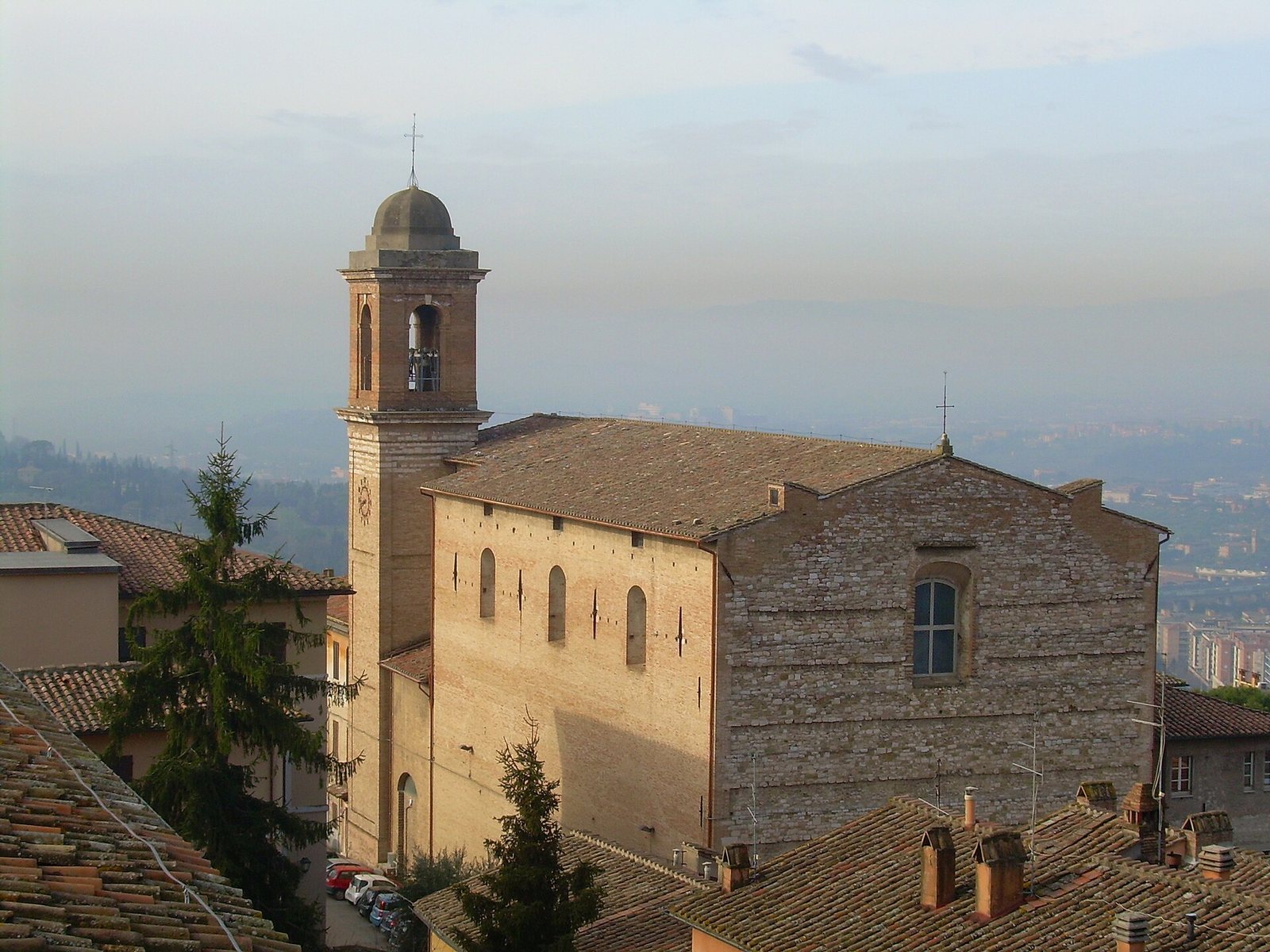
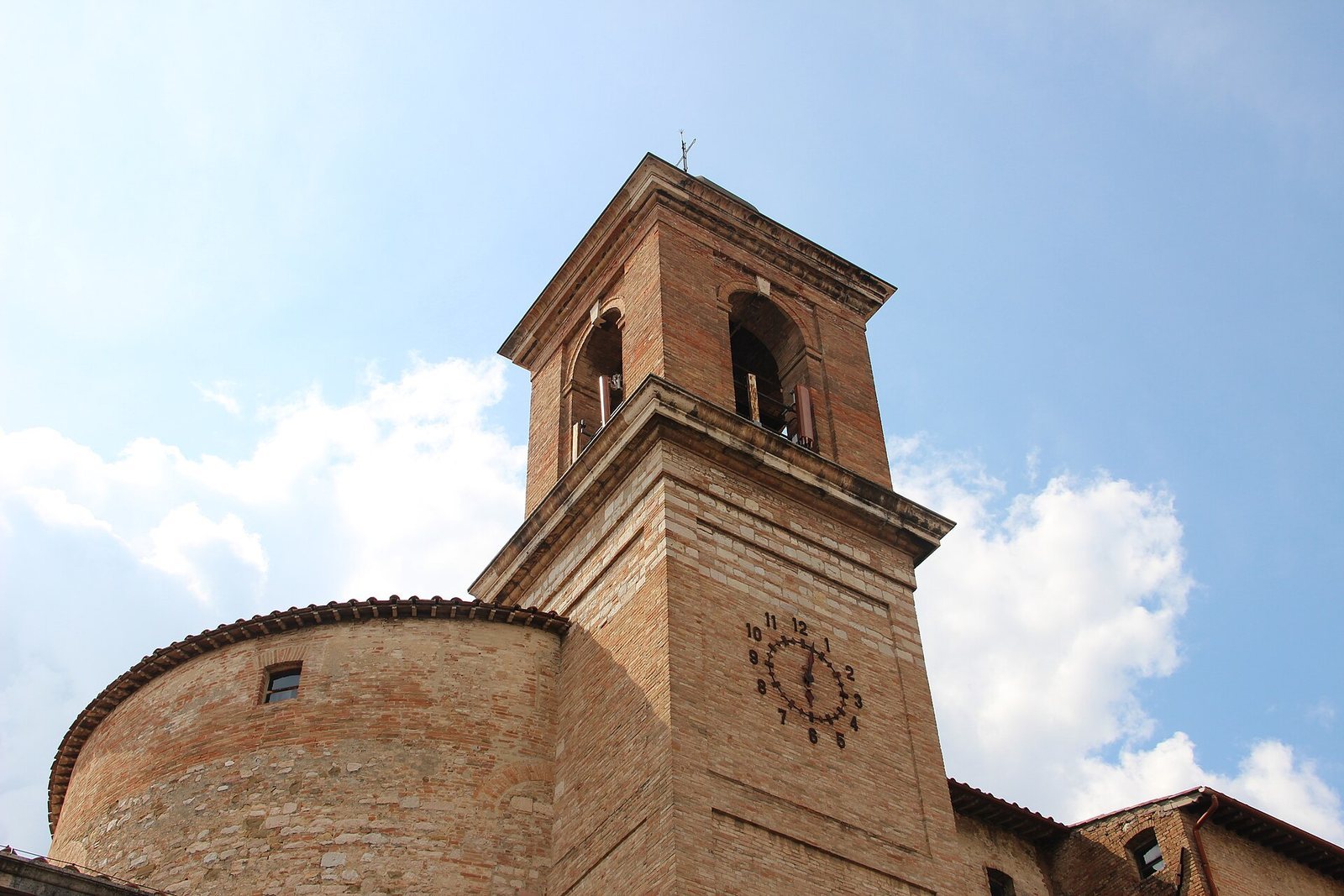
A nineteenth-century tower on the church’s left flank replaced a small bell-cote, a compact structure for housing bells shown in older prints. The tower rises from a square base to a bell chamber capped by a small polygonal dome. A side entrance on this flank serves in place of the large facade portal.
Altars along the nave
First altar on the right
Francesco Busti’s Madonna and Child with Saint Michael the Archangel Defeating Lucifer hangs above the first altar on the right. A procession of angels above the central scene conveys alarm and revulsion. The subject refers to a dream in which Saint Michael appeared to Francis of Paola and entrusted him with a shield bearing Charitas, Latin for charity. Pietro Carattoli’s painted architectural setting forms the background.
Second altar on the right
Cristoforo Gasperi’s Trinity in Glory with Saint Francis de Sales, painted in 1788, was made for the beatification of the Minim friars Gaspare de Bono of Valencia and Nicola Saggio of Longobardi, near Cosenza. The two friars stand beside Francis de Sales as he intercedes with the Trinity for them. Below, angels hold a bishop’s mitre, a penitential garment called a cilice, a scourge, and a lily. A landscape shows the Minim convent at Paola, while painted architecture frames the scene. Allegories of Faith and Hope appear at the base, and the work also represents Temperance and Prudence. Charity, regarded as foundational to the Minim order, is part of the painting’s religious context.
Third altar on the right
A niche at the third altar contains an oil painting of Francis of Paola by an unknown artist. Made before 1861, the image was highly venerated. Four carved, gilded, and twisted wooden columns from the late seventeenth century frame the altar.
First altar on the left
Giacinto Boccanera’s 1731 painting above the first left-hand altar depicts Spyridon, an early Christian bishop, baptizing the Roman emperor Constans. Carattoli’s painted architectural perspective fills the background.
Goldsmiths’ Altar
The second altar on the left, known as the Goldsmiths’ Altar, contains Mattia Batini’s painting of Andronicus and Athanasia, fourth-century saints from Egypt. They grieve for their children while submitting to divine will, and Andronicus points upward. The children have greenish complexions and adult features, rendered at a smaller scale.
Madonna Altar
The third left-hand altar is made of polychrome carved wood, with eighteenth-century stucco decoration and twisted columns that echo those at the altar of Francis of Paola opposite. Its present Madonna statue replaced an earlier one described in Serafino Siepi’s guide. Twelve stars form a halo around the figure, interpreted through the Apocalypse as the twelve tribes of Israel and, symbolically, all humanity. Two angels holding torches stand beside the statue. Above it, an eighteenth-century bust by an unknown sculptor depicts the Eternal Father holding a globe.
Transept, apse, and central altar
Right arm of the transept
The church’s mechanical organ stands in the right arm of the transept. It dates to 1800 and incorporates elements by the organ builder Angelo Morettini. Its oak facade dates from the 1930s. The instrument was damaged after 1861, then altered and restored by the Pinchi firm of Foligno in 1942. That work added electro-pneumatic action, in which electrical controls and pneumatic mechanisms operate the instrument. From 2011, Giuseppe Lucca restored it to working order.
Apse paintings
At the end of the church, the apse, or area around the main altar, has three blind arches, decorative arches that do not open through the wall. Each frames a painting. Lazzaro Baldi’s central work, The Descent of the Holy Spirit, places the Virgin at the top of a staircase, with the apostles below, including Peter at the lower left and John on the right. Two seventeenth-century paintings by artists associated with Baldi’s style flank it. They show Saint Peter administering Baptism and Confirmation.
Left arm of the transept
Francesco Busti’s 1738 painting of Saint Joseph with Jesus on his lap hangs in the left arm of the transept. On its end wall is another work by Busti, transferred from San Giacomo, showing Saint James as a pilgrim with a staff pointing the way. Busti’s Immaculate Conception, in which the Virgin crushes a serpent, is also displayed in this part of the church.
Choir stalls and central crucifix
Eighteenth-century walnut choir stalls occupy the area around the central altar. Above the altar hangs a wooden crucifix made in 1939 by J. Purger of Ortisei, in the Val Gardena region.
Entrance, stained glass, and sacristy
Painting above the entrance
On the interior face of the facade, above the entrance, a large painting by an unknown artist shows Saint Francis of Assisi receiving the stigmata, bodily marks resembling the wounds of Christ’s crucifixion, on Mount La Verna. The painting dates to the seventeenth or eighteenth century, and its subject is familiar in Franciscan art.
Stained glass
The church’s stained glass was made at Perugia’s Moretti-Caselli workshop. A window by Rosa and Cecilia Caselli, dated 1954, depicts Jesus. It occupies an opening on the right side of the nave that formerly gave access to a pulpit. In the left arm of the transept, Anna Matilde Falsetti’s 1985 work, Creation Praises Your Presence, O Lord, continues the workshop’s tradition; Falsetti was a great-granddaughter of Ludovico Caselli and worked there as an artist. A stained-glass lunette, a semicircular panel, was added to the entrance portal in 2011. It shows the people of God carrying the Holy Spirit into the world, with air, water, fire, and earth expressed through light and colour. Its inscription reads, “You will receive power from the Holy Spirit and you will be my witnesses to the ends of the earth.”
Sacristy
The sacristy contains a sixteenth-century Crucifix of the Five Wounds, transferred from the nearby church of San Giacomo.