Former Saint George Basilian Monastery and School at Liubar
Site at a Glance
- Popularity
- Low
- Country
- Ukraine
- Primary era
- Early Modern
- Eras represented
- Early Modern, Modern
- Civilizations
- Polish–Lithuanian Commonwealth, Russian
- Site type
- Religious
- Remains
- Monastery
On this page15 sections
History
The former Saint George Basilian monastery and school is a religious and educational complex in Liubar, Ukraine, founded in 1604 as a men’s monastery under Orthodox abbot Cyril Konstantynivsky. Construction was completed in 1616. The complex later became an important Basilian center, combining monastic life with a prominent school and, after 1873, a women’s community. Its buildings were associated with Baroque architecture, an ornate European style that flourished from the late sixteenth through the eighteenth centuries.
Foundation and early changes
The monastery’s foundation probably received support from Prince Konstanty Wasyl Ostrogski, a Ruthenian patron of Orthodox institutions. A chronicle names Cyril Konstantynivsky as the community’s founding abbot. Anna Ostrogska, the daughter-in-law of Konstanty Wasyl, has also been credited with helping to establish the monastery, although that attribution is considered unlikely. Cyril appears as abbot in records from 1611, 1613, 1618, 1628, and 1643. In 1628 he also held senior responsibility for monasteries across much of the Ukrainian lands. Cyril Tranquillion-Stavrovetsky served as abbot around 1619–20.
The monastery probably suffered a decline during the Khmelnytsky Uprising, a mid-seventeenth-century Cossack revolt, and the subsequent period of political conflict known as the Ruin. The Lubomirski princes restored the institution in 1666. The religious identity of the restored community is uncertain, as it may have been Jesuit or Orthodox. Monks from the Assumption Monastery in Polonne moved to Liubar, and the founders provided substantial estates.
Basilian rule and the school
In 1702 the monastery entered communion with Rome and became Greek Catholic. Greek Catholics of the Ruthenian tradition followed the Byzantine rite while remaining in communion with the Roman Catholic Church. In 1739 the monastery joined the Order of Saint Basil the Great, an Eastern Catholic monastic order commonly called the Basilians, and came under its Ruthenian Province. A 1745 meeting judged Liubar capable, together with other monasteries, of supporting at least eight monks. Trihir and Krasnohir became its dependencies, and it also owned a monastery in Kolodiazhne. In 1753 Prince Franciszek Ferdinand Lubomirski formally confirmed the Basilians’ rights to their lands.
The monastery’s educational role grew from a Jesuit school established there by the mid-eighteenth century with financial support from Lubomirski. After Pope Clement XIV suppressed the Jesuit order in 1773, the Basilians took over the school and established a boarding institution for pupils. The school later became an advanced school, or college, and was regarded as one of Volhynia’s leading institutions, ranking behind the Piarist school at Mezhyrich. Piarists were members of a Catholic teaching order.
In 1784 the school had six classes and 450 pupils. Courses at leading Greek Catholic monastic schools, including Liubar, lasted five or six years. Pupils studied subjects ranging from grammar, rhetoric, philosophy, arithmetic, and moral conduct to politics, physics, and pedagogy. The program also included music and several languages. Students could learn guitar, clarinet, violin, flute, and piano, while school groups performed ballet, opera, and orchestral music. After examinations, they staged Gretry’s Zemire et Azor.
Inspections brought outside attention to the school. In 1780 Prince Adam Kazimierz Czartoryski examined pupils in person, and a further examination took place in 1784. In 1800 the Basilian school became a district school with the rights of a gymnasium. Tadeusz Czacki, an educator who inspected schools in the Volhynia, Podolia, and Kyiv gubernias, helped shape its development. A gubernia was a province-level division of the Russian Empire.
The school’s teaching resources included a physics collection, a chemical laboratory, and a collection of more than 40 scientific instruments. From 1805 to 1823 the monastery spent 2,000 zlotys annually on books and instruments and contributed to a library hall and physics cabinet. The library held more than 17,000 books in several languages. Its collection began with books from the former Jesuit college and suffered heavy losses in fires. Students and monks also helped sustain local cultural and religious life. A theatre was built on monastery land in 1802 at their expense. Basilians took part in Roman Catholic feast celebrations and maintained close ties with Liubar’s Dominicans, who attended Basilian funerals and joined services for the Feast of Saint Basil, when the monks renewed their vows. Capuchins from Konstantyniv celebrated the feast in 1779; Dominicans and Bernardines from Chudniv attended the Saint Onuphrius celebration, and Basilians visited their churches to preach.
The cloister was closed to women, although pupils’ families and other visitors came to the monastery. A guesthouse was planned for distinguished women, and in 1801 an inspector urged that women be kept at least from the upper corridor. In 1787 the monks prevailed in a dispute with Liubar’s Jewish community over land beneath the monastery. The Jewish cemetery on the land was removed, worsening relations between the communities. That year the monastery also hosted a formal reception for Stanislaus Augustus Poniatowski, the last king of the Polish-Lithuanian Commonwealth.
Russian imperial rule and the school’s closure
After Volhynia became part of the Russian Empire, the Basilians faced pressure to join the Orthodox Church and repeated fires. On 8 January 1795 an Orthodox district dean arrived with military personnel, ordered the school rector and physics teacher arrested, and tried to compel monks and teachers to convert. They refused. In April 1796 the local dean and his party took the monastery church from the Basilians. The monastery had 21 monks and an income of 6,443 zlotys in 1803–04; by 1826 it had 12 monks.
After the Polish uprising of 1830–31, a revolt in the Polish lands, the district school was reorganized and officially closed in 1832. It then had nine teachers and 140 pupils. The school’s equipment went to the Zhytomyr boys’ gymnasium, and its library was moved to Kyiv, where it became the foundation of the library at the University of Saint Vladimir. Some pupils were offered places at a new district school in Novohrad-Volynskyi.
Return to Orthodoxy and the women’s monastery
In 1839 the Russian Empire forcibly incorporated the Greek Catholic Church into the Russian Orthodox Church, and Liubar’s monastery returned to Orthodoxy. Many monks opposed the change. Authorities sought to secure their acceptance, and in 1840 fifteen monks signed commitments to join the Orthodox Church. The transfer brought the expulsion of monks and the loss of most monastic estates to government control. Liubar and Trihir were also used temporarily to confine Greek Catholics who refused to convert.
After cholera killed almost all the monks in 1872, the monastery became a second-class women’s monastery in early 1873. The term described an administrative rank for a women’s religious community. Nuns arrived from overcrowded convents at Korets and Horodyshche and began restoring the premises in 1878. The community had as many as 150 nuns in the late nineteenth century and 121 in 1914. That year it held 117 desiatinas of land, an old Russian measure of about 1.1 hectares each, leased a mill to local peasants, and maintained a women’s literacy school with an annual state subsidy. A school for orphan girls also operated there from at least 1890 to 1903.
The monastery’s Saint Onuphrius icon drew pilgrims. In 1912 Archbishop Anthony of Volhynia and Zhytomyr gave the community an icon of Saint George and part of the saint’s relics. Saint Onuphrius was an early Christian ascetic venerated in Eastern Christianity, while Saint George was venerated as a Christian martyr and soldier saint.
Closure and later uses
During the 1920s the women’s community occupied two buildings and held services in one church with a single priest. Other buildings housed a children’s settlement of 351 children and staff. Two nuns remained at Liubar, while 34 others travelled within the Berdychiv district. The monastery closed during the decade. Monastic life resumed briefly during the German occupation of 1941–44. The women’s monastery was still operating in mid-1944 but closed again about a month before Germany’s surrender.
The former Basilian school building received state protection as an architectural monument in 1979. An educational institution opened in the building in 1963 and became the Liubar Professional Lyceum in 2004. Other premises were used for administrative offices, a cinema, and a children’s home. The entrance gate served first as a local history museum and later as a social-protection reception office. Other post-Soviet uses included lyceum facilities, a district printing works, and a sewing factory.
Remains
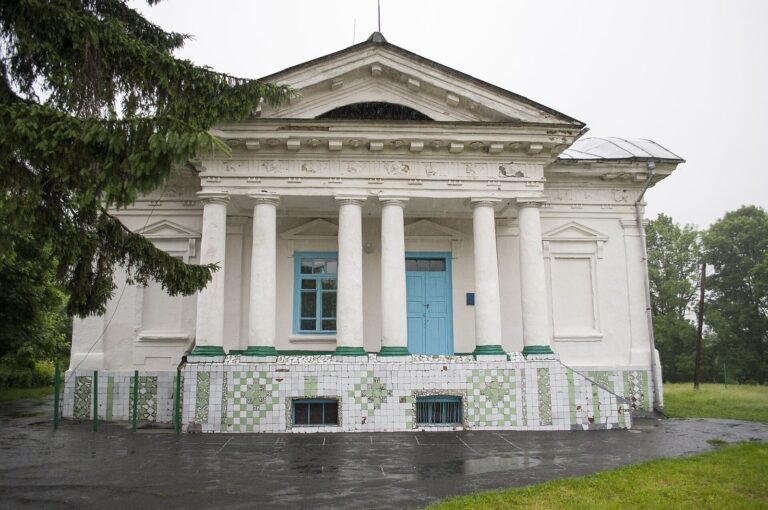
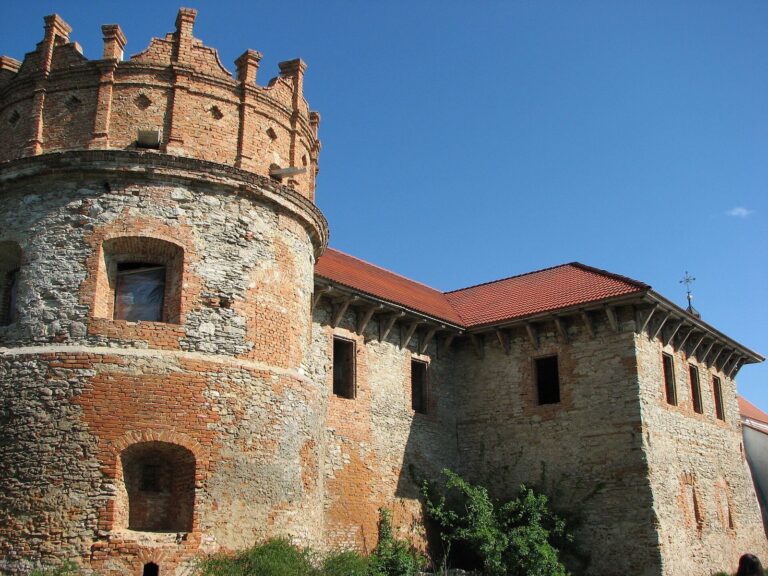
The complex developed in stages and included church, school, residential, and service buildings, as well as a library and botanical garden. Baroque architecture characterized the monastery. The school building survives as a two-storey brick structure, while the churches and residential buildings reflect successive periods of construction and change.
Buildings and grounds
School building
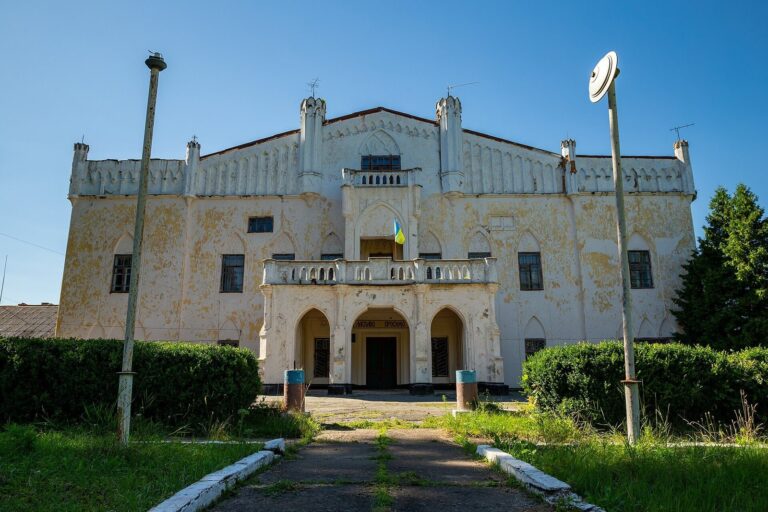
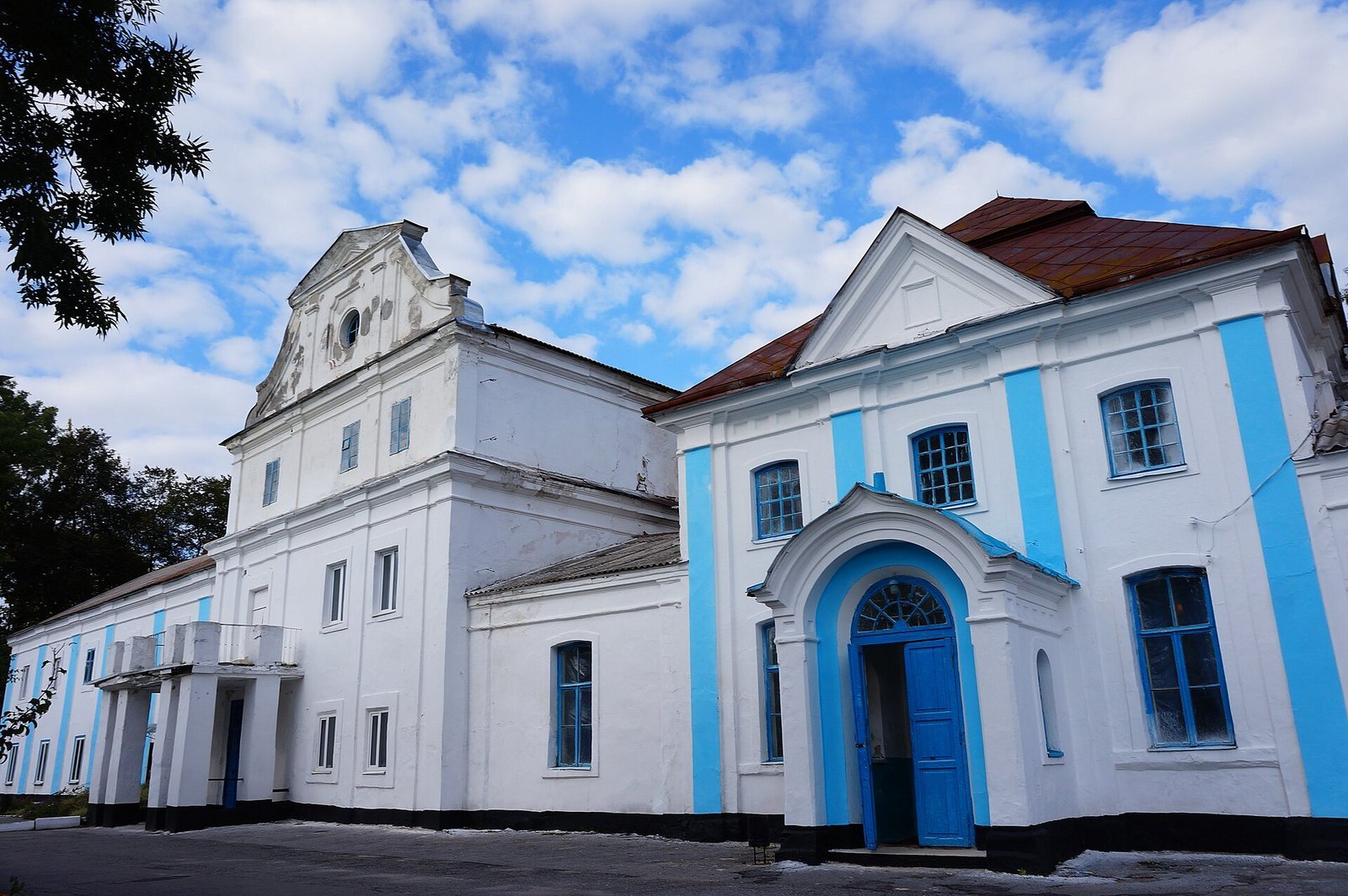
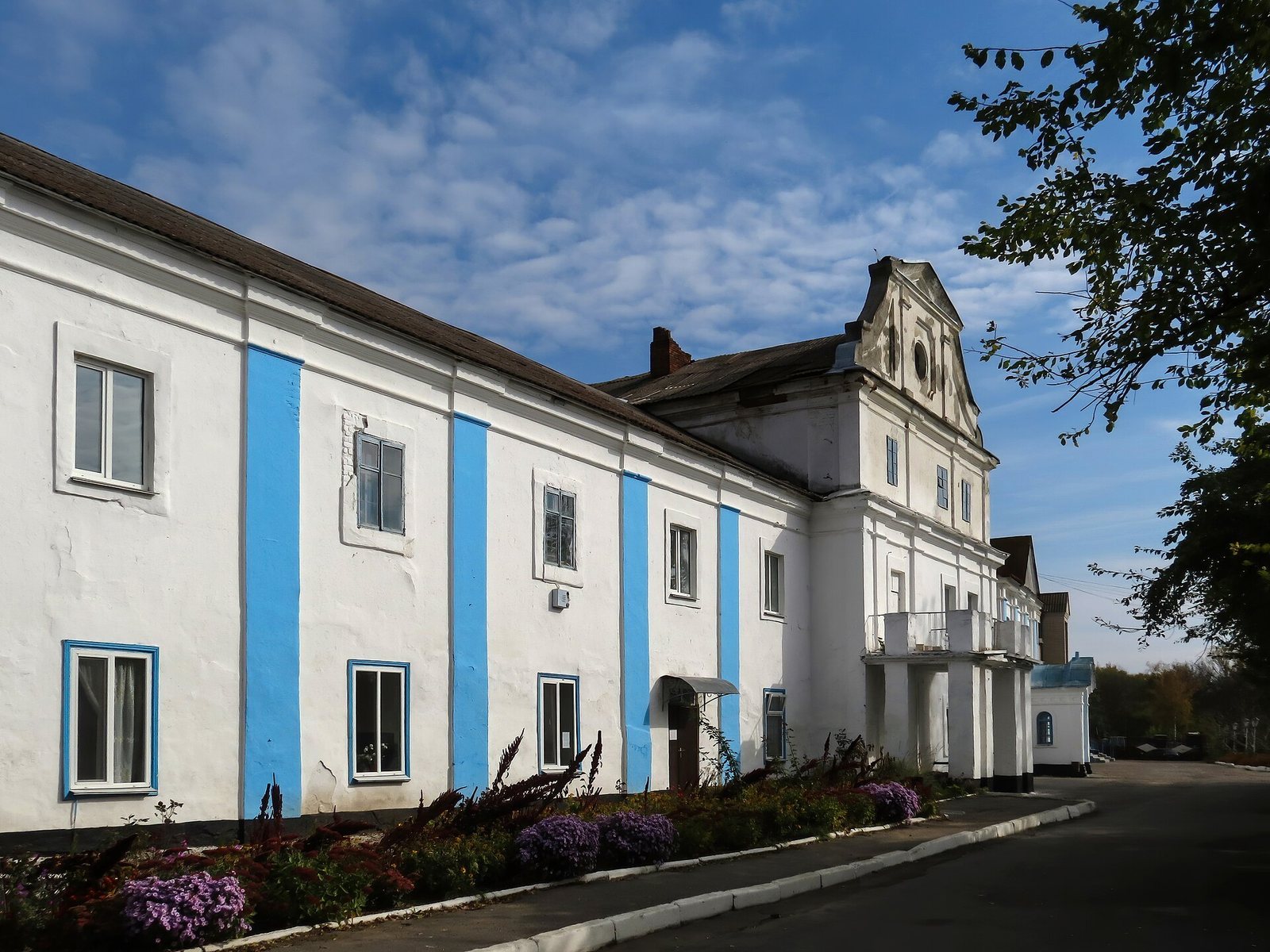
Completed in 1775, the school is a two-storey brick building. Its main entrance is set off-center within a three-storey section crowned by a shaped pediment, a gable-like feature above a facade. Vertical strips resembling pilasters divide the exterior, which is finished with cornices that project in sections. Buttresses strengthen the walls. Inside, rooms line one side of a corridor. The ceilings include semicircular vaults with lunettes, curved sections formed where smaller vaults meet a larger one, as well as flat sections. The building survives and houses an educational institution.
Church buildings
The monastery’s churches were built and altered in successive phases. A wooden church was erected in 1756, followed by a stone church in 1775 and a heated church at the Saint George cathedral in 1776. The cathedral church had been restored by 1880, and a new stone cathedral was completed in 1902. The Saint George church was dismantled between 1936 and 1938.
Residential buildings
A stone monastic block was begun in 1779 under Abbot Josaphat Ohotsky. A separate house on monastery land was built at his own expense by shoemaker Pavel Pomazhansky, with the rector’s permission and an agreement to pay 54 zlotys in annual rent. By 1880 the women’s community had built a two-storey residential block containing 36 cells.
Entrance gate
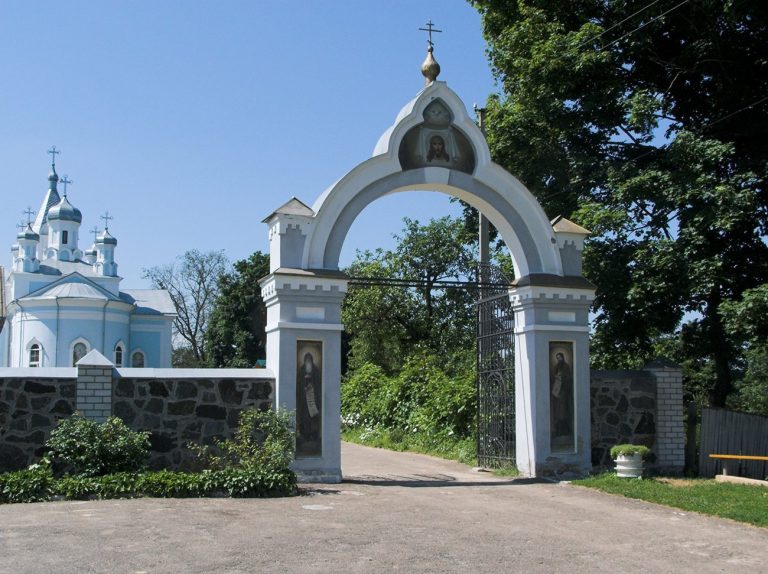
A stone entrance gate was built in 1890. In later years it was adapted first for use as a local history museum and then as a social-protection reception office.
Library
The school library occupied a separate stone building. Its collection included books in Latin, Ruthenian, Church Slavonic, German, French, Italian, and Polish. Among its notable volumes was a Bible inherited from the Jesuit college at Ostroh, printed in Paris in seven languages.
Botanical garden
The monastery grounds included a botanical garden established by Dionysius Mikler, a botanist and landscape gardener. It contained more than 500 exotic plants. After the monks were expelled, the garden declined and was cut down for fuel for the monastery bathhouse.
Icons and relics
The Saint Onuphrius icon was an object of pilgrimage at the monastery. In 1912 the community received an icon of Saint George and part of his relics from Archbishop Anthony of Volhynia and Zhytomyr.