Grottes du Volp: A Network of Prehistoric Caves in France
Site at a Glance
- Popularity
- Medium
- Country
- France
- Primary era
- Stone Age
- Eras represented
- Stone Age
- Civilizations
- Unclassified
- Site type
- Religious
- Remains
- Sanctuary
On this page16 sections
History
The Grottes du Volp are a group of three prehistoric caves near Montesquieu-Avantès in France. Used chiefly during the Magdalenian, an Upper Paleolithic cultural phase in western Europe, they served different purposes: Enlène was a long-used dwelling and a base camp during Magdalenian IV, Trois-Frères functioned mainly as a sanctuary, and Tuc d’Audoubert was used for both habitation and ritual activity. Enlène offered direct access to Trois-Frères, while links with Tuc d’Audoubert and the more distant Mas-d’Azil cave are considered probable.
Prehistoric use
Use of the caves extended beyond the Magdalenian. Mousterian activity, associated with the Middle Paleolithic, occurred in two side passages at Tuc d’Audoubert. Enlène has developed Badegoulian remains, from another Upper Paleolithic phase, as well as Bronze Age burials. Late Middle Magdalenian remains at Enlène and Tuc d’Audoubert date to about 15,000 years BP, a dating convention that counts years before 1950.
Exploration and discoveries, 1882–1914
Enlène was known locally and had been explored by several people by 1882, including the priest Jean-Jacques Pouech. It was treated as a burial cave in 1884 and again in 1893. During Easter 1911, Henri Bégouën and his three sons found a decorated spear-thrower, a device that increases the arm’s leverage when casting a spear. The property’s owner then barred them from returning, fearing they might take supposed monetary treasures and reduce its value.
In July 1912, Henri’s sons entered Tuc d’Audoubert from the Volp on a makeshift raft. The cave entrance and river were already known, but its interior had not been scientifically explored. The brothers discovered the clay bison group on 10 October. Henri Breuil arrived on 19 October, Émile Cartailhac the next day, and the two prehistorians visited the cave together on 21 October.
In 1914, the Bégouën family followed the Volp’s underground course and found an air-filled opening blocked by stones. After clearing it, Maximilien Bégouën and the young coachman François Camel descended and came out through Enlène. Further exploration led to the Sanctuary chamber and the gallery of white hands on a red background, found on 21 July. Trois-Frères is the only one of the three principal caves discovered by the family. Its name refers to Henri Bégouën’s three sons.
Research and conservation
Breuil returned in 1919 and made 18 visits to the caves between 1912 and 1958. Louis Bégouën stopped excavating in 1937 because he considered the methods then in use outdated. In 1970, Robert Bégouën sifted part of the old excavation spoil at Enlène. The results prompted him and Jean Clottes to begin a major excavation campaign there in 1976. A study of Enlène’s archaeological material appeared in 2016, and a sample from the cave later yielded a fully decoded bison genome.
From the time of their discovery, the Bégouën family limited access to protect the fragile art and archaeological deposits. Following Cartailhac’s advice, Henri Bégouën opposed public visits and tourist installations. A single raised route was used to protect the cave floors, and most archaeological material remained in place. The caves remain closed to the public and their archaeological deposits are exceptionally well preserved.
Louis Bégouën bequeathed the caves to his children. In 1989, they founded the Association Louis Bégouën to own, conserve, and study them. Robert Bégouën served as conservator with help from his son Éric, and the association established a research and conservation base.
The caves became part of the Ariège Pyrenees Regional Natural Park when it was established in 2009. In 2013, the Volp karst basin and surrounding landscapes were designated a natural monument and site. The protected area covers 1,928 hectares across Montesquieu-Avantès, Lescure, and Camarade, with the aim of protecting the limestone landscape, the Volp watershed, and water quality. Environment minister Delphine Batho proposed the designation. A historic-monument classification was also discussed amid local concern about planning restrictions.
Remains
The cave system
Layout and connections
The three main caves are arranged from east to west as Enlène, Trois-Frères, and Tuc d’Audoubert. Enlène’s entrance lies about 70 metres east of the entrance to Trois-Frères; Tuc d’Audoubert’s is about 800 metres west of Trois-Frères. Enlène and Trois-Frères extend generally southwest in roughly parallel courses. Deep inside, a narrow, deep gallery joins them, a passage used extensively during the Magdalenian. About 100 metres inside Enlène, another branch turns east toward the Volp’s sink, the point where the stream disappears underground. Tuc d’Audoubert extends west-southwest. Its Heel Chamber is less than 10 metres from the part of Trois-Frères farthest from that cave’s entrance.
Underground river and geology
The caves are cut entirely into Urgo-Aptian limestone, a type of Early Cretaceous limestone. Near the caves, the Volp sink lies where geological faults bring this rock against clay-rich limestone of the Lower Cretaceous. The underground course crosses three more faults and approaches Kimmeridgian limestone, from the Late Jurassic. At Tuc d’Audoubert, the river leaves the Urgo-Aptian rock and resurfaces among Lower Vraconian layers of fine-grained, mud-rich sediment and sandstone. The caves lie in a fault zone about one kilometre wide at Montesquieu, associated with the period of mountain building that formed the Pyrenees.
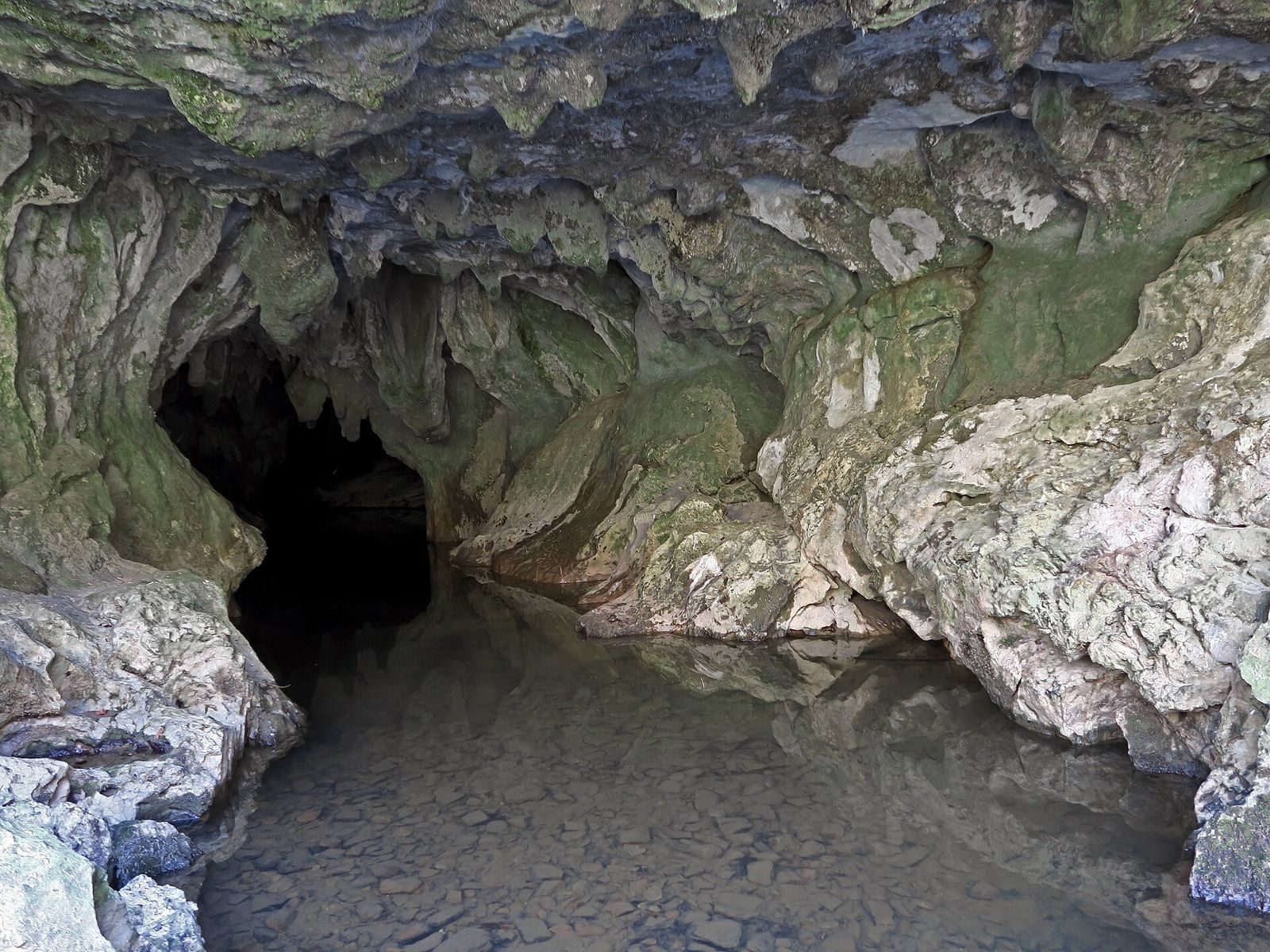
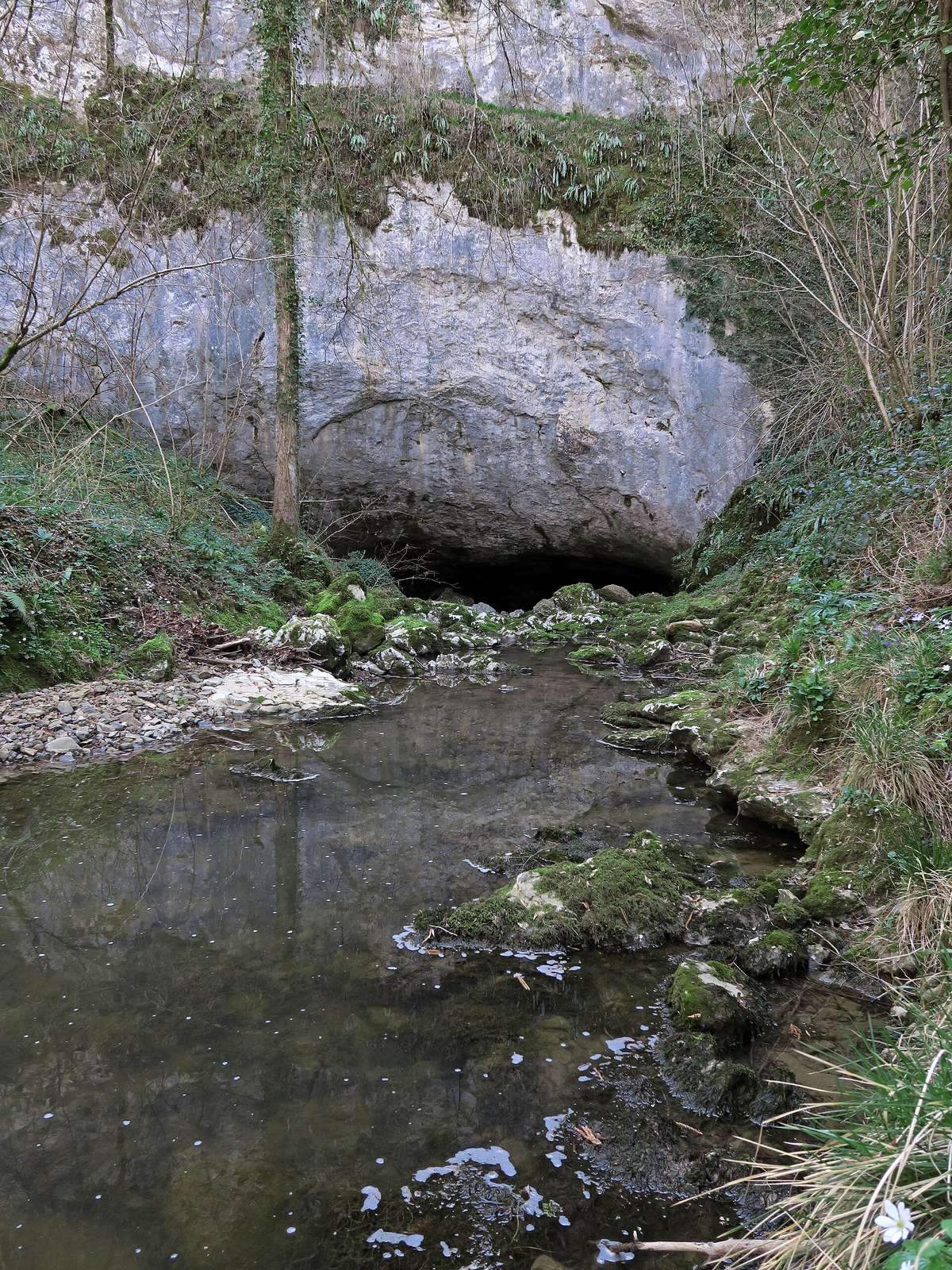
The underground river runs for roughly one kilometre through the lower galleries, passing two siphons, or submerged passages, that cannot be traversed. The galleries range from narrow passages to spaces more than 30 metres wide. The Volp reappears at about 450 metres above sea level through the entrance of Tuc d’Audoubert, then turns north about 400 metres downstream. The entrance to Enlène is about 80 metres northwest of the sink, and the entrance to Trois-Frères lies roughly 70 metres farther west.
Water and archaeological deposits
During exceptional floods, the underground Volp covers the floors of decorated areas. Under ordinary conditions, it runs beside terraces rich in archaeological remains. These changes in water level form part of the physical setting of the caves’ preserved deposits and decorated spaces.
Enlène
Chambers and deposits
Enlène includes the Hall of the Dead, where Magdalenian occupation and Bronze Age burials are present, and the Back Chamber, which contains Magdalenian remains. Near the entrance, scrapers and small stone blades with a blunted edge belong to the developed Badegoulian. These finds represent different episodes of use within the same cave.
Engraved and portable objects
Enlène has yielded abundant archaeological material, including many engraved plaques. One, known as the “Enlène couple,” depicts a pair of figures. A bone engraving shows a grasshopper and birds. Its detailed image allows the insect to be identified as Troglophilus, evidence that this grasshopper lived in the Pyrenees during the Würm, the Alpine term for the last major glacial period. Other finds include a perforated object called a “salmon baton,” dated to about 14,000 years BP, and spear-throwers. One depicts a quadruped; another is finely made and decorated with ibexes. This type of spear-thrower occurs at other Magdalenian sites and indicates substantial exchange. Some fissures in the cave contain bone splinters forced into them.
Trois-Frères
Trois-Frères contains more than 1,300 cave-wall and ceiling images, known as parietal art, accounting for over half of the parietal art known from the Ariège Pyrenees. Its imagery includes two figures identified as shamans, ritual specialists associated with communication with the spirit world. One is called the “dancing shaman.” Engraved lions are also present. Other features include the Sanctuary chamber and a gallery bearing white hand images on a red background.
Tuc d’Audoubert
Tuc d’Audoubert contains 371 examples of parietal art, including 103 animal representations and images of fantastic or unreal animals. Its clay bison form a notable sculptural group within the cave.
Rhinoceros Shelter
The Rhinoceros Shelter is a small rock shelter in the same Volp cave network, about six metres above and approximately over the resurgence at Tuc d’Audoubert. Finds from the shelter include a rhinoceros tooth and a fragment of antler from a member of the deer family.
Research and conservation base
The Association Louis Bégouën’s research and conservation base occupies a building owned by the association. It contains a store for excavation materials, laboratories, and a library.