Sant’Agostino Church: An Augustinian Church in Amatrice, Italy
Site at a Glance
- Popularity
- Medium
- Country
- Italy
- Primary era
- Medieval
- Eras represented
- Medieval
- Civilizations
- Kingdom of Naples
- Site type
- Religious
- Remains
- Church
On this page12 sections
History
Sant’Agostino Church is a Roman Catholic church built in 1428 in Amatrice, Italy, by the Augustinians, a Catholic religious order following a rule associated with Augustine of Hippo. Its architecture combines Romanesque and Gothic medieval styles. Augustine was a Christian bishop and theologian of the fourth and fifth centuries. The church was first dedicated to Saint Nicholas of Bari and rededicated to Saint Augustine in the 18th century. It belongs to the Diocese of Rieti, the Catholic jurisdiction of a bishop.
Medieval setting
The church stood near Porta Carbonara, a medieval gate in Amatrice’s walls, and the towers of a small fortification. The town’s walls and towers protected Amatrice until 1528, when Charles V, Holy Roman Emperor and king of Spain, sacked and burned it.
The Augustinian convent
An Augustinian convent near the church existed by at least the late 13th century and may have been older. It closed in 1809, when its archive and library were destroyed. The buildings were in disrepair by 1824, and a 1836 effort to adapt them for public use, including as a prison or hospital, failed. The former convent was later used as a barn and slaughterhouse before it was demolished.
Fires and repairs
Fires in 1580 and 1781 destroyed the church’s interior and part of its old apse. Repairs continued into the 19th century, with work in the 1830s, 1847, 1857, 1894, and later. In 1845, workers dismantled the vaulted ceiling because it was considered unsafe, and the interior was whitewashed.
In 1821, bell founder Pasquale della Noce recast the small bell, which weighed about 123 kilograms. Bell maker Nicola Marinelli di Gagliano reworked the larger bell, weighing about 2,300 kilograms, that same year. The bell tower was restored in 1825 and 1854 because it was at risk of collapse, and again in the 20th century. The façade also underwent restoration later in the 20th century.
Earthquake damage
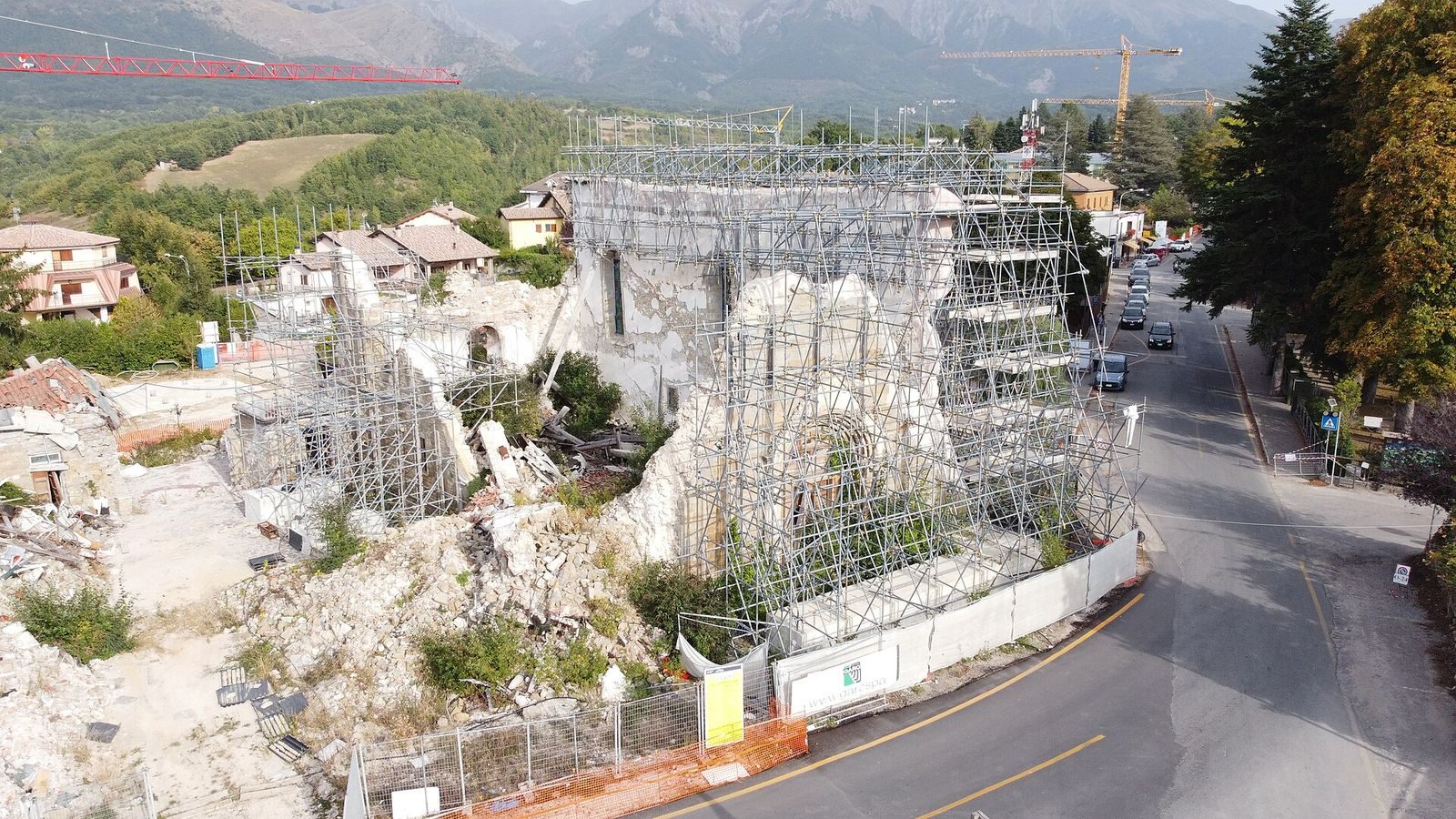
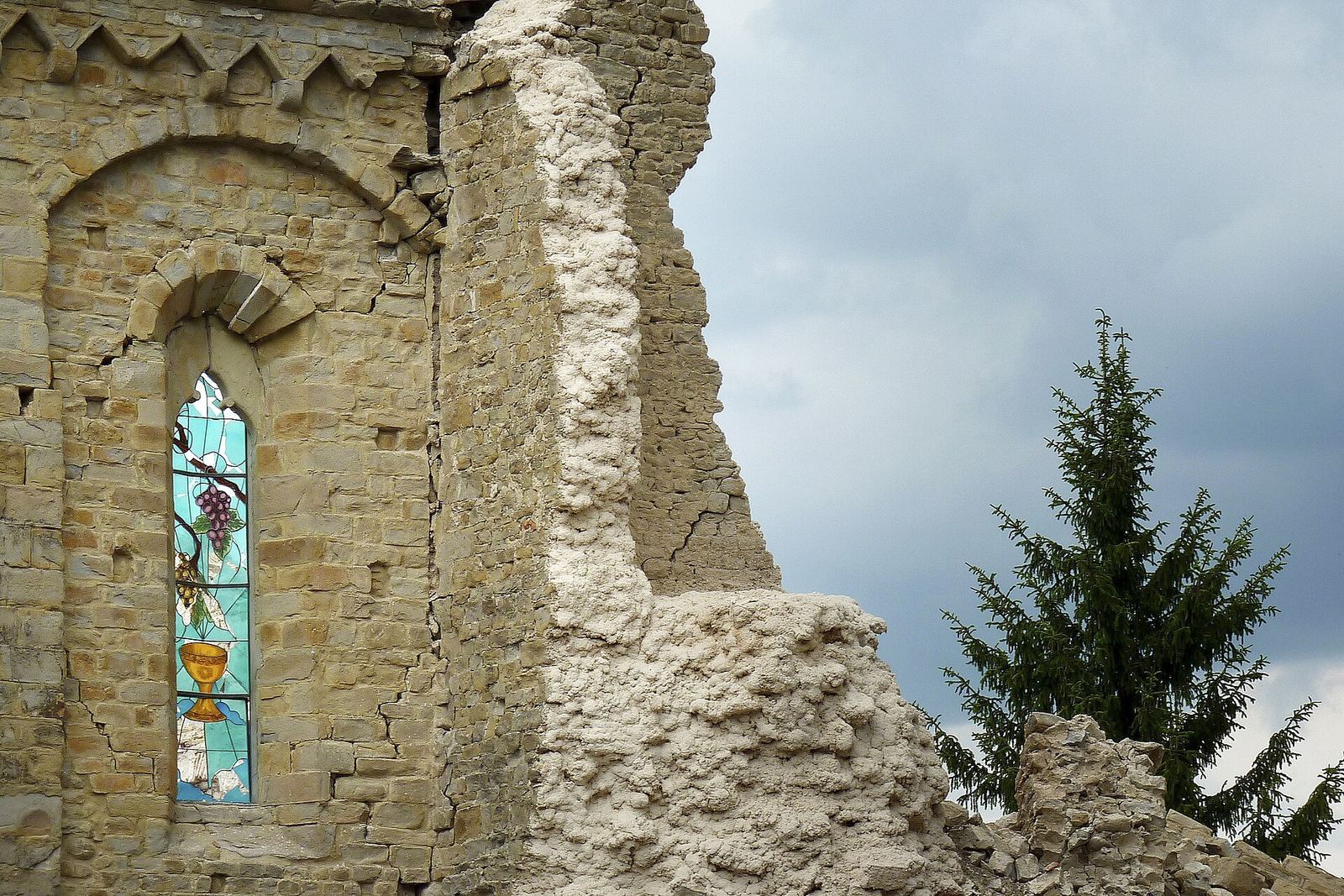
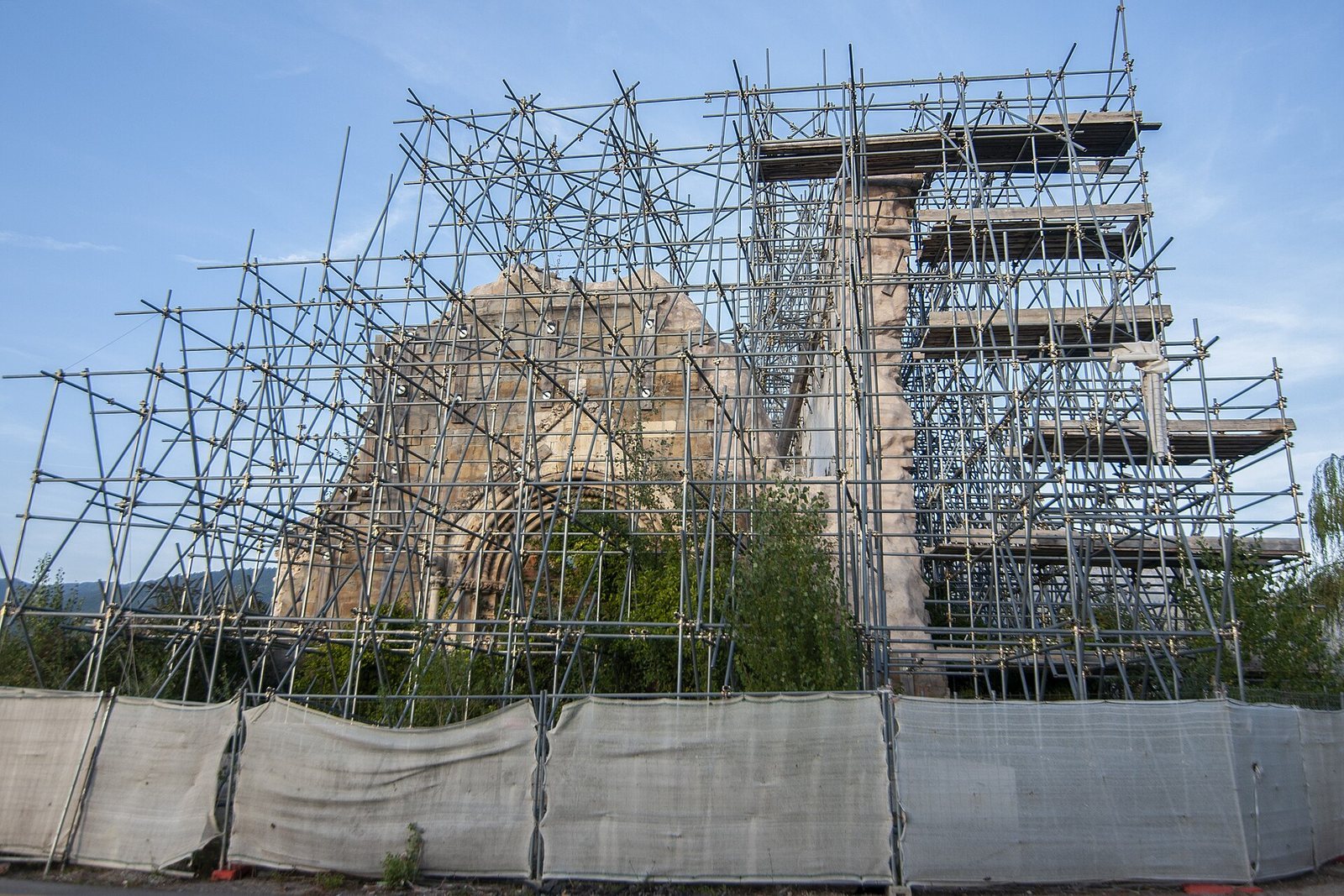
The earthquake of 24 August 2016 severely damaged the church, which closed that day. Further earthquakes in January 2017 caused the bell tower to collapse on the 18th and the church’s right wall to fall on the 29th.
Remains
The church stood at Amatrice’s southeastern edge, at an elevation of about 955 metres. Its sandstone façade and surviving architectural features reflect a combination of Romanesque and Gothic forms, with the upper façade altered according to Renaissance principles, design ideas drawing on classical antiquity.
Church exterior
Façade and entrance
The lower façade contains a marble entrance portal in a late Gothic-Romanesque style. Its carved capitals, the tops of its supports, depict a bear on the left and a caryatid on the right. A caryatid is a sculpted human figure used as architectural support. Sculptures of the Madonna and the Archangel Gabriel once stood in the semicircular space above the doorway; they were stolen in the 20th century. The lintel above the entrance bears the date 1428 and Amatrice’s coat of arms. A plaque to the right of the entrance, below the rose window, carries the church’s former coat of arms and a Latin inscription commemorating architect Giovanni dell’Amatrice. The circular rose window, with radiating divisions, replaced an earlier rectangular window in the early 1930s.
Side walls and bell tower
Each side of the church had two large oblong windows with arched tops. Flat, wall-attached supports reinforced the walls and were linked by pointed arches. A rectangular-section bell tower, 34 metres high, stood beside the church, near the medieval Porta Carbonara.
Interior and devotional art
The interior was remade in the 18th century and had a single nave, or main hall. Three frescoes, paintings made on plaster, were discovered inside the church in 1894.
Frescoes
The Annunciation, dated 1491, is probably by Carlo Crivelli, a 15th-century Italian painter, though it is also attributed to Dionisio Cappelli, an Italian painter of the same period. A Madonna and Child Enthroned, dated 1497, was painted over an earlier fresco; parts of the earlier work remained visible before the 2016 earthquake. The later Madonna of the Rosary depicts Saint Dominic, founder of the Dominican Order, and Saint Catherine. These subjects are associated with Dominican rather than Augustinian religious imagery.
Stations of the Cross
A series of 14 terracotta panels stood along the church’s right side. They were made in high relief, projecting strongly from their background, and depicted the Stations of the Cross, devotional scenes from Jesus’ path to crucifixion.
The 2016 earthquake brought down part of the roof and the upper half of the façade, including the rose window. The portal and the left wall are the parts of the church that remain standing.