St. Martin’s Church, Moletano: A Thirteenth-Century Catholic Church in Italy


Site at a Glance
- Rating
- 4.4
- Popularity
- Very Low
- Country
- Italy
- Primary era
- Medieval
- Eras represented
- Medieval
- Civilizations
- Kingdom of Naples, Kingdom of Sicily
- Site type
- Religious
- Remains
- Church
On this page9 sections
History
St. Martin’s Church, Moletano, is a Catholic church in Italy dedicated to Saint Martin of Tours and belonging to the Diocese of Rieti. Its consecration dates to the thirteenth century, and its traditional foundation is placed around the middle of that century. The church was associated with French soldiers stationed near Amatrice during the conflict of 1265–1275 between Manfred and Conradin of Swabia, members of the Hohenstaufen dynasty, and Charles I of Anjou, founder of the Angevin dynasty that ruled from France and fought for control of the Kingdom of Sicily and southern Italy.
Traditional Foundation
According to local tradition, the soldiers built the church under a commander from Tours. Saint Martin had served as bishop of that city and was one of the most widely venerated Christian saints in Western Europe. This connection is presented as the reason for the church’s dedication. The building served a settlement that was once much more extensive than the surviving village before the earthquake of 24 August 2016.
Enlargement and Fifteenth-Century Restoration
The church was enlarged in 1422 and restored in 1479. An inscription on the projecting spur at the apse preserves the earlier date, while the architrave, the horizontal element above the doorway, bears the later one. The fifteenth-century portal also carried imagery and heraldry that connected the church with its French and Angevin associations.
Earthquakes and Destruction
Earthquakes repeatedly damaged the church and the surrounding settlement. The earthquake of 1639 caused the building to collapse. The earthquake of 1703 killed several people in the settlement, and the parish priest entered the disaster in the baptismal register as occurring “in the time of the great earthquake.” Earlier seismic events had already reduced the original village to a few houses before the earthquake of 24 August 2016.
Two successive events in the 2016 earthquake caused the church’s near-total destruction. A coordinated recovery operation by Italy’s Ministry of Cultural Heritage and Activities and Tourism, the Fire Brigade, the Carabinieri Cultural Heritage Protection Command, the Opificio delle Pietre Dure in Florence, and Civil Protection volunteers recovered 57 works and objects. The objects were deposited at the former State Forestry Corps school in Cittaducale. They included paintings, liturgical furnishings, statues, reliquaries, other objects used in worship, vestments, and printed texts.
Parish and Museum History
After several changes and difficulties, the Parish of San Martino was canonically constituted on 1 September 1986 and recognized as a civil institution on 7 October 1986. Before the 2016 earthquake, a small museum occupied the upper floor of the church. The room had formerly been the residence of a hermit custodian and displayed sacred furnishings, ecclesiastical objects, and documents dating from the late nineteenth to the mid-twentieth century.
Remains
The church occupied a projecting spur above the Tronto River, near Moletano in the municipality of Amatrice, at approximately 1,150 metres above sea level. The site lay at the beginning of a route leading toward the peaks of the Laga Mountains. Before its near-total destruction in 2016, the building had a rectangular plan measuring 19 metres in length and 11.6 metres in width. It consisted of a single nave, the main longitudinal space of the church, covered by a timber truss roof.
Facade and Portal
The facade had an asymmetrical bell gable, a wall with openings for bells rather than a separate tower, containing two bells. Its rose window was made of grey pietra serena, a fine-grained sandstone, and was asymmetrical in relation to both the bell gable and the facade. The sandstone portal dated from the fifteenth century. Its rough sculptural decoration represented the Annunciation, the Christian scene in which the angel Gabriel announces to the Virgin Mary that she will bear Jesus.
The portal’s architrave bears the date 1479 and carries an Angevin coat of arms. The shield shows a cross and is surmounted by three French fleurs-de-lis, an emblem also repeated in the coat of arms of the city of Amatrice. Beside it, an angel on the left holds three flowers, while a reclining angel on the right flies with a cross across its shoulders. Beneath the figures are a lectern with an open book and the Virgin reading it; a dove representing the Holy Spirit appears above the book. The portal lunette, the semicircular area above the opening, contained a badly deteriorated painting of the Virgin and several saints. The composition’s arrangement followed an established model of the Annunciation and possessed substantial historical and cultural value.
Paintings and Furnishings
Fifteenth-century votive frescoes, religious wall paintings made as acts of devotion, covered the right interior wall and were attributed to Dionisio Cappelli, a Renaissance Italian artist associated with religious works. Other frescoes showed the Madonna of Mercy on the side altars and Saints Peter and Paul beside the central altar. Above the central altar hung a sixteenth- or seventeenth-century canvas of Saint Martin wearing episcopal insignia. Saints Francis and Lawrence appeared below him, with the probable commissioner at lower left.
Behind the new liturgical altar stood a finely made gilded wooden tabernacle shaped as a small throne. A tabernacle is the container used to keep consecrated Eucharistic elements. The altar and its table had been made from two elm windbreak trees that had stood beside the church. The left wall carried a series of Stations of the Cross prints made in Paris around 1736 by the French printer F. Dubercelle. In the sacristy, the room used to store liturgical furnishings and prepare for worship, was a small terracotta Archangel Gabriel attributed to Dionisio Cappelli.
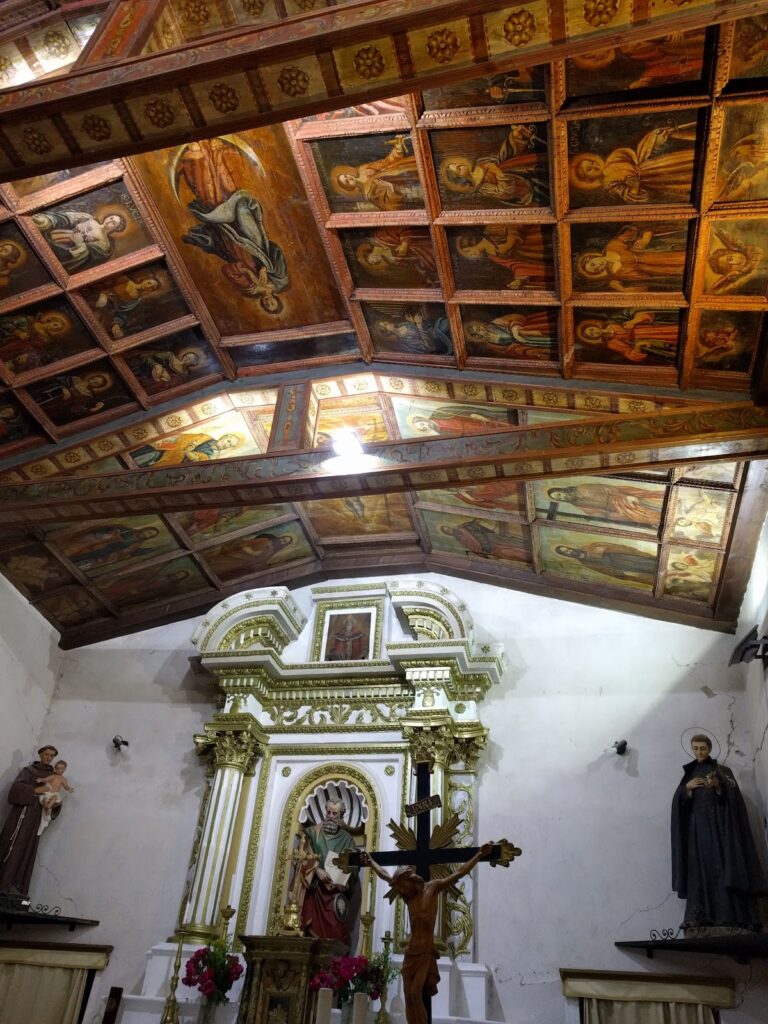
Baptistery and Recovered Objects
The baptistery was undergoing renovation before the 2016 earthquake. The work concerned its sixteenth-century wooden roof, which had been completely recovered. The recovery operation after the destruction brought together 57 objects, including two oil paintings, a canvas altar frontal, a chest of drawers, two plaster statues, two pairs of angel candle holders, the Stations of the Cross series, a painted wooden tabernacle, reliquaries, liturgical objects, priestly vestments, and printed texts. These movable remains preserve part of the church’s artistic, devotional, and documentary contents after the loss of most of the building.