Santa Caterina: A Roman Catholic Church in Scanzano, Italy
Site at a Glance
- Popularity
- Very Low
- Country
- Italy
- Primary era
- Early Modern
- Eras represented
- Medieval, Early Modern, Modern
- Civilizations
- Habsburg, Italian, Kingdom of Naples
- Site type
- Religious
- Remains
- Church
On this page11 sections
History
Santa Caterina is a Roman Catholic church in Scanzano, Italy, built in 1487 and associated with the city hospital and municipal government. It served as a place of worship and a venue for municipal council meetings.
Medieval origins and civic use
A church or oratory dedicated to St Catherine stood at Scanzano by 1447, when it was moved to its present site. The crypt beneath the church dates to the late 14th century. Construction of the church is dated to 1487, and its ties to the hospital and municipal patronage gave it civic as well as religious functions.
Charitable and religious institutions
By 1585, the church was associated with a Monte della Pietà, a charitable credit institution that operated as a pawn bank. It raised money to ransom Christians captured by people whom Europeans called Saracens, a historical term for Muslim peoples, especially in the Mediterranean. In the 17th century, the Venerable Archconfraternity of Our Lady of Pity and St Catherine of Alexandria, a religious association of lay members, took the bank’s place.
Rebuilding and later use
The church was wholly rebuilt in 1725 and consecrated in 1809. Until 1931, a service seeking St Joseph’s protection was held before each ship was launched from the nearby shipyard. A restoration took place in 1941.
Santa Caterina is now part of the parish of Santa Maria della Pace and the Archdiocese of Sorrento-Castellammare di Stabia, a major territorial jurisdiction of the Catholic Church.
Remains
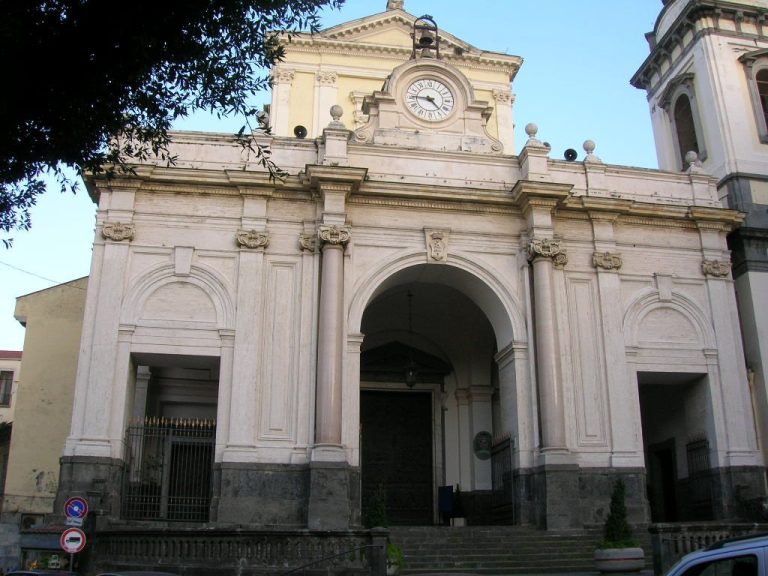
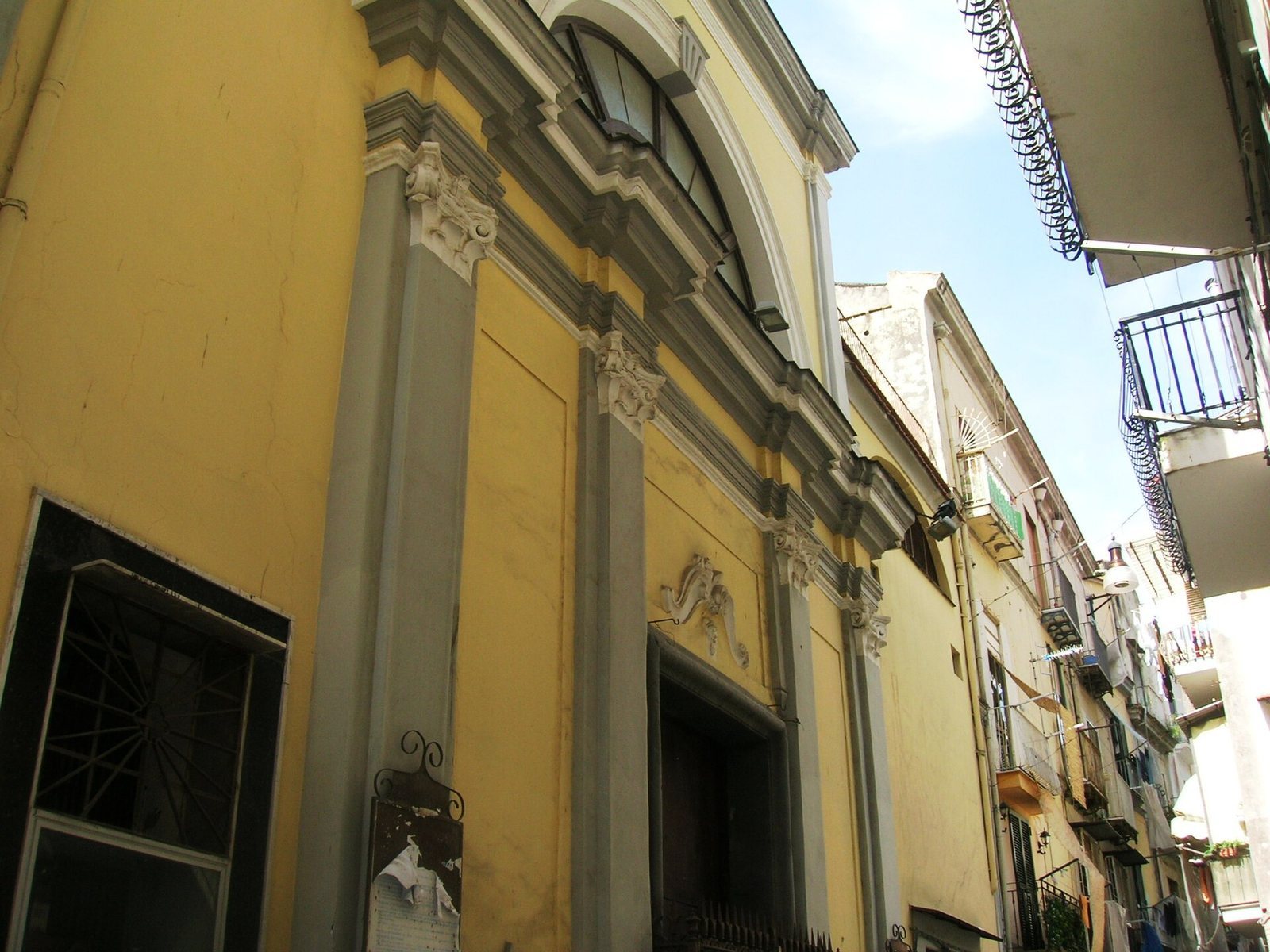
The church has a two-level façade and a single main worship space. An adjacent chapel and a Romanesque crypt, a medieval architectural style associated with rounded arches and massive masonry, form part of the complex. The crypt lies beneath the church.
Church and associated spaces
Façade
An entablature, a horizontal architectural band, separates the façade’s two levels, and a pediment crowns it. The lower level has an entrance portal behind an iron gate, stucco decoration with symbols associated with the cult of the dead, and two pairs of pilasters, or flat supports attached to the wall, with capitals. A large semicircular window occupies the upper level.
Nave and marble altars
The interior is a single nave, the main space for worship, finished with faux marble, gilding, and stucco decoration by Francesco Filosa in 1965. Three altars and a balustrade are made of polychrome, or multicolored, marble and date to the late 18th century. The principal altar is dedicated to St Catherine of Alexandria, an early Christian martyr, and holds a 19th-century statue of the saint. Three paintings dated 1788 depict St Paul, St Peter, and the Pietà.
The other altars are dedicated to St Judas Thaddeus and the Virgin of Sorrows, a title for Mary that emphasizes her suffering. The altar to St Judas Thaddeus has a 19th-century statue of the saint. Following the 1941 restoration, the altars dedicated to him and the Virgin of Sorrows were consecrated.
Paintings and sculpture
Other works in the church include a painting of the Resurrection of Christ dated 1764 and an 18th-century depiction of the Martyrdom of St Catherine. Wooden statues of St Catherine, St Joseph, and St Judas Thaddeus are attributed to the workshop of brothers Giuseppe and Francesco Verzella and date broadly to the 18th and 19th centuries. The church also keeps a 19th-century statue of St Joseph and various relics. A choir loft stands at the rear.
Chapel of the Resurrection
The adjacent Chapel of the Resurrection dates to 1725, and its altar to 1739. A Pietà in the chapel is attributed to Giuseppe Bonito; the image above the altar is also described as a copy of the Pietà on the church’s principal altar. A 19th-century canvas depicts scenes from the Passion of Christ. The chapel also contains a painting attributed to Ludovico Mazzanti showing St Catherine rescued by the Archangel Michael from martyrdom on the wheel.
Crypt
The late-14th-century crypt was altered in 1754 and again in 1970. Columns divide it into three spaces, and the central space has a stucco-decorated vault. The crypt contains burial niches and a small statue of St Michael, an archangel. The statue is a replica of one formerly kept at the Sanctuary of Faito and later at the co-cathedral of Castellammare.